Lëtzebuergesch, from hello to the dictionary
Luxembourgish, the language nobody expects you to speak
Luxembourgish (Lëtzebuergesch) has been Luxembourg's national language by law since 1984 and has been in the constitution since 2023. It belongs to the Moselle Franconian group, close to the Rhenish dialects of German, with plenty of French borrowed along the way. Hello is «Moien» and thank you is «Merci».
Learn three words, «Moien», «Merci» and «Äddi», and use them even if the conversation carries on in English. You won't need them to get by, but greeting someone in their own language goes a long way in a country where most visitors don't bother.

Before you go
What I would keep in mind
-
01 Most beautiful
Hello is Moien, at any time of day
It's the first word the government's official portal suggests. In the morning you can also say «Gudde Moien», in the evening «Nowend», and to say goodbye «Äddi» or the slightly more formal «Awuer».
what language do they speak in Luxembourg -
02 My tip
The official dictionary translates into English
The Lëtzebuerger Online Dictionnaire (LOD) gives English, German, French, Portuguese and Dutch, with pronunciation and verb tables. For a British visitor it's the best free tool there is.
-
03 To save money
A free online course
LLO.LU, run by the National Institute for Languages, teaches Luxembourgish free of charge, with no age limit and from any country, according to the official portal. For a trip, the greetings are plenty.
-
04 My tip
Every town has two names
Road signs give the official name and often the Luxembourgish one too. Vianden is Veianen and Clervaux is Klierf, which saves confusion when you hear them on the radio or from a bus driver.
towns in Luxembourg
Hardly anyone goes to Luxembourg to speak Luxembourgish, and that’s fine. You’ll be served in French in a café and in perfectly good English in any hotel. Still, the country’s own language is worth ten minutes before you go. It’s what you hear on local radio, what appears on village signs and what Luxembourgers speak among themselves. A couple of words of it from a visitor changes the mood of any exchange.
What kind of language is it?
The government’s official portal describes it as a West Central German language of the Moselle Franconian group. It’s closely related to the Rhenish dialects of German, the so-called «Rhenish fan», but over the centuries it has taken on a great deal of French. The result is a language where the two worlds sit side by side, sometimes in the same sentence.
The portal’s own example is the best way in. To say goodbye you can use «Äddi», from the old German «Ade», or the slightly more formal «Awuer», which echoes the French «au revoir». On the street you’ll also hear «Salut» and «Ciao». If you have school French, plenty of words will look familiar; if you have some German, the grammar will.
From kitchen table to constitution
Until the 19th century Luxembourgish was mainly the spoken language of ordinary people, while the middle classes, nobility and clergy used French or German. The first literary works appeared mid-century, «De Feierwon» in 1859 and «De Reenert» in 1872, and a law first mentioned the language in 1912.
The turning point was the German occupation. After the war came the work of standardising grammar and pronunciation, and the portal notes that French influences were deliberately favoured in reaction to the occupation. A law made Luxembourgish the national language in 1984, another in 2018 set up a language commissioner and a centre of its own, the Zenter fir d’Lëtzebuerger Sprooch, and since 1 July 2023 it has sat in article 4 of the constitution. How it shares the day with French and German has a page of its own, what language do they speak in Luxembourg, while its wartime role gets its due in Luxembourg in the Second World War.
Once your dates are set, check which hotels are still free in Vianden before prices climb.
Moien, Merci and Äddi
The government publishes a short list of expressions for newcomers, and that’s what I’ve put in the phrase table on this page. If I had to pick three, they’d be «Moien» for hello at any hour, «Merci» for thank you and «Äddi» for goodbye. To go one better, add «Wannechgelift» (please) and «Villmools Merci» (thanks a lot).
Don’t expect the reply to come back in Luxembourgish. More likely you’ll get French or English, because in a country where nearly half the residents are foreign nationals, switching language mid-conversation is normal. The official portal describes exactly that, people changing language in the middle of a sentence.
Who speaks it today?
The portal gives two figures worth reading together. According to the 2021 census, nearly 49% of residents speak Luxembourgish, more than speak Portuguese or French. Another study puts those who use it in daily life, at home, school or work, at over 61%. These measure something different from the 2018 survey quoted on the languages page, which is why the numbers don’t line up. What they agree on is that the share falls as immigration grows while the absolute number of speakers keeps rising. Who makes up that population is in Luxembourg population.
Beyond the Grand Duchy it’s spoken around Arlon in Belgium, in the French Moselle and along the German border, and emigration in earlier centuries left pockets in Transylvania and the American Midwest. Even so, UNESCO’s atlas lists it as «potentially endangered», because French and English rule the workplace.
Once your dates are set, check which hotels are still free in Vianden before prices climb.
Translating it and learning it
The official tool is the Lëtzebuerger Online Dictionnaire (LOD), which translates into English, German, French, Portuguese and Dutch, plus sign language, with pronunciation and verb tables. For a British visitor that’s genuinely handy. There’s also the Sproochmaschinn, which reads written Luxembourgish aloud and transcribes the spoken language.
If the bug bites, LLO.LU from the National Institute for Languages is free and open from anywhere. People who move there can take courses from A1 to C1, and since the 2008 nationality law anyone applying for a Luxembourg passport has to pass a language test. The national anthem is in Luxembourgish too, and I cover it with the Luxembourg flag.
If you would rather have a local show you round, book a guided tour in Vianden and choose by the reviews.
A car frees you from timetables: search car hire in Luxembourg on DiscoverCars and compare companies.
So you do not pay over the odds, look at trains, coaches and flights to Luxembourg on Omio and pick the one that suits you.
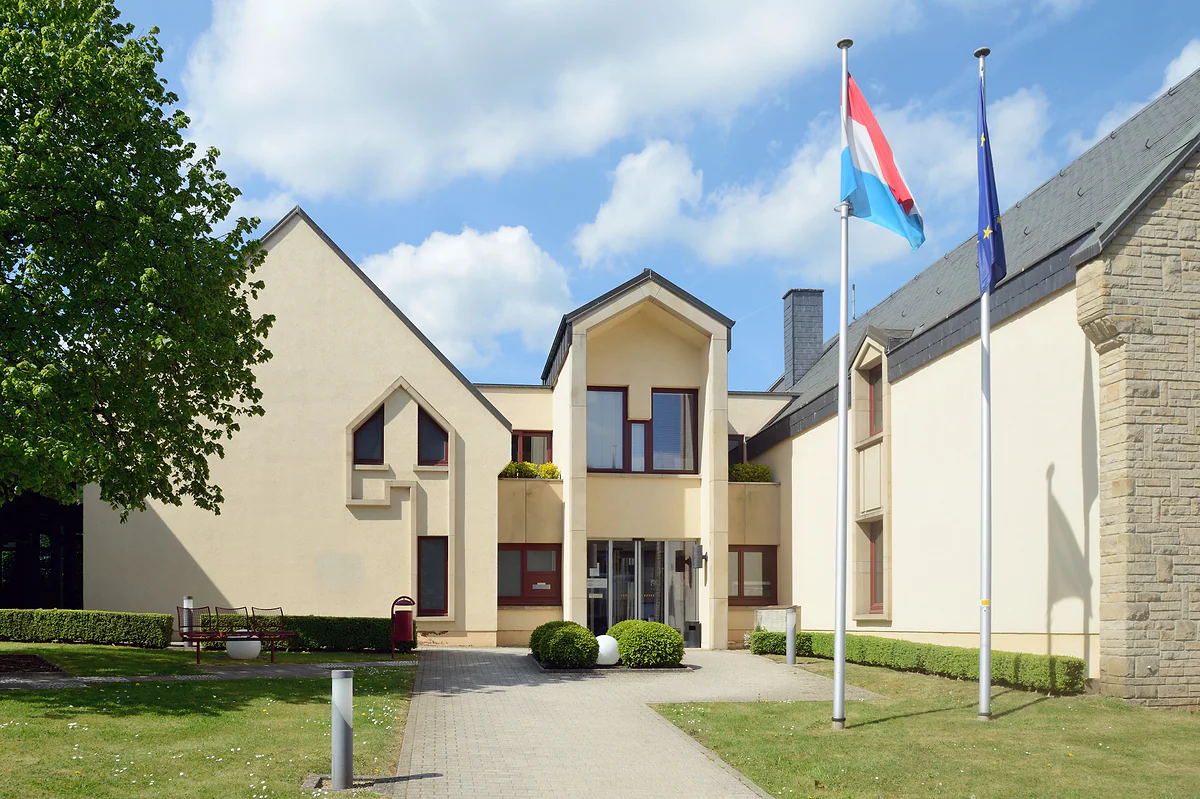
Steinsel town hall, with gabled façades, a lawn in front and the flags of Luxembourg and the EU
Useful Luxembourgish phrases
| In English | In Luxembourgish |
|---|---|
| Hello | Moien |
| Good morning | Gudde Moien |
| Good evening | Nowend |
| Goodbye | Äddi, or Awuer (more formal) |
| Good night | Gutt Nuecht |
| Have a nice day | E schéinen Dag nach |
| How are you? | Wéi geet et? |
| Yes / No | Jo / Neen |
| Please | Wannechgelift |
| Thank you / Thanks a lot | Merci / Villmools Merci |
| You're welcome | Gär geschitt |
| I'm sorry | Et deet mir leed |
Phrases from the official portal luxembourg.public.lu (introduction to Luxembourgish), checked on 29-09-2026.
Luxembourgish through the years
| Year | What happened |
|---|---|
| 1859 and 1872 | First literary works, De Feierwon and De Reenert |
| 1912 | First mention of Luxembourgish in a law |
| 1941 | Census of 10 October, when many people answer «Luxembourgish» |
| 1984 | A law declares it the national language |
| 2008 | The nationality law requires a Luxembourgish test |
| 2018 | Promotion law, with a commissioner and a language centre |
| 2023 | Written into article 4 of the revised constitution |
Test yourself
True or false?
0/4 Pick before you peek.
-
Luxembourgish is a dialect of French.
See the answer
False. It's a Moselle Franconian language, related to the Rhenish dialects of German. It has borrowed many French words, such as «Merci» and «Awuer».
-
Luxembourgish is still spoken in parts of the United States.
See the answer
True. According to the official portal, 19th-century emigration took it to the Midwest, and some of those varieties survive.
-
Anyone applying for Luxembourg nationality has to pass a Luxembourgish test.
See the answer
True. The 2008 nationality law requires it. Between 2008 and 2022 the number of courses at the National Institute for Languages more than tripled.
-
UNESCO considers Luxembourgish completely safe.
See the answer
False. Its World Atlas of Languages lists it as «potentially endangered», mainly because French and English dominate the workplace.
0 of 425 Luxembourg guides
Your next stamp
- Languages
- Is it a country?
- Food
- Facts
- Where is Luxembourg
- Population
- A Possen Museum
- American Cemetery
- Ansembourg
- Ansembourg Castles
- Asselborn
- Bascharage
- Beaufort castles
- Belval
- Belval blast furnaces
- Berg Castle
- Bernard-Massard cellars
- Bourglinster Castle
- Bourscheid Castle
- Brandenbourg
- Brandenbourg Castle
- Caves St Martin
- Christmas
- Clervaux Castle
- Echternach
- Echternach Abbey
- Ehnen
- Ehnen Wine Museum
- Esch-sur-Alzette
- Esch-sur-Sûre Castle
- European Museum Schengen
- Fond-de-Gras
- General Patton Museum
- German war cemetery
- Haff Réimech
- Hohllay
- Hollenfels Castle
- Hosingen
- Kautenbach
- Kneiff
- Koerich Castle
- Larochette Castle
- Lasauvage
- Mersch Castle
- Military History Museum
- Moersdorf
- Mondorf Domaine Thermal
- Munsbach Castle
- National Mining Museum
- Parc Merveilleux
- Park Sënnesräich
- Places to visit
- Remich
- Rindschleiden
- Schiessentümpel
- Septfontaines Castle
- Slate Museum
- Stolzembourg
- Tudor Museum
- Useldange Castle
- Valley of the Seven Castles
- Vianden
- Vianden Castle
- Ville Haute
- Wasserbillig Aquarium
- Weiswampach lakes
- Wiltz Castle
- Ahn
- Berdorf
- Bourscheid-Plage
- Butterfly garden
- Clervaux
- Differdange
- Echternach lake
- Grevenmacher
- Heringer Millen
- Hollenfels
- Luxembourg City
- Luxembourg Science Center
- Meysembourg Castle
- Mullerthal
- National Day
- National Resistance Museum
- Perekop
- Remerschen
- Schoenfels Castle
- The Family of Man
- Things to do
- Upper Sûre Lake
- Vianden chairlift
- Wasserbillig
- Clervaux Abbey
- Echternach Roman villa
- Éislek
- Insenborn
- Kallektuffquell
- Machtum
- Most beautiful places
- Our Nature Park
- Pétange
- Pettingen Castle
- Schueberfouer
- Schwebsingen
- Victor Hugo House
- Waldbillig
- Dudelange
- Kuelscheier
- Lultzhausen
- Moselle Valley
- Octave
- Prettiest villages
- Sanem
- Schengen
- Wellenstein
- Wiltz
- Wolfsschlucht
- Beaufort
- Bech-Kleinmacher
- Éimaischen
- Gaalgebierg
- Guttland
- Marnach
- Mondorf-les-Bains
- Putscheid
- Schifflange
- UNESCO World Heritage
- Carnival
- Consdorf
- Ellergronn
- Käerjeng
- Kayl
- Map
- Minett
- Munshausen
- Tandel
- Bech
- Buergbrennen
- Esch-sur-Sûre
- Rumelange
- Lac de la Haute-Sûre (commune)
- Rosport-Mompach
- Wormeldange
- Larochette
- Mondercange
- Regions
- Bettembourg
- Bock Casemates
- Cantons
- Dancing procession
- Diekirch
- Fischbach
- Garnich
- Mersch
- Moselle wine route
- Ettelbruck
- Grund
- Heffingen
- Kehlen
- Lintgen
- Moselle river cruises
- Pétrusse Casemates
- Towns and villages
- Chemin de la Corniche
- Erpeldange-sur-Sûre
- Junglinster
- Kopstal
- Lorentzweiler
- Nommern
- Pfaffenthal
- Bissen
- Clausen
- Grand Ducal Palace
- Koerich
- Schieren
- Size
- Vallée de l'Ernz
- Feulen
- Kirchberg
- Notre-Dame Cathedral
- Reisdorf
- Steinfort
- Bettendorf
- Habscht
- St Michael's Church
- Helperknapp
- Place Guillaume II
- Name
- Place d'Armes
- History
- Place de la Constitution
- Grand Duke
- Colmar-Berg
- Flaxweiler
- Gare
- Hamm
- Kirchberg funicular
- Luxembourg fortress
- Mamer
- Mertert
- Minett Trail
- Mullerthal Trail
- Neumünster Abbey
- Parc Hosingen
- Pfaffenthal lift
- Political system
- Redange
- The Passerelle
- Wine festivals
- Winseler
- Beckerich
- Biwer
- EU institutions
- Goesdorf
- Limpertsberg
- Mudam
- Natur Musée
- Pulvermühl
- Stadtbredimus
- Troisvierges
- Wenzel walk
- Bonnevoie
- Bous-Waldbredimus
- Ell
- Flag
- Kiischpelt
- Manternach
- Philharmonie
- Vauban circuit
- Weiswampach
- Betzdorf
- Boulaide
- Dräi Eechelen Museum
- Hollerich
- Lenningen
- Useldange
- Wincrange
- Bourscheid
- Dalheim
- Gasperich
- Public holidays
- Red Bridge
- Saeul
- Belair
- Second World War
- Vichten
- Battle of the Bulge
- Merl
- Préizerdaul
- Cents
- EU and Schengen
- Groussbus-Wal
- Entry requirements
- Neudorf
- Rambrouch
- Currency and payments
- Mertzig
- Weimerskirch
- Adolphe Bridge
- Beggen
- Escapardenne
- How to get there
- International March of Diekirch
- MNHA (National Museum)
- Rock climbing
- Sandweiler
- Bridges
- Eich
- Flights
- Golf
- Hesperange
- Lëtzebuerg City Museum
- Canoeing and kayaking
- Dommeldange
- Luxembourg airport
- Strassen
- Villa Vauban
- Airport to city centre
- Bertrange
- Casino Luxembourg
- Mühlenbach
- Swimming pools
- From Brussels
- Pétrusse Valley
- Rollingergrund
- Walferdange
- Cessange
- Day trip from Brussels
- Municipal Park
- Steinsel
- Free walking tours
- From Paris
- Niederanven
- From Frankfurt
- Schuttrange
- Sightseeing train and bus
- By train
- Contern
- By coach
- Weiler-la-Tour
- Driving
- Luxembourg in one day
- Pretzel Sunday
- Rham Plateau
- Tour de Luxembourg
- Candlemas (Liichtmëssdag)
- Car hire
- Luxembourg in two days
- Saint-Esprit Plateau
- Luxembourg in three days
- Melusina statue
- Parking
- St Nicholas Day (Kleeschen)
- Fête de la Musique
- Luxembourg in four days
- Museums in Luxembourg
- Petrol
- Place de Clairefontaine
- A week in Luxembourg
- Getting around
- Luxembourg Marathon
- Tram and Bus Museum
- Free public transport
- Parks in Luxembourg City
- Road trip
- Belgium and Luxembourg
- Tram
- Buses
- Viewpoints
- Trains
- Luxembourg station
- Cycling
- LuxembourgPass
- Prices and budget
- On a budget
- Free things to do
- Mobile and roaming
- Healthcare
- Safety
- Scams
- Tourist information
- Packing list
- Swimming lakes
- With a dog
- Markets
- Tipping
- Shopping
- What to buy
- Shopping centres
- With kids
- For couples
- Playgrounds
- Adventure parks
- Nightlife
- Castles
- Theatres and concert venues
- Leudelange
- Nature parks
- Where to stay
- City-centre hotels
- Hiking
- Nature reserves
- Reckange-sur-Mess
- Hotels near the station
- Roeser
- Frisange
- Hotels in Kirchberg
- Airport hotels
- Dippach
- Hotels in Vianden
- Hotels in Echternach
- Hotels in Clervaux
- Hotels in Mondorf-les-Bains
- Hotels in Esch-sur-Alzette
- Hotels on the Moselle
- Mullerthal hotels
- Upper Sûre lake hotels
- Hotels in Diekirch and Ettelbruck
- Cheap hotels
- Luxury hotels
- Boutique hotels
- Spa hotels
- Family hotels
- Apartments
- Weather
- Youth hostels
- Best time to visit
- Campsites
- Holiday cottages
- In winter
- Castle hotels
- In spring
- Day trips
- In summer
- Around Luxembourg
- In autumn
- Ice skating
- Trier day trip
- Metz day trip
- Arlon day trip
- In January
- In February
- In March
- In April
- In May
- In June
- In July
- In August
- In September
- In October
- In November
- Where to eat
- In December
- Michelin restaurants
- Cheap eats
- Judd mat Gaardebounen
- Bouneschlupp
- Gromperekichelcher
- Kniddelen
- Quetschentaart
- Rieslingspaschtéit
- Events
- Wine
- Crémant
- Beer
Frequently asked questions
What kind of language is Luxembourgish?
A West Central German language of the Moselle Franconian group, closely related to the Rhenish dialects of German and full of words taken from French. It has been Luxembourg's national language since 1984.
How do you say hello in Luxembourgish?
«Moien», which works at any time of day. In the morning people also say «Gudde Moien», and in the evening «Nowend». You'll hear «Bonjour», «Salut» and «Hey» on the street too.
How do you say thank you in Luxembourgish?
«Merci», as in French, and «Villmools Merci» for thanks a lot. If someone thanks you, the reply is «Gär geschitt», which means you're welcome.
Is Luxembourgish the same as German?
No. It's closely related to the Rhenish dialects of German, but it's a language in its own right, the national language since 1984 and named in the constitution since 2023. It also borrows heavily from French.
Where else is Luxembourgish spoken?
Around Arlon in Belgium, in the French Moselle and along the German border. Emigration in earlier centuries also left speakers in Transylvania and the American Midwest.
Can I learn Luxembourgish online for free?
Yes. LLO.LU, run by the National Institute for Languages, is free and open to anyone anywhere, according to the official portal. The institute also runs classroom courses from A1 to C1.
Is Luxembourgish an endangered language?
UNESCO's World Atlas of Languages lists it as «potentially endangered», according to the official portal. Even so, the number of speakers keeps rising in absolute terms.
By
Tourism graduate with a master’s in Tourism Management and Planning from the University of Málaga, who has travelled across Europe. He writes every guide from official sources and his own judgement.
Published on . Facts checked on .
Sources
Some links in this guide are affiliate links: if you book through them, the site earns a commission at no extra cost to you. Affiliate disclosure
Photos: LBM1948 (CC BY-SA 4.0); Cayambe (CC BY-SA 3.0), via Wikimedia Commons.