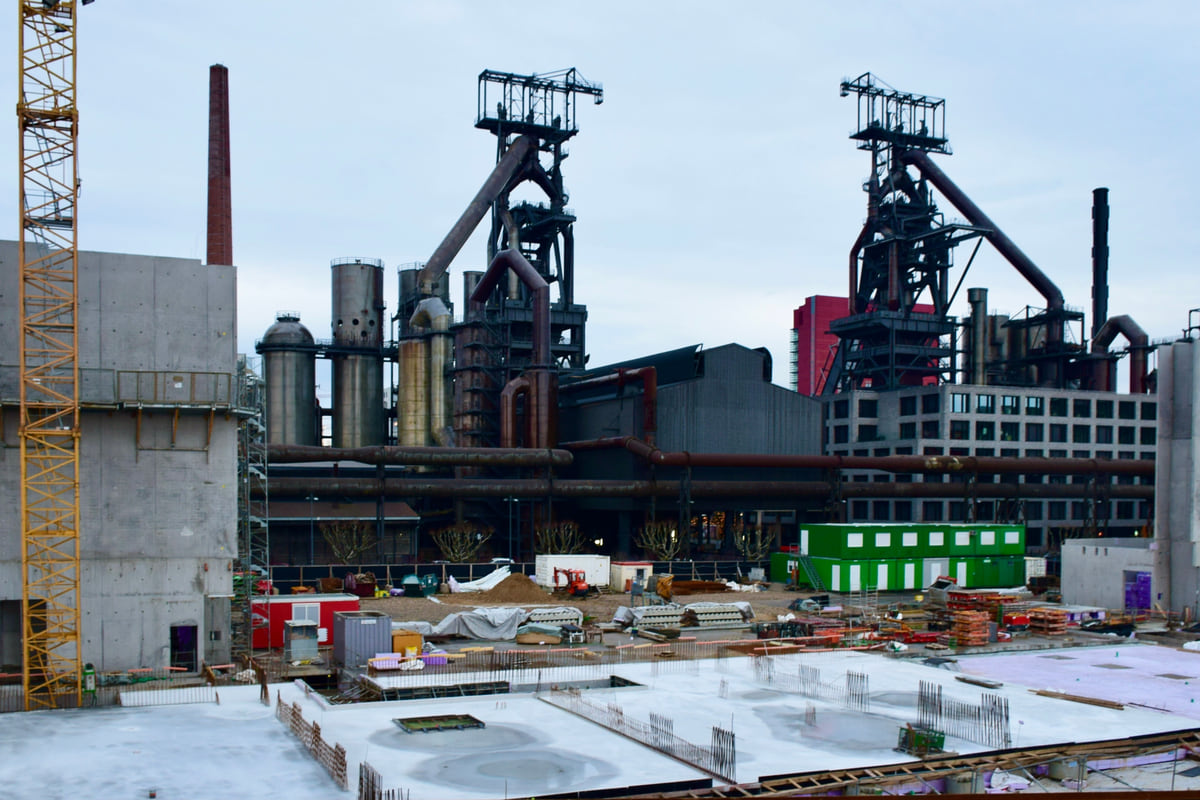
District of Esch-sur-Alzette, in the Minett
Belval, where the last casting made way for a university

- Communes
- Esch-sur-Alzette and Sanem
- Before
- Steelworks, shut in the 1990s
Map
Where Belval is
The thick dashed line is the border with Belgium, France and Germany, and the fine ones divide the twelve cantons. The Éislek lies to the north and the Moselle to the east. Every number opens its guide.
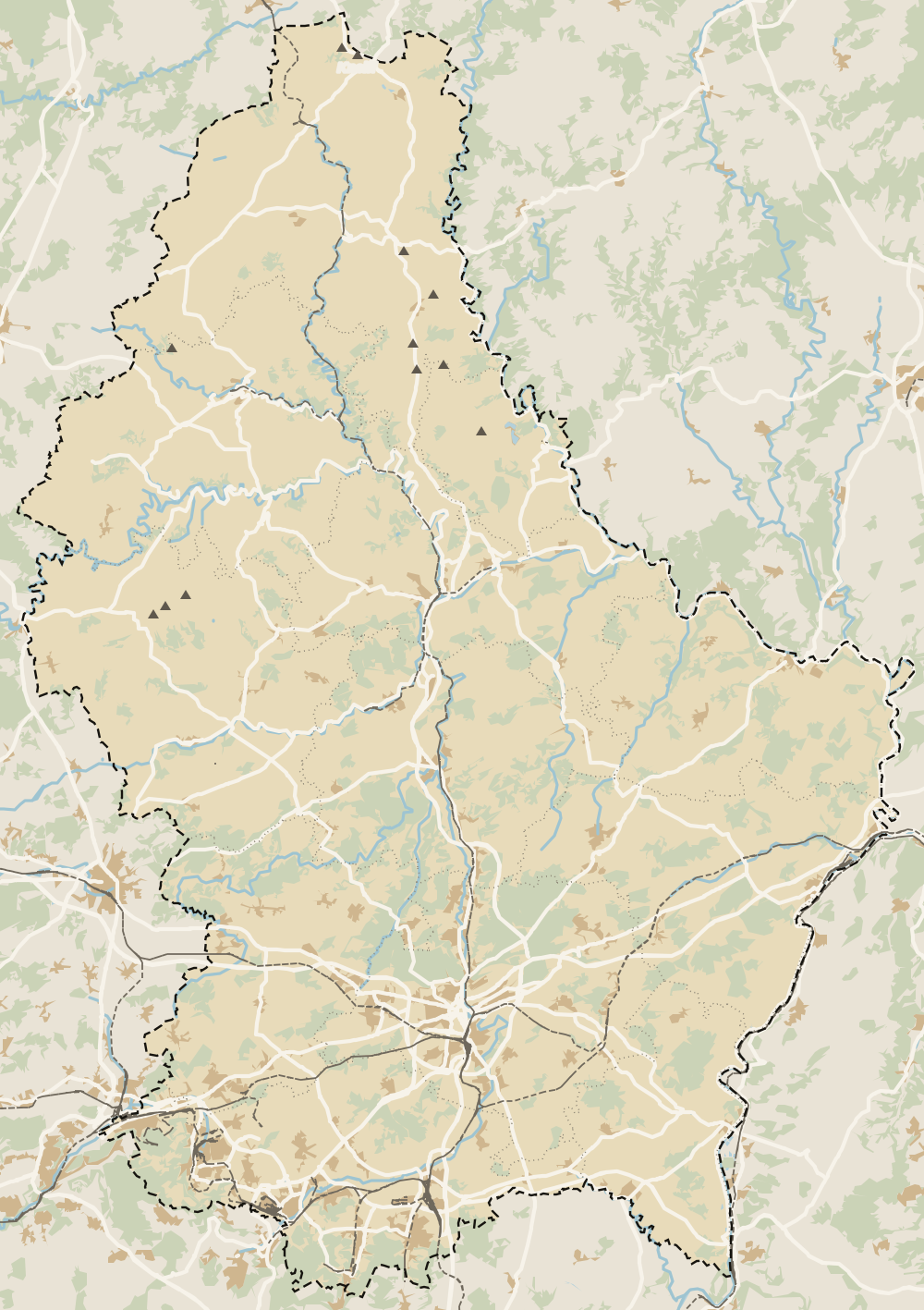 1Belval 2Esch-sur-Alzette 3National Resistance Museum 4Gaalgebierg 5Ellergronn
Map data © OpenStreetMap contributors (ODbL)
Belval is the district built on the old Esch-sur-Alzette steelworks, where Luxembourg steel's last symbolic casting took place in 1997. Today it brings together two restored blast furnaces, climbable for €5, the University of Luxembourg campus, the Rockhal and a park, with three railway stops.
I'd take the train to Belval-Université and climb blast furnace A in the morning. Then I'd wander the Cité des Sciences and the park, and if there were a gig at the Rockhal that evening, I'd stay, as it's the big venue in the south.
Belval, in short
Full read: 4 min
- Belval is the Esch-sur-Alzette district built on the old steelworks.
- It keeps two blast furnaces; you can climb furnace A to a platform 40 metres up.
- It's home to the University of Luxembourg, research centres and the Rockhal.
- Three CFL stops, free in second class from the capital.
My key points
Worth knowing about Belval
-
01 Most beautiful
Blast furnace A at 40 metres
It's the only blast furnace in Luxembourg you can visit. The climb ends on a platform looking over the district, the university and what's left of the works.
Belval blast furnaces -
02 To save money
The Möllerei is free
The old ore store keeps its silos, rails and conveyor belts, and you can walk in for nothing every day except Tuesday.
-
03 Worth the splurge
A gig at the Rockhal
Opened in 2005, it's the country's main live venue, holding 6,500 in the main hall, 1,200 in The Club and 200 in The Floor.
-
04 Getting there
Three railway stops
Belval-Université, Belval-Lycée and Belval-Rédange are on the CFL network. From the capital the ride costs nothing in second class.
trains in Luxembourg
The blast furnaces and what survived
The Möllerei was the store holding the fuel and ore that kept the furnaces fed around the clock. Silos, tracks and conveyors are all still in place, and the building opened to the public during Esch’s European Capital of Culture year in 2022. It’s open every day except Tuesday, from 10am to 7pm (4pm in winter), and entry is free.
What many visitors miss is that the university library, the Luxembourg Learning Centre, sits inside the Möllerei. The Fonds Belval describes it as a building devoted to academic research yet open to the public, and the Valentiny HVP practice kept the old store’s steel frame when it built it. visitluxembourg says the coloured glass on the façade copies the ash stains the furnaces left on the factory windows, and as soon as you walk in you see the giant old hoist built into the new interior. I’d call it the cheapest way to see a converted steelworks hall from the inside, as long as you treat it like the reading room it is.
Next door, the Massenoire is an exhibition hall on industrial heritage, named after the black paste used to plug the furnaces’ tapholes. And the Skip, a 400 m² building painted the yellow of site machinery by the Luxembourg practice Polaris Architects, takes its name from the carts that hauled ore up an inclined hoist to the top of the furnace.
The Rockhal
The Rockhal opened in 2005 and is the country’s main live venue. It has a main hall for 6,500 people, The Club for 1,200 standing and The Floor for 200, with the Rocklab alongside offering rehearsal and recording rooms for musicians. It only opens when there’s an event on, so I’d check the listings before fixing travel dates. It sits alongside the other theatres and concert venues in Luxembourg.
The Cité des Sciences
Today Belval is a mixed district where residents, researchers and office workers share the streets. The University of Luxembourg has its campus here, surrounded by scientific institutes, a modern library, a large shopping centre, Belval Plaza, restaurants and nightlife. visitluxembourg calls the whole thing the Cité des Sciences and singles out the contemporary architecture by international practices.
For me the piece that holds it all together is the Belval blast furnaces. Furnace A is open to visitors and has a platform 40 metres up from which the district reads like a map. It costs €5, is free with the LuxembourgPass and the visit starts in the Möllerei.
Once your dates are set, check which hotels are still free in Esch-sur-Alzette before prices climb.
With a guide, ideally as a group
For groups, the Fonds Belval runs a guided tour combining the blast furnace with the Cité des Sciences. It lasts an hour and a half on foot, takes up to 25 people and is offered in German, English, French, Dutch and Luxembourgish. The published price is €120 per guide plus €3 per adult, and booking is compulsory. For a couple it doesn’t add up, but for a group of friends or colleagues it works out cheap per head, and the guide explains how the land was transformed, something you can only guess at on your own.
The park and everyday life
If you’d rather be outdoors, Belval park has paths, a skatepark, sports pitches and a broad lawn. visitluxembourg puts it neatly, saying you’re in the middle of town and in the countryside at the same time, and the mix of new buildings and bits of old works gives it a feel no other Luxembourg district has.
So you do not pay over the odds, look at trains, coaches and flights to Luxembourg on Omio and pick the one that suits you.
From recreation ground to steelworks
Luxembourg’s official portal sums up the district’s past in a few lines. Around 1850 it was a recreation ground. In the early 20th century the first steelworks arrived, and it grew so important that in 1953 the ECSC chose it for its first symbolic casting. In the 1960s and 70s the furnaces were upgraded, and after the steel crisis they went cold in the 1990s. A final symbolic casting in 1997 closed that chapter.
Belval belongs to Esch-sur-Alzette, although the neighbouring commune of Sanem notes in its official history that part of the steel land was its own and that the university settled there too.
Getting there
Belval has three railway stops, Belval-Université, Belval-Lycée and Belval-Rédange, all on the line linking the capital with Rodange. Belval-Université is the handiest for the blast furnaces. Like all public transport in the country, that train is free in second class, and a few minutes on it drops you in central Esch-sur-Alzette.
One practical note. Belvaux, next to Belval, has one of the country’s three out-of-hours medical centres, open without an appointment from 8pm to midnight on weekdays and from 8am to midnight at weekends and on public holidays. Bring your GHIC along with your travel insurance. For the rest of the south, the Minett guide pulls it all together.
If you would rather have a local show you round, book a guided tour in Esch-sur-Alzette and choose by the reviews.
A car frees you from timetables: search car hire in Luxembourg on DiscoverCars and compare companies.
Once your dates are set, check which hotels are still free in Esch-sur-Alzette before prices climb.
What's in Belval
| Place | What it is | Access |
|---|---|---|
| Blast furnaces | Two restored furnaces; A can be climbed to 40 m | €5; free under 21 and with LuxembourgPass |
| Möllerei | Former ore and fuel store | Free; closed Tuesdays |
| Massenoire | Exhibition hall on industrial heritage | Depends on the show |
| Skip | 400 m² yellow building by Polaris Architects | Hired out for events |
| Rockhal | Concert venue opened in 2005 | Depends on the event |
| Belval park | Paths, skatepark, pitches and lawns | Open access |
visitluxembourg, September 2026.
Belval through the years
| Year | What happened |
|---|---|
| Around 1850 | Recreation ground |
| Early 20th century | First steelworks |
| 1953 | First symbolic casting of the ECSC |
| 1960s and 70s | Blast furnaces modernised |
| 1990s | Blast furnaces shut down |
| 1997 | Last symbolic casting |
Luxembourg.public.lu, Minett page.
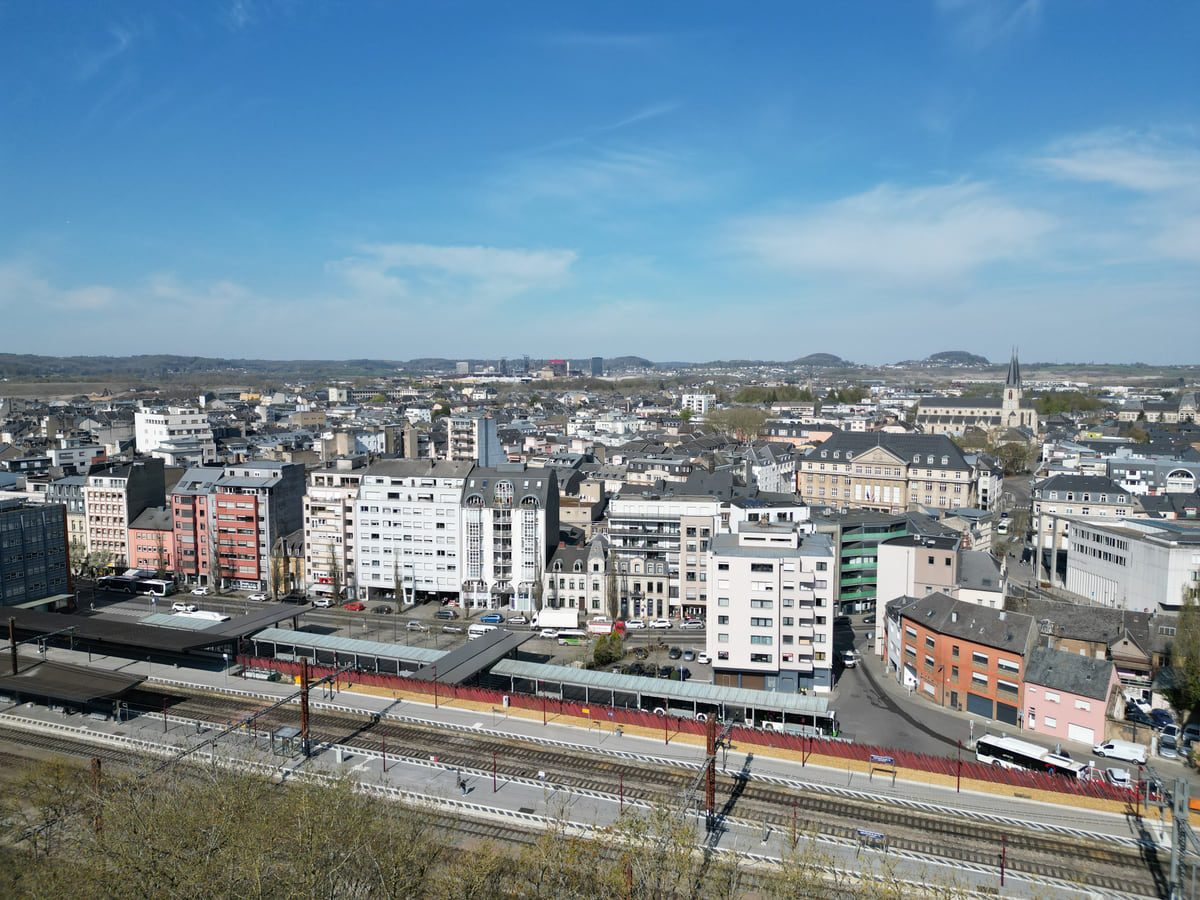
Esch-sur-Alzette from above, with the station and railway tracks in front and blocks of flats to the horizon
Test yourself
True or false?
0/3 Pick before you peek.
-
The European Coal and Steel Community's first symbolic casting took place at Belval.
See the answer
True. It happened in 1953, according to Luxembourg's official portal, a sign of how important the works were at the time.
-
The Rockhal opened for Esch's Capital of Culture year in 2022.
See the answer
False. The Rockhal opened in 2005. What opened to the public in 2022 was, among other spaces, the Möllerei.
-
The Skip building is named after the blast furnace's ore carts.
See the answer
True. Skips were the carts that hauled ore up an inclined hoist to load the furnace.
- Height of the furnace A platform
- 40 m
- Last symbolic casting
- 1997
- Capacity of the Rockhal main hall
- 6,500
- Railway stops in the district
- 3
What to see
What to see in Belval
Frequently asked questions
What is Belval in Luxembourg?
A new district of Esch-sur-Alzette built on the old steelworks. It keeps two blast furnaces and is home to the University of Luxembourg's campus, research centres, the Rockhal and a large shopping centre.
How do I get to Belval from Luxembourg City?
Take the CFL train on the line from the capital to Rodange and get off at Belval-Université, right by the blast furnaces. Second class within Luxembourg is free.
Can you visit the Belval blast furnaces?
Yes. Blast furnace A opens every day except Tuesday and you climb to a platform 40 metres up. Entry is €5, free for under-21s and with the LuxembourgPass.
What is the Rockhal?
Luxembourg's main concert venue, opened at Belval in 2005. It has a main hall for 6,500 people, The Club for 1,200 standing and The Floor for 200, plus the Rocklab for musicians.
Is Belval part of Esch or Sanem?
Belval is a district of Esch-sur-Alzette, although part of the former steel land belongs to the neighbouring commune of Sanem, which says so in its official history.
What is Belval Plaza?
The district's shopping centre at 7 avenue du Rock'n'Roll, with shops, restaurants and a cinema. visitluxembourg pitches it as the place to combine shopping, dinner and a Rockhal gig next door.
What is the Fonds Belval?
The body that runs the guided tours of the blast furnaces and is the contact for the Möllerei. Group bookings go to [email protected].
Can you go inside the library at Belval?
Yes. The Luxembourg Learning Centre, the University of Luxembourg's library, occupies the old Möllerei, and the Fonds Belval describes it as open to the public even though it's built for research. Its opening hours aren't on the official tourism listings, so check them with the university before you go.
0 of 425 Luxembourg guides
Your next stamp
- Esch-sur-Alzette
- Belval blast furnaces
- Minett
- Hotels in Esch-sur-Alzette
- Theatres and concert venues
- Lëtzebuerg City Museum
- Rollingergrund
- Dommeldange
- A Possen Museum
- American Cemetery
- Ansembourg
- Ansembourg Castles
- Asselborn
- Bascharage
- Beaufort castles
- Berg Castle
- Bernard-Massard cellars
- Bourglinster Castle
- Bourscheid Castle
- Brandenbourg
- Brandenbourg Castle
- Caves St Martin
- Christmas
- Clervaux Castle
- Echternach
- Echternach Abbey
- Ehnen
- Ehnen Wine Museum
- Esch-sur-Sûre Castle
- European Museum Schengen
- Fond-de-Gras
- General Patton Museum
- German war cemetery
- Haff Réimech
- Hohllay
- Hollenfels Castle
- Hosingen
- Kautenbach
- Kneiff
- Koerich Castle
- Larochette Castle
- Lasauvage
- Mersch Castle
- Military History Museum
- Moersdorf
- Mondorf Domaine Thermal
- Munsbach Castle
- National Mining Museum
- Parc Merveilleux
- Park Sënnesräich
- Places to visit
- Remich
- Rindschleiden
- Schiessentümpel
- Septfontaines Castle
- Slate Museum
- Stolzembourg
- Tudor Museum
- Useldange Castle
- Valley of the Seven Castles
- Vianden
- Vianden Castle
- Ville Haute
- Wasserbillig Aquarium
- Weiswampach lakes
- Wiltz Castle
- Ahn
- Berdorf
- Bourscheid-Plage
- Butterfly garden
- Clervaux
- Differdange
- Echternach lake
- Grevenmacher
- Heringer Millen
- Hollenfels
- Luxembourg City
- Luxembourg Science Center
- Meysembourg Castle
- Mullerthal
- National Day
- National Resistance Museum
- Perekop
- Remerschen
- Schoenfels Castle
- The Family of Man
- Things to do
- Upper Sûre Lake
- Vianden chairlift
- Wasserbillig
- Clervaux Abbey
- Echternach Roman villa
- Éislek
- Insenborn
- Kallektuffquell
- Machtum
- Most beautiful places
- Our Nature Park
- Pétange
- Pettingen Castle
- Schueberfouer
- Schwebsingen
- Victor Hugo House
- Waldbillig
- Dudelange
- Kuelscheier
- Lultzhausen
- Moselle Valley
- Octave
- Prettiest villages
- Sanem
- Schengen
- Wellenstein
- Wiltz
- Wolfsschlucht
- Beaufort
- Bech-Kleinmacher
- Éimaischen
- Gaalgebierg
- Guttland
- Marnach
- Mondorf-les-Bains
- Putscheid
- Schifflange
- UNESCO World Heritage
- Carnival
- Consdorf
- Ellergronn
- Käerjeng
- Kayl
- Map
- Munshausen
- Tandel
- Bech
- Buergbrennen
- Esch-sur-Sûre
- Rumelange
- Where is Luxembourg
- Is it a country?
- Lac de la Haute-Sûre (commune)
- Rosport-Mompach
- Wormeldange
- Larochette
- Mondercange
- Regions
- Bettembourg
- Bock Casemates
- Cantons
- Dancing procession
- Diekirch
- Fischbach
- Garnich
- Mersch
- Moselle wine route
- Ettelbruck
- Grund
- Heffingen
- Kehlen
- Lintgen
- Moselle river cruises
- Pétrusse Casemates
- Towns and villages
- Chemin de la Corniche
- Erpeldange-sur-Sûre
- Junglinster
- Kopstal
- Lorentzweiler
- Nommern
- Pfaffenthal
- Population
- Bissen
- Clausen
- Grand Ducal Palace
- Koerich
- Schieren
- Size
- Vallée de l'Ernz
- Feulen
- Kirchberg
- Languages
- Notre-Dame Cathedral
- Reisdorf
- Steinfort
- Bettendorf
- Habscht
- St Michael's Church
- Helperknapp
- Luxembourgish
- Place Guillaume II
- Name
- Place d'Armes
- History
- Place de la Constitution
- Grand Duke
- Colmar-Berg
- Flaxweiler
- Gare
- Hamm
- Kirchberg funicular
- Luxembourg fortress
- Mamer
- Mertert
- Minett Trail
- Mullerthal Trail
- Neumünster Abbey
- Parc Hosingen
- Pfaffenthal lift
- Political system
- Redange
- The Passerelle
- Wine festivals
- Winseler
- Beckerich
- Biwer
- EU institutions
- Goesdorf
- Limpertsberg
- Mudam
- Natur Musée
- Pulvermühl
- Stadtbredimus
- Troisvierges
- Wenzel walk
- Bonnevoie
- Bous-Waldbredimus
- Ell
- Flag
- Kiischpelt
- Manternach
- Philharmonie
- Vauban circuit
- Weiswampach
- Betzdorf
- Boulaide
- Dräi Eechelen Museum
- Facts
- Hollerich
- Lenningen
- Useldange
- Wincrange
- Bourscheid
- Dalheim
- Gasperich
- Public holidays
- Red Bridge
- Saeul
- Belair
- Second World War
- Vichten
- Battle of the Bulge
- Merl
- Préizerdaul
- Cents
- EU and Schengen
- Groussbus-Wal
- Entry requirements
- Neudorf
- Rambrouch
- Currency and payments
- Mertzig
- Weimerskirch
- Adolphe Bridge
- Beggen
- Escapardenne
- How to get there
- International March of Diekirch
- MNHA (National Museum)
- Rock climbing
- Sandweiler
- Bridges
- Eich
- Flights
- Golf
- Hesperange
- Canoeing and kayaking
- Luxembourg airport
- Strassen
- Villa Vauban
- Airport to city centre
- Bertrange
- Casino Luxembourg
- Mühlenbach
- Swimming pools
- From Brussels
- Pétrusse Valley
- Walferdange
- Cessange
- Day trip from Brussels
- Municipal Park
- Steinsel
- Free walking tours
- From Paris
- Niederanven
- From Frankfurt
- Schuttrange
- Sightseeing train and bus
- By train
- Contern
- By coach
- Weiler-la-Tour
- Driving
- Luxembourg in one day
- Pretzel Sunday
- Rham Plateau
- Tour de Luxembourg
- Candlemas (Liichtmëssdag)
- Car hire
- Luxembourg in two days
- Saint-Esprit Plateau
- Luxembourg in three days
- Melusina statue
- Parking
- St Nicholas Day (Kleeschen)
- Fête de la Musique
- Luxembourg in four days
- Museums in Luxembourg
- Petrol
- Place de Clairefontaine
- A week in Luxembourg
- Getting around
- Luxembourg Marathon
- Tram and Bus Museum
- Free public transport
- Parks in Luxembourg City
- Road trip
- Belgium and Luxembourg
- Tram
- Buses
- Viewpoints
- Trains
- Luxembourg station
- Cycling
- LuxembourgPass
- Prices and budget
- On a budget
- Free things to do
- Mobile and roaming
- Healthcare
- Safety
- Scams
- Tourist information
- Packing list
- Swimming lakes
- With a dog
- Markets
- Tipping
- Shopping
- What to buy
- Shopping centres
- With kids
- For couples
- Playgrounds
- Adventure parks
- Nightlife
- Castles
- Leudelange
- Nature parks
- Where to stay
- City-centre hotels
- Hiking
- Nature reserves
- Reckange-sur-Mess
- Hotels near the station
- Roeser
- Frisange
- Hotels in Kirchberg
- Airport hotels
- Dippach
- Hotels in Vianden
- Hotels in Echternach
- Hotels in Clervaux
- Hotels in Mondorf-les-Bains
- Hotels on the Moselle
- Mullerthal hotels
- Upper Sûre lake hotels
- Hotels in Diekirch and Ettelbruck
- Cheap hotels
- Luxury hotels
- Boutique hotels
- Spa hotels
- Family hotels
- Apartments
- Weather
- Youth hostels
- Best time to visit
- Campsites
- Holiday cottages
- In winter
- Castle hotels
- In spring
- Day trips
- In summer
- Around Luxembourg
- In autumn
- Ice skating
- Trier day trip
- Metz day trip
- Arlon day trip
- In January
- In February
- In March
- In April
- In May
- In June
- In July
- In August
- In September
- Food
- In October
- In November
- Where to eat
- In December
- Michelin restaurants
- Cheap eats
- Judd mat Gaardebounen
- Bouneschlupp
- Gromperekichelcher
- Kniddelen
- Quetschentaart
- Rieslingspaschtéit
- Events
- Wine
- Crémant
- Beer

Questions about Belval? Write to me
I read every email. If a fact is wrong or missing, tell me and I will check it.
My email sergiolepone@gmail.com
By
Tourism graduate with a master’s in Tourism Management and Planning from the University of Málaga, who has travelled across Europe. He writes every guide from official sources and his own judgement.
Published on . Updated on . Facts checked on .
Sources
Some links in this guide are affiliate links: if you book through them, the site earns a commission at no extra cost to you. Affiliate disclosure
Photos: Zinneke (CC BY-SA 3.0); Zinneke (CC BY-SA 4.0), via Wikimedia Commons.