Basilica, crypt and museum in Echternach
Echternach Abbey, thirteen centuries built round one tomb
Echternach Abbey was founded by Willibrord in 698, and its basilica keeps his tomb in a Carolingian crypt with 11th-century frescoes. The church was blown up in December 1944 and reconsecrated in 1953. The basilica is free; the abbey museum, in the cellars of the 1727 abbot's palace, charges €3.
In 30 seconds
Full read: 4 min
- Echternach Abbey was founded by Willibrord in 698, and its basilica holds his tomb.
- The crypt is Carolingian, from around 800, with 11th-century Romanesque frescoes.
- The basilica was blown up in 1944 and reconsecrated on 20 September 1953.
- Entry to the basilica is free; the abbey museum costs €3.
Go down to the crypt first. It's the oldest part and it explains everything above it, and early in the day you'll often have it alone. Then the museum, which at €3 is one of the best-value tickets in town if manuscripts interest you.

Before you go
What I would keep in mind
-
01 Most beautiful
Romanesque frescoes in the crypt
The vault above the crypt's choir still shows 11th-century scenes from the life of the Virgin, from the Annunciation to the shepherds. They're all that survives of the paintings that once covered the abbey church.
-
02 To save money
Free audio guide in the museum
The museum lends ten free audio guides in German, French, Dutch and English. You just leave an ID card as a deposit.
-
03 My tip
The oldest picture of the procession
In the north aisle chapel, Anton Stevens's triptych of 1604-05 shows pilgrims dancing with musicians in one corner. It's the earliest known depiction of the dancing procession.
Echternach dancing procession -
04 Most beautiful
The abbey gardens
The town park with the 18th-century abbey gardens runs down to the Sûre, with the orangery and a Rococo pavilion. It's open all year.
Echternach
What I would book
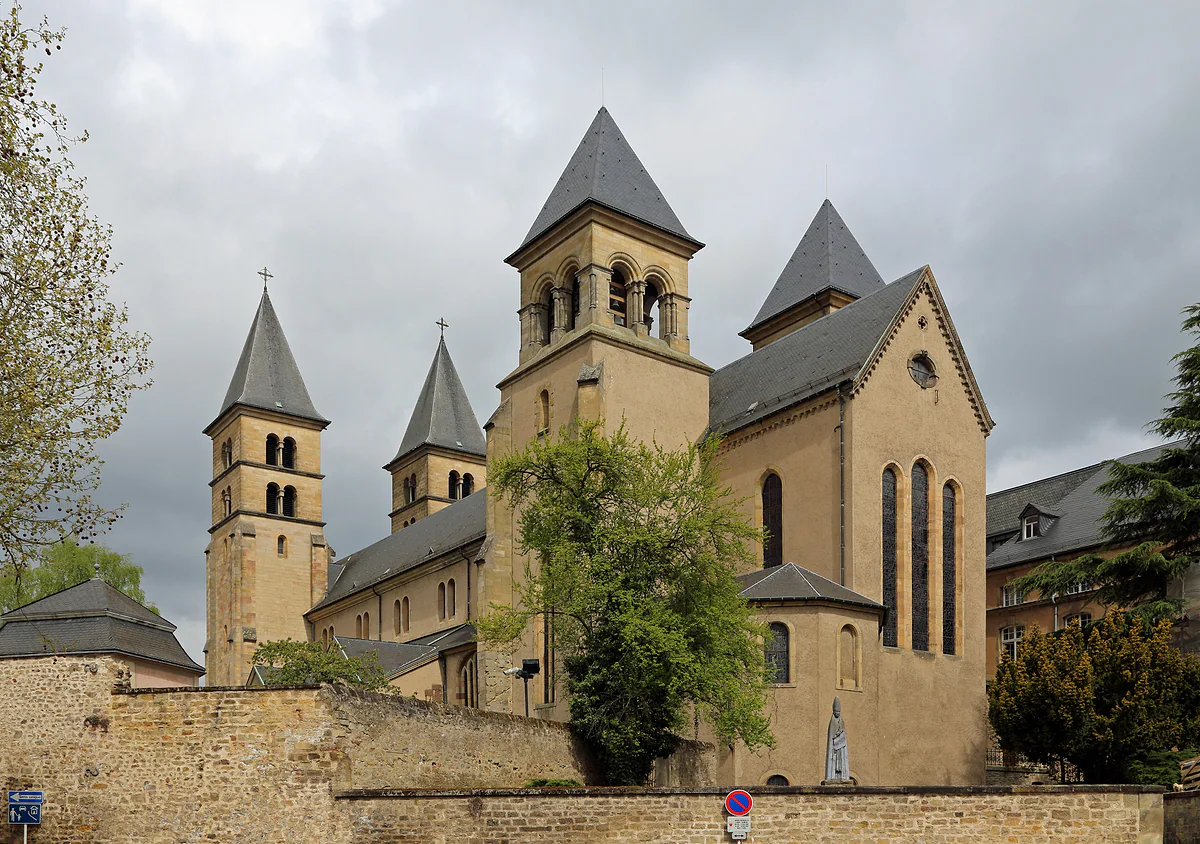
Echternach’s basilica plays a trick on you. From outside, with its four towers, it looks like a textbook Romanesque church; inside, it has the light and order of a post-war building. Both impressions are right. Thirteen centuries are stacked on top of a single tomb here, and the fun lies in reading each layer.
From a small church to a four-towered basilica
Willibrord was born in Northumbria in 658, worked as a missionary in Frisia, was made archbishop of the Frisians in Rome and in 698 founded the abbey at Echternach on land given by Irmina of Oeren. Around 706 he built a single-aisled Merovingian church, traces of which turned up under the nave in 1949. He died on 7 November 739 and was buried in it.
Pilgrims brought growth. Around 800 a three-aisled church more than 60 metres long went up, and the five-aisled, barrel-vaulted crypt you visit today dates from then. A fire in 1016 destroyed it, and the rebuilding, completed in 1031, fixed the plan and proportions the basilica still has. In the 13th century Abbot Arnold I gave it Gothic vaults.
Then came 1794. French troops took the town, looted the abbey and ended monastic life. The church became a pottery works and then a military drill hall, and by the mid-19th century it was half in ruins. Townspeople founded the Oeuvre Saint-Willibrord in 1862 to save it, and it was reconsecrated in 1868.
The crypt comes first
Down below is the Merovingian sarcophagus with the saint’s bones, enclosed since 1906 in a Carrara marble monument carved with scenes from his life, which moved to the crypt in 1939, right beside his first burial place. On the choir vault are 11th-century Romanesque frescoes of the Annunciation, the Visitation, the Nativity and the shepherds. They’re the only survivors of the paintings that once covered the whole abbey church. There’s also St Willibrord’s spring, which the parish links to an early baptistery.
If you are staying the night, see the best hotel deals in Echternach for your dates: the well-placed rooms go fast.
Why does it look so new?
Because much of it is. In December 1944, during the Battle of the Bulge, retreating German troops blew the basilica up. After liberation, rebuilding it was treated as a national priority. The west front was recreated on the model of Paray-le-Monial in Burgundy, the two eastern towers went back up and the nave got a flat timber ceiling. It was reconsecrated on 20 September 1953.
Inside, look at the nave arcades, a large arch on heavy piers with two smaller ones on Corinthian columns in between, known as the Echternach system. In the north aisle chapel hangs Anton Stevens’s triptych of 1604-05, with the earliest known scene of the Echternach dancing procession. The Baroque confessionals were made in the early 17th century for the Jesuit church in Luxembourg City, now the cathedral.
The glass is post-war and worth a slow look. In the choir, Jacques Le Chevallier’s windows show Willibrord before the Holy Trinity, flanked by Peter and Paul, patrons of the first abbey church. The transept windows by Echternach-born François Gillen show the Seven Sorrows of the Virgin on the north side and the Seven Joys on the south, and the rose window on the west front, by Emile and Joseph Probst, carries the signs of the zodiac. Above the high altar hangs a late Gothic Christ from northern France, around 1500, on a cross forged in 2022 by the German artist Johannes Nagel.
The abbey museum
In the vaulted cellars of the abbot’s palace of 1727, the museum explains why Echternach was famous across Europe for its manuscripts. It shows high-quality facsimiles of the Codex Epternacensis and other books from the abbey’s scriptorium, along with Willibrord’s life and archaeological finds. It costs €3, half that for over-60s, and is free with the LuxembourgPass. English speakers are covered, as the free audio guides come in English, French, German and Dutch.
The scriptorium’s most famous book isn’t in Echternach. The Golden Gospels, the Codex Aureus Epternacensis, belong to the Germanisches Nationalmuseum in Nuremberg, which dates them to around 1030 to 1045. All four Gospels are written out in gold ink, with more than 60 painted or decorated pages and over 500 initials, inside a cover of gold, ivory, gems and pearls made in Trier around 985 to 990, half a century before the manuscript itself. That’s why I’d give the museum proper time, because its facsimiles show the workshop behind one of the most lavish books of the early Middle Ages.
Inside the basilica itself, the procession documentation centre gathers paintings, films and maps about the procession and the church’s history, plus a corridor of tomb fragments from the 11th to 18th centuries. In 2022 the basilica, crypt, documentation centre, old monastery buildings and museum jointly received the European Heritage Label.
If you are staying the night, see the best hotel deals in Echternach for your dates: the well-placed rooms go fast.
Fitting it into your day
The abbey sits in the centre of Echternach, opposite the tourist office, and Routes 1 and 2 of the Mullerthal Trail set off from its door. Give the basilica, crypt and museum about ninety minutes, then walk out into the 18th-century abbey gardens and the orangery by the Sûre. In winter, bear in mind the museum only opens on request.
So you do not lose the morning at the ticket office, browse tickets and tours in Echternach Abbey on GetYourGuide.
If you would rather go at your own pace, see the car hire deals in Luxembourg: the earlier you book, the more cars are left to choose from.
Before you fix your dates, compare tickets to Luxembourg: the same journey can cost very different amounts from one day to the next.
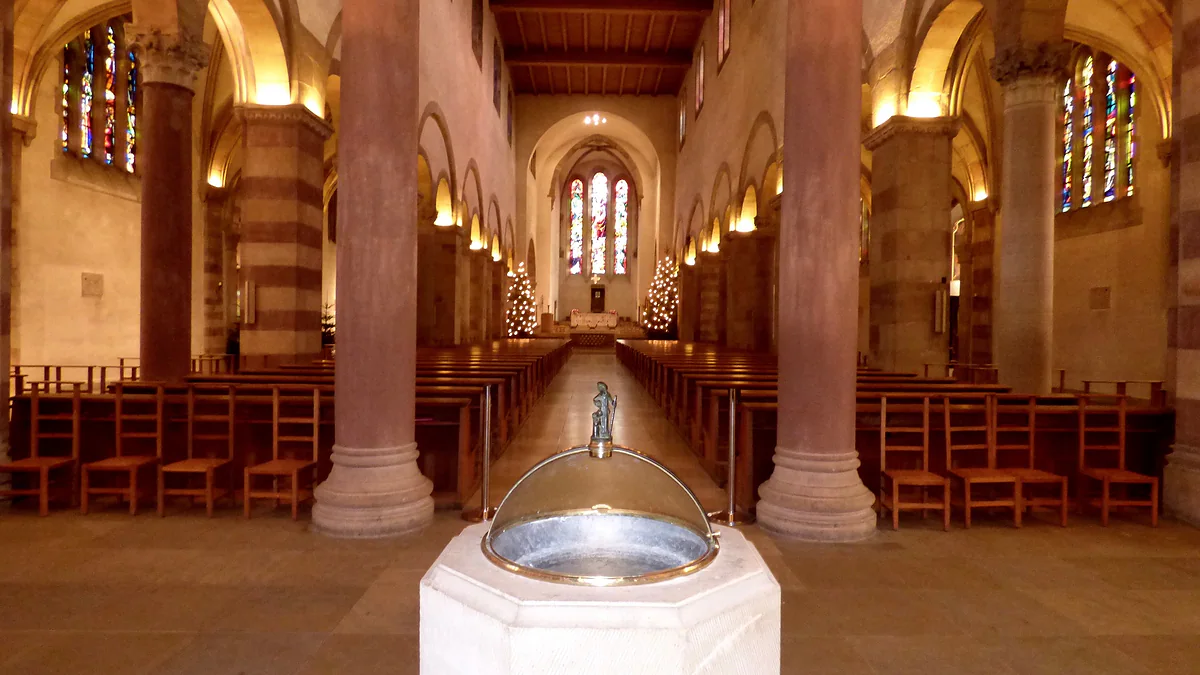
The nave of St Willibrord's Basilica in Echternach, with reddish columns, wooden pews and the font
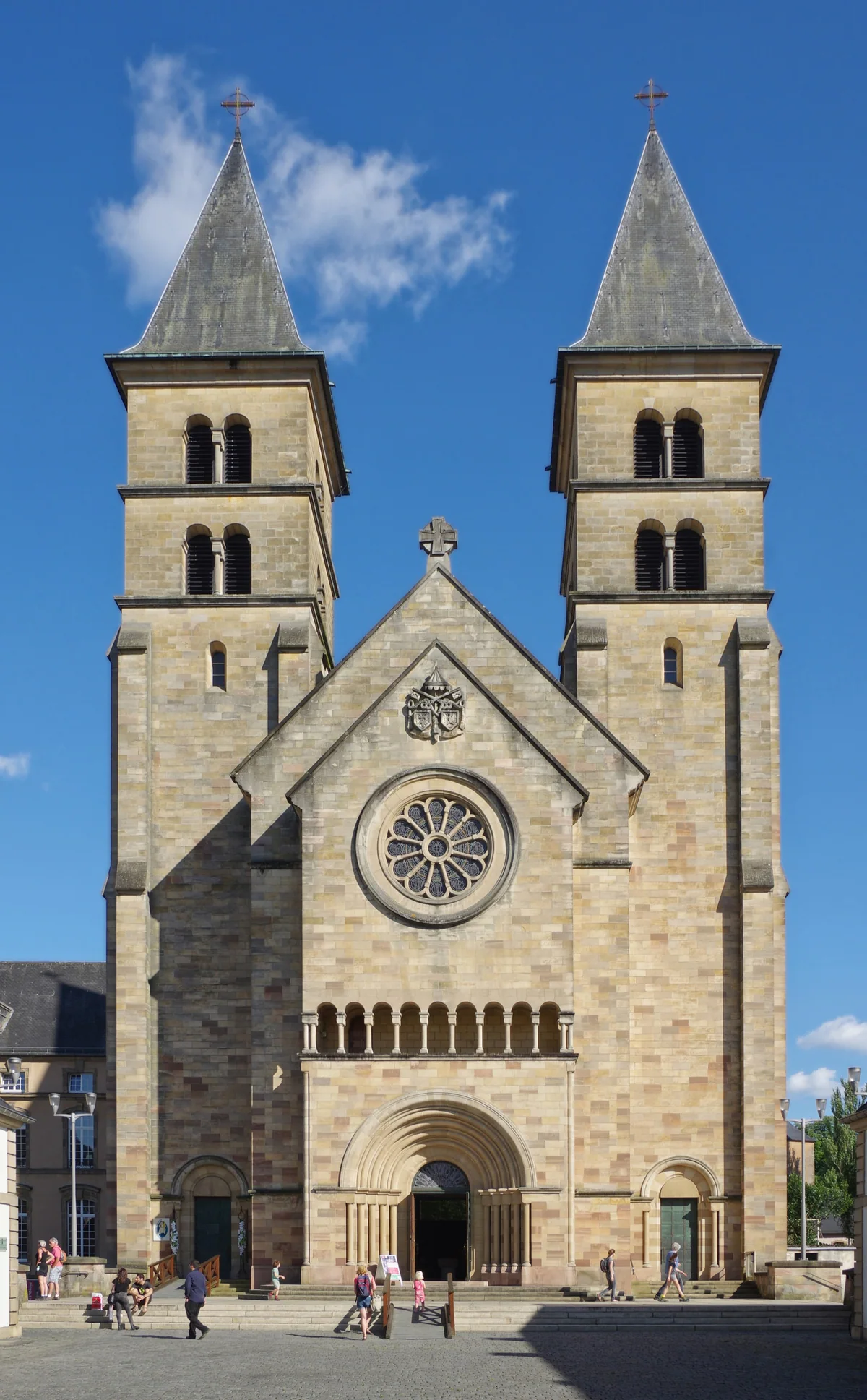
The façade of Echternach Basilica with its twin towers, rose window and doorway under a blue sky
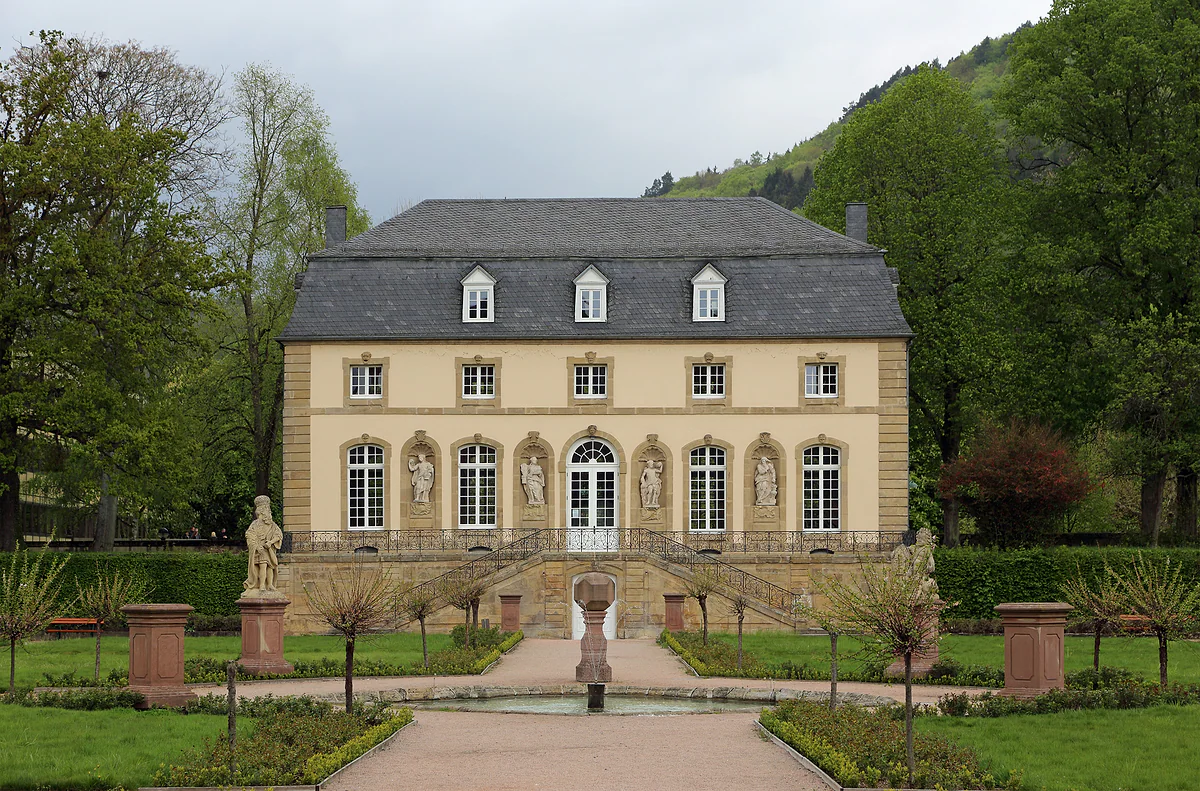
The orangery of the former abbey at Echternach, a Baroque pavilion with statues and a formal garden in front
Opening times and prices, week of 29-09 to 05-10-2026
| Part | Hours | Price |
|---|---|---|
| St Willibrord's Basilica | 08:00-18:00; Sunday 13:00-18:00 | Free |
| Abbey museum | 10:00-12:00 and 14:00-17:00; winter on request | Adults €3; over-60s and groups €1.50 |
| Procession documentation centre | April-October 10:00-12:00 and 14:00-17:00; November-March weekends 14:00-16:00 | No published price |
| Town park and abbey gardens | All year | Free |
visitluxembourg.com and basilika.lu, checked on 29-09-2026. The museum is free with the LuxembourgPass.
The basilica through time
| Year | What happened |
|---|---|
| 698 | Irmina of Oeren gives Willibrord an estate at Echternach and he founds the abbey |
| 739 | Willibrord dies and is buried in his church |
| c. 800 | Three-aisled Carolingian church and today's crypt |
| 1016-1031 | Fire and rebuilding to the present plan |
| 1794 | French troops loot the abbey and monastic life ends |
| 1868 | The ruined church is reconsecrated |
| 1944 | Retreating German troops blow it up in December |
| 1953 | Reconsecration on 20 September |
Basilica parish (basilika.lu), checked on 29-09-2026.
Test yourself
True or false?
0/3 Pick before you peek.
-
Today's basilica is the church Willibrord himself built.
See the answer
False. His small Merovingian church was replaced around 800, burned in 1016, remodelled in the 13th century, blown up in 1944 and rebuilt.
-
Pope John Paul II visited Willibrord's tomb.
See the answer
True. The parish records his visit on 16 May 1985.
-
The basilica's confessionals were made for what is now Luxembourg's cathedral.
See the answer
True. They were carved in the early 17th century for the Jesuit church in the capital, today's cathedral, and rank among the country's most important early Baroque sculpture.
- Abbey founded
- 698
- Willibrord dies and is buried here
- 739
- Abbot's palace, home of the museum
- 1727
- Abbey museum entry
- €3
Map
Where Echternach Abbey is
The thick dashed line is the border with Belgium, France and Germany, and the fine ones divide the twelve cantons. The Éislek lies to the north and the Moselle to the east. Every number opens its guide.
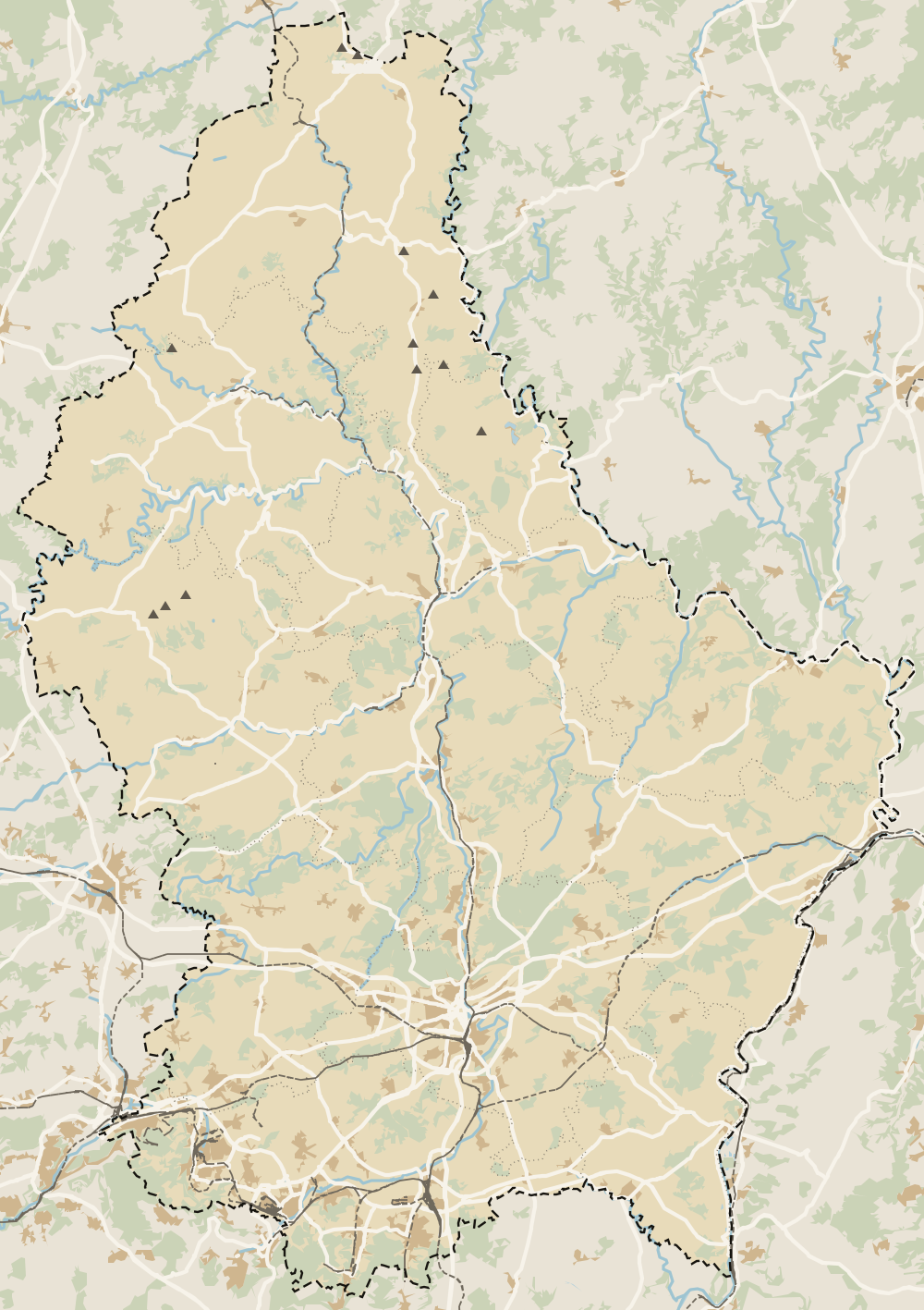 1Echternach 2Echternach Abbey 3Echternach lake 4Echternach Roman villa 5Wolfsschlucht
 Map data © OpenStreetMap contributors (ODbL)
0 of 425 Luxembourg guides
Your next stamp
- Echternach
- Dancing procession
- Clervaux Abbey
- Tudor Museum
- Echternach Roman villa
- A Possen Museum
- American Cemetery
- Ansembourg
- Ansembourg Castles
- Asselborn
- Bascharage
- Beaufort castles
- Belval
- Belval blast furnaces
- Berg Castle
- Bernard-Massard cellars
- Bourglinster Castle
- Bourscheid Castle
- Brandenbourg
- Brandenbourg Castle
- Caves St Martin
- Christmas
- Clervaux Castle
- Ehnen
- Ehnen Wine Museum
- Esch-sur-Alzette
- Esch-sur-Sûre Castle
- European Museum Schengen
- Fond-de-Gras
- General Patton Museum
- German war cemetery
- Haff Réimech
- Hohllay
- Hollenfels Castle
- Hosingen
- Kautenbach
- Kneiff
- Koerich Castle
- Larochette Castle
- Lasauvage
- Mersch Castle
- Military History Museum
- Moersdorf
- Mondorf Domaine Thermal
- Munsbach Castle
- National Mining Museum
- Parc Merveilleux
- Park Sënnesräich
- Places to visit
- Remich
- Rindschleiden
- Schiessentümpel
- Septfontaines Castle
- Slate Museum
- Stolzembourg
- Useldange Castle
- Valley of the Seven Castles
- Vianden
- Vianden Castle
- Ville Haute
- Wasserbillig Aquarium
- Weiswampach lakes
- Wiltz Castle
- Ahn
- Berdorf
- Bourscheid-Plage
- Butterfly garden
- Clervaux
- Differdange
- Echternach lake
- Grevenmacher
- Heringer Millen
- Hollenfels
- Luxembourg City
- Luxembourg Science Center
- Meysembourg Castle
- Mullerthal
- National Day
- National Resistance Museum
- Perekop
- Remerschen
- Schoenfels Castle
- The Family of Man
- Things to do
- Upper Sûre Lake
- Vianden chairlift
- Wasserbillig
- Éislek
- Insenborn
- Kallektuffquell
- Machtum
- Most beautiful places
- Our Nature Park
- Pétange
- Pettingen Castle
- Schueberfouer
- Schwebsingen
- Victor Hugo House
- Waldbillig
- Dudelange
- Kuelscheier
- Lultzhausen
- Moselle Valley
- Octave
- Prettiest villages
- Sanem
- Schengen
- Wellenstein
- Wiltz
- Wolfsschlucht
- Beaufort
- Bech-Kleinmacher
- Éimaischen
- Gaalgebierg
- Guttland
- Marnach
- Mondorf-les-Bains
- Putscheid
- Schifflange
- UNESCO World Heritage
- Carnival
- Consdorf
- Ellergronn
- Käerjeng
- Kayl
- Map
- Minett
- Munshausen
- Tandel
- Bech
- Buergbrennen
- Esch-sur-Sûre
- Rumelange
- Where is Luxembourg
- Is it a country?
- Lac de la Haute-Sûre (commune)
- Rosport-Mompach
- Wormeldange
- Larochette
- Mondercange
- Regions
- Bettembourg
- Bock Casemates
- Cantons
- Diekirch
- Fischbach
- Garnich
- Mersch
- Moselle wine route
- Ettelbruck
- Grund
- Heffingen
- Kehlen
- Lintgen
- Moselle river cruises
- Pétrusse Casemates
- Towns and villages
- Chemin de la Corniche
- Erpeldange-sur-Sûre
- Junglinster
- Kopstal
- Lorentzweiler
- Nommern
- Pfaffenthal
- Population
- Bissen
- Clausen
- Grand Ducal Palace
- Koerich
- Schieren
- Size
- Vallée de l'Ernz
- Feulen
- Kirchberg
- Languages
- Notre-Dame Cathedral
- Reisdorf
- Steinfort
- Bettendorf
- Habscht
- St Michael's Church
- Helperknapp
- Luxembourgish
- Place Guillaume II
- Name
- Place d'Armes
- History
- Place de la Constitution
- Grand Duke
- Colmar-Berg
- Flaxweiler
- Gare
- Hamm
- Kirchberg funicular
- Luxembourg fortress
- Mamer
- Mertert
- Minett Trail
- Mullerthal Trail
- Neumünster Abbey
- Parc Hosingen
- Pfaffenthal lift
- Political system
- Redange
- The Passerelle
- Wine festivals
- Winseler
- Beckerich
- Biwer
- EU institutions
- Goesdorf
- Limpertsberg
- Mudam
- Natur Musée
- Pulvermühl
- Stadtbredimus
- Troisvierges
- Wenzel walk
- Bonnevoie
- Bous-Waldbredimus
- Ell
- Flag
- Kiischpelt
- Manternach
- Philharmonie
- Vauban circuit
- Weiswampach
- Betzdorf
- Boulaide
- Dräi Eechelen Museum
- Facts
- Hollerich
- Lenningen
- Useldange
- Wincrange
- Bourscheid
- Dalheim
- Gasperich
- Public holidays
- Red Bridge
- Saeul
- Belair
- Second World War
- Vichten
- Battle of the Bulge
- Merl
- Préizerdaul
- Cents
- EU and Schengen
- Groussbus-Wal
- Entry requirements
- Neudorf
- Rambrouch
- Currency and payments
- Mertzig
- Weimerskirch
- Adolphe Bridge
- Beggen
- Escapardenne
- How to get there
- International March of Diekirch
- MNHA (National Museum)
- Rock climbing
- Sandweiler
- Bridges
- Eich
- Flights
- Golf
- Hesperange
- Lëtzebuerg City Museum
- Canoeing and kayaking
- Dommeldange
- Luxembourg airport
- Strassen
- Villa Vauban
- Airport to city centre
- Bertrange
- Casino Luxembourg
- Mühlenbach
- Swimming pools
- From Brussels
- Pétrusse Valley
- Rollingergrund
- Walferdange
- Cessange
- Day trip from Brussels
- Municipal Park
- Steinsel
- Free walking tours
- From Paris
- Niederanven
- From Frankfurt
- Schuttrange
- Sightseeing train and bus
- By train
- Contern
- By coach
- Weiler-la-Tour
- Driving
- Luxembourg in one day
- Pretzel Sunday
- Rham Plateau
- Tour de Luxembourg
- Candlemas (Liichtmëssdag)
- Car hire
- Luxembourg in two days
- Saint-Esprit Plateau
- Luxembourg in three days
- Melusina statue
- Parking
- St Nicholas Day (Kleeschen)
- Fête de la Musique
- Luxembourg in four days
- Museums in Luxembourg
- Petrol
- Place de Clairefontaine
- A week in Luxembourg
- Getting around
- Luxembourg Marathon
- Tram and Bus Museum
- Free public transport
- Parks in Luxembourg City
- Road trip
- Belgium and Luxembourg
- Tram
- Buses
- Viewpoints
- Trains
- Luxembourg station
- Cycling
- LuxembourgPass
- Prices and budget
- On a budget
- Free things to do
- Mobile and roaming
- Healthcare
- Safety
- Scams
- Tourist information
- Packing list
- Swimming lakes
- With a dog
- Markets
- Tipping
- Shopping
- What to buy
- Shopping centres
- With kids
- For couples
- Playgrounds
- Adventure parks
- Nightlife
- Castles
- Theatres and concert venues
- Leudelange
- Nature parks
- Where to stay
- City-centre hotels
- Hiking
- Nature reserves
- Reckange-sur-Mess
- Hotels near the station
- Roeser
- Frisange
- Hotels in Kirchberg
- Airport hotels
- Dippach
- Hotels in Vianden
- Hotels in Echternach
- Hotels in Clervaux
- Hotels in Mondorf-les-Bains
- Hotels in Esch-sur-Alzette
- Hotels on the Moselle
- Mullerthal hotels
- Upper Sûre lake hotels
- Hotels in Diekirch and Ettelbruck
- Cheap hotels
- Luxury hotels
- Boutique hotels
- Spa hotels
- Family hotels
- Apartments
- Weather
- Youth hostels
- Best time to visit
- Campsites
- Holiday cottages
- In winter
- Castle hotels
- In spring
- Day trips
- In summer
- Around Luxembourg
- In autumn
- Ice skating
- Trier day trip
- Metz day trip
- Arlon day trip
- In January
- In February
- In March
- In April
- In May
- In June
- In July
- In August
- In September
- Food
- In October
- In November
- Where to eat
- In December
- Michelin restaurants
- Cheap eats
- Judd mat Gaardebounen
- Bouneschlupp
- Gromperekichelcher
- Kniddelen
- Quetschentaart
- Rieslingspaschtéit
- Events
- Wine
- Crémant
- Beer
Frequently asked questions
Who founded Echternach Abbey?
Willibrord, a monk born in Northumbria in 658 who became archbishop of the Frisians, based in Utrecht. In 698 Irmina of Oeren gave him an estate at Echternach, where he founded a Benedictine abbey.
Where is St Willibrord buried?
In the crypt of Echternach's basilica. His Merovingian sarcophagus sits inside a Carrara marble monument of 1906, which was moved down into the crypt in 1939.
Is Echternach Basilica free to visit?
Yes. The abbey museum next door costs €3 for adults and €1.50 for over-60s, and it's free with the LuxembourgPass.
What are the opening times?
In the week of 29 September 2026 the basilica opened 8:00 to 18:00, Sundays 13:00 to 18:00, and the museum 10:00 to 12:00 and 14:00 to 17:00. In winter the museum opens on request.
Why does the basilica look so new?
Because much of it is. Retreating German troops blew it up in December 1944; rebuilding was treated as a national priority and it was reconsecrated on 20 September 1953.
What is the Codex Epternacensis?
One of the manuscripts produced in the abbey's scriptorium. The museum shows high-quality facsimiles of it and other codices made at Echternach.
Where are the Echternach Gospels kept?
The Golden Gospels of Echternach, the Codex Aureus Epternacensis, are in the Germanisches Nationalmuseum in Nuremberg, Germany. They were made in the abbey's scriptorium around 1030 to 1045, with all four Gospels written in gold ink. In Echternach itself, the abbey museum shows facsimiles of the scriptorium's books.
By
Tourism graduate with a master’s in Tourism Management and Planning from the University of Málaga, who has travelled across Europe. He writes every guide from official sources and his own judgement.
Published on . Updated on . Facts checked on .
Sources
Some links in this guide are affiliate links: if you book through them, the site earns a commission at no extra cost to you. Affiliate disclosure
Photos: Marc Ryckaert (CC BY 3.0); Denise Hastert (CC BY-SA 4.0); Berthold Werner (CC BY-SA 3.0); Marc Ryckaert (CC BY 3.0), via Wikimedia Commons.