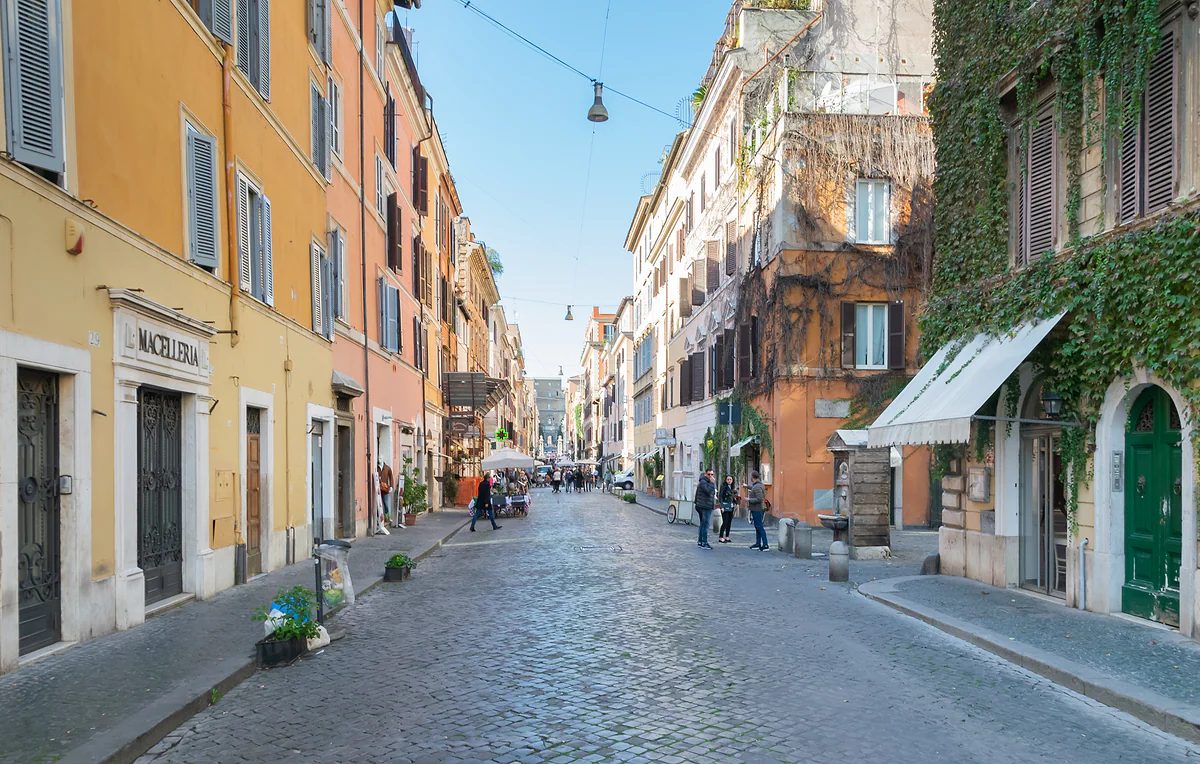
Rione XIV, between the colonnade and the Tiber
Borgo, the Rome district living in St Peter's shadow
Borgo is Rome's rione XIV, the district filling the space between St Peter's Square and Castel Sant'Angelo. Borgo Pio is its best-known street, and above the rooftops runs the Passetto, the popes' raised corridor. Sixtus V made it a district of Rome in 1586. For me it's the place to stay if the Vatican is the heart of your trip.
In 30 seconds
Full read: 5 min
- Borgo is Rome's rione XIV, the strip of city running from the rim of St Peter's Square down to the Tiber and Castel Sant'Angelo. It isn't part of the Vatican.
- Its best-known street is Borgo Pio, laid out in 1565 when Pius IV walled the north of the district, and the popes' Passetto runs above its rooftops.
- My favourite detail is the stone ring on the corner with Via del Campanile, used to check the size of a loaf when famine struck.
- It's where I'd stay if the trip revolves around the Vatican or the audience, because you walk everywhere. The nearest metro stops are Ottaviano and Lepanto.
- Santo Spirito in Sassia, with 1,200 m² of frescoes in its Corsie Sistine, and Santa Maria in Traspontina are the two churches almost nobody visits.
If the Vatican is the reason for your trip, I'd stay in Borgo, all the more so for a Wednesday audience or with small children. For a wander, I'd save its streets for the end of the day, between the castle terrace and dinner, when it's easiest to see this was a pilgrims' quarter long before it was a tourist one.

Before you go
What I would keep in mind
-
01 Most beautiful
Bread measured in stone on Borgo Pio
On the corner of Borgo Pio and Via del Campanile there's a disc carved into the stone that was used to check loaves weren't smaller than the legal minimum during famines. It's my favourite detail in the district, ordinary people's lives right next to the popes'.
St Peter's Square -
02 Worth the splurge
Walk above the district on the Passetto
The popes' corridor can be visited inside with a guide on Friday to Sunday mornings, €30 including castle entry, and on Saturday evenings. From the street you see it for free, but walking along the top is something else.
Castel Sant'Angelo -
03 Getting there
Castle to St Peter's without crossing a road
Piazza Pia has been pedestrianised since 23 December 2024, with traffic sent through a tunnel, so you can walk from Castel Sant'Angelo to Via della Conciliazione. Borgo has no metro station of its own; Ottaviano and Lepanto on line A are the stops to use.
How to get to Vatican City from Rome and the airports -
04 Watch out
With luggage, skip bus 64
Buses 40 and 64 both run from Termini towards this area, but the US State Department's security report names the 64 as a problem route for thieves. If you're arriving with bags, I'd take the metro.
Vatican scams and tourist traps to avoid in 2026 -
05 To save money
Staying here saves you fares on the big day
From Borgo you walk to St Peter's Square, the castle and the Wednesday audience queue. If your trip is built round the Vatican, you won't need a single ticket for the things that matter.
Papal audience
My priorities
Unmissable
- Wander Borgo Pio and find the bread ring carved into the stone
- Trace the Passetto between the rooftops along Via dei Corridori, free from the street
- End the walk on the castle terrace at sunset
If you have time
- Walk the Passetto from the inside with a guide, entering through the castle, for €30
- Santo Spirito in Sassia and the foundling wheel still set into its wall
- Step into Santa Maria in Traspontina, the church with a low dome kept out of the cannons' way
What I would book
- Places to stayBooking.com Staying in Borgo, a stroll from St Peter's If the Vatican is the reason for your trip, this is where I'd stay. You can walk to the square, the castle and the Wednesday audience queue.
- Book a tableTheFork A table for dinner in Borgo I'd save these streets for dinner, after the castle terrace. With a table booked you can pick somewhere in the lanes away from the square, which is where the better food is.
My ranking, scored
The corners of Borgo I wouldn't miss
My own scores out of 10, so opinion. I rate what you take away from each place, how different it is from what you'll already have seen in the Vatican and how easily it fits into a stroll. Places that charge lose points if they don't earn it.
0 of 6 seen
-
Castel Sant'Angelo and its terrace
Hadrian's mausoleum, papal fortress and prison in one, with one of the finest views in Rome according to the city's tourist board. It's in Borgo, even though it appears on Prati's coat of arms.
9.5 out of 10
-
The Passetto di Borgo
The battlemented corridor the popes used to reach the castle. Just watching it run over the streets is striking, and since 23 December 2024 you can walk it with a guide.
9.0 out of 10
-
Borgo Pio and its bread disc
The street everyone searches for, with the stone circle on the corner of Via del Campanile. For me it's the best spot to grasp that people lived here long before tourists came.
8.6 out of 10
-
Santo Spirito in Sassia
One of Europe's oldest hospitals, founded for Saxon pilgrims. The Corsie Sistine are 120 metres long, hold over 1,200 m² of frescoes and shelter Palladio's only work in Rome.
8.4 out of 10
-
Via della Conciliazione and Piazza Pia
The grand approach to St Peter's Square. I knock points off because half the old district was flattened to build it, but now it's traffic-free up to the castle, it makes a lovely walk.
7.8 out of 10
-
Santa Maria in Traspontina
The church with a drumless dome so it wouldn't block the castle's cannons. That story alone is reason enough for me to step inside.
7.5 out of 10
Most people march through Borgo eyes front, with St Peter’s dome ahead and no time to lose. To my mind they’re missing the point, because this district is the reason the Vatican looks the way it does. It was built to house pilgrims, popes ran through it in fear of their lives and half of it was knocked down to make way for an avenue. It deserves an afternoon of your time.
A district built for pilgrims on their way to St Peter
The name comes from the Saxon “Burg”, a small fortress or walled village, and that’s no accident. In 727 the Saxon king Ine founded the Schola Saxonum here to house pilgrims coming to Peter’s tomb, and over the centuries that hostel grew into Santo Spirito in Sassia. Sixtus V made the area Rome’s rione XIV on 9 December 1586 and gave it a coat of arms with a crouching lion before three hills and a star, his own emblem.
Today Borgo stretches from the edge of St Peter’s Square, at Piazza Pio XII and Largo del Colonnato, to the riverside and Castel Sant’Angelo. Rome’s tourist board calls it the natural antechamber to St Peter’s and the Museums, full of small restaurants, hotels, religious souvenir shops and historic tailors making cassocks and vestments. From the centre you reach it over Ponte Sant’Angelo and its ten angels.
What to see on Borgo Pio and the streets around it
Borgo Pio, Borgo Vittorio and Borgo Angelico are the streets in the northern part of the district. They date from 1565, when Pius IV Medici built the walls here, and that’s when the Passetto stopped being a defence and became part of the street plan, running above the houses. Borgo Pio is the one everyone searches for and the one I’d walk first.
My favourite detail is where Borgo Pio meets Via del Campanile. Carved into the stone there is a circle that fixed the smallest a loaf could legally be in times of famine, so no baker could cheat. What I love is that there’s nothing papal about it. It’s the everyday life of the neighbourhood, right beside one of the great seats of power in history.
The clerical outfitters are the district’s other quirk. The tourist board lists them as historic workshops, and even if you’re not buying, peering into a window full of cassocks two streets from the Pope has a certain charm.
The Passetto, the corridor running over your head
The Passetto di Borgo is a battlemented corridor of around 800 metres linking the Vatican palaces with Castel Sant’Angelo along Via dei Corridori and Borgo Sant’Angelo. Clement VII fled along it to the castle during the Sack of Rome in 1527. From the street you can follow it for free, tracing it between the rooftops.
Since 23 December 2024 you can walk it inside with a guide, always entering through the castle except on the step-free visit, which starts at the Torre del Mascherino. Prices, days and the Saturday evening visit are all in my guide to Castel Sant’Angelo. If you only pay for one thing in the district, I’d make it this.
Two churches almost everyone walks past
Santo Spirito in Sassia stands on the old gardens of Agrippina the Elder, and its basements still hold Roman walls, mosaics and frescoes. It’s one of the oldest hospitals in Europe. Outside you’ll find the Ruota degli Esposti, the wheel where abandoned newborns were left, and inside Sixtus IV’s Corsie Sistine run 120 metres long and 13 wide, with over 1,200 m² of frescoes restored up to July 2022. Under the octagonal lantern stands a ciborium that is Andrea Palladio’s only work in Rome. The Sala Alessandrina now houses the Museo di Storia dell’Arte Sanitaria, a museum of medical history.
Santa Maria in Traspontina, right on Via della Conciliazione, has one of my favourite stories in Rome. Pius IV pulled down the earlier church in 1564 because it got in the way of the castle’s cannons, and the new one, from 1566, was given a dome without a drum so it would never block the line of fire again. The castle’s gunners prayed in its chapel of St Barbara.
What Via della Conciliazione swept away
Via della Conciliazione is now the grand approach to the Vatican, but to build it the Spina di Borgo was demolished between 1935 and 1937. It was a triangular block of houses between Borgo Nuovo and Borgo Vecchio, pointing towards the castle. The tourist board doesn’t mince its words. The surprise of stepping out of the narrow streets and suddenly facing the colonnade and the basilica was lost. I’m sorry I never got to see it that way.
What the district has gained is Piazza Pia, traffic-free since 23 December 2024, with cars sent through the Lungotevere in Sassia tunnel. You can now walk from the castle to St Peter’s without crossing a road. This was also where the Meta Romuli stood, a Roman funerary pyramid, long gone, that for centuries was thought to be the tomb of Remus.
Is Borgo a good place to stay and eat?
For sleeping, I’m clear on it. If the Vatican is the core of your trip, if you’re going to the Wednesday papal audience or travelling with small children, Borgo puts everything within walking distance. The catch is it has no metro station of its own, so for the rest of Rome you’ll rely on Ottaviano, Lepanto or the bus. If the Vatican is just one day of your trip, I’d look at Prati first. The full comparison is in where to stay near the Vatican.
For eating, the tourist board talks of little streets full of small restaurants, but it doesn’t publish a list and I won’t recommend a specific place without checking it first. My rule is to get away from the first row on the square and on Via della Conciliazione and head into the inner streets. If you’d rather shop at a market, the Trionfale and the Unità are a stroll away in Prati, as I explain in where to eat near the Vatican.
Getting to Borgo
| How | Where it drops you | Note |
|---|---|---|
| Metro line A towards Battistini | Ottaviano, for the Vatican Museums side | The stop the Museums recommend |
| Metro line A | Lepanto, for Castel Sant'Angelo | The stop the castle's ticket office recommends |
| Bus 40 from Termini | Borgo Sant'Angelo, by the castle | Leaves from bay A; the terminus comes from unofficial sources |
| On foot from St Peter's | Via della Conciliazione and Piazza Pia | Traffic-free to the castle since 23 December 2024 |
Information from the Vatican Museums, CoopCulture (the castle's ticket office), ATAC and Roma Capitale, checked on 24 September 2026.
Mass times at Santa Maria in Traspontina
| Day | Times |
|---|---|
| Monday to Friday | 7:30, 9:00 and 18:30 |
| Saturdays and eves of holy days | 9:00 and 18:30 |
| Sundays and holy days | 8:00, 9:30, 11:00 and 18:30 |
Times published by Turismo Roma, checked on 24 September 2026.
- Year Sixtus V made Borgo Rome's rione XIV
- 1586
- Founding of the Schola Saxonum for pilgrims
- 727
- Approximate length of the Passetto from the Vatican to the castle
- 800 m
- Length of the Corsie Sistine at Santo Spirito in Sassia
- 120 m
- Demolition of the Spina di Borgo for Via della Conciliazione
- 1935-1937
Map
Everything within a short walk
Green for Rome, black for the Vatican. Every number opens its guide.
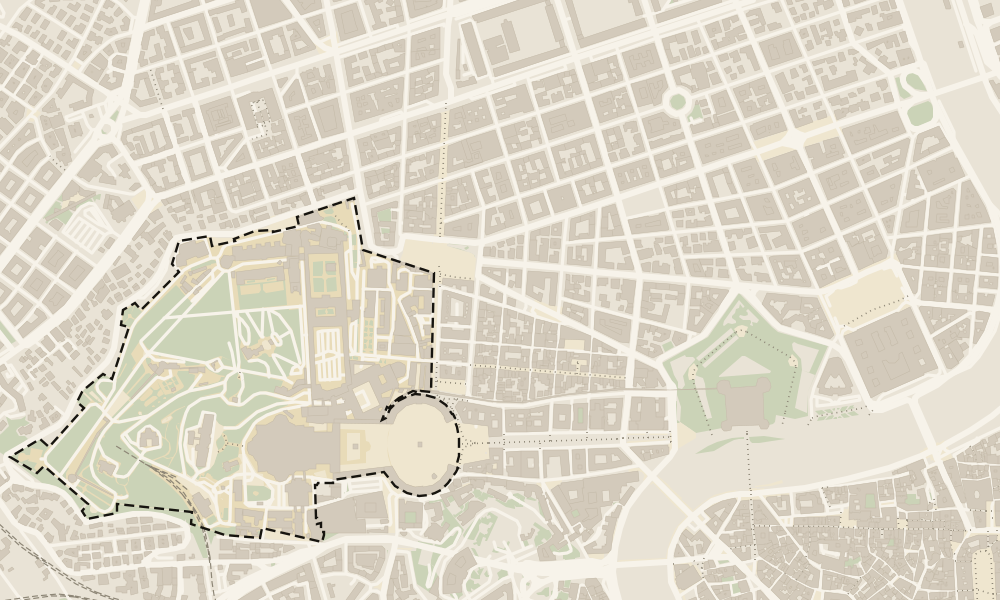 1Castel Sant'Angelo 2Borgo 3Sistine Chapel 4Prati 5Ponte Sant'Angelo 6Vatican Museums 7St Peter's Basilica 8St Peter's Square 9St Peter's Dome 10Vatican Necropolis 11Vatican Gardens 12Swiss Guard 13Seeing the Pope 14Apostolic Palace 15Papal audience 16Angelus 17Who painted it 18Where the Pope lives 19Facts 20Vatican Grottoes 21Pietà 22Baldachin 23Ceiling 24Chair of St Peter 25Last Judgement 26Raphael Rooms 27Architecture and architects 28Gallery of Maps 29Holy Door 30Bramante Staircase 31Facade and balcony 32Mass at St Peter's 33Pio Clementino Museum 34Vatican Pinacoteca 35Gallery of Tapestries 36Gallery of the Candelabra 37Egyptian and Etruscan Museums 38Obelisk 39Bernini's colonnade 40Chiaramonti and Braccio Nuovo 41Christmas 42Anima Mundi Museum 43Easter 44Carriage Pavilion 45Courtyard of the Pine Cone 46Train station 47Borgia Apartment 48Modern art collection 49Pharmacy, shop and petrol
 Map data © OpenStreetMap contributors (ODbL)
- 1Castel Sant'AngeloHadrian's mausoleum, a short walk from the Vatican
- 2BorgoRione XIV, between the colonnade and the Tiber
- 3Sistine ChapelInside the Vatican Museums
- 4PratiRione XXII, the last one Rome created
- 5Ponte Sant'AngeloTen marble angels, and two missing
- 6Vatican MuseumsSeven kilometres of galleries in Vatican City
- 7St Peter's BasilicaConsecrated in 1626, 400 years old this year
- 8St Peter's SquareFree, open to all, and technically another country
- 9St Peter's DomeMichelangelo's dome, 136.57 metres to the cross
- 10Vatican NecropolisThe Scavi tour, by request and with a guide
- 11Vatican Gardens22 hectares behind the museums
- 12Swiss GuardWho guards the Pope, and why they are Swiss
- 13Seeing the PopePope Leo XIV, Wednesdays and Sundays
- 14Apostolic PalaceThe Sistine Chapel is inside, though it doesn't feel like it
- 15Papal audiencePope Leo XIV in St Peter's Square
- 16AngelusSt Peter's Square, Sundays at noon
- 17Who painted itMichelangelo wasn't alone, and he wasn't first
- 18Where the Pope livesApostolic Palace, Santa Marta and Castel Gandolfo
- 19FactsFrom mould on the Flood to visitors' sweat
- 20Vatican GrottoesUnder the basilica, free and without booking
- 21PietàNew protective glass since November 2024
- 22BaldachinBack on view, restored, since October 2024
- 23CeilingMichelangelo, 1508-1512
- 24Chair of St PeterTen years' work and a dove twenty metres up
- 25Last JudgementCleaned between February and March 2026
- 26Raphael RoomsVatican Museums, just before the Sistine
- 27Architecture and architectsTwenty pontificates for one church
- 28Gallery of MapsNumber 8 on the official museum map
- 29Holy DoorClosed by Leo XIV on 6 January 2026
- 30Bramante StaircaseTwo spiral staircases, one name
- 31Facade and balcony116 metres of travertine most people walk past
- 32Mass at St Peter'sNine Masses every weekday, all free
- 33Pio Clementino MuseumClassical sculpture since 1506
- 34Vatican PinacotecaOpened on 27 October 1932
- 35Gallery of TapestriesNumber 7 on the map, between Candelabra and Maps
- 36Gallery of the CandelabraNumber 6 on the map, just before the Tapestries
- 37Egyptian and Etruscan MuseumsNumber 1 on the map, by the Cortile della Pigna
- 38Obelisk330 tonnes of granite without a single hieroglyph
- 39Bernini's colonnade284 columns in four rows that turn into one
- 40Chiaramonti and Braccio NuovoNumbers 2 and 3 on the map, first floor
- 41ChristmasThe 2026 nativity and tree are already announced
- 42Anima Mundi MuseumNumber 21 on the map, in the basement
- 43EasterThe 2026 timetable and what we know of 2027
- 44Carriage PavilionNumber 22 on the map, opened in 1973
- 45Courtyard of the Pine ConePoint CP on the map, open to the sky
- 46Train stationDesigned by Giuseppe Momo, opened in 1933
- 47Borgia ApartmentSix rooms painted in eighteen months
- 48Modern art collectionVan Gogh and Matisse on the way to the Sistine
- 49Pharmacy, shop and petrolOpen to anyone with a paper prescription
0 of 8 Italy guides
Your next stamp
Frequently asked questions
What is Borgo Pio?
It's one of the streets of Borgo, Rome's rione XIV, between the Vatican and Castel Sant'Angelo. Along with Borgo Vittorio and Borgo Angelico it grew up north of the Passetto after Pius IV walled the area in 1565. Today it's the district's best-known street.
Is Borgo part of Vatican City?
No. Borgo is a district of Rome, in Italy, which begins where St Peter's Square ends, at Piazza Pio XII and Largo del Colonnato. Castel Sant'Angelo and the Passetto are in Borgo, not in the Vatican.
Is Borgo a good area to stay in Rome?
For a Vatican-focused trip, I think it's the best, because you can walk to St Peter's, the audience and the castle. If you'll be getting around the rest of Rome a lot, I'd look at Prati, as Borgo has no metro station of its own.
Where should I eat in Borgo Pio?
Rome's tourist board describes Borgo as a web of little streets full of small restaurants, and Borgo Pio is the best known. I won't point you to a specific one without a source, but I would steer you away from the first row facing the square. Prati also has the Trionfale and Unità markets.
What is the Passetto di Borgo and can you visit it?
It's the raised, battlemented corridor linking the Vatican palaces with Castel Sant'Angelo, which Clement VII fled along in 1527. Guided visits have run since 23 December 2024, entering through the castle, on Friday to Sunday mornings and Saturday evenings.
Why is the district called Borgo?
It comes from the Saxon word "Burg", a small fortress or walled village. That's why so many streets here start with Borgo, such as Borgo Pio, Borgo Vecchio and Borgo Nuovo.
By
Tourism graduate with a master’s in Tourism Management and Planning from the University of Málaga, who has travelled across Europe. He writes every guide from official sources and his own judgement.
Published on . Facts checked on .
Sources
Photos: Krzysztof Golik (CC BY-SA 4.0), via Wikimedia Commons.