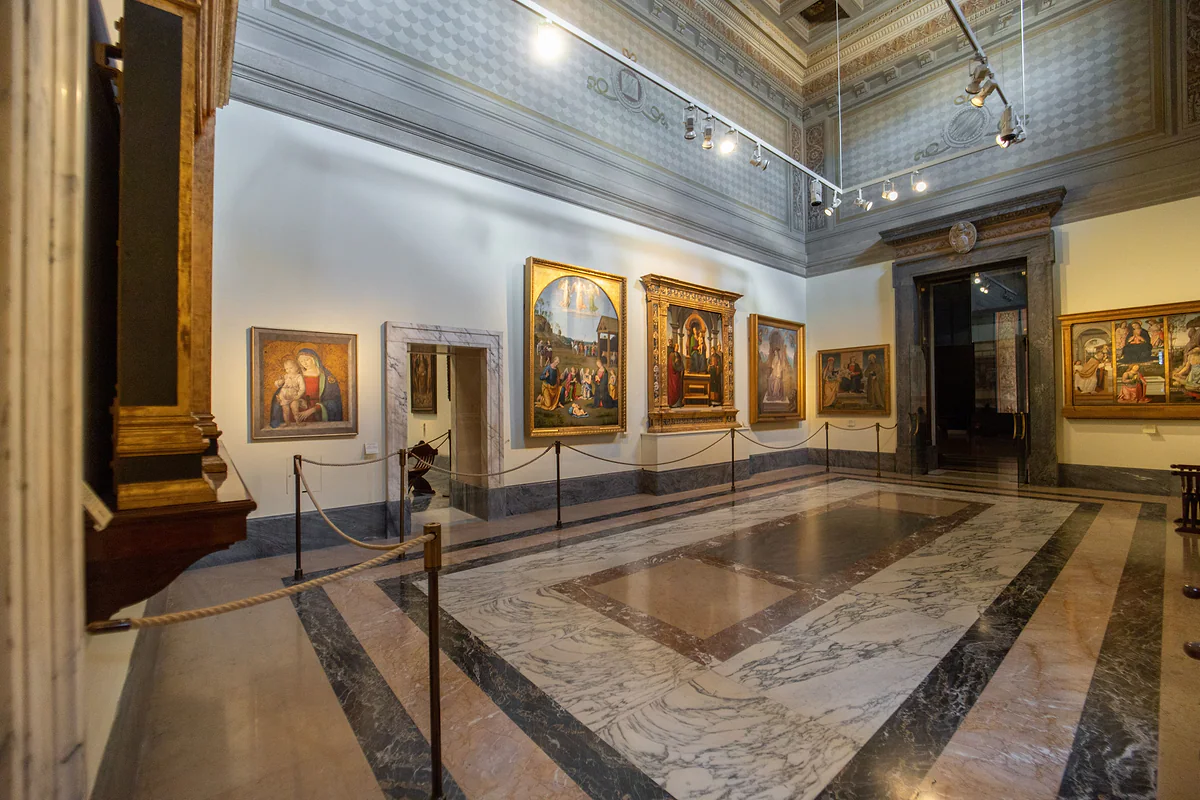
Opened on 27 October 1932
The Vatican Pinacoteca, with Raphael, Leonardo and Caravaggio in three rooms
The Vatican Pinacoteca is the picture gallery of the Vatican Museums, opened in 1932 in a building by Luca Beltrami. It holds some 460 paintings in 18 rooms, from 12th-century Primitives to the 19th century, including Raphael's Transfiguration, Leonardo's Saint Jerome and Caravaggio's Deposition. It's covered by the Museums ticket, from €20.
In 30 seconds
Full read: 4 min
- The Vatican Pinacoteca is the museums' picture gallery, opened on 27 October 1932 in a building by Luca Beltrami.
- It has around 460 paintings in 18 rooms, from 12th-century Primitives to the 19th century.
- The three key rooms are VIII (Raphael), IX (Leonardo) and XII (Caravaggio).
- It's covered by the standard Museums ticket, from €20, with no separate ticket.
- I'd give it 35 minutes and see it first, as the official tours do.
Plenty of people skip it because it sits off to one side of the route, and I think that's a mistake. In room VIII you see Raphael young, in his prime and in his very last painting without taking a step, and no other room in the Vatican offers that.

Before you go
What I would keep in mind
-
01 Most beautiful
Three Raphaels from three stages of his life
The Coronation of the Virgin, from 1502-1504, painted while he still echoed Perugino; the Madonna of Foligno, from 1511-1512; and the Transfiguration, his final work. For me it's the best painting lesson in the museums.
Raphael Rooms -
02 My tip
Start here, like the official tours
The museums' guided tours begin in the Pinacoteca and move on to the Pio Clementino. Come in at 08:00 and head here first, and you'll have the three great paintings almost to yourself.
Pio Clementino Museum -
03 To save money
Free on the last Sunday of the month
The Pinacoteca is part of the free last-Sunday opening, 09:00 to 14:00, and that day's official tour takes it in for €20 with headset.
Is the Sistine Chapel free? -
04 Watch out
There's no ticket just for the Pinacoteca
It's part of the standard Museums ticket. If a website sells Vatican Pinacoteca tickets as a separate product, it's the normal ticket with a mark-up.
Vatican scams and tourist traps to avoid in 2026
My priorities
Unmissable
- All of room VIII, with the three Raphaels in date order
- Leonardo's Saint Jerome in room IX, looking at the unfinished parts
- Caravaggio's Deposition in room XII
If you have time
- Giotto's Stefaneschi Triptych, made for the old St Peter's Basilica
- Melozzo da Forlì's music-making angels in room IV
- Bernini's clay models for the Chair of St Peter
- Carry on to the 20th-century modern collection
I would skip
- Doing all 18 rooms on a first visit and running out of steam for the rest
- Leaving it till last, when rooms start clearing half an hour before closing
- Buying a so-called Pinacoteca-only ticket from a reseller
What I would book
- Places to stayBooking.com Prati, to be first into room VIII The Pinacoteca is the natural first stop, and at 08:00 it's nearly empty. From Prati you can walk there without crossing Rome.
- Tours and ticketsGetYourGuide A tour that actually goes into the Pinacoteca Some tours skip it to save time. I'd ask whether it's included and check that entry is part of the price.
My ranking, scored
The Pinacoteca paintings I'd go looking for
My own scores out of 10. They weigh the painting's impact in person, what it tells you about the artist and how easily it fits a three-hour visit. Facts from the official pages; scores and timings are opinion.
0 of 7 seen
-
Raphael, Transfiguration (room VIII)
His final painting, 1516-1520, 410 by 279 centimetres, with Christ between Moses and Elijah above and the possessed boy below. Vasari called it the most celebrated, the most beautiful and the most divine.
9.8 out of 10
-
Caravaggio, Deposition (room XII)
It isn't a burial. Christ is laid on the Stone of Unction while Mary of Clopas throws her arms up to heaven. Painted around 1600-1604 for the Chiesa Nuova.
9.5 out of 10
-
Leonardo, Saint Jerome (room IX)
An unfinished Leonardo from around 1482 that shows how he worked. Cardinal Fesch, Napoleon's uncle, found it by chance, and the panel is actually cut into five pieces.
9.3 out of 10
-
Raphael, Madonna of Foligno (room VIII)
A votive offering for a house spared by lightning, which you can see in the landscape behind. Painted in 1511-1512, while he was working on the Room of Heliodorus.
8.8 out of 10
-
Giotto and workshop, Stefaneschi Triptych (room II)
Painted around 1315-1320 for the old St Peter's, on both sides, one facing the priest and one facing the congregation.
8.6 out of 10
-
Melozzo da Forlì, music-making angels (room IV)
Fragments of a fresco from around 1480 in the apse of Santi Apostoli, destroyed in 1711. The angel with the lute is, to me, one of the loveliest things in the building.
8.2 out of 10
-
Raphael, Coronation of the Virgin (room VIII)
An early work, 1502-1504, always described as the closest to his master Perugino. Flowers fill the Virgin's empty tomb.
8.0 out of 10
The Pinacoteca is the part of the Vatican Museums people skip most often, and I can see why, since it’s in a separate building and the tide of visitors pulls towards the Sistine. But to my mind it’s the best way to start. In a little over half an hour you see Raphael’s last painting, an unfinished Leonardo and one of the great Caravaggios, all before the museums fill up. Here’s what it is, what’s in each room and how I’d go round it. Everything else is gathered in my walk through the Vatican Museums.
A picture gallery that arrived late
It sounds odd, but the popes were collecting sculpture long before they had a proper home for their paintings. Around 1790 Pius VI put together a first collection of just 118 pictures, and it didn’t last. In 1797, under the Treaty of Tolentino, several masterpieces left for Paris, and the idea of a gallery open to the public only took shape in 1817, after Napoleon’s fall, as the works came back. Even then the pictures kept being moved from room to room inside the Apostolic Palaces, with no home worthy of them.
Pius XI solved it. He commissioned Luca Beltrami to design a building in part of the Giardino Quadrato, standing alone among paths and chosen for its light, and opened it on 27 October 1932, next to the museums’ new entrance. That’s the same year usually given for the double spiral staircase that half the world mistakes for the Bramante Staircase. Today it holds around 460 paintings in 18 rooms, arranged by period and school, from the Primitives of the 12th and 13th centuries to the 19th.
Room VIII, or Raphael from start to finish
If I could only walk into one room in the whole building, it would be this one. It holds three Raphaels that, taken in order, read like a biography. The Coronation of the Virgin, from 1502-1504, is so youthful that the museums describe it as his work closest to Perugino, his master. The Madonna of Foligno, from 1511-1512, was painted while he was decorating the Room of Heliodorus, as a thank-offering from Sigismondo de’ Conti for his house in Foligno, spared by the lightning you can see in the landscape behind.
Then comes the Transfiguration, 1516-1520, more than four metres tall. Cardinal Giulio de’ Medici commissioned it for Narbonne Cathedral, but Raphael died in 1520 and the cardinal kept it, later giving it to San Pietro in Montorio. Above, Christ in glory between Moses and Elijah; below, the apostles faced with the possessed boy. It’s his final painting, and Vasari called it the most celebrated, the most beautiful and the most divine. After seeing it, the Raphael Rooms look quite different.
Is the unfinished Leonardo worth it?
Very much so, and precisely because it’s unfinished. The Saint Jerome in room IX, from around 1482, is still at the sketch stage, with some areas nearly complete and others barely drawn in, so you can see how Leonardo built up a figure. The painting’s history sounds made up, but it’s on the official page. Cardinal Joseph Fesch, Napoleon’s uncle, found it by chance, and tradition says it was in two halves. In fact the panel is cut into five pieces. Pius IX bought it in 1856.
Caravaggio, Giotto and Melozzo
Room XII has Caravaggio’s Deposition, painted around 1600-1604 for Santa Maria in Vallicella. Look at what it actually shows, because it isn’t a burial. Nicodemus and John lower Christ onto the Stone of Unction, the slab that will seal the tomb, while Mary of Clopas raises her arms to heaven. It too went to Paris in 1797 and came back in 1816.
If you’ve time to spare, I’d go back to the beginning. Room II has the Stefaneschi Triptych by Giotto and his workshop, from around 1315-1320, painted on both sides for the old St Peter’s Basilica, one face for the priest and one for the congregation. Room IV has Melozzo da Forlì’s music-making angels, fragments of an apse from around 1480 destroyed in 1711. And elsewhere in the gallery is something I’m very fond of, the clay-and-straw models Bernini used to cast the bronze figures of the Chair of St Peter.
My plan for the Pinacoteca
The official guided tours start here and move on to the Pio Clementino Museum, and I’d do the same on the 08:00 slot. I’d give it about 35 minutes, going straight to rooms VIII, IX and XII, and only stop for Giotto and Melozzo if I had energy to spare. Walking all 18 rooms on a first visit is the surest way to reach the Sistine exhausted.
It’s on the standard ticket, with nothing extra to pay, and personal photos without flash are allowed. By the exit of the Carriage Pavilion, the Le Carrozze café looks out over the Pinacoteca, in case you need a coffee before carrying on.
What's in each room (a selection from the official site)
| Room | Centuries | Highlights |
|---|---|---|
| II | 13th-15th | Giotto's Stefaneschi Triptych, Simone Martini, Gentile da Fabriano |
| III | 15th | Fra Angelico, Benozzo Gozzoli |
| IV | 15th-16th | Melozzo da Forlì, music-making angels and Sixtus IV with Platina |
| VII | 15th-16th | Perugino |
| VIII | 16th | Raphael, Transfiguration, Madonna of Foligno, Coronation of the Virgin |
| IX | 15th-16th | Leonardo, Saint Jerome; Giovanni Bellini |
| X | 16th | Titian, Veronese, Giulio Romano |
| XII | 17th | Caravaggio, Deposition; Guido Reni, Poussin, Domenichino |
| XV | 18th | Papal portraits by Maratta, Batoni and Crespi, plus Lawrence's George IV |
Some 460 paintings in 18 rooms arranged by period and school, from the Primitives to the 19th century, according to the Vatican Museums.
Tickets and hours (2026)
| What | Detail |
|---|---|
| Standard ticket | €20 at the desk, €25 online |
| Reduced | €10 at the desk, €15 online |
| Monday to Saturday | 08:00-20:00, last entry 18:00 |
| Last Sunday of the month | 09:00-14:00, free, last entry 12:30 |
The Pinacoteca has no ticket of its own. It's covered by the Museums ticket, Sistine Chapel included.
Test yourself
True or false?
0/4 Pick before you peek.
-
Raphael's Transfiguration was painted for a church in Rome.
See the answer
False. It was commissioned for Narbonne Cathedral in France. After Raphael died it was never sent, and Cardinal Giulio de' Medici gave it to San Pietro in Montorio.
-
Leonardo's Saint Jerome is unfinished.
See the answer
True. It's still at the sketch stage, finished to different degrees in different areas, which is why it shows how Leonardo worked. It's dated to around 1482.
-
The Vatican Pinacoteca is older than the Pio Clementino Museum.
See the answer
False. The Pio Clementino dates from the 18th century and today's Pinacoteca opened on 27 October 1932. The idea of a picture gallery open to the public only arose in 1817.
-
Several of its masterpieces once hung in Paris.
See the answer
True. Under the Treaty of Tolentino in 1797 works including the Transfiguration and Caravaggio's Deposition were taken to Paris. They came back in 1816.
- Paintings, spread over 18 rooms
- c. 460
- Opened on 27 October under Pius XI
- 1932
- Paintings in Pius VI's first collection, c. 1790
- 118
- Height of the Transfiguration, Raphael's last painting
- 410 cm
0 of 88 Vatican City guides
Your next stamp
- Raphael Rooms
- Vatican Museums
- Sistine Chapel
- Gallery of Maps
- Modern art collection
- Gallery of Tapestries
- Egyptian and Etruscan Museums
- Borgia Apartment
- Things to do
- One day
- Tickets
- Two days
- St Peter's Basilica
- St Peter's Square
- St Peter's Dome
- Vatican Necropolis
- Vatican Gardens
- Swiss Guard
- Seeing the Pope
- How to visit
- Castel Gandolfo
- Where to eat
- Free and cheap
- Apostolic Palace
- Scams to avoid
- Getting there
- Money and payments
- Exclusive experiences
- Papal audience
- Angelus
- Who painted it
- Where the Pope lives
- Where to stay
- Dress code
- Facts
- Opening hours
- Map
- Flag
- Post office and stamps
- Is it a country?
- Vatican Grottoes
- History
- Pietà
- Baldachin
- Ceiling
- Chair of St Peter
- Last Judgement
- Architecture and architects
- Holy Door
- Library and Archives
- Bramante Staircase
- Facade and balcony
- Mass at St Peter's
- Pio Clementino Museum
- Papal blessing
- Catacombs
- Gallery of the Candelabra
- Obelisk
- Vatican Museums map
- Bernini's colonnade
- How long you need
- Night opening
- Chiaramonti and Braccio Nuovo
- Christmas
- Anima Mundi Museum
- Easter
- Carriage Pavilion
- Gift shops and souvenirs
- With kids
- Best time to visit
- Courtyard of the Pine Cone
- Photography
- Train station
- Accessible travel
- Vatican Observatory
- Papal Palace
- Barberini Gardens
- Facts
- Getting there
- Holy See
- Lake Albano
- Police and army
- Passport
- Pharmacy, shop and petrol
- What Vatican means
- Papal tombs
- List of popes
Frequently asked questions
What is the Vatican Pinacoteca?
It's the picture gallery of the Vatican Museums, opened on 27 October 1932 in a building designed by Luca Beltrami for Pius XI. It holds around 460 paintings in 18 rooms, from the 12th-century Primitives to the 19th century.
Does the Vatican Museums ticket include the Pinacoteca?
Yes. The Pinacoteca is part of the standard ticket, €20 at the desk or €25 online, just like the Sistine Chapel. There's no separate ticket for it, and entry is free on the last Sunday of each month.
What should you see in the Vatican picture gallery?
If you're short of time, three rooms. Room VIII for Raphael's Transfiguration, Madonna of Foligno and Coronation of the Virgin, room IX for Leonardo's Saint Jerome and room XII for Caravaggio's Deposition. With more time, add Giotto's Stefaneschi Triptych and Melozzo's angels.
Where is Raphael's Transfiguration?
In room VIII of the Vatican Pinacoteca, beside the Madonna of Foligno and the Coronation of the Virgin. It was Raphael's last painting, made between 1516 and 1520, and measures 410 by 279 centimetres.
Is there a Caravaggio in the Vatican Museums?
Yes, the Deposition, in room XII of the Pinacoteca. He painted it around 1600-1604 for Santa Maria in Vallicella; it went to Paris in 1797 and joined Pius VII's picture gallery after its return in 1816.
How long do you need for the Pinacoteca?
There's no official figure. I'd allow about 35 minutes heading straight for rooms VIII, IX and XII, or an hour to see it all. With 18 rooms, doing the lot on a first visit leaves you with nothing left for Raphael's frescoes and the Sistine.
By
Tourism graduate with a master’s in Tourism Management and Planning from the University of Málaga, who has travelled across Europe. He writes every guide from official sources and his own judgement.
Published on . Facts checked on .
Sources
Photos: Fabrizio Garrisi (CC BY-SA 4.0), via Wikimedia Commons.