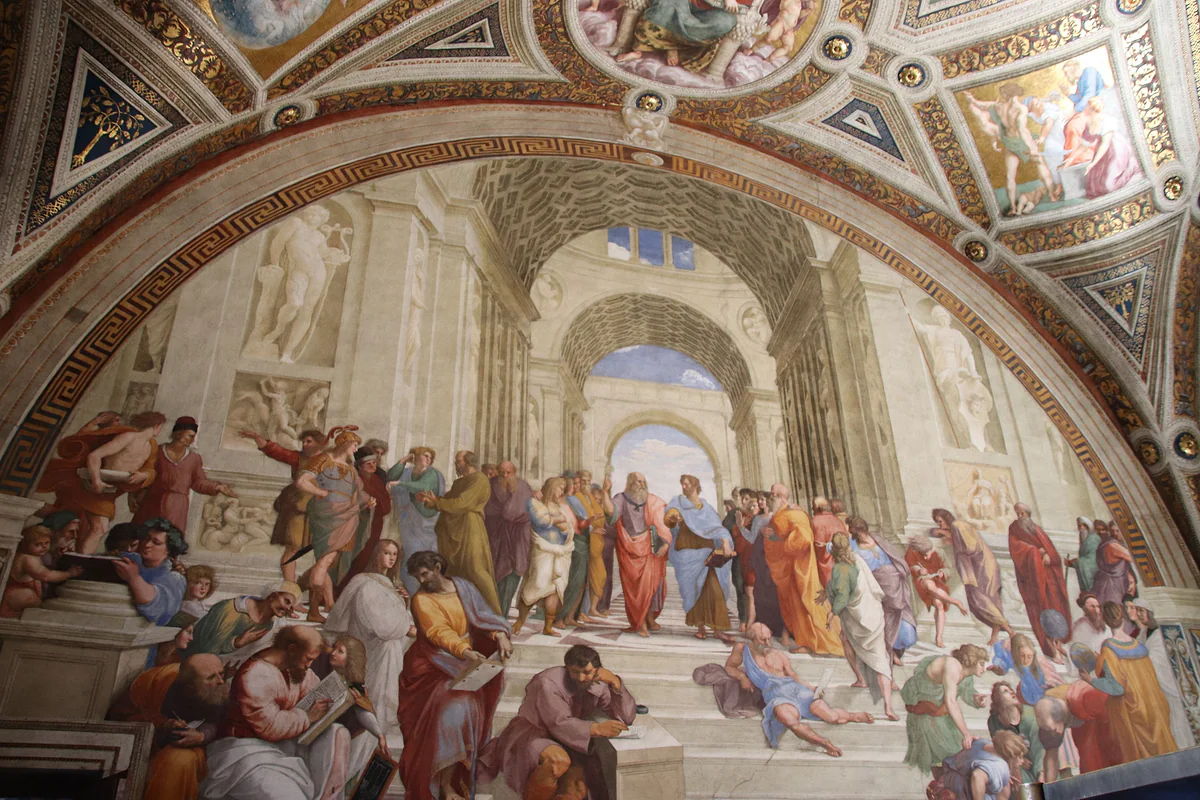
Vatican Museums, just before the Sistine
The Raphael Rooms, room by room, with the School of Athens
The Raphael Rooms are four rooms of the apartment Julius II chose on the second floor of the Papal Palace, painted by Raphael and his workshop between 1508 and 1524. The most famous is the Room of the Signatura, home to the School of Athens. They sit inside the Vatican Museums, just before the Sistine Chapel, on the same ticket, from €20.
In 30 seconds
Full read: 5 min
- The Raphael Rooms are four rooms of Julius II's apartment, painted by Raphael and his workshop between 1508 and 1524.
- The key one is the Room of the Signatura, with the School of Athens, the Disputation of the Holy Sacrament and the Parnassus.
- They're inside the Vatican Museums, number 10 on the official map, just before the Borgia Apartment and the Sistine Chapel.
- They're covered by the general Museums ticket, €20 at the desk or €25 online, and flash-free photos are allowed.
- I'd give them about 35 minutes, with half of that in the Signatura.
If you're short on time, I'd give half of it to the Signatura and cross the other three with my eyes on a single fresco each. Raphael painted the School of Athens while Michelangelo was up on the Sistine ceiling a few metres away, and seeing them an hour apart is the best thing the museum offers.

Before you go
What I would keep in mind
-
01 Most beautiful
The School of Athens, with Michelangelo in it
The official description identifies Heraclitus with Michelangelo's features and Raphael's self-portrait in a black cap at the far right. I love hunting for those two before Plato and Aristotle.
Vatican Museums -
02 My tip
Photos are allowed here
In the Raphael Rooms you can take personal photos without flash, tripod or selfie stick. It's your last chance before the Sistine Chapel, where photos and phones are banned.
Visiting Vatican City in 2026 -
03 To save money
The free last-Sunday tour comes through here
On the last Sunday of the month entry is free, and that day's official guided tour, €20 with headset, takes in the Pinacoteca, the galleries, the Raphael Rooms and the Sistine in about three hours.
Is the Sistine Chapel free? -
04 Watch out
No tour gets you the rooms exclusively
The Raphael Rooms are included in the standard Museums ticket. If someone sells you a supplement for them, or a far pricier «no queue» ticket, it's the same €25 ticket with a mark-up.
Vatican scams and tourist traps to avoid in 2026 -
05 Getting there
Come by metro, not tram
The Museums entrance is on Viale Vaticano, near Ottaviano and Cipro stations on line A. Tram 19 isn't running through Prati until, most likely, early 2027.
How to get to Vatican City from Rome and the airports
My priorities
Unmissable
- The School of Athens, spotting Heraclitus with Michelangelo's face and Raphael's self-portrait
- The Disputation of the Holy Sacrament opposite, which sits behind you while you admire the School
- The Liberation of St Peter in the Heliodorus room, for the way Raphael paints light
If you have time
- The Parnassus, with Apollo, the nine Muses, blind Homer, Dante and Sappho with her name on a scroll
- The two oil figures in the Hall of Constantine, Raphael's final brushstrokes here
- Reading on the Sistine ceiling what Michelangelo was painting in those same years
- Go down to the Borgia Apartment Julius II fled
I would skip
- Reaching the rooms at the tail end of an afternoon slot, as the clearing out starts
- Repeating that Plato has Leonardo's face as fact, since the official description doesn't say so
- Paying a supplement for them, when they come with the normal Museums ticket
What I would book
- Places to stayBooking.com Prati, to reach Raphael with energy left I'd go in on the first slot of the morning so I don't reach Raphael worn out, and from Prati the Viale Vaticano entrance is a few minutes' walk.
- Tours and ticketsViator A guided tour that lingers over Raphael If the official tour doesn't fit your dates, accredited guides show up here. I'd pick one that doesn't rush the rooms on the way to the Sistine and check that entry is included.
My ranking, scored
The four rooms, from the one I'd give most time to the least
My own scores out of 10. They weigh how much of each room is truly Raphael's, how much you can follow without a guide and the impact on walking in. They don't follow the order the rooms were painted or the order you walk through them.
0 of 4 seen
-
Room of the Signatura (1508-1511)
Raphael's Vatican debut and his best-known frescoes, the School of Athens, the Disputation of the Holy Sacrament opposite and the Parnassus. The official theme is Truth, Goodness and Beauty.
9.8 out of 10
-
Room of Heliodorus (1511-1514)
Julius II's private audience room. It holds the Liberation of St Peter, which the official site singles out for its light, from the angel's glow to the dawn, the moon, the torches and the gleam on the armour.
9.1 out of 10
-
Hall of Constantine (1517-1524)
The room Raphael didn't live to see finished. The restoration completed in 2024 confirmed he painted two figures himself in oil on the wall, Comitas and Iustitia.
8.3 out of 10
-
Room of the Fire in the Borgo (1514-1517)
Raphael took the commission but left much of it to his workshop. It's worth it for the title fresco, the fire of 847 that Leo IV put out with a blessing according to the Liber Pontificalis.
7.9 out of 10
The Raphael Rooms are the part of the Museums most people hurry through, arriving after seven kilometres of galleries with the Sistine waiting just beyond. I think that’s a mistake, because they’re the Vatican’s other great painted ensemble, made in the very years Michelangelo was on the ceiling next door. Here’s what they are, where you’ll find them, what’s in each and how I’d split my time. The full museum route is in my Vatican Museums guide.
A papal flat turned into a gallery
Julius II della Rovere left the Borgia Apartment so as not to be reminded of his predecessor, and moved to an apartment on the second floor of the Papal Palace. Its four rooms are what we now call the Raphael Rooms. Raphael and his workshop painted them between 1508 and 1524, room by room and with three different popes footing the bill, Julius II first, then Leo X and finally Clement VII.
What I like about seeing them this way is that they’re a home, not a museum. One was a library and study, one an audience room, one a dining room and the last a ceremonial hall, and each pope had the story that suited him painted on his walls. The clearest proof is in the Fire in the Borgo room, where earlier popes called Leo all wear the face of Leo X.
Where are the Raphael Rooms on the route?
On the official Museums map they’re number 10. You reach them after the Gallery of the Candelabra, the Tapestries, the Gallery of Maps and the Room of the Immaculate Conception, and after them come the Borgia Apartment, home to the contemporary art collection, and then the Sistine Chapel. In other words, they’re the last big stop before the Sistine Chapel.
Two warnings you’ll rarely hear. Several unofficial guides say you walk through them today in the order Constantine, Heliodorus, Signatura and Fire in the Borgo, which isn’t the order they were painted, but the official map numbers them as a single block and doesn’t confirm it. The map also marks a short route to the Sistine without making clear whether it passes through them. If you don’t want to miss them, stick to the main route rather than the shortcut.
The Signatura and the School of Athens
This is the first room Raphael painted, between 1508 and 1511, his Vatican debut and the home of his most famous frescoes. Julius II wanted it as his library and private study, not to be confused with the Vatican Library, and the scheme revolves around Truth, Goodness and Beauty. Revealed truth is the Disputation of the Holy Sacrament, rational truth the School of Athens, goodness the Virtues and the Law, and beauty the Parnassus.
The School of Athens gathers the ancient philosophers beneath architecture inspired by Bramante’s design for the new St Peter’s. At the centre stand Plato, pointing upwards with the Timaeus in his hand, and Aristotle holding the Ethics. Around them, according to the official description, are Pythagoras explaining the diatessaron, Diogenes sprawled on the steps, Euclid teaching geometry, Zoroaster and Ptolemy with their spheres, Heraclitus with Michelangelo’s features and, at the far right, Raphael himself in a black cap. Plato having Leonardo’s face gets repeated by plenty of guides, but the official description doesn’t say it and I wouldn’t claim it.
Opposite is the Disputation, which the Museums say should really be called the Triumph of Religion, with the Church Triumphant in a semicircle on the clouds and below it the four Latin Fathers of the Church. In the Parnassus, Apollo plays among the nine Muses and poets such as blind Homer, Virgil, Dante and Sappho, whose name is written on the sheet she holds.
Heliodorus, the room where Raphael paints light
Between 1511 and 1514 Raphael decorated the Pope’s private audience room. Its theme is God’s miraculous protection of the Church, very much in tune with a Julius II bent on winning back temporal power, and the frescoes are the Expulsion of Heliodorus from the Temple, the Mass at Bolsena, the Meeting of Leo the Great and Attila and the Liberation of St Peter.
Of the four, the last is my pick. The angel leads Peter out of prison while the guards sleep, a nod to Julius II, who had been cardinal of San Pietro in Vincoli before becoming pope. The official site praises its light, the angel’s radiance, the dawn, the moon, the torches and the reflections on the armour. The room had earlier decoration too, and fragments attributable to Signorelli, Bramantino, Lotto and Cesare da Sesto survive.
The Fire in the Borgo, the workshop’s room
The ceiling predates Raphael, painted by Perugino in 1508, while Leo X commissioned the walls between 1514 and 1517. Raphael accepted the job and left much of it to his workshop, and it shows. Still, the title fresco carries a lot of history. It depicts the Borgo fire of 847 which, according to the Liber Pontificalis, Leo IV put out with a blessing from the Loggia of Blessings, and it’s a neat bridge into the history of Vatican City, since the same pope built the walls that enclosed this area.
Constantine, the room Raphael never saw finished
Raphael died on 6 April 1520 with this room still to do. His pupils completed it from the master’s drawings under Leo X and Clement VII, with the workshop of Giulio Romano and Giovan Francesco Penni in charge. It tells four episodes from Constantine’s life, the Vision of the Cross, the Battle of the Milvian Bridge, the Baptism and the Donation of Rome. The ceiling you see isn’t Raphael’s either, it was painted by Tommaso Laureti in the late 16th century.
What I like most here is recent. The restoration began in March 2015 and ended in December 2024, and when the Museums presented it in February 2025 they confirmed that Raphael personally painted two figures in oil straight onto the wall, Comitas and Iustitia, an experimental technique. They’re probably the last things of his you’ll see in the Vatican.
How I’d split the time
There’s no official duration, and I’d give the four rooms about 35 minutes, just before the Sistine, which is how they fit into my one-day Vatican itinerary. Half would go to the Signatura, as it’s the room where everything is Raphael’s and the easiest to follow without a guide. In the other three I’d focus on one fresco each. Photos for personal use are allowed here, without flash, tripod or selfie stick, so make the most of it, because they stop at the Sistine.
Entry is the general Museums ticket, €20 at the desk or €25 online with a time slot, which you can compare in Vatican City tickets. I’d go for a morning slot. Rooms start clearing half an hour before closing, and if you reach Raphael late you’ll reach the Sistine Chapel ceiling even later, painted at the same time a few metres away.
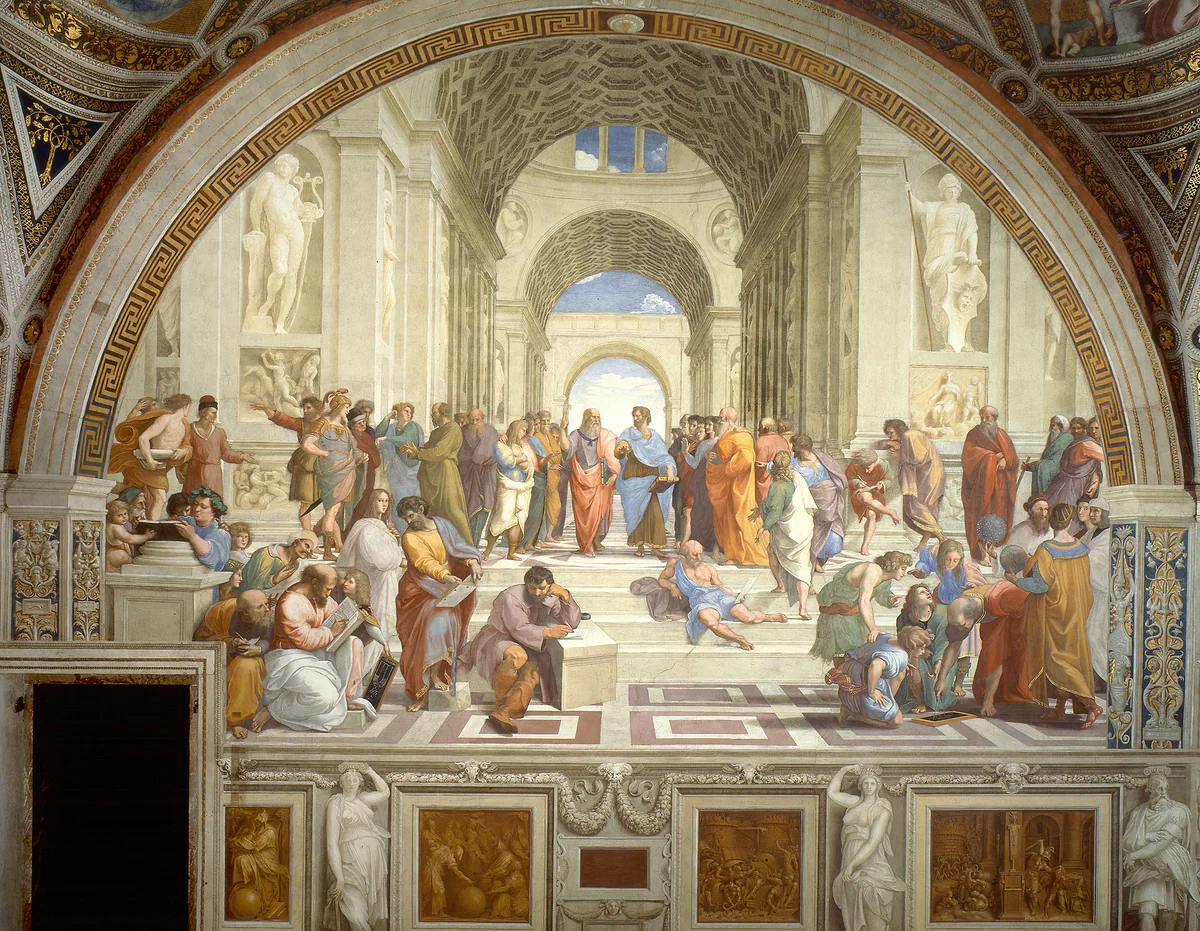
The complete School of Athens fresco by Raphael, with the philosophers beneath arches and its painted architectural frame.
The four rooms, in the order they were painted
| Room | Dates | Original use | Main frescoes |
|---|---|---|---|
| Signatura | 1508-1511 | Julius II's library and study | School of Athens, Disputation, Parnassus, Virtues and the Law |
| Heliodorus | 1511-1514 | The Pope's private audiences | Expulsion of Heliodorus, Mass at Bolsena, Liberation of St Peter, Leo the Great and Attila |
| Fire in the Borgo | 1514-1517 | Signatura court under Julius II; dining room under Leo X | Fire in the Borgo, Battle of Ostia, Coronation of Charlemagne, Oath of Leo III |
| Constantine | 1517-1524 | Receptions and official ceremonies | Vision of the Cross, Battle of the Milvian Bridge, Baptism, Donation of Rome |
Dates and works from the Vatican Museums website. Raphael died on 6 April 1520, so his pupils finished the Hall of Constantine from his drawings.
Tickets and hours (2026)
| What | Detail |
|---|---|
| Full ticket | €20 at the desk, €25 online with a time slot |
| Reduced (ages 7 to 18 and students up to 25) | €10 at the desk, €15 online |
| Monday to Saturday | 08:00-20:00, last entry 18:00 |
| Last Sunday of the month | 09:00-14:00, free, last entry 12:30 |
The Museums ticket covers the Raphael Rooms and the Sistine Chapel, valid only on the day of issue.
- Rooms of Julius II's apartment painted by Raphael and workshop
- 4
- From the first brushstroke in the Signatura to Constantine's close
- 1508-1524
- Raphael's death, on 6 April, before the last room was done
- 1520
- Restoration of the Hall of Constantine
- 2015-2024
0 of 88 Vatican City guides
Your next stamp
- Vatican Pinacoteca
- Gallery of Tapestries
- Vatican Museums
- Borgia Apartment
- Apostolic Palace
- Gallery of the Candelabra
- Gallery of Maps
- Egyptian and Etruscan Museums
- Sistine Chapel
- Things to do
- One day
- Tickets
- Two days
- St Peter's Basilica
- St Peter's Square
- St Peter's Dome
- Vatican Necropolis
- Vatican Gardens
- Swiss Guard
- Seeing the Pope
- How to visit
- Castel Gandolfo
- Where to eat
- Free and cheap
- Scams to avoid
- Getting there
- Money and payments
- Exclusive experiences
- Papal audience
- Angelus
- Who painted it
- Where the Pope lives
- Where to stay
- Dress code
- Facts
- Opening hours
- Map
- Flag
- Post office and stamps
- Is it a country?
- Vatican Grottoes
- History
- Pietà
- Baldachin
- Ceiling
- Chair of St Peter
- Last Judgement
- Architecture and architects
- Holy Door
- Library and Archives
- Bramante Staircase
- Facade and balcony
- Mass at St Peter's
- Pio Clementino Museum
- Papal blessing
- Catacombs
- Obelisk
- Vatican Museums map
- Bernini's colonnade
- How long you need
- Night opening
- Chiaramonti and Braccio Nuovo
- Christmas
- Anima Mundi Museum
- Easter
- Carriage Pavilion
- Gift shops and souvenirs
- With kids
- Best time to visit
- Courtyard of the Pine Cone
- Photography
- Train station
- Accessible travel
- Vatican Observatory
- Modern art collection
- Papal Palace
- Barberini Gardens
- Facts
- Getting there
- Holy See
- Lake Albano
- Police and army
- Passport
- Pharmacy, shop and petrol
- What Vatican means
- Papal tombs
- List of popes
Frequently asked questions
Where are the Raphael Rooms in the Vatican?
Inside the Vatican Museums, on the second floor of the Papal Palace. The official map numbers them 10, after the Galleries of the Candelabra, Tapestries and Maps and the Room of the Immaculate Conception, and before the Borgia Apartment and the Sistine Chapel.
How many Raphael Rooms are there?
Four. The Room of the Signatura, the Room of Heliodorus, the Room of the Fire in the Borgo and the Hall of Constantine, painted by Raphael and his workshop between 1508 and 1524. Raphael died in 1520, so his pupils completed the last one.
Who is in the School of Athens?
According to the official description, Plato pointing upwards with the Timaeus and Aristotle with the Ethics at the centre, plus Pythagoras, Diogenes sprawled on the steps, Heraclitus with Michelangelo's features, Euclid, Zoroaster and Ptolemy, and Raphael in a black cap at the far right. Plato having Leonardo's face is repeated by many guides, but the official description doesn't say so.
Do you need a separate ticket for the Raphael Rooms?
No. They're included in the general Vatican Museums ticket, €20 at the desk or €25 online with a time slot, which also covers the Sistine Chapel. Entry is free on the last Sunday of each month.
How long do you need for the Raphael Rooms?
There's no official figure. I'd give them about 35 minutes, half of it in the Signatura. If you've booked the last afternoon slot, bear in mind rooms start clearing half an hour before closing and the Sistine still lies ahead.
Why is it called the Room of the Signatura?
After the Signatura Gratiae et Iustitiae, the Church's highest court, which met in these rooms under Julius II. The official site places its sessions in the neighbouring room, the Fire in the Borgo, so I wouldn't claim it sat in the Signatura itself.
By
Tourism graduate with a master’s in Tourism Management and Planning from the University of Málaga, who has travelled across Europe. He writes every guide from official sources and his own judgement.
Published on . Facts checked on .
Sources
Photos: Gary Todd from Xinzheng, China (Public domain); Rafael (obra); reproducción a partir de vatican.va (Public domain), via Wikimedia Commons.