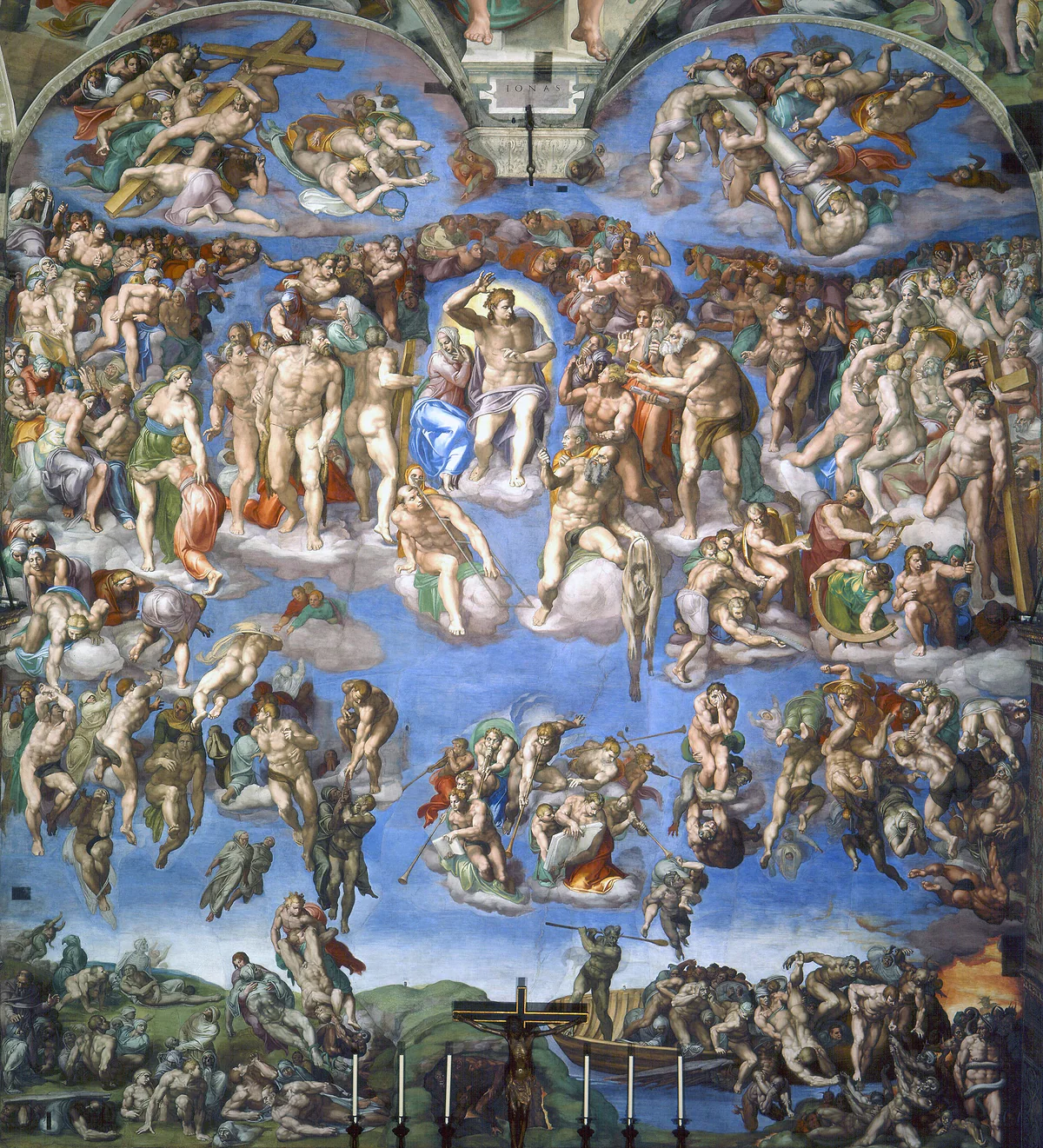
Cleaned between February and March 2026
The Last Judgement in the Sistine Chapel, and how to read it
The Last Judgement covers the whole altar wall of the Sistine Chapel. Michelangelo painted it from 1536 to the autumn of 1541, commissioned by Clement VII and started under Paul III, and some of the nudes were covered up in 1564. A whitish film of calcium lactate was removed between 1 February and 27 March 2026. You see it on a Vatican Museums ticket, from €20.
In 30 seconds
Full read: 4 min
- The Last Judgement fills the whole altar wall of the Sistine Chapel and Michelangelo painted it from 1536 to the autumn of 1541.
- Clement VII commissioned it at the end of 1533, and frescoes by Perugino on the same wall were lost to make room for it.
- In 1564 some of the nudes were ordered covered, and Daniele da Volterra painted the first draperies.
- From 1 February to 27 March 2026 a calcium lactate film linked to visitors' perspiration was cleaned off.
- You see it on a Vatican Museums ticket, €20 at the office or €25 online, and photos and phones aren't allowed inside.
I'd save it for the end of the chapel and stand with my back to the entrance, ceiling already done. Then I'd read it from the bottom up, from Charon's boat to Christ, because that's how the swirl that organises the whole wall makes sense. And I wouldn't leave without finding St Bartholomew's skin.

Before you go
What I would keep in mind
-
01 Most beautiful
A slow whirl of bodies around Christ
What gets me is that the wall doesn't read in tiers, it turns. The Museums describe a broad, slow rotation set off by Christ's gesture that pulls in every figure except the angels in the two lunettes at the top.
Sistine Chapel -
02 My tip
Learn the saints before you go in
Phones are off limits inside and guides must stay silent. Peter has two keys, Lawrence the gridiron, Bartholomew his own skin, Catherine the spiked wheel and Sebastian his arrows. With that list you'll find them on your own.
Visiting Vatican City in 2026 -
03 Watch out
No tour gets you closer to the wall
Nobody sells special access to the Last Judgement. It's included in the Museums ticket, and the only official skip-the-line is the €5 booking fee on tickets.museivaticani.va. Anything sold as exclusive elsewhere is the same ticket with a mark-up.
Vatican scams and tourist traps to avoid in 2026 -
04 To save money
Free on the last Sunday, crowds permitting
On the last Sunday of the month the Museums are free from 09:00 to 14:00, last entry 12:30. It's not the day I'd pick for a wall that rewards standing still, but it's the only official way to see it without paying.
Is the Sistine Chapel free?
My priorities
Unmissable
- Christ and the Virgin at the centre, to grasp the rotation that carries every figure
- St Bartholomew's skin, usually read as Michelangelo's self-portrait
- Charon's boat and Minos, bottom right
If you have time
- Pick out Peter, Lawrence, Catherine and Sebastian by their emblems
- Spot the draperies added from 1564 onwards over the nudes
- Turn back to the ceiling to compare Michelangelo's two campaigns
- Go over the chapel's three painting campaigns
What I would book
- Tours and ticketsGetYourGuide A guided tour that briefs you on the wall first Guides can't speak inside the chapel, so they explain the Last Judgement beforehand. I'd check the Museums ticket is included.
- Places to stayBooking.com Prati, for the 08:00 slot On the first slot you reach the chapel with fewer people in front of the wall, and from Prati you can walk to Viale Vaticano.
My ranking, scored
What I'd look for in the Last Judgement, in order
My own scores out of 10. They weigh how much each group strikes you from the chapel floor and how much it helps you make sense of the whole wall. It's a running order for a few phone-free minutes, not an art history lecture.
0 of 8 seen
-
Christ the Judge and the Virgin
Christ is caught just before the verdict, with a gesture the Museums call commanding and calm at once. Beside him the Virgin turns her head in resignation, since she can no longer intervene.
9.8 out of 10
-
St Bartholomew and his skin
He holds the skin flayed from him in martyrdom, and the face on it is usually read as Michelangelo's self-portrait. It's the detail most people come out looking for.
9.5 out of 10
-
Charon and Minos
Bottom right, Charon drives the damned off his boat with his oar and delivers them to Minos, a serpent coiled round his body. The Museums see Dante's Inferno written all over it.
9.2 out of 10
-
The trumpeting angels
In the middle of the lower band, the angels of the Apocalypse wake the dead with long trumpets. They're the hinge between those rising and those falling.
8.9 out of 10
-
The dead rising
On the left, the dead climb out of the earth and get their bodies back as they rise. I look at them after the damned, because the contrast is what gives the wall its meaning.
8.6 out of 10
-
Saints with their emblems
Peter with two keys, Lawrence with the gridiron, Catherine with the spiked wheel and Sebastian kneeling with his arrows. They wait for the verdict as anxiously as everyone else.
8.3 out of 10
-
The two Passion lunettes
At the top, angels carry the Cross, dice and crown of thorns on the left, and the column, ladder and sponge on the right. They're the only part left out of the rotation.
7.8 out of 10
-
Daniele da Volterra's draperies
In 1564 it was decided to cover some figures, and Daniele da Volterra painted the first loincloths, which earned him the nickname il braghettone. More were added in later centuries.
7.2 out of 10
Nearly everyone walks into the Sistine Chapel looking up and walks out without ever stopping in front of the far wall. I think that’s a mistake, because the Last Judgement is easier to grasp in five minutes than the ceiling is, provided you know where to start. Here’s how I’d read it, group by group, with what the Vatican Museums say and without the legends nobody can source.
A commission that wiped the altar wall
When Michelangelo took this job on, the altar wall was already painted. At the end of 1533 Clement VII asked him to change the chapel’s decoration once more, and that cost the fifteenth-century frescoes on that wall. The Museums list the Assumption of the Virgin among the Apostles and the opening scenes of the Moses and Christ cycles, all by Perugino. Michelangelo also knocked out two lunettes he had painted himself for the Sistine Chapel ceiling.
Clement died in 1534, and it was Paul III who got things moving, with scaffolding up in April 1535. Painting began in 1536 and ended in the autumn of 1541. The curator Fabrizio Biferali sums it up in a line I like, more than five years on the scaffold, lit by the windows or by feeble torches.
Read it from the boat upwards
My advice is not to start at the top. I’d look first at the bottom right-hand corner, where Charon uses his oar to drive the damned off his boat and hand them over to Minos, judge of the underworld, a serpent wrapped around his body. The Museums say the debt to Dante’s Inferno is obvious here, and for me it’s the most gripping part of the wall.
Then work up through the middle band. At its centre, the angels of the Apocalypse wake the dead with long trumpets. To the left, the dead climb out of the ground, recover their bodies and rise. To the right, angels and demons compete to hurl the damned downwards.
Finally, Christ. The Museums describe him in the moment before the verdict, with a gesture both commanding and composed that sets off a slow, circular movement taking in every figure. That’s the key to the wall for me. There are no neat tiers, just a whirl. Only the two lunettes at the very top stay out of it, with angels carrying the Cross, the dice and the crown of thorns on one side, and the column, the ladder and the sponge on the other.
Where is Michelangelo in the Last Judgement?
In a skin. Around Christ and the Virgin, who turns her head in resignation because she can no longer intervene, the saints and the elect wait anxiously, and several can be picked out by what they carry. Peter with his two keys, Lawrence with his gridiron, Catherine of Alexandria with her spiked wheel and Sebastian, kneeling, with his arrows. Below Christ sits St Bartholomew, who was flayed alive and holds up his own skin, and the face on that skin is usually taken to be the painter’s own.
I find it one of the boldest ideas in the whole chapel. The man who carved Michelangelo’s Pietà at 23 and signed it in full turns up here, more than forty years on, as an empty hide in a martyr’s hand.
The nudes, and the man they called il braghettone
The Last Judgement had admirers from day one, and enemies too. According to Vasari, the pope’s master of ceremonies, Biagio da Cesena, said it was shameful to paint so many naked figures in so honoured a place, and that the work belonged in bathhouses and taverns, not a papal chapel. You’ll often read that Minos was given Biagio’s face in return. The Museums’ own page doesn’t say so, so I’d treat it as what it is, a story told by Vasari.
The row rumbled on, and in 1564 the Congregation of the Council of Trent decided to cover some figures it considered obscene. The job of painting the draperies went to Daniele da Volterra, known ever since as il braghettone, roughly the breeches-maker. His were only the first, as more were added over the following centuries. When you look at the wall, those cover-ups are part of what you’re seeing.
Why it looks different in 2026
Restoration of this wall wrapped up in 1994, and John Paul II said Mass on 8 April to mark it. Thirty years later a new problem appeared. In 2024 the Museums’ scientists found a widespread whitening caused by calcium lactate. There’s lactic acid in the chapel’s air, which can come from perspiration, and when it reacts with the calcium in the fresco it forms a film almost invisible to the naked eye that dulled the colours and the light and shade.
It was removed between 1 February and 27 March 2026 with Japanese paper and distilled water, and the chapel never closed. The head restorer, Paolo Violini, says the fresco now looks as it did at the end of the 1994 restoration. For me that episode is the clearest proof that crowds leave a physical mark on the paint, and the best argument I know for going early.
Seeing it properly without a phone
The wall sits at the far end of the Sistine Chapel, which is itself the last room of the Vatican Museums. Inside there are no photos, no phones and no guide talking you through it, so the list of saints and the reading order have to be in your head. I’d take in the ceiling first and leave the Last Judgement until the end, standing still and unhurried.
To reach it with the room at its quietest, I’d book the 08:00 slot through the Vatican tickets page. A full-price ticket is €20 at the office or €25 online, and it covers the whole chapel, altar wall included.
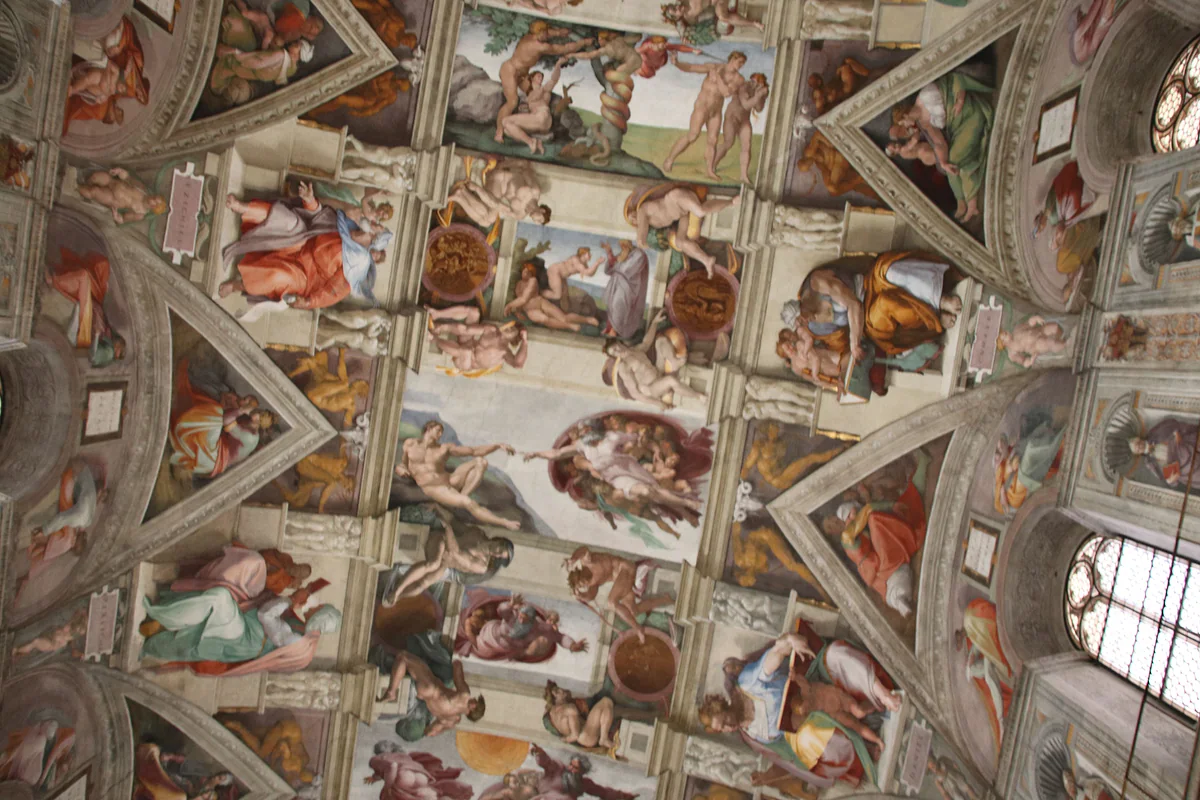
The Sistine Chapel ceiling painted by Michelangelo, with the Genesis scenes, including The Creation of Adam, and the prophets and sibyls.
The Last Judgement in eight dates
| Date | What happened |
|---|---|
| Late 1533 | Clement VII commissions Michelangelo to paint the altar wall |
| April 1535 | Under Paul III, the scaffolding goes up |
| 1536 | Michelangelo starts painting |
| Autumn 1541 | The fresco is finished |
| 1564 | Figures are ordered covered and Daniele da Volterra paints the draperies |
| 8 April 1994 | John Paul II says Mass to mark the end of the restoration |
| 1 February 2026 | Scaffolding goes up for the extraordinary maintenance |
| 27 March 2026 | Removal of the calcium lactate film is completed |
Dates from the Vatican Museums website and the Holy See's page on the Sistine Chapel. The chapel stayed open throughout the 2026 work.
Tickets and opening times (2026)
| What | Detail |
|---|---|
| Full price | €20 at the ticket office, €25 online with a time slot |
| Reduced | €10 at the ticket office, €15 online |
| Monday to Saturday | 08:00-20:00, last entry 18:00 |
| Last Sunday of the month | 09:00-14:00, free, last entry 12:30 |
| Photos and phones | Not allowed inside the chapel |
There's no separate ticket for the Last Judgement. You reach it at the end of the Museums route, and the only official seller is tickets.museivaticani.va.
Test yourself
True or false?
0/4 Pick before you peek.
-
The same pope commissioned the Sistine ceiling and the Last Judgement.
See the answer
False. The ceiling was Julius II's commission in 1508. Clement VII commissioned the Last Judgement at the end of 1533, and Paul III saw it begun in 1536.
-
Frescoes by Perugino were destroyed to make room for the Last Judgement.
See the answer
True. According to the Museums, the Assumption of the Virgin among the Apostles and the first two scenes of the Moses and Christ cycles, all by Perugino, were lost.
-
The Sistine Chapel closed while the Last Judgement was cleaned in 2026.
See the answer
False. From 1 February to 27 March 2026 the chapel stayed open. While the scaffolding was up, a canvas reproducing the fresco hung in front of it.
-
Daniele da Volterra painted every one of the draperies covering the nudes.
See the answer
False. He painted the first ones after the 1564 decision, but the Museums say others were added in the centuries that followed.
- Years Michelangelo spent painting the altar wall
- 1536-1541
- Year some of the nudes were ordered covered
- 1564
- 2026 maintenance, 1 February to 27 March
- 55 days
- Museums ticket at the office, chapel included
- €20
0 of 88 Vatican City guides
Your next stamp
- Sistine Chapel
- Who painted it
- Ceiling
- Facts
- Pietà
- Pio Clementino Museum
- Vatican Pinacoteca
- Chiaramonti and Braccio Nuovo
- Things to do
- One day
- Tickets
- Two days
- Vatican Museums
- St Peter's Basilica
- St Peter's Square
- St Peter's Dome
- Vatican Necropolis
- Vatican Gardens
- Swiss Guard
- Seeing the Pope
- How to visit
- Castel Gandolfo
- Where to eat
- Free and cheap
- Apostolic Palace
- Scams to avoid
- Getting there
- Money and payments
- Exclusive experiences
- Papal audience
- Angelus
- Where the Pope lives
- Where to stay
- Dress code
- Opening hours
- Map
- Flag
- Post office and stamps
- Is it a country?
- Vatican Grottoes
- History
- Baldachin
- Chair of St Peter
- Raphael Rooms
- Architecture and architects
- Gallery of Maps
- Holy Door
- Library and Archives
- Bramante Staircase
- Facade and balcony
- Mass at St Peter's
- Papal blessing
- Catacombs
- Gallery of Tapestries
- Gallery of the Candelabra
- Egyptian and Etruscan Museums
- Obelisk
- Vatican Museums map
- Bernini's colonnade
- How long you need
- Night opening
- Christmas
- Anima Mundi Museum
- Easter
- Carriage Pavilion
- Gift shops and souvenirs
- With kids
- Best time to visit
- Courtyard of the Pine Cone
- Photography
- Train station
- Accessible travel
- Vatican Observatory
- Borgia Apartment
- Modern art collection
- Papal Palace
- Barberini Gardens
- Facts
- Getting there
- Holy See
- Lake Albano
- Police and army
- Passport
- Pharmacy, shop and petrol
- What Vatican means
- Papal tombs
- List of popes
Frequently asked questions
Who painted the Last Judgement in the Sistine Chapel?
Michelangelo. Clement VII commissioned it at the end of 1533, but work began in 1536 under Paul III, who had the scaffolding put up in April 1535. He finished in the autumn of 1541, almost thirty years after completing the ceiling of the same chapel.
Is Judgement Day in the Sistine Chapel the same as the Last Judgement?
Yes, it's the same fresco. The Museums call it the Giudizio Universale, and it shows Christ's return at the end of time, drawn from Matthew and the first letter to the Corinthians. It fills the wall behind the altar, and people search for it under both names.
Where is Michelangelo's self-portrait in the Last Judgement?
In the skin held by St Bartholomew, seated below Christ. The saint was flayed alive and carries his own skin as his emblem, and the face on it is usually read as Michelangelo's. The Museums present it as a common reading rather than a signature.
Why are some figures in the Last Judgement covered up?
Because the nudes caused a scandal from the start. Vasari reports that the papal master of ceremonies, Biagio da Cesena, called it fit for bathhouses and taverns rather than a papal chapel. In 1564 the Congregation of the Council of Trent ordered some figures covered, and Daniele da Volterra painted the first draperies. Others were added later.
What was done to the Last Judgement in 2026?
Extraordinary maintenance from 1 February to 27 March. A whitish film of calcium lactate was removed, caused by lactic acid from visitors' perspiration reacting with the calcium in the fresco. It came off with Japanese paper and distilled water, and the chapel stayed open the whole time.
How long did Michelangelo take to paint the Last Judgement?
More than five years of painting, from 1536 to the autumn of 1541. The Museums' curator Fabrizio Biferali describes over five years on the scaffold, lit only by the windows or by dim torches.
Can you take photos of the Last Judgement?
No. Photos and filming on any device are banned throughout the Sistine Chapel, and so is using your phone. Attendants can ask you to delete what you've taken, so I'd look properly while you're there and find reproductions afterwards.
By
Tourism graduate with a master’s in Tourism Management and Planning from the University of Málaga, who has travelled across Europe. He writes every guide from official sources and his own judgement.
Published on . Facts checked on .
Sources
Photos: Miguel Ángel (obra); reproducción de dominio público (Public domain); Gary Todd from Xinzheng, China (Public domain), via Wikimedia Commons.