The state explained for travellers
Is Vatican City a country? What makes it one, and what it goes without
Yes. Vatican City has been a sovereign state since the Lateran Pacts of 1929, covering 0.44 km² with 882 residents and 618 citizens at the end of 2024. The Pope rules it as an absolute monarch, and it issues its own passports, number plates and .va domain, yet it sits outside the EU and Schengen and has no army.
In 30 seconds
Full read: 5 min
- Yes, Vatican City is a country. It has been a sovereign state since 7 June 1929, when ratifications of the Lateran Pacts were exchanged.
- It covers 0.44 km² and at the end of 2024 had 882 residents, 618 of them citizens, with only 246 citizens living inside the walls.
- The Pope rules it as an absolute monarch, currently Leo XIV, who issued a new Fundamental Law on 31 July 2026.
- It's outside the EU and Schengen and has no army, though it uses the euro, issues passports and has its own number plates and .va domain.
- You won't pass any passport check to visit, but I'd carry photo ID because the Museums ask for it with online tickets.
The trick, for me, is to split two things almost everyone runs together. The Holy See governs the Church and holds the seat at the UN, while Vatican City is the 44-hectare patch of ground you actually walk on. Once that clicks, every oddity about the place makes sense.

Before you go
What I would keep in mind
-
01 My tip
No passport stamp, but bring photo ID
There are no border checks to enter the square, the basilica or the Museums. Even so, an online Museums ticket is shown together with an identity document, and non-tourist areas such as the pharmacy go through the Permit Office at St Anne's Gate.
Visiting Vatican City in 2026 -
02 Money
It pays in euros and mints its own
It isn't in the EU, but a monetary agreement in force since 1 January 2010 lets it use the euro and mint a limited number of coins, capped at one million euros' worth a year.
Vatican City currency -
03 Most beautiful
A country with its own postmark
It runs its own post office, with a branch on the square open every day from 8:30 to 18:30. To me a postcard with the Vatican postmark is the souvenir that best proves you've been to another country.
Vatican post office and stamps -
04 Getting there
You walk in from Italy, no customs
Its whole perimeter borders Rome, and on the square the boundary is a strip of travertine in the paving. Take Metro line A to Ottaviano or Cipro and cross without any formality.
How to get to Vatican City from Rome and the airports -
05 My tip
Where the border actually runs
If you want to see the whole country at a glance, the map shows which part you can visit, which part needs booking and which part no tourist ever sets foot in.
Vatican City map and where it is in Rome
My priorities
Unmissable
- Getting clear on the Holy See, which holds the UN seat, versus the state you actually walk into
- Posting a card with a Vatican postmark from the post office on the square
- Spotting the travertine strip that marks the boundary with Italy in St Peter's Square
If you have time
- Reading how the state came about, from the fall of Rome in 1870 to the 1929 Pacts
- Looking at the yellow and white flag, whose colours date from 1808 and predate the country
- Seeing the Swiss Guard, the only armed corps the state has kept
- Understand the Holy See versus the state
- Find out who keeps order in a country with no army
What I would book
- Places to stayBooking.com Staying in Borgo, a short walk from the border I like Borgo for this trip because the travertine strip between Italy and the Vatican is a stroll away, and you cross it every morning without any formalities.
- Places to stayBooking.com Prati, with line A at Ottaviano and Cipro If the Vatican is one day of a wider Rome trip, I'd stay in Prati. Line A stops at Ottaviano and Cipro, and there's no passport check to get in.
Yes, Vatican City is a country, and not as a figure of speech or a diplomatic courtesy. It’s a sovereign state with territory, people, a government, laws and passports, recognised by Italy in a 1929 treaty, while the Holy See at its head keeps diplomatic relations with 184 states. The catch is that it’s such an odd country that every answer comes with a caveat, and those caveats are what I find most interesting. Here’s what makes it a state and what it deliberately goes without, written for someone about to walk in. The wider overview is in my Vatican City guide.
The Holy See and Vatican City, two bodies under one head
This is where nearly everyone gets tangled, and fair enough. The Holy See is the sovereign body of the Catholic Church, while the State of Vatican City is the 44-hectare territory by the Tiber. Each has its own international legal personality, and both answer to the Pope, who represents the state abroad through the Secretariat of State.
In practice, whenever you read that the Vatican has ambassadors or sits at the UN, it’s usually the Holy See doing the talking. The UN accepted it as a Permanent Observer on 6 April 1964, without a vote. The state, by contrast, belongs to very down-to-earth bodies such as the Universal Postal Union and the International Telecommunication Union. I think this split is the single most useful thing to grasp, because it explains how a country the size of a neighbourhood carries so much weight abroad.
Why is Vatican City a country at all?
Because it was negotiated. After Italian troops took Rome in 1870, the Pope lost the Papal States and withdrew into the Vatican, and for nearly sixty years refused to recognise the Kingdom of Italy. The stand-off ended with the Lateran Pacts, signed on 11 February 1929 by Cardinal Pietro Gasparri and Benito Mussolini. In article 26 of the Treaty, Italy recognises the State of Vatican City under papal sovereignty, and the Holy See declares the Roman Question settled. Ratifications were exchanged on 7 June 1929, the date the state started working, and the flag went up the next day. The full story, from Nero’s circus to the present, is in the history of Vatican City.
The stated aim was to give the Holy See independence that was «absolute and visible». A tiny territory of its own meant the Pope depended on no government.
How big it is, who lives there and what they speak
The official area is 0.44 km². At the end of 2024 there were 882 residents, counting citizens and non-citizens alike. Citizens numbered 618, and only 246 of them lived inside the walls, 104 of those being Swiss Guards. Around half of all citizens live abroad, mainly diplomatic staff.
What strikes me most is how citizenship works. You can’t inherit it and you don’t get it by being born there. It’s tied to living in the state because of an office or job, and it lapses when that role ends. Cardinals living in Rome hold it too, and at the end of 2024 there were 66 of them, ten actually resident in the Vatican.
On language I’d be careful. The Treccani encyclopaedia gives Italian as the language of the state, and it’s what you’ll hear, but I haven’t found a Vatican legal text that says so. Latin is the official language of the Holy See, which isn’t the same thing.
An absolute monarch with a brand-new constitution
Vatican City is an absolute monarchy. The Pope holds legislative, executive and judicial power, delegating the first to the Pontifical Commission, made up of cardinals appointed for five years, and the second to the President of the Governorate. Justice is handed down by a Tribunal, a Court of Appeal and a Court of Cassation, all ruling in the Pope’s name.
The head of state is Leo XIV, Robert Francis Prevost, elected on 8 May 2025. On 31 July 2026 he issued a new Fundamental Law of the State, replacing the 2023 one entirely and keeping, in its first article, the Pope’s fullness of governing power.
Passports, number plates, dialling code and domain
It has its own paperwork, and the Holy See and state split shows up again. The state issues the ordinary passport, electronic and only for Vatican citizens, valid for up to five years. The Holy See issues diplomatic and service passports, which people who aren’t citizens can also hold. Both use the VAT issuing code.
Cars belonging to the state and the Holy See carry SCV plates, while those of citizens and authorised people carry CV, and the international code is V. The internet domain is .va, registered on 11 September 1995. The phone system has a quirk I love. The ITU has assigned +379 to Vatican City but marks it as reserved for future use, so real numbers start with +39 06 698, which is Rome’s code.
What it goes without, on purpose
It isn’t an EU member. It uses the euro under a monetary agreement signed in 2009 and in force from 1 January 2010, which allows it to mint a limited number of coins and bars it from printing notes. Everything practical about paying there is in money and payments in Vatican City. Nor is it in Schengen, which the European Commission puts at 29 countries, yet you still stroll in from Rome with no checks of any kind.
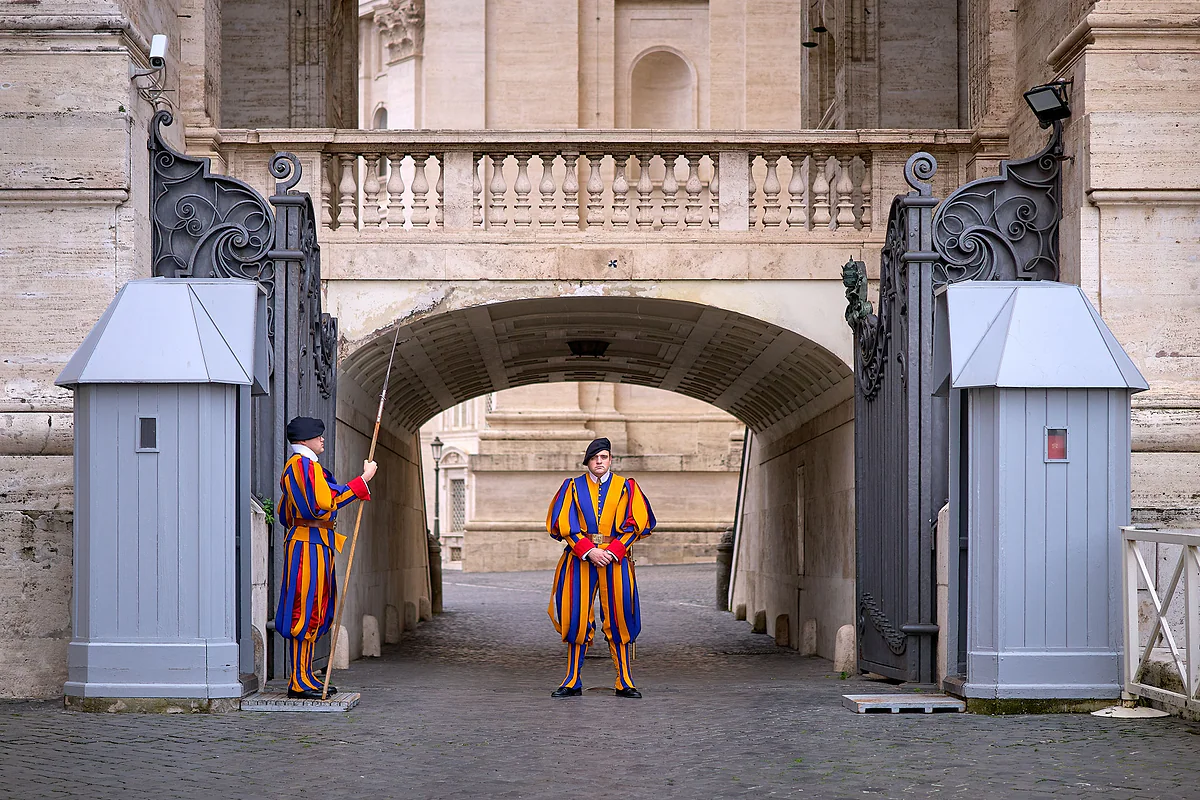
It has no army either. On 14 September 1970 Paul VI abolished every military corps except the Swiss Guard, now 135 strong. Security and policing fall to the Gendarmerie, and the fire brigade sits in the same directorate. According to the ACI Stampa news agency there are three cells in the Gendarmerie building and longer sentences are served in Italy, which fits the Treaty’s provision for Italy to punish crimes committed inside at the Holy See’s request.
A pharmacy, a supermarket and everyday life in a micro-state
The domestic side is what I like best. The Vatican Pharmacy is run by the Brothers Hospitallers of St John of God, and anyone with a prescription can buy there, resident or not. You go in through the Permit Office at St Anne’s Gate with photo ID and the original paper prescription, as digital ones aren’t accepted. It opens Monday to Friday 8:30 to 18:00 and Saturday 8:30 to 13:00, with shorter summer hours, and there’s a parapharmacy under the colonnade on the square.
The supermarket, the Annona, is for Governorate and Holy See staff, and reopened after refurbishment as Tigre-Annona. There’s a state mint too, and a post office with its own postmark. On the square side there’s no wall, only that strip of travertine, and you’ll see where each boundary runs on the Vatican City map. My takeaway for travellers is simple. It’s a real country, but you visit it like a district of Rome, with no customs and with a state’s rules that are worth reading first in how to visit Vatican City.
And what ID to bring, in passport for the Vatican.
More surprising figures are among the Vatican City facts.
Vatican City in official figures
| Item | Figure | Source |
|---|---|---|
| Area | 0.44 km² (44 hectares) | Governorate |
| Residents (31-12-2024) | 882, citizens or not | Governorate |
| Citizens (31-12-2024) | 618, of whom 246 live inside | Governorate |
| Diplomatic relations | 184 states, plus the EU and the Order of Malta | Holy See Press Office, 09-01-2026 |
| At the UN | Permanent Observer since 06-04-1964 (the Holy See) | Holy See Mission to the UN |
| Dialling code | +39 06 698 (+379 is reserved) | ITU |
| Internet domain | .va, registered 11-09-1995 | IANA |
| Number plates | SCV and CV; international code V | Governorate |
| Postcode | 00120 | Poste Vaticane |
Italian as the language of the state comes from the Treccani encyclopaedia; I haven't found a Vatican legal text that declares it. Latin is the official language of the Holy See.
- Area of the state, per the Governorate
- 0.44 km²
- Residents on 31 December 2024
- 882
- Vatican citizens, 246 of them inside the walls
- 618
- States with diplomatic ties to the Holy See (January 2026)
- 184
- Year of the Lateran Pacts that created the state
- 1929
0 of 88 Vatican City guides
Your next stamp
- Holy See
- Facts
- History
- Flag
- Passport
- Map
- Sistine Chapel
- Things to do
- One day
- Tickets
- Two days
- Vatican Museums
- St Peter's Basilica
- St Peter's Square
- St Peter's Dome
- Vatican Necropolis
- Vatican Gardens
- Swiss Guard
- Seeing the Pope
- How to visit
- Castel Gandolfo
- Where to eat
- Free and cheap
- Apostolic Palace
- Scams to avoid
- Getting there
- Money and payments
- Exclusive experiences
- Papal audience
- Angelus
- Who painted it
- Where the Pope lives
- Where to stay
- Dress code
- Facts
- Opening hours
- Post office and stamps
- Vatican Grottoes
- Pietà
- Baldachin
- Ceiling
- Chair of St Peter
- Last Judgement
- Raphael Rooms
- Architecture and architects
- Gallery of Maps
- Holy Door
- Library and Archives
- Bramante Staircase
- Facade and balcony
- Mass at St Peter's
- Pio Clementino Museum
- Papal blessing
- Vatican Pinacoteca
- Catacombs
- Gallery of Tapestries
- Gallery of the Candelabra
- Egyptian and Etruscan Museums
- Obelisk
- Vatican Museums map
- Bernini's colonnade
- How long you need
- Night opening
- Chiaramonti and Braccio Nuovo
- Christmas
- Anima Mundi Museum
- Easter
- Carriage Pavilion
- Gift shops and souvenirs
- With kids
- Best time to visit
- Courtyard of the Pine Cone
- Photography
- Train station
- Accessible travel
- Vatican Observatory
- Borgia Apartment
- Modern art collection
- Papal Palace
- Barberini Gardens
- Getting there
- Lake Albano
- Police and army
- Pharmacy, shop and petrol
- What Vatican means
- Papal tombs
- List of popes
Frequently asked questions
Why is Vatican City its own country?
Because the Holy See and Italy agreed it in the Lateran Pacts, signed on 11 February 1929. Italy recognised the State of Vatican City under the Pope's sovereignty, and the Holy See declared the Roman Question, open since 1870, settled. The state came into being in practice when ratifications were exchanged on 7 June 1929.
What is the population of Vatican City?
882 residents on 31 December 2024, according to the Governorate, counting citizens and non-citizens. There were 618 citizens, but only 246 lived inside the walls, 104 of them Swiss Guards. Around half of all citizens live abroad, mostly diplomatic staff.
How big is Vatican City?
0.44 km², or 44 hectares, by the Governorate's official figure. It sits on a slight rise near the right bank of the Tiber and is surrounded by Rome on every side. Half of that area is the Vatican Gardens, which you can only see on an official guided visit.
Do you need a passport for Vatican City?
There's no passport control to enter the square, the basilica or the Museums, and nobody stamps your passport. You do need photo ID if you bought your Museums ticket online, as it's checked alongside the ticket. Since you arrive through Italy, Italy's entry rules are the ones that apply.
Is Vatican City in the EU or Schengen?
Neither. It isn't an EU member, and the European Commission lists 29 Schengen countries without it. It does have a monetary agreement with the EU, in force since 1 January 2010, that lets it use the euro and mint a limited number of its own coins.
Does Vatican City have an army?
No. On 14 September 1970 Paul VI abolished every military corps except the Pontifical Swiss Guard, which today numbers 135 men and protects the Pope. Policing is handled by the Gendarmerie, founded in 1816 as the Pontifical Carabinieri.
Can you become a Vatican citizen?
Not by birth or descent. Citizenship is tied to living there because of an office or job, and it's lost when that role ends. Cardinals living in Rome are citizens too, and at the end of 2024 there were 66 cardinals holding Vatican citizenship.
By
Tourism graduate with a master’s in Tourism Management and Planning from the University of Málaga, who has travelled across Europe. He writes every guide from official sources and his own judgement.
Published on . Facts checked on .
Sources
Photos: Radek Kucharski (CC BY 4.0), via Wikimedia Commons.