Classical sculpture since 1506
The Pio Clementino Museum, where the Vatican Museums began
The Pio Clementino Museum is the classical sculpture section of the Vatican Museums, grown from Julius II's Courtyard of the Statues, now the Octagonal Court. That's where you'll find the Laocoön, found in 1506, and the Apollo Belvedere, with the Belvedere Torso in the Room of the Muses. It's named after Clement XIV and Pius VI and included in the ticket, from €20.
In 30 seconds
Full read: 4 min
- The Pio Clementino is the classical sculpture section of the Vatican Museums, named after Clement XIV and Pius VI.
- It grew from Julius II's Courtyard of the Statues, now the Octagonal Court, where the Laocoön and the Apollo Belvedere still stand.
- The Belvedere Torso, signed by Apollonios of Athens, is in the Room of the Muses.
- It's covered by the standard Museums ticket, from €20, and the official tours pass through it.
- I'd give it about 40 minutes, ten of them for the Laocoön alone.
I'd give it more time than nearly everyone does, as most people hurry through with their minds on the Sistine. Forty minutes gets you the Laocoön, the Apollo and the Torso at an easy pace, and shows you why the popes collected marble long before paintings.

Before you go
What I would keep in mind
-
01 Most beautiful
The Laocoön, the piece where it all began
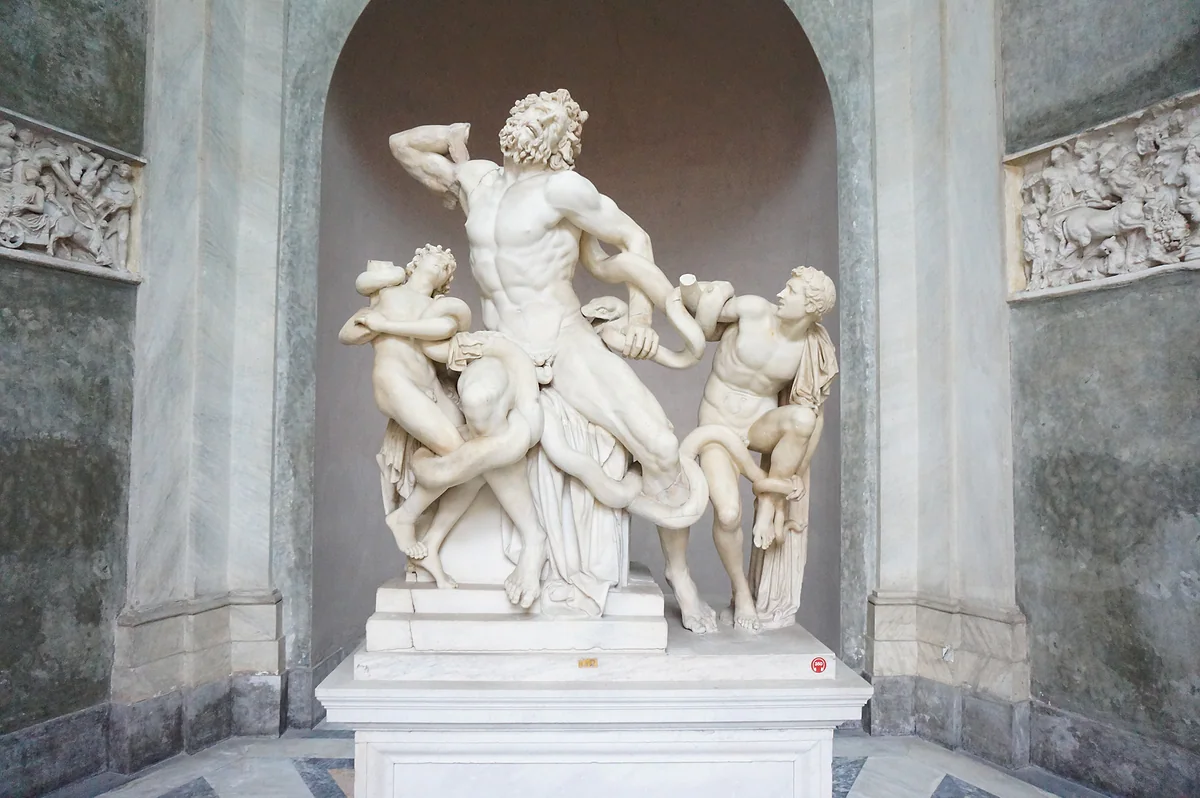
It turned up on the Esquiline in 1506 and Julius II snapped it up for his Courtyard of the Statues. It's identified with the group Pliny credits to three sculptors from Rhodes. For me it's the most powerful sculpture in the Vatican.
Vatican Museums -
02 My tip
Look for the Apollo's new hand
After structural damage was found in December 2019, the Apollo gained a carbon-fibre support at the back, and its left hand is now a cast of the so-called Baia hand, a Roman fragment of a copy taken from the Greek original.
-
03 Worth the splurge
The Cabinet of the Masks, behind closed doors
This Pio Clementino room, named after mosaics from Hadrian's Villa, only opens through the Reparti Chiusi scheme, €300 per group of 1 to 10 people plus each person's ticket.
Private Vatican tours and what's worth paying for -
04 Watch out
Don't pay extra to see the Laocoön
The Pio Clementino is part of the standard Museums ticket. Any supplement for the sculptures is a reseller's mark-up. The only official online ticket office is tickets.museivaticani.va.
Vatican scams and tourist traps to avoid in 2026 -
05 To save money
The official tours come through here
The free last-Sunday opening has an official tour, €20 with headset, taking in the Pinacoteca, the Pio Clementino, the upper galleries, the Raphael Rooms and the Sistine in about three hours. It's the cheapest way to see it with commentary.
Is the Sistine Chapel free?
My priorities
Unmissable
- The Laocoön in the Octagonal Court, walking all the way round to see both sons
- The Apollo Belvedere a few steps away, with its new support and the Baia hand
- The Belvedere Torso in the Room of the Muses
If you have time
- The Round Room and its porphyry basin, 13 metres in circumference
- The porphyry sarcophagi in the Greek Cross Room
- The Gallery of the Candelabra, grouped with this museum, which leads on to the Maps
I would skip
- Crossing the courtyard in five minutes with your mind already on the Sistine
- Paying a supplement for the sculptures, which come with the normal ticket
- Bringing a large rucksack, which you'll have to leave at the cloakroom
What I would book
- Places to stayBooking.com Prati, for the courtyard without the groups The Laocoön is best seen before the first wave of tour groups, and from Prati you can walk in for the 08:00 slot.
- Tours and ticketsViator A guide who tells you the myths Classical sculpture gains a great deal from someone who tells the story. I'd choose a tour that doesn't rush the courtyard and has entry included.
My ranking, scored
The Pio Clementino pieces I wouldn't miss
My own scores out of 10. They weigh the impact of the work in person, what it tells you about the museums' history and how easy it is to reach without a detour. The facts come from the official pages; the scores and timings are opinion.
0 of 7 seen
-
Laocoön (Octagonal Court)
The Trojan priest and his two sons caught by the serpents sent by Athena and Poseidon. Found in 1506, dated to around 40-30 BC and the centrepiece of Julius II's courtyard.
9.7 out of 10
-
Apollo Belvedere (Octagonal Court)
A Roman copy of a Greek bronze from around 330 BC, probably by Leochares. Winckelmann called it the highest ideal of art among the ancient works to survive.
9.0 out of 10
-
Belvedere Torso (Room of the Muses)
A body with no head, arms or legs that artists have admired ever since. The leading theory is that it shows Ajax contemplating suicide, and it's signed by Apollonios of Athens.
8.9 out of 10
-
Round Room
A dome modelled on the Pantheon, finished in 1779, with ancient mosaics underfoot and a red porphyry basin 13 metres round in the centre.
8.6 out of 10
-
Canova's Perseus Triumphant
Carved by Canova in 1800-1801 and bought by Pius VII for the Apollo's empty pedestal while the Apollo was in Paris. The one modern piece that holds its own in the courtyard.
8.1 out of 10
-
Greek Cross Room
The museum's old entrance hall, with «Museum Pium» over the doorway and two huge porphyry sarcophagi, those of St Helena and Constantina.
7.8 out of 10
-
Room of the Animals
Pius VI's «stone zoo», with ancient sculpture restored and sometimes reworked in the 18th century. If you're with children, it's the room I wouldn't skip.
7.4 out of 10
The Pio Clementino is the part of the Vatican Museums that most people walk straight through, and I think that’s the costliest mistake of the whole visit. There are no famous frescoes or ceilings to photograph here, just marble, and marble asks you to stop. Yet this is exactly where it all started, and it holds the sculpture I’d put above any other in the Vatican. Here’s what it is, which pieces to look for and how long I’d give it. If you haven’t settled on an order for your visit yet, start with what to see in the Vatican Museums in three hours.
A courtyard of statues that turned into a museum
The papal collections of classical sculpture began in Julius II’s Courtyard of the Statues, known today as the Octagonal Court. In the second half of the 18th century they grew through excavations in Rome and Lazio and purchases from collectors and dealers, and under the influence of the Enlightenment they became something new for the time, a public museum designed to protect and study ancient art. Clement XIV and Pius VI founded it, and their names give us Pio Clementino.
The rooms were created by adapting and extending the Palazzetto del Belvedere of Innocent VIII, with neoclassical architecture by Alessandro Dori, Michelangelo Simonetti and Giuseppe Camporese. Then came the blow. In 1797, under the Treaty of Tolentino, the Papal States had to hand the finest pieces to Napoleon’s France, and off they went to Paris. After 1815 nearly all of them came home, and it was Canova who negotiated their return. So when you stand in front of them, remember they’ve been on quite a journey.
The Laocoön, the sculpture I’d never miss
Laocoön was a Trojan priest of Apollo who argued against letting the wooden horse into Troy. Athena and Poseidon, who were on the Greeks’ side, sent two monstrous serpents from the sea that seized him and his two sons. The official page adds a reading I love, because in Roman eyes those innocent deaths allow Aeneas to escape and, in time, to found Rome.
The group came to light on the Esquiline in 1506 and was at once identified with the Laocoön that Pliny describes as the masterpiece of Agesander, Athenodorus and Polydorus of Rhodes. Julius II wasn’t going to let it get away and made it the heart of his courtyard. Its date has been argued over at length, and the one that now prevails is around 40-30 BC. My advice is to walk round it. Head-on you see the father’s cry, but from the side you understand what’s happening to the sons.
Why does the Apollo Belvedere have a new hand?
A few steps away stands the Apollo, found in 1489 in the ruins of a house on the Viminal and bought by Cardinal Giuliano della Rovere, the future Julius II, who moved it to the Belvedere, where it’s recorded from 1508. What you see is Roman marble, carved in the early decades of the 2nd century AD after a Greek bronze original dated to about 330 BC and probably by Leochares. Montorsoli restored it in 1532 and 1533, completing the left arm.
The recent chapter is the one I enjoy most. In December 2019 serious structural problems came to light, and the fix was a carbon-fibre support at the back anchored to the base, an idea Canova had already used when the statue came back from Paris in 1816. The restorers also swapped Montorsoli’s left hand for a cast of the Baia hand, a fragment of a Roman plaster copy taken from the Greek original. While the Apollo was away in France, Pius VII put Canova’s Perseus on its pedestal, a statue modelled on the Apollo that’s still in the courtyard.
The Torso, and rooms that feel like a palace
In the Room of the Muses you’ll find the Belvedere Torso, a marble body with no head, arms or legs, known in Rome since the 15th century and added to the collections between 1530 and 1536. The leading theory is that it shows Ajax contemplating suicide, and it bears the signature of Apollonios of Athens. The room opened in 1784 for statues found at a villa near Tivoli, and there’s a nice twist, since some of them weren’t muses at all and 18th-century restorers altered them to make up the nine.
The Round Room is something else again, a dome modelled on the Pantheon and finished in 1779, with ancient mosaics from Otricoli and Sacrofano on the floor and a red porphyry basin that reaches 13 metres in circumference. In the Greek Cross Room, the old entrance hall with «Museum Pium» over the door, two porphyry sarcophagi dominate. And in the Room of the Animals, Pius VI set up a stone zoo that I’d call the best stop of all if you’re with children.
How I’d go round it
The official tours come here after the Vatican Pinacoteca, and I’d do the same. I’d give it about forty minutes, ten for the Laocoön, five for the Apollo, five for the Torso and the rest for the rooms. On the way out, the Gallery of the Candelabra, which the official site groups with this museum, leads you straight to the Gallery of Maps.
One room sits outside the normal visit, the Cabinet of the Masks with its mosaics from Hadrian’s Villa, which only opens under the same paid scheme as the Bramante Staircase. Everything else is on the standard ticket, and here you can take photos as long as you leave the flash off.
The key pieces, from their official pages
| Work | Room | Date | Detail |
|---|---|---|---|
| Laocoön | Octagonal Court | c. 40-30 BC | Found on the Esquiline in 1506 |
| Apollo Belvedere | Octagonal Court | Early 2nd century AD | Found on the Viminal in 1489 |
| Belvedere Torso | Room of the Muses | 1st century BC | Signed by Apollonios of Athens |
| Hermes Belvedere | Octagonal Court | Reign of Hadrian | Long mistaken for Antinous |
| Apoxyomenos | Cabinet of the Apoxyomenos | Mid-1st century AD | Copy of Lysippos's bronze, found in 1849 |
| Perseus Triumphant | Octagonal Court | 1800-1801 | By Antonio Canova |
From each work's page on the Vatican Museums website.
Tickets and hours (2026)
| What | Detail |
|---|---|
| Standard ticket | €20 at the desk, €25 online |
| Reduced | €10 at the desk, €15 online |
| Monday to Saturday | 08:00-20:00, last entry 18:00 |
| Last Sunday of the month | 09:00-14:00, free, last entry 12:30 |
The Pio Clementino has no ticket of its own. It's covered by the Museums ticket, Sistine Chapel included.
Test yourself
True or false?
0/4 Pick before you peek.
-
The Laocoön is identified with a work Pliny credits to three sculptors from Rhodes.
See the answer
True. It was straight away matched to the group Pliny praises as the masterpiece of Agesander, Athenodorus and Polydorus of Rhodes. It's now dated to around 40-30 BC.
-
The Apollo Belvedere is an original Greek bronze.
See the answer
False. It's a Roman marble copy from the early 2nd century AD of a Greek bronze from around 330 BC, probably by Leochares.
-
The Belvedere Torso carries its sculptor's signature.
See the answer
True. It's signed by Apollonios of Athens, a Neo-Attic artist of the 1st century BC who was probably working from an earlier bronze.
-
The Pio Clementino's statues have never left the Vatican.
See the answer
False. Under the Treaty of Tolentino in 1797 the main pieces were taken to Paris. Most came back after the Congress of Vienna, thanks to Antonio Canova's diplomacy.
- The Laocoön is found on the Esquiline
- 1506
- The Apollo Belvedere is found on the Viminal
- 1489
- Circumference of the Round Room's porphyry basin
- 13 m
- Treaty of Tolentino, which sent the statues to Paris
- 1797
0 of 88 Vatican City guides
Your next stamp
- Vatican Museums
- Sistine Chapel
- Chiaramonti and Braccio Nuovo
- Anima Mundi Museum
- Egyptian and Etruscan Museums
- Gallery of Maps
- Gallery of the Candelabra
- Gallery of Tapestries
- Things to do
- One day
- Tickets
- Two days
- St Peter's Basilica
- St Peter's Square
- St Peter's Dome
- Vatican Necropolis
- Vatican Gardens
- Swiss Guard
- Seeing the Pope
- How to visit
- Castel Gandolfo
- Where to eat
- Free and cheap
- Apostolic Palace
- Scams to avoid
- Getting there
- Money and payments
- Exclusive experiences
- Papal audience
- Angelus
- Who painted it
- Where the Pope lives
- Where to stay
- Dress code
- Facts
- Opening hours
- Map
- Flag
- Post office and stamps
- Is it a country?
- Vatican Grottoes
- History
- Pietà
- Baldachin
- Ceiling
- Chair of St Peter
- Last Judgement
- Raphael Rooms
- Architecture and architects
- Holy Door
- Library and Archives
- Bramante Staircase
- Facade and balcony
- Mass at St Peter's
- Papal blessing
- Vatican Pinacoteca
- Catacombs
- Obelisk
- Vatican Museums map
- Bernini's colonnade
- How long you need
- Night opening
- Christmas
- Easter
- Carriage Pavilion
- Gift shops and souvenirs
- With kids
- Best time to visit
- Courtyard of the Pine Cone
- Photography
- Train station
- Accessible travel
- Vatican Observatory
- Borgia Apartment
- Modern art collection
- Papal Palace
- Barberini Gardens
- Facts
- Getting there
- Holy See
- Lake Albano
- Police and army
- Passport
- Pharmacy, shop and petrol
- What Vatican means
- Papal tombs
- List of popes
Frequently asked questions
What is the Pio Clementino Museum?
It's the classical sculpture section of the Vatican Museums, home to the Laocoön, the Apollo Belvedere and the Belvedere Torso. It grew out of Julius II's Courtyard of the Statues and became a public museum in the 18th century under Clement XIV and Pius VI, who gave it their names.
Where is the Laocoön in the Vatican Museums?
In the Octagonal Court of the Pio Clementino Museum, formerly Julius II's Courtyard of the Statues. The Apollo Belvedere, the Hermes Belvedere and Canova's Perseus stand in the same courtyard.
What does the Laocoön show?
Laocoön, a Trojan priest of Apollo who opposed bringing the wooden horse into Troy, caught with his two sons by two serpents sent by Athena and Poseidon. In the Roman reading, their deaths allow Aeneas to escape and found Rome.
What is the Belvedere Torso?
A marble sculpture with no head, arms or legs, from the 1st century BC and signed by Apollonios of Athens. It entered the papal collections between 1530 and 1536, and the leading theory is that it shows Ajax contemplating suicide. It's in the Room of the Muses.
Do you need a separate ticket for the Pio Clementino?
No. It's included in the standard Vatican Museums ticket, €20 at the desk or €25 online, which also covers the Sistine Chapel. Entry is free on the last Sunday of each month.
How long should you spend in the Pio Clementino?
There's no official figure. I'd give it about 40 minutes, ten of them for the Laocoön and the rest split between the Apollo, the Torso and the Round Room. If you're pressed, a quarter of an hour in the Octagonal Court is still worth it.
By
Tourism graduate with a master’s in Tourism Management and Planning from the University of Málaga, who has travelled across Europe. He writes every guide from official sources and his own judgement.
Published on . Facts checked on .
Sources
Photos: Berlinuno (CC BY-SA 4.0), via Wikimedia Commons.