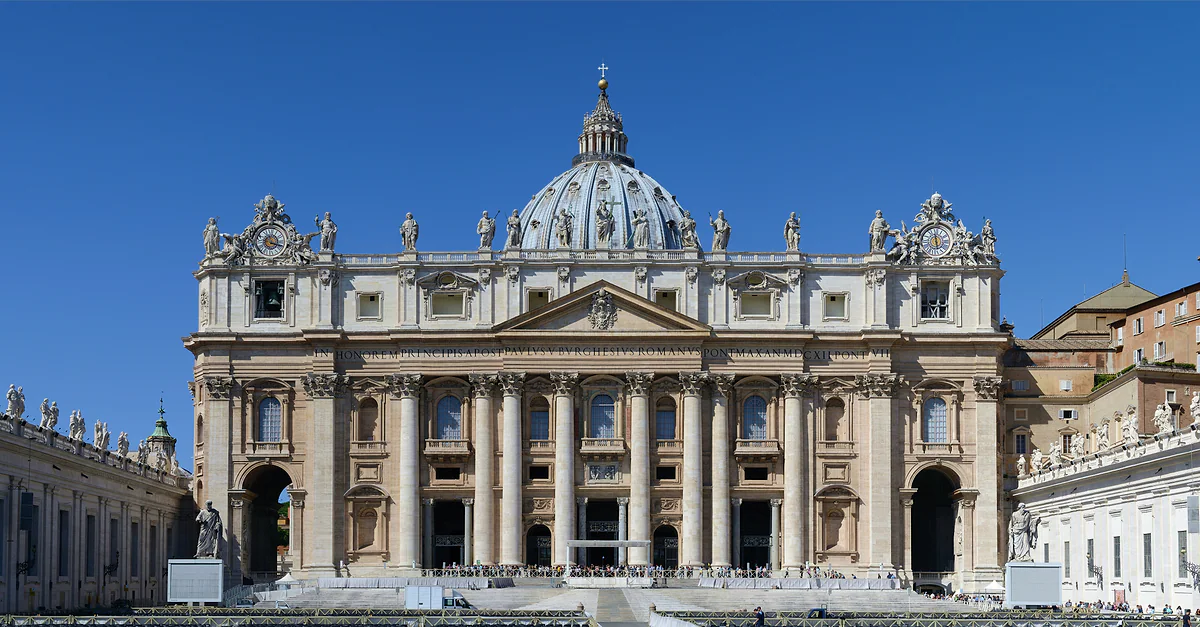
116 metres of travertine most people walk past
St Peter's facade, the Benediction Loggia and the two clocks
The facade of St Peter's Basilica is Carlo Maderno's work for Paul V, built between 1607 and 1614. It's 116 m wide and 45.50 m high without its statues, topped by Christ, John the Baptist and eleven apostles. The pope appears on its central balcony, the Benediction Loggia, when he's first elected and for the Urbi et Orbi blessing at Christmas and Easter. You can see it free from the square.
In 30 seconds
Full read: 4 min
- St Peter's facade was built by Carlo Maderno for Paul V between 1607 and 1614.
- It's 116 m wide and 45.50 m high, crowned by Christ, John the Baptist and eleven 5.65-metre apostles.
- The pope appears on its central balcony, the Benediction Loggia, when first elected and for the Urbi et Orbi.
- Its two clocks date from 1786-1790, and the northern one counts hours from sunset.
- It's free to see from the square, and it looks its best floodlit at night.
I like this facade best at night, floodlit, and from halfway across the square, which is where you see that Maderno made it wide rather than tall. Before leaving I'd check the two clocks, because one of them still counts the hours from sunset.

Before you go
What I would keep in mind
-
01 Most beautiful
The balcony where every new pope appears
The Benediction Loggia is the central opening on the upper storey. From it the senior cardinal deacon announces the new pope's name, and the pope then steps out to greet the crowd.
How to see the Pope -
02 My tip
The one-handed clock
The clock on the north side has a single hand and shows old Italian time, which started counting at sunset. The south clock shows modern time. Both date from 1786-1790.
Vatican obelisk -
03 My tip
Urbi et Orbi at Christmas and Easter
From the central loggia the pope gives the blessing to the city and the world at Christmas and at Easter. Those are the days this facade has thousands of people staring up at it.
Vatican Christmas -
04 To save money
No queue and no ticket to see it
You enjoy the facade from the square, with no security check and no entry fee. The queue is for the portico below, where the Holy Door is.
Holy Door at the Vatican
My priorities
Unmissable
- Pick out the Benediction Loggia, the central balcony on the upper storey
- Count the thirteen statues and notice St Peter isn't one of them
- Look at it from the centre of the square, by the obelisk
If you have time
- Tell the two clocks apart and find the one-handed one
- Understand how the basilica behind it was designed
- Come back after dark to see it lit
I would skip
- Waiting for the pope on this balcony on a Sunday, when the Angelus is at the palace window
- Mixing up the Peter and Paul statues on the steps with those on the roofline
What I would book
My ranking, scored
What to look for on the facade, best first
My own scores out of 10. They weigh what you can see clearly from the square with the naked eye and what it tells you about the basilica. All free, all done in ten minutes.
0 of 6 seen
-
The Benediction Loggia
The central balcony, in use since 1611. It's where Habemus Papam is announced and the Urbi et Orbi given, and knowing that changes how you read the whole facade.
9.4 out of 10
-
The thirteen statues on top
Christ the Redeemer in the middle, John the Baptist and eleven apostles, each 5.65 metres. St Peter isn't up there; he's inside and down below.
9.0 out of 10
-
Valadier's two clocks
From 1786-1790, with angels holding up the papal tiara. One tells modern time, the other, with a single hand, old Italian time.
8.4 out of 10
-
Paul V's inscription
Eighty metres of letters 1.10 metres high along the frieze, dedicated to the pope who paid for it. Easy to read from the middle of the square.
7.8 out of 10
-
The Giving of the Keys
Ambrogio Buonvicino's relief over the central door. It's the theme of the whole basilica, Christ handing the keys to Peter.
7.5 out of 10
-
The bells on the south side
Six bells in the attic, on the left as you face the basilica. When they all ring together they confirm a new pope has been elected.
7.2 out of 10
St Peter’s facade is one of those things you’ve seen so often in photos that you stop seeing it. You walk down Via della Conciliazione with it straight ahead for ten minutes, and once you’re in the square all you look at is the queue. I think it deserves a proper look, because it holds the balcony where every pope is presented, thirteen huge statues and two clocks with an odd story. Here’s what the Holy See says about it, and how I’d take it in.
Maderno and a tricky brief
The facade is Carlo Maderno’s work, built between 1607 and 1614 for Paul V. The first stone went in on 11 February 1608, and the pope’s name fills the frieze inscription, eighty metres of letters over a metre high. It’s travertine, 116 metres wide and 45.50 high without the statues, with columns 27.48 metres tall.
Maderno had a hard job. He lengthened the nave by two bays, as the state’s own website notes, and put a very wide front on it, and in my view the result comes at a price. Up close, the facade hides a good part of the dome. That’s why I look at it from halfway across the square, or better still from Via della Conciliazione, where the whole thing gets its proportions back. Why the church ended up so long is explained under St Peter’s Basilica architecture.
After 1667 Bernini altered it and cut the steps back to the central section, which had previously run the full width. It was fully restored for the Jubilee of 2000.
Thirteen statues and no St Peter
Along the top stand thirteen statues. In the middle is Christ the Redeemer, six metres with his cross. Either side are John the Baptist and eleven apostles, each 5.65 metres. The Milanese sculptor Ambrogio Buonvicino made them, along with the Giving of the Keys relief over the central door, between 1612 and 1614.
One is missing, and not by accident. St Peter isn’t on the front of his own basilica. He has a colossal marble statue at the foot of the steps, on the left, placed there in 1847, and a bronze one inside the nave. It makes a good pub-quiz question for whoever you’re travelling with.
Which balcony does the pope use?
The central one on the upper storey, the Benediction Loggia. It hasn’t always been there. For a long time a temporary wooden pulpit was put up in front of the basilica for big ceremonies, and it was Pius II who began a loggia in the 15th century. The one you see now was designed by Maderno and first used on 13 May 1611, for the Ascension blessing.
After each conclave the senior cardinal deacon names the new pope from here, and every Christmas and Easter the pope blesses the crowd Urbi et Orbi. There’s one date I love. On 6 February 1922 the newly elected Pius XI gave his first blessing from here, something that hadn’t happened since 1870, under Pius IX. Half a century without a pope stepping out to bless the square from that spot.
A warning, to save you a wasted wait. The Sunday Angelus isn’t said from this balcony but from a window of the Apostolic Palace, on the right of the square. If you want to see the pope in the loggia, you need to be here for Christmas at the Vatican or for Easter.
Two clocks and six bells
At the corners of the attic are two almost identical clocks, each with a pair of angels holding up the papal tiara. Luigi Valadier and his son Giuseppe made them between 1786 and 1790, under Pius VI, in place of two bell towers that had been started and then had to be demolished. The south clock tells time the way we do. The northern dial has just one hand and keeps the old Italian reckoning, which started the day at dusk, so hour twenty-four arrived with the following sunset. Electricity has driven them since 1957.
The bells hang in the southern opening of the attic, on the left. There are six, dating from 1353 to 1932, and the biggest is known as the ‘campanone’. When all six ring together, the so-called plenum, they confirm the smoke was white and there’s a new pope. They also ring out for the Gloria at the Easter Vigil and at Midnight Mass, for the Urbi et Orbi and on 29 June after the Angelus.
How I’d look at it
I’d start far back, on Via della Conciliazione, to see the facade with the dome above it. Then I’d stand beside the obelisk in St Peter’s Square and pick out the loggia, the thirteen statues and the clocks. And I’d come back at night, because it looks far better lit and the square empties. For what’s behind the doors, from the Pietà to the dome, my guide to St Peter’s Basilica has the hours, the queues and what not to miss.
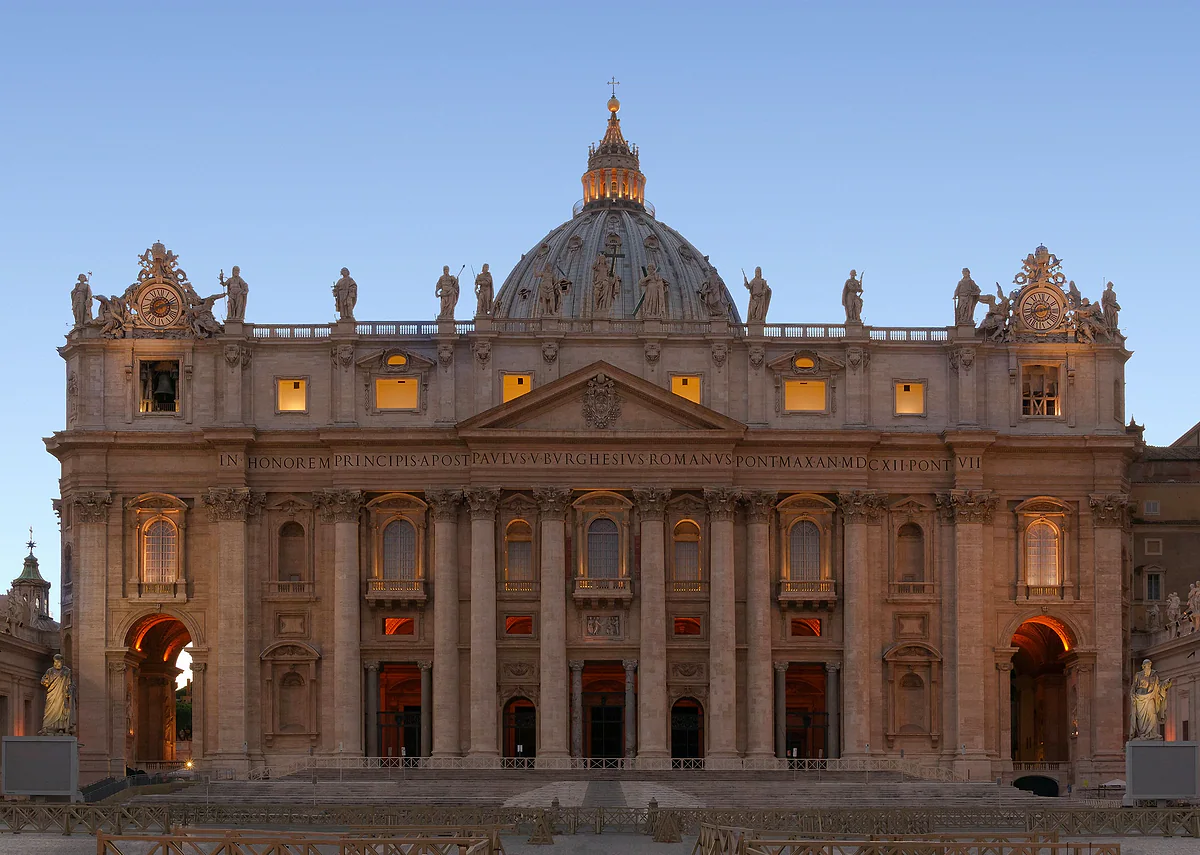
Facade of St Peter's Basilica with lit windows during the blue hour, with the dome behind it.
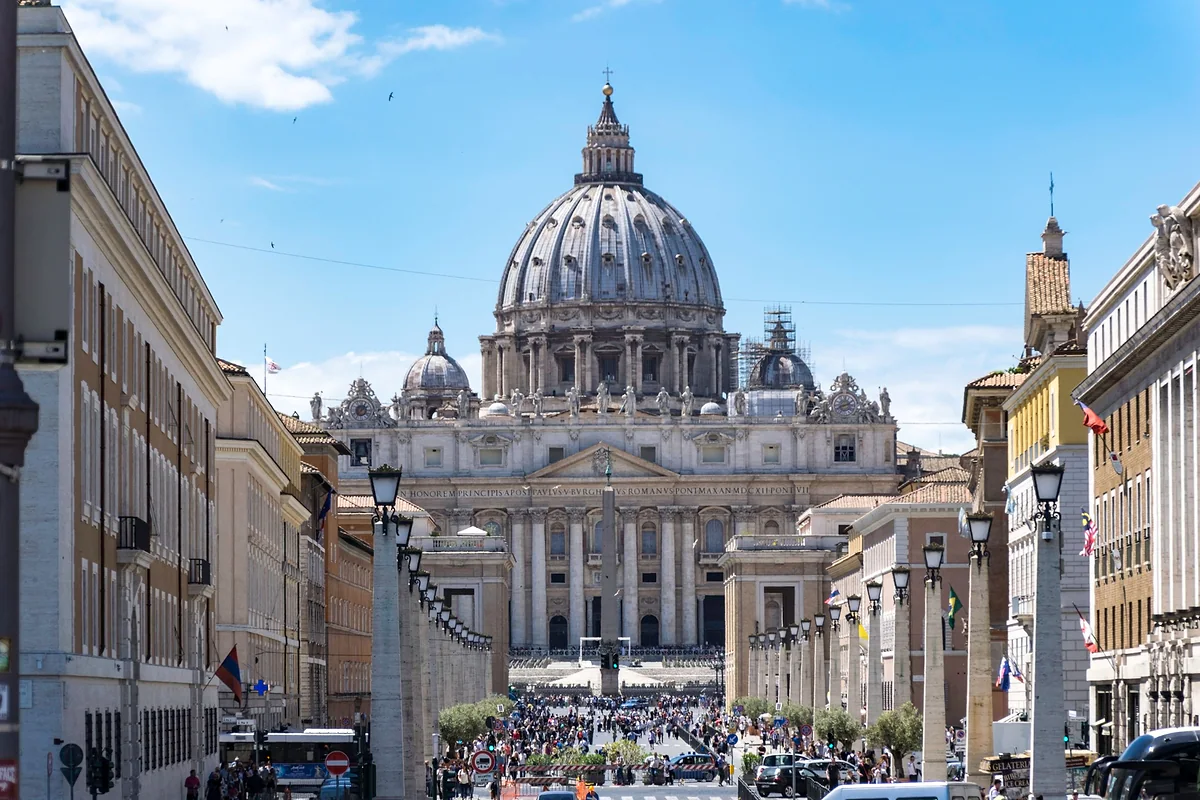
St Peter's Basilica and its dome at the end of Via della Conciliazione, with St Peter's Square in front, on a sunny day.
St Peter's facade in figures
| Fact | Figure |
|---|---|
| Architect and patron | Carlo Maderno, for Paul V |
| Built | 1607-1614; first stone 11-02-1608 |
| Height | 45.50 m without the statues |
| Width | 116 m |
| Columns | 27.48 m tall, 2.77 m in diameter |
| Statues | Apostles and John the Baptist 5.65 m; Christ the Redeemer 6 m |
| Inscription | 80.10 m long, letters 1.10 m high |
| Last full restoration | For the Jubilee of 2000 |
Holy See official fact sheet (vatican.va). The Fabbrica di San Pietro dates the work to 1608-1612; both agree on the first stone in 1608.
What happens on the central balcony
| Occasion | What you'll see |
|---|---|
| After a conclave | The senior cardinal deacon announces the new pope's name |
| Christmas Day | The pope gives the Urbi et Orbi blessing |
| Easter Sunday | The pope gives the Urbi et Orbi blessing |
From the official fact sheet on the Benediction Loggia. The Sunday Angelus isn't given here but from a window of the Apostolic Palace.
Test yourself
True or false?
0/4 Pick before you peek.
-
St Peter is one of the statues on the facade of his basilica.
See the answer
False. The roofline has Christ, John the Baptist and eleven apostles. St Peter is represented inside the basilica.
-
The pope says the Sunday Angelus from the central balcony of the facade.
See the answer
False. The Angelus is said from a third-floor window of the Apostolic Palace. The central balcony is for the Urbi et Orbi and presenting a new pope.
-
One of the clocks on the facade has only one hand.
See the answer
True. The northern clock shows old Italian time with a single hand that sweeps across the whole dial.
-
The Benediction Loggia was first used in the 17th century.
See the answer
True. It was first used on 13 May 1611, for the Ascension blessing.
- Width of the facade
- 116 m
- Height without the statues
- 45.50 m
- Statues on top, Christ, the Baptist and eleven apostles
- 13
- First use of the Benediction Loggia
- 1611
0 of 88 Vatican City guides
Your next stamp
- Architecture and architects
- St Peter's Basilica
- St Peter's Square
- Bernini's colonnade
- Obelisk
- Baldachin
- Chair of St Peter
- Angelus
- Sistine Chapel
- Things to do
- One day
- Tickets
- Two days
- Vatican Museums
- St Peter's Dome
- Vatican Necropolis
- Vatican Gardens
- Swiss Guard
- Seeing the Pope
- How to visit
- Castel Gandolfo
- Where to eat
- Free and cheap
- Apostolic Palace
- Scams to avoid
- Getting there
- Money and payments
- Exclusive experiences
- Papal audience
- Who painted it
- Where the Pope lives
- Where to stay
- Dress code
- Facts
- Opening hours
- Map
- Flag
- Post office and stamps
- Is it a country?
- Vatican Grottoes
- History
- Pietà
- Ceiling
- Last Judgement
- Raphael Rooms
- Gallery of Maps
- Holy Door
- Library and Archives
- Bramante Staircase
- Mass at St Peter's
- Pio Clementino Museum
- Papal blessing
- Vatican Pinacoteca
- Catacombs
- Gallery of Tapestries
- Gallery of the Candelabra
- Egyptian and Etruscan Museums
- Vatican Museums map
- How long you need
- Night opening
- Chiaramonti and Braccio Nuovo
- Christmas
- Anima Mundi Museum
- Easter
- Carriage Pavilion
- Gift shops and souvenirs
- With kids
- Best time to visit
- Courtyard of the Pine Cone
- Photography
- Train station
- Accessible travel
- Vatican Observatory
- Borgia Apartment
- Modern art collection
- Papal Palace
- Barberini Gardens
- Facts
- Getting there
- Holy See
- Lake Albano
- Police and army
- Passport
- Pharmacy, shop and petrol
- What Vatican means
- Papal tombs
- List of popes
Frequently asked questions
Which balcony does the pope come out on?
The Benediction Loggia, the central balcony on the upper storey of St Peter's facade. It's used to present a newly elected pope and for the Urbi et Orbi blessing at Christmas and Easter. The Sunday Angelus is different, said from a window of the Apostolic Palace on the right of the square.
When does the pope come out on his balcony?
At Christmas and Easter for the Urbi et Orbi, and when a new pope is presented after a conclave. It isn't a weekly event. To see him every Sunday you go to the Angelus, which isn't on this balcony.
Who designed the facade of St Peter's Basilica?
Carlo Maderno, for Pope Paul V, whose name runs along the frieze. He worked on it between 1607 and 1614, and the first stone was laid on 11 February 1608. After 1667 Bernini altered it and cut the steps back to the central section.
How big is the facade of St Peter's?
116 metres wide and 45.50 metres high without the statues, according to the Holy See's fact sheet. The columns are 27.48 metres tall and the apostles on top 5.65 metres.
Who are the statues on top of St Peter's?
Christ the Redeemer in the centre, John the Baptist and eleven apostles. St Peter isn't among them. He has a colossal statue at the foot of the steps and the bronze one people touch inside the basilica.
Why does St Peter's have two clocks?
They replaced two bell towers that were started and then had to be pulled down. The Valadier family made them between 1786 and 1790 under Pius VI. The south clock tells modern time, while the north one, with a single hand, showed Italian time counted from sunset.
By
Tourism graduate with a master’s in Tourism Management and Planning from the University of Málaga, who has travelled across Europe. He writes every guide from official sources and his own judgement.
Published on . Facts checked on .
Sources
Photos: Alvesgaspar (CC BY-SA 4.0); Jebulon (CC0); Rabax63 (CC BY-SA 4.0), via Wikimedia Commons.