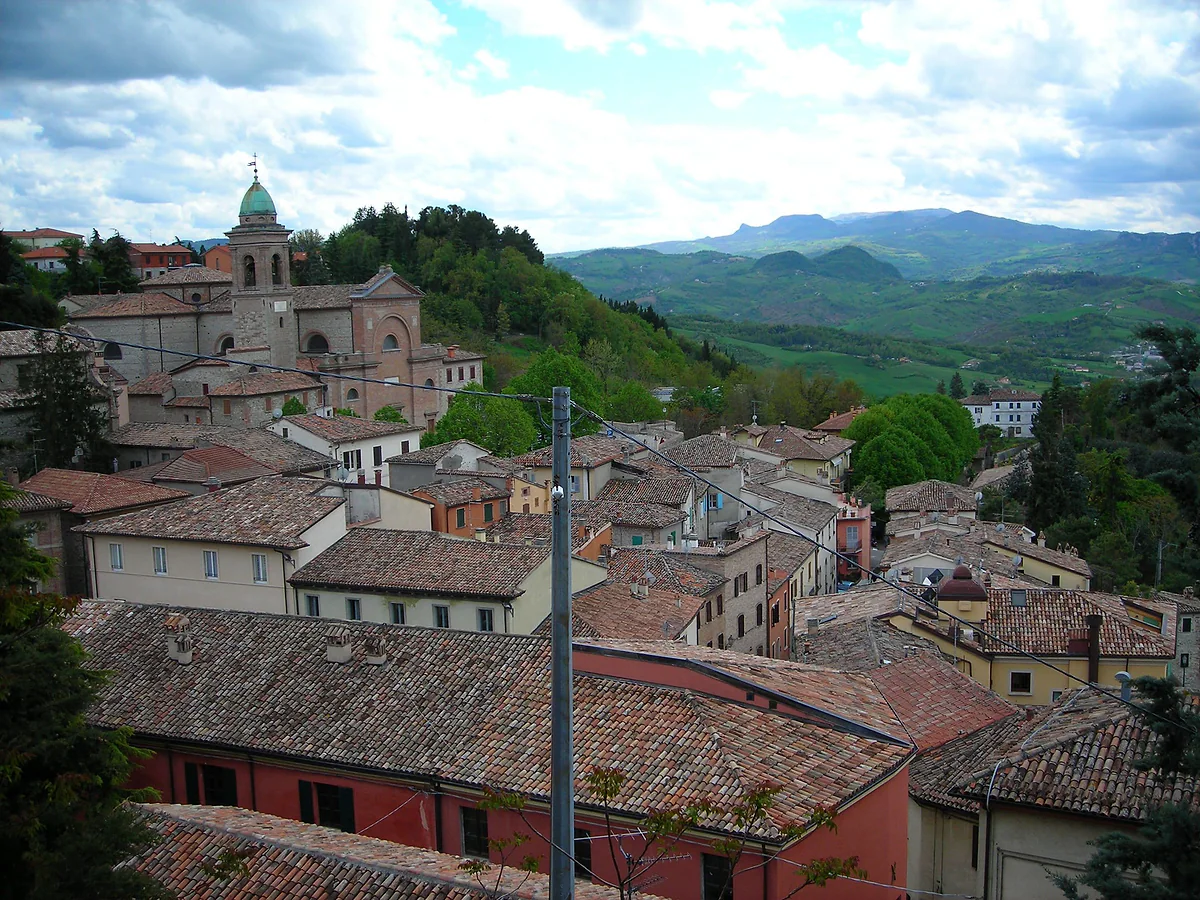
10 km from San Marino
Verucchio, the Malatesta town you can see from the Guaita
Verucchio is a medieval Italian hill town 10 km from San Marino and 16 km from Rimini. The Malatesta, lords of Rimini, came from here, and long before that it was a Villanovan centre, with more than 600 tombs whose wooden thrones and Baltic amber now fill its Archaeological Museum. At weekends it shares a €14.50 ticket with San Leo.
In 30 seconds
Full read: 3 min
- Verucchio is in Italy, 10 km from San Marino and 16 from Rimini.
- It was a Villanovan centre from the 9th to 6th centuries BC, and its Archaeological Museum holds wooden thrones and amber.
- The Malatesta, lords of Rimini, came from here.
- At weekends there's a €14.50 combined ticket with San Leo.
- I'd drive: there's no readable official source for the bus.
I'd do Verucchio in the afternoon, after San Leo, on the weekend combined ticket. The Rocca del Sasso is quick to see, but the Archaeological Museum deserves time. Wooden thrones almost three thousand years old are about as rare as village museum exhibits get.

Before you go
What I would keep in mind
-
01 Most beautiful
Visible from San Marino's tower
San Marino's State Museums note that from the top of the Guaita you can see Malatesta castles in the distance, Verucchio among them. Going there afterwards closes the circle.
Guaita, San Marino's First Tower -
02 To save money
With San Leo, €14.50 for both
At weekends and on public holidays, Verucchio's Rocca Malatestiana and Archaeological Museum join San Leo's fortress on a €14.50 combined ticket. San Leo alone costs €11.
San Leo and its fortress -
03 My tip
Go on a clear day
The regional tourist board advises planning the visit for a clear, haze-free day, because from the top of the rock you see the Marecchia valley and the whole Rimini coast. In mist you lose half of it.
-
04 Getting there
Better by car
I couldn't find a readable official source for buses to Verucchio, so I'm assuming a car. From San Marino it's 10 km and from Rimini 16, along the Marecchia valley.
day trips from San Marino
What I would book
- Places to stayBooking.com San Marino as a base with a car Verucchio is 10 km away. With a car and a night on Mount Titano, San Leo and Verucchio fit in one day.
- Tours and ticketsGetYourGuide A guided tour of the Marecchia valley Without a car, an organised tour is the realistic way there, as I couldn't confirm the public bus.
My ranking, scored
What to see in Verucchio, in order
My own scores out of 10. I weigh what you can't see anywhere else, what it says about the Malatesta and the time it takes. Enough for an afternoon.
0 of 5 seen
-
Archaeological Museum
Carved wooden thrones, textiles and Baltic amber from the Villanovan culture. The region says it was named among Europe's ten best museums in 2000.
9.2 out of 10
-
Rocca del Sasso
One of the oldest and best-preserved fortifications in the region, hanging over the valley. The Malatesta came from here.
8.8 out of 10
-
Santa Croce convent and its cypress
Emilia-Romagna's oldest tree, which tradition credits to Saint Francis in 1213, plus 14th-century Rimini-school frescoes.
8.0 out of 10
-
The Collegiata
Two large painted crucifixes on panel, one from 14th-century Rimini and one 15th-century Venetian, and a canvas by Centino.
7.4 out of 10
-
Modern art gallery
A surprise in a village this size, with Picasso, Fontana and Vasarely. If you have time.
7.0 out of 10
From the top of the Guaita, San Marino’s First Tower, you can see Malatesta castles in the distance, and one of them is Verucchio. I like starting there, because it explains why this village is the closest day trip from Mount Titano and one of the most rewarding. It’s 10 kilometres away, on a hill watching over the Marecchia valley, and it holds two stories that have nothing to do with each other.
Three thousand years before the Malatesta
The first story is genuinely ancient. Between the 9th and 6th centuries BC, Verucchio was a centre of the so-called Villanovan culture, now seen as the dawn of the Etruscans. Its more than 600 excavated tombs produced weapons, pottery and jewellery, but above all something that almost never survives, inlaid wooden thrones and preserved textiles. There was also a huge quantity of amber brought from the Baltic, which Greek merchants traded here for their own goods.
It’s all in the Archaeological Museum, which according to the Emilia-Romagna region was named among Europe’s ten best in 2000. For me it’s the main reason to come, and I’d put it ahead of the fortress. One Malatesta stronghold looks much like another, and this area has plenty; a wooden throne almost three thousand years old, on the other hand, is something you won’t see anywhere else on the trip.
Cradle of the lords of Rimini
The second story is the Malatesta’s. The first lord of Rimini, the «Old Mastiff» (1212-1312) whom Dante mentions in the Divine Comedy, came from Verucchio, and the village remained a family stronghold. His descendant Sigismondo is the one who built Rimini’s Tempio Malatestiano, covered in my guide to Rimini.
The village has barely changed since, with its lanes, stairways, walls and towers, and it stretches between two strongholds. The Rocca del Passerello later became a convent. The Rocca del Sasso, hanging over the valley, is one of the oldest and best-preserved fortifications in the region. Seeing it after San Leo is instructive, because you move from the Montefeltro’s showpiece to the fortress of the family that fought them for the valley for generations.
What else to see in the village
The Collegiata holds a canvas by Centino and two large crucifixes painted on panel, one from 14th-century Rimini and one 15th-century Venetian. The town’s art gallery has a modern collection that’s surprising in a village this size, with works by Picasso, Fontana, Vedova, Capogrossi and Vasarely, among others.
My favourite corner, for the story it tells, is the convent of Santa Croce. In its cloister grows a 13th-century cypress, the oldest tree in Emilia-Romagna, which tradition says Saint Francis caused to spring up in 1213. The church has a 13th-century crucifix from the school of Giunta and 14th-century frescoes from the Rimini school.
When to go and how to combine it
The region itself advises going on a clear, haze-free day, because from the top of the rock the view takes in the Marecchia valley and the whole Rimini coast down to the Adriatic. In mist you lose half the visit.
The main festivals, according to the same source, are the Verucchio Music Festival in July, the medieval dinners and shows at the Rocca in August, Verucchio Calici, a tasting of local wines, also in August, and the Fiera di Santa Croce in mid-September. I have no 2027 dates, so check before planning a trip around any of them.
The best way to visit, to my mind, is together with San Leo, 16 kilometres away. One €14.50 ticket, valid on Saturdays, Sundays and holidays, covers San Leo’s fortress plus this village’s stronghold and museum. Starting up at San Leo and finishing here in the afternoon light is my idea of a perfect day.
Getting there from San Marino
Verucchio is 10 kilometres from San Marino and 16 from Rimini. I couldn’t find a readable official source for bus times to the village, so I’m treating it as a drive. Without a car, an organised tour of the Marecchia valley is the realistic option. Nearby, 5 kilometres away, is Torriana, and four more beyond it, Montebello, with the castle of the Azzurrina ghost legend. The other options, compared, are in day trips from San Marino.
Verucchio at a glance
| What | Detail |
|---|---|
| Villanovan culture | 9th to 6th centuries BC, more than 600 tombs excavated |
| Archaeological Museum | Wooden thrones, textiles and Baltic amber |
| Strongholds | Rocca del Sasso and Rocca del Passerello (now a convent) |
| Santa Croce convent | A cypress tradition dates to 1213 |
| Art gallery | Works by Picasso, Fontana, Vedova and Vasarely, among others |
| Festivals | Music Festival (July), medieval dinners (August), Fiera di Santa Croce (September) |
Emilia-Romagna regional tourism portal, updated 14 May 2026. Combined ticket from San Leo 2000.
Test yourself
True or false?
0/3 Pick before you peek.
-
You can see Verucchio from San Marino's First Tower.
See the answer
True. San Marino's State Museums say that from the Guaita's bell tower you can see distant Malatesta castles such as Verucchio.
-
Verucchio's Archaeological Museum is mainly about the Romans.
See the answer
False. What makes it unique is older, the Villanovan culture of the 9th to 6th centuries BC, with wooden thrones, textiles and Baltic amber.
-
The first Malatesta lord of Rimini came from Verucchio.
See the answer
True. He was the Old Mastiff (1212-1312), mentioned by Dante. Verucchio was the Malatesta stronghold.
- From San Marino
- 10 km
- Villanovan tombs excavated, and counting
- 600
- The Santa Croce cypress, by tradition
- 1213
- Combined ticket with San Leo fortress
- €14.50
0 of 8 Italy guides
Your next stamp
Frequently asked questions
How far is Verucchio from San Marino?
10 km, according to the Emilia-Romagna region. It's 16 km from Rimini and also 16 from San Leo. It's the closest day trip from San Marino.
What is there to see in Verucchio?
The Rocca del Sasso above the valley; the Archaeological Museum with its Villanovan thrones and amber; the Santa Croce convent with a 13th-century cypress; the Collegiata; and the modern art gallery.
Is there a combined ticket with San Leo?
Yes, at weekends and on public holidays. San Leo's fortress with Verucchio's Rocca Malatestiana and Archaeological Museum costs €14.50, or €18 adding the Gradara rampart walk.
Who were the Malatesta?
The family who ruled Rimini and much of Romagna. The first lord of Rimini, the Old Mastiff (1212-1312) Dante mentions, came from Verucchio. His descendant Sigismondo built Rimini's Tempio Malatestiano.
How do I get to Verucchio?
I'd drive, 10 km from San Marino or 16 from Rimini. I couldn't find a readable official source with bus times to the village.
When are Verucchio's festivals?
According to the region, the Verucchio Music Festival is in July, the medieval dinners and shows at the Rocca in August, Verucchio Calici also in August, and the Fiera di Santa Croce in mid-September. The 2027 dates haven't been published.
By
Tourism graduate with a master’s in Tourism Management and Planning from the University of Málaga, who has travelled across Europe. He writes every guide from official sources and his own judgement.
Published on . Facts checked on .
Sources
Photos: Bultro (CC BY-SA 3.0), via Wikimedia Commons.