Eight popes and the icon Francis prayed before
Santa Maria Maggiore, the basilica where Pope Francis lies
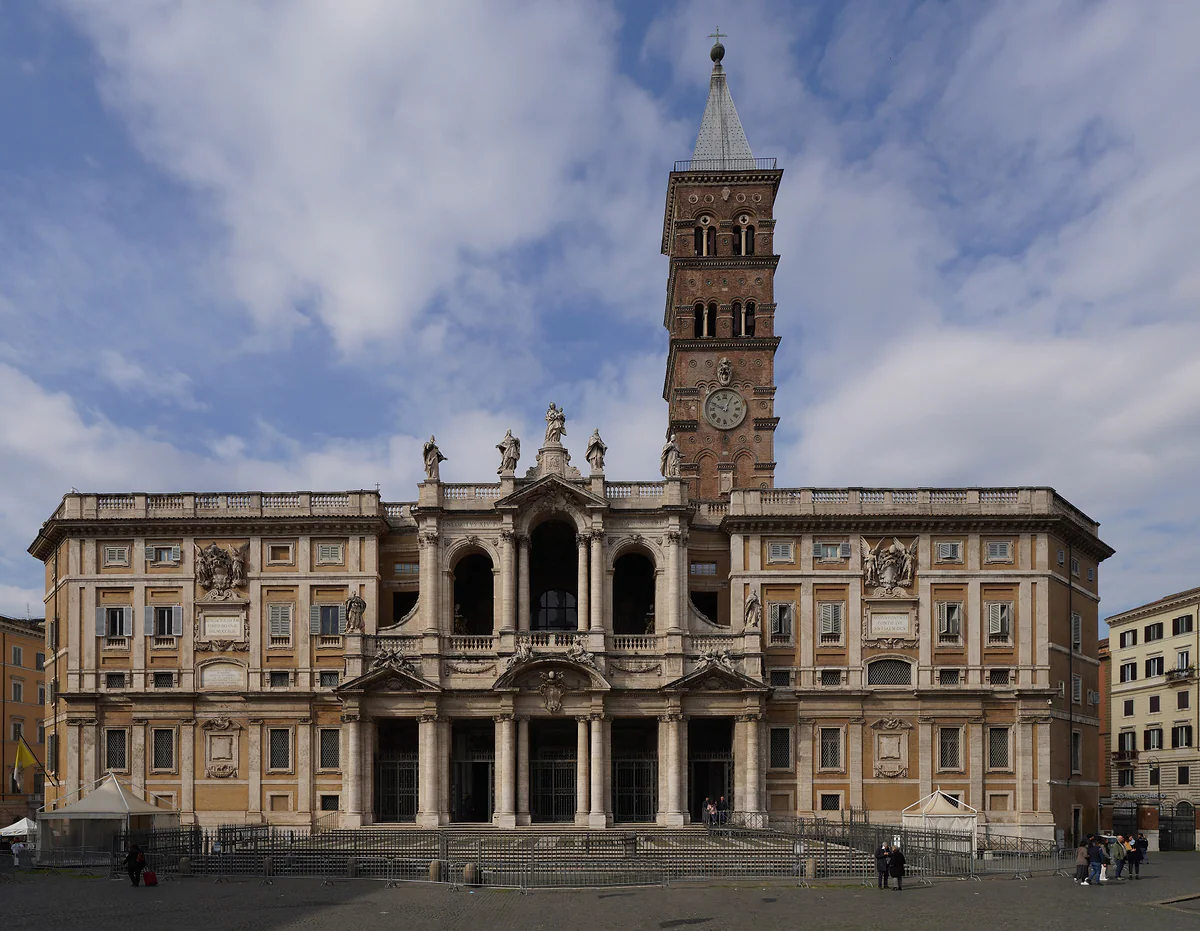
Santa Maria Maggiore is one of Rome's four papal basilicas, on top of the Esquiline. It belongs to the Holy See and enjoys diplomatic immunities, but it stands on Italian territory. It holds the tomb of Pope Francis, buried on 26 April 2025, and seven other popes. The first weekday Mass is at 07:00 and the museum areas cost €7.50.
I wouldn't come just for Francis's tomb, which you take in within a minute. I'd come for the whole basilica, the only one of Rome's great basilicas to keep its early Christian layout, and I'd pay the €7.50 for the museum areas to climb up to the Loggia of Blessings and see the façade mosaic close up.

Before you go
What I would keep in mind
-
01 Most beautiful
Galileo's moon in the Pauline Chapel dome
In the dome of the Pauline Chapel, Cigoli painted the Virgin standing on a cratered moon, copied from the observations Galileo published in 1610. Hardly anyone looks up at it.
-
02 My tip
Owned by the Holy See, but not the Vatican
The Lateran Treaty recognises it as Holy See property with the immunities of a diplomatic mission, yet inside Italian territory. That's why Francis isn't buried in Vatican City.
Holy See and Vatican City difference -
03 Worth the splurge
The underground with a guide, for €13.50
The Underground Experience takes you into the basilica's archaeological depths with a guide for about 50 minutes. It costs €13.50 and isn't open to under-sevens.
-
04 My tip
No big rucksacks and no cloakroom
The basilica has no cloakroom and won't let in suitcases or large rucksacks. If you're coming straight from the station with luggage, drop it somewhere first.
Vatican dress code 2026 -
05 My tip
Rome's other papal tombs
Francis shares this basilica with seven other popes, and about 91 lie in the Vatican. I've set out where each of the recent ones is buried.
where the popes are buried
What I would book
My ranking, scored
What I'd see inside Santa Maria Maggiore
My own marks out of 10, for what each stop adds to the visit and how easy it is to find. Everything here is in the basilica or its museum complex, according to its official website.
0 of 6 seen
-
The Pauline Chapel and the Salus Populi Romani
The icon tradition attributes to St Luke, in a lapis lazuli tabernacle, under a dome where the Virgin stands on a moon drawn as Galileo saw it. It's the heart of the basilica.
9.3 out of 10
-
Pope Francis's tomb
In the left aisle beside the Pauline Chapel, a slab of Ligurian stone reading FRANCISCVS and a large pectoral cross on the wall. Plain, as he wanted it.
8.7 out of 10
-
The mosaics of the nave and triumphal arch
They date from the pontificate of Sixtus III in the fifth century. Looking up the nave, past the cipollino marble columns, is seeing an early Christian basilica almost as it was.
8.6 out of 10
-
The Sistine Chapel and Arnolfo's nativity
Sixtus V's chapel of 1585-1587, with his tomb and Pius V's, sits over the oratory of Arnolfo di Cambio's crib of 1291, the first known in the history of art.
8.2 out of 10
-
The Loggia of Blessings
You go up with the museum-areas ticket and see Filippo Rusuti's mosaics of around 1300 up close, including the miracle of the snow.
7.9 out of 10
-
The Holy Crib beneath the papal altar
Five slats of sycamore wood in a rock-crystal reliquary by Valadier, from 1802. It's why the basilica calls itself the Bethlehem of the West.
7.4 out of 10
Plenty of people come to Santa Maria Maggiore looking for just one thing, Pope Francis’s tomb. I understand why, but it seems a shame to stop there. It’s the only one of Rome’s great basilicas to keep its early Christian form, it holds the city’s most venerated icon and it has a Sistine Chapel of its own. It belongs to the Holy See, yet it isn’t in the Vatican at all.
Where is Pope Francis buried?
It’s in the aisle on your left as you enter, in the stretch between the Pauline and Sforza chapels, near the altar of St Francis of Assisi. The burial took place on 26 April 2025, a half-hour rite led by the Cardinal Camerlengo. The tomb is as plain as he asked. A slab of Ligurian stone engraved FRANCISCVS, a floor of Finale Ligure stone honouring his family’s roots and, on the niche wall, the pectoral cross he wore every day, reproduced at a larger size.
The choice makes sense the moment you step into the Pauline Chapel. That’s where the Salus Populi Romani hangs, the icon Francis went to pray before and after every trip abroad. On 21 April 2026, the first anniversary of his death, a plaque was unveiled to the right of the chapel recording his 126 visits. If you’re wondering where the other recent popes lie, it’s all in where the popes are buried.
A papal basilica outside the Vatican
This is the mix-up I come across most. Santa Maria Maggiore is one of Rome’s four papal basilicas and has been Holy See property since the Lateran Treaty of 1929. The same treaty gives it the immunities international law grants to embassies. Yet the text is explicit that it forms part of Italian state territory.
In practice, you cross no border and never leave Rome when you walk in. I explain the distinction in what the Holy See is, as opposed to Vatican City. That’s how Francis can lie in a papal basilica and still be the first pope in more than a hundred years whose grave sits outside the Vatican state.
What I’d see inside
The first thing I’d do is look up the central nave. The cipollino marble columns, the fifth-century mosaics from the pontificate of Sixtus III and the gilded wooden ceiling designed by Giuliano and Antonio da Sangallo give you the ancient basilica almost untouched. Turismo Roma passes on the tradition that the ceiling was gilded with the first gold brought back from the Americas, a gift from Isabella of Spain, and I prefer that story to any statistic.
Then I’d head for the two great side chapels. Paul V’s Pauline Chapel keeps the Salus Populi Romani in a lapis lazuli tabernacle, and in its dome Cigoli painted the Virgin standing on a cratered moon, following the observations Galileo had just published in 1610. Opposite, the Sistine Chapel Sixtus V commissioned from Domenico Fontana between 1585 and 1587 holds his tomb and St Pius V’s, and it sits over the oratory with the nativity Arnolfo di Cambio carved in 1291, the first known in the history of art.
That leaves three short stops. Under the papal altar, the Holy Crib, slats from the Bethlehem manger in a reliquary by Valadier. In the right aisle, the Bernini family tomb, astonishingly modest for the man who filled Rome with marble. And the Sforza Chapel, designed by Michelangelo at the age of 87.
What’s free and what you pay for
Entering the basilica costs nothing. What you pay for is the museum complex, with the Loggia of Blessings, the Hall of the Popes, Bernini’s staircase and the Liberian Museum, at €7.50. For me it’s the extra most worth having, because the loggia puts you face to face with the façade mosaics. The Underground Experience, €13.50, is for anyone who has already seen the basilica and wants to go below, and the art historian’s tour, €16.50, for those who’d rather be talked through it.
The museum complex opens Monday to Saturday from 8:00 to 18:30, last entry 18:00, and on Sundays from 12:30 to 17:00. All the prices and times are in the tables on this page.
Rules, clothing and access
The basilica asks for modest dress, no strappy or low-cut tops, no shorts above the knee, no miniskirts and no hats. It’s very close to the Vatican’s own rule, which I’ve set out in the Vatican dress code. There’s no cloakroom and suitcases or large rucksacks aren’t allowed in, so if you’re coming from the station with luggage, drop it first. There’s a metal detector at the entrance.
For wheelchair users there’s a ramp, adapted toilets and mobile platforms to reach the chapels, which you ask the staff for, and the museum complex has a lift.
When to go
My favourite day would be 5 August, when the basilica marks the miraculous snowfall of its founding legend with a shower of white petals from the ceiling during Mass. The rest of the year I’d go early, around the first Mass, when there are more worshippers than tourists. Christmas carries special weight here too, because this is where Midnight Mass was celebrated for the first time, which ties in with Christmas at the Vatican.
Its Holy Door, on the left of the portico, opened on 1 January 2025 and closed on 25 December that year, ahead of St Peter’s. The story of all four is in the Holy Door of St Peter’s. And if you cross the Tiber later the same day, Castel Sant’Angelo is the best end to an afternoon I know on that bank.
Visit prices
| What | Full | Reduced | Details |
|---|---|---|---|
| Basilica | Free | Free | No booking |
| Museum areas | €7.50 | €4.50 | Loggia, Hall of the Popes, Bernini's staircase and the Liberian Museum |
| Visit with the art historian | €16.50 | €13.50 | About 60 minutes |
| Underground Experience | €13.50 | €11.50 | About 50 minutes, age 7 and over |
| Basilica audio guide | €7.00 | €7.00 | Self-guided |
Prices from the official ticket office (tickets.museivaticani.va), read on 24 September 2026. The 360° Panoramic Terraces are on sale, but I couldn't read their price.
Opening times
| What | Times |
|---|---|
| Museum complex | Monday to Saturday 8:00-18:30 (last entry 18:00); Sunday 12:30-17:00 |
| Weekday Mass | 07:00, 08:00, 09:00, 10:00, 11:00, 12:00 and 18:00 |
| Sunday and holiday Mass | 10:00, 12:00 and 18:00 |
| Rosary | 11:30, Monday to Saturday |
Basilica's official website, 29 September 2026. It doesn't publish general opening hours for the basilica itself, only Mass times and the museum complex hours.
Test yourself
True or false?
0/4 Pick before you peek.
-
Santa Maria Maggiore is part of Vatican City State.
See the answer
False. It has belonged to the Holy See since the Lateran Treaty, which grants it the immunities of a diplomatic mission, but the same treaty says it forms part of Italian territory.
-
The basilica has its own Sistine Chapel.
See the answer
True. Sixtus V had it built between 1585 and 1587 by Domenico Fontana. It holds the funerary monuments of Sixtus V himself and of St Pius V.
-
Pope Francis is the only pope buried in this basilica.
See the answer
False. The basilica counts eight popes buried there. Alongside Francis, Honorius III, Nicholas IV, Pius V, Sixtus V, Clement VIII, Paul V and Clement IX.
-
Gian Lorenzo Bernini is buried in Santa Maria Maggiore.
See the answer
True. The Bernini family tomb is in the right aisle, with a plain Latin inscription saying the noble Bernini family awaits the resurrection here.
Map
Everything within a short walk
Green for Rome, black for the Vatican. Every number opens its guide.
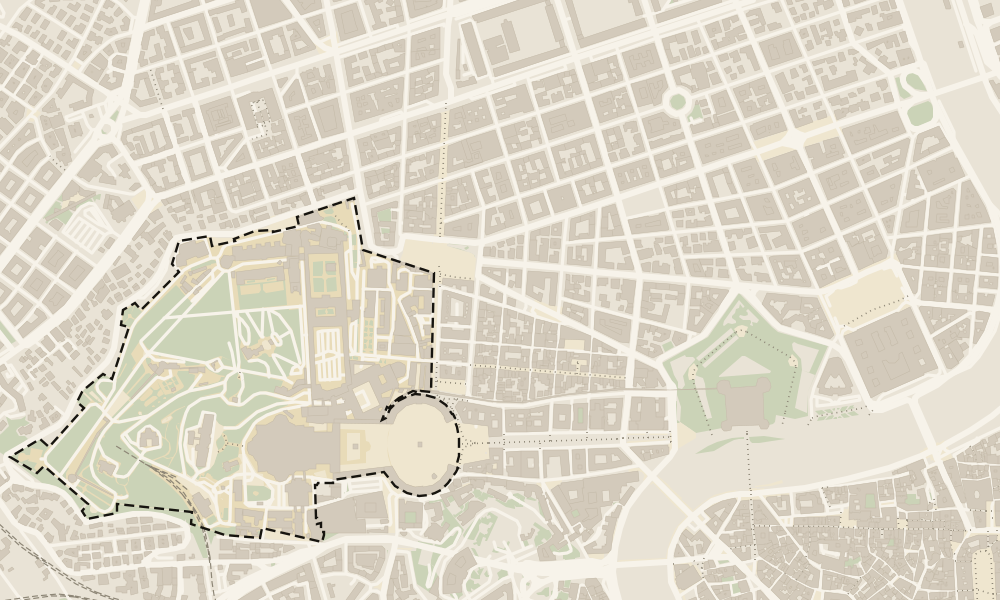 1Castel Sant'Angelo 2Borgo 3Sistine Chapel 4Prati 5Ponte Sant'Angelo 6Vatican Museums 7St Peter's Basilica 8St Peter's Square 9St Peter's Dome 10Vatican Necropolis 11Vatican Gardens 12Swiss Guard 13Seeing the Pope 14Apostolic Palace 15Papal audience 16Angelus 17Who painted it 18Where the Pope lives 19Facts 20Vatican Grottoes 21Pietà 22Baldachin 23Ceiling 24Chair of St Peter 25Last Judgement 26Raphael Rooms 27Architecture and architects 28Gallery of Maps 29Holy Door 30Bramante Staircase 31Facade and balcony 32Mass at St Peter's 33Pio Clementino Museum 34Vatican Pinacoteca 35Gallery of Tapestries 36Gallery of the Candelabra 37Egyptian and Etruscan Museums 38Obelisk 39Bernini's colonnade 40Chiaramonti and Braccio Nuovo 41Christmas 42Anima Mundi Museum 43Easter 44Carriage Pavilion 45Courtyard of the Pine Cone 46Train station 47Borgia Apartment 48Modern art collection 49Pharmacy, shop and petrol
 Map data © OpenStreetMap contributors (ODbL)
- 1Castel Sant'AngeloHadrian's mausoleum, a short walk from the Vatican
- 2BorgoRione XIV, between the colonnade and the Tiber
- 3Sistine ChapelInside the Vatican Museums
- 4PratiRione XXII, the last one Rome created
- 5Ponte Sant'AngeloTen marble angels, and two missing
- 6Vatican MuseumsSeven kilometres of galleries in Vatican City
- 7St Peter's BasilicaConsecrated in 1626, 400 years old this year
- 8St Peter's SquareFree, open to all, and technically another country
- 9St Peter's DomeMichelangelo's dome, 136.57 metres to the cross
- 10Vatican NecropolisThe Scavi tour, by request and with a guide
- 11Vatican Gardens22 hectares behind the museums
- 12Swiss GuardWho guards the Pope, and why they are Swiss
- 13Seeing the PopePope Leo XIV, Wednesdays and Sundays
- 14Apostolic PalaceThe Sistine Chapel is inside, though it doesn't feel like it
- 15Papal audiencePope Leo XIV in St Peter's Square
- 16AngelusSt Peter's Square, Sundays at noon
- 17Who painted itMichelangelo wasn't alone, and he wasn't first
- 18Where the Pope livesApostolic Palace, Santa Marta and Castel Gandolfo
- 19FactsFrom mould on the Flood to visitors' sweat
- 20Vatican GrottoesUnder the basilica, free and without booking
- 21PietàNew protective glass since November 2024
- 22BaldachinBack on view, restored, since October 2024
- 23CeilingMichelangelo, 1508-1512
- 24Chair of St PeterTen years' work and a dove twenty metres up
- 25Last JudgementCleaned between February and March 2026
- 26Raphael RoomsVatican Museums, just before the Sistine
- 27Architecture and architectsTwenty pontificates for one church
- 28Gallery of MapsNumber 8 on the official museum map
- 29Holy DoorClosed by Leo XIV on 6 January 2026
- 30Bramante StaircaseTwo spiral staircases, one name
- 31Facade and balcony116 metres of travertine most people walk past
- 32Mass at St Peter'sNine Masses every weekday, all free
- 33Pio Clementino MuseumClassical sculpture since 1506
- 34Vatican PinacotecaOpened on 27 October 1932
- 35Gallery of TapestriesNumber 7 on the map, between Candelabra and Maps
- 36Gallery of the CandelabraNumber 6 on the map, just before the Tapestries
- 37Egyptian and Etruscan MuseumsNumber 1 on the map, by the Cortile della Pigna
- 38Obelisk330 tonnes of granite without a single hieroglyph
- 39Bernini's colonnade284 columns in four rows that turn into one
- 40Chiaramonti and Braccio NuovoNumbers 2 and 3 on the map, first floor
- 41ChristmasThe 2026 nativity and tree are already announced
- 42Anima Mundi MuseumNumber 21 on the map, in the basement
- 43EasterThe 2026 timetable and what we know of 2027
- 44Carriage PavilionNumber 22 on the map, opened in 1973
- 45Courtyard of the Pine ConePoint CP on the map, open to the sky
- 46Train stationDesigned by Giuseppe Momo, opened in 1933
- 47Borgia ApartmentSix rooms painted in eighteen months
- 48Modern art collectionVan Gogh and Matisse on the way to the Sistine
- 49Pharmacy, shop and petrolOpen to anyone with a paper prescription
0 of 8 Italy guides
Your next stamp
Frequently asked questions
Where is Pope Francis buried?
In the basilica of Santa Maria Maggiore, in the left aisle, between the Pauline Chapel and the Sforza Chapel, near the altar of St Francis of Assisi. He was buried on 26 April 2025 under a slab of Ligurian stone bearing the word FRANCISCVS.
Why is Pope Francis buried in Santa Maria Maggiore?
Because of his devotion to the Salus Populi Romani, the icon in the Pauline Chapel. The basilica recalls that he visited it before and after every journey, and a plaque unveiled in 2026 counts 126 of his visits.
How much does it cost to visit Santa Maria Maggiore?
The basilica itself is free. What you pay for are the museum areas, €7.50 or €4.50 reduced, the art historian's tour at €16.50, the Underground Experience at €13.50 and the audio guide at €7.
What are Santa Maria Maggiore's opening times?
The official website lists the museum complex, Monday to Saturday 8:00 to 18:30 with last entry at 18:00 and Sundays 12:30 to 17:00, and Mass times, the first at 07:00 on weekdays. It gives no general opening hours for the basilica.
Is Santa Maria Maggiore part of the Vatican?
It belongs to the Holy See, which isn't the same thing. The Lateran Treaty recognises its ownership and the immunities of a diplomatic mission, but the basilica is on Italian territory and isn't part of Vatican City State.
Which popes are buried in Santa Maria Maggiore?
Eight, according to the basilica. Honorius III, Nicholas IV, Pius V, Sixtus V, Clement VIII, Paul V, Clement IX and Francis. Sixtus V and Pius V have their monuments in the basilica's Sistine Chapel.
What should I wear to Santa Maria Maggiore?
The basilica asks for modest dress. No sleeveless or low-cut tops, shorts above the knee, miniskirts or hats, and no dogs other than assistance dogs.
By
Tourism graduate with a master’s in Tourism Management and Planning from the University of Málaga, who has travelled across Europe. He writes every guide from official sources and his own judgement.
Published on . Facts checked on .
Sources
Photos: NikonZ7II (CC BY-SA 4.0), via Wikimedia Commons.