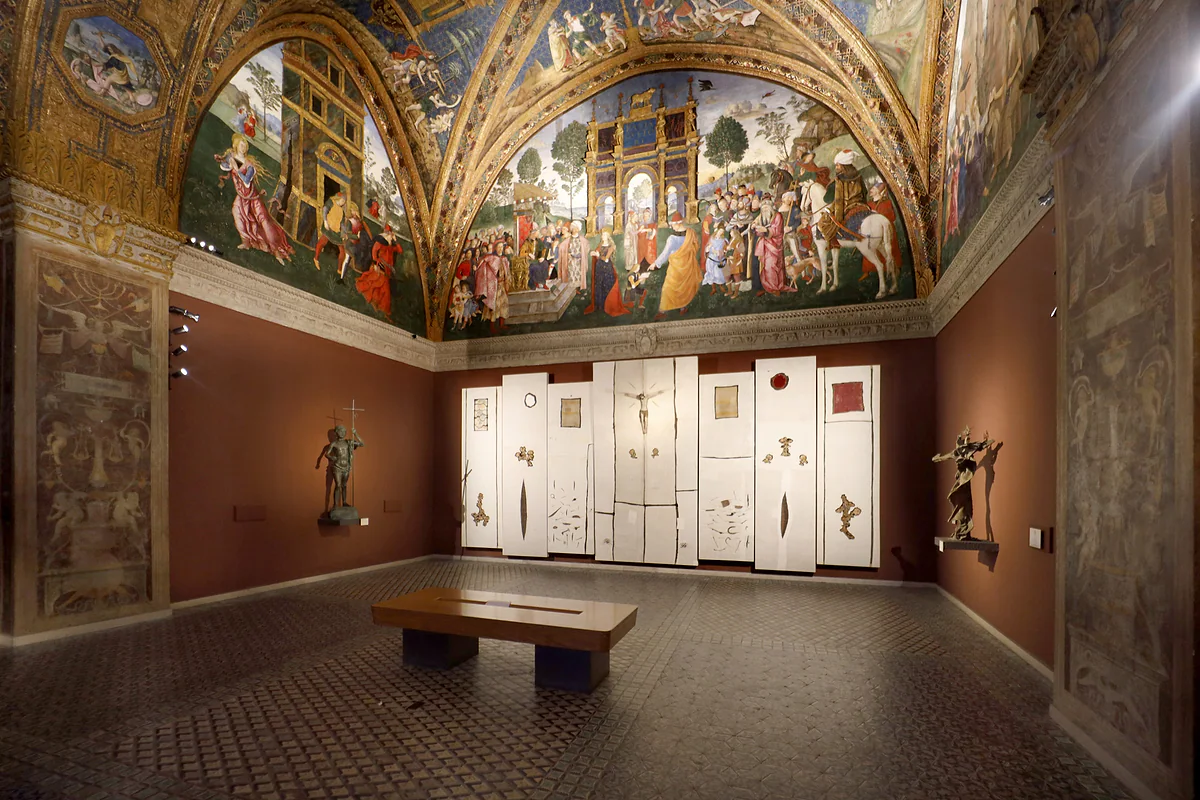
Six rooms painted in eighteen months
The Borgia Apartment, the rooms Julius II couldn't bear to live in
The Borgia Apartment is six rooms of the Apostolic Palace decorated by Pinturicchio for Alexander VI, the Borgia pope, between autumn 1492 and early 1494. They're now on the Vatican Museums route and house part of the Modern Art Collection. You see them with a standard ticket, €20 or €25 booked online, on the way to the Sistine Chapel.
In 30 seconds
Full read: 3 min
- The Borgia Apartment is six rooms of the Apostolic Palace painted by Pinturicchio for Alexander VI.
- He decorated them at speed, from autumn 1492 to early 1494, mostly painting on dry plaster.
- Julius II refused to live there because of his predecessor and moved upstairs, to the Raphael Rooms.
- Today they're on the Museums route to the Sistine and house part of the modern art collection.
- They're included in the ticket, €20 or €25 booked, and free on the last Sunday of the month.
My advice is not to rush through on your way to the Sistine Chapel, which is what nearly everyone does. Ten minutes in the Hall of the Saints, taking in Pinturicchio's gold and raised plasterwork, tells you more about the Spanish pope's taste than any guidebook summary.

Before you go
What I would keep in mind
-
01 Most beautiful
The Hall of the Saints
The one I'd stop in, with lunettes crowded with figures and gilded relief. For me it shows exactly why Pinturicchio was Alexander VI's favourite painter.
Vatican modern art collection -
02 My tip
It's on the way to the Sistine
The Museums route passes through the Borgia Apartment before the Sistine Chapel, with the modern art collection in its rooms. No detour needed, just don't speed up.
the Vatican Museums map -
03 To save money
Free on the last Sunday of the month
Like the rest of the Museums, it's free on the last Sunday of the month from 09:00 to 14:00, last entry 12:30. In 2026 that leaves 25-10, 29-11 and 27-12.
Is the Sistine Chapel free? -
04 Worth the splurge
Some doors stay shut whatever you pay
The Room of the Vestments, the Galleriola, the Room of the Falda and Nicholas V's cubicle aren't open. The Museums' paid special openings cover other areas, such as the Niccoline Chapel.
Private Vatican tours and what's worth paying for
My priorities
Unmissable
- Stop in the Hall of the Saints and look at the gilded plasterwork
- See the Raphael Rooms upstairs to compare two neighbouring popes
If you have time
I would skip
- Rushing through because the Sistine is next door
- Using flash, banned throughout the museum
What I would book
- Tours and ticketsGetYourGuide Museums with a guide Many groups march through the Borgia Apartment without stopping. If you want Pinturicchio and the Borgia pope explained, pick a tour that isn't in a hurry.
- Places to stayBooking.com Prati, for the 08:00 entry First thing, the route to the Sistine is calm and you can linger in these rooms without being jostled.
My ranking, scored
The six Borgia rooms, my way
My own scores out of 10. They weigh how much Pinturicchio you see in each room and what it adds for someone passing through to the Sistine. All six are on the same ticket.
0 of 6 seen
-
Hall of the Saints
In the wing of Nicholas V, one of the pope's three private rooms. To my eye it shows off Pinturicchio's gold best, so if you stop in one, make it this.
9.4 out of 10
-
Hall of the Mysteries
Another of the three 'secret rooms' in the Nicholas V wing, the pope's private quarters according to his master of ceremonies' diary.
8.6 out of 10
-
Hall of the Liberal Arts
The third private room. Two small rooms opened off it, probably a bedroom and a bathroom.
8.3 out of 10
-
Hall of the Sibyls
In the Borgia Tower, the part the pope added to the palace. With the Creed room it makes up the tower pair.
7.8 out of 10
-
Hall of the Creed
The second Borgia Tower room. I rank it here because I see it more in passing than the private rooms.
7.5 out of 10
-
Hall of the Popes
In the oldest wing, Nicholas III's (1277-1280). Last on my list purely on personal taste.
7.2 out of 10
The Borgia Apartment is one of the Vatican Museums stops that most people cross without looking, because it’s on the way to the Sistine Chapel and everyone’s in a hurry. I think that’s a mistake. These are the rooms of a Spanish pope with a terrible reputation, painted in record time by one of the best painters of his day, and they tell a great story about papal grudges. Here’s what’s in each room and how to see them without losing your place for the Sistine.
The Spanish pope and his rooms
Rodrigo de Borja, Borgia in Italian, was elected pope on the death of Innocent VIII and took the name Alexander VI. His pontificate, 1492 to 1503, coincided with the arrival in the Americas and the great jubilee of 1500. He lived on the first level of the Apostolic Palace and had six monumental rooms remodelled and decorated, the ones that now carry his surname.
They aren’t all in the same building. The Halls of the Sibyls and of the Creed are in the Borgia Tower. The Halls of the Liberal Arts, the Saints and the Mysteries are in the wing built by Nicholas V, and the diary of Johannes Burckhardt, the pope’s master of ceremonies, calls them ‘camere segrete’, as they were for his private use. The Hall of the Popes is in the oldest wing, Nicholas III’s, from the 13th century. Other rooms of that residence stay closed, namely the Room of the Vestments, the Galleriola, the Room of the Falda and Nicholas V’s cubicle.
Who painted the Borgia Apartment?
Bernardino di Betto, whom everyone called Pinturicchio, ‘the little painter’, because of his size. He signed that way himself. He started out at the Vatican in Perugino’s team, when the Sistine walls were being painted (see who painted the Sistine Chapel), and ended up serving five successive popes.
What strikes me most is the speed. The decoration went up between autumn 1492 and early 1494, little more than a year. The Museums give two reasons. A well-run team, with Piermatteo d’Amelia, Benedetto Bonfigli, Pietro d’Andrea and Antonio da Viterbo, and a quick technique. Pinturicchio painted mostly on dry plaster, over a layer of gypsum and glue, and only partly in true fresco, which gave him more pigments and a finish almost like a panel painting. On top came gilded stucco and raised decoration everywhere. The theologian Annio da Viterbo may have devised the scheme.
Julius II couldn’t stand it
This is the story I like best. When Alexander VI died, his near-immediate successor, Julius II, abandoned the apartment. According to the Museums, he didn’t want a constant reminder of his hated predecessor, so he moved upstairs, to the rooms Raphael later painted. In other words, the Raphael Rooms exist partly because of a grudge.
The apartment then had several lives. ‘Cardinal nephews’ such as St Charles Borromeo lived there, it became Pius VII’s picture gallery in 1816 and Cardinal Mai’s library, and only in the late 19th century did Leo XIII open it to the public after a thorough restoration.
The 20th century under a 15th-century ceiling
Since 1973 these rooms have displayed part of the Vatican modern art collection, which is why 20th-century pieces hang beneath Pinturicchio’s lunettes. Some visitors find it jarring. I find it one of the most interesting things in the Museums, because it makes you look at two eras on the same wall.
What’s special about Pinturicchio’s technique?
He was after the effect of a panel painting on a wall. Working on dry plaster let him use pigments and lakes true fresco won’t take, and he then added stucco and raised gilded detail, so these walls shine quite differently from the Raphael Rooms just above. My tip is to see the two back to back. Upstairs, Raphael’s clarity. Downstairs, Pinturicchio’s almost goldsmith-like luxury. Two opposite ideas of the same palace, only a few years apart.
Fitting it into your visit
It costs nothing extra, as it sits on the ordinary Vatican Museums route. I’d give it ten minutes and stop above all in the Hall of the Saints. In the first slot, 08:00, you’ll have it almost to yourself. And if you’re curious what else of the palace you can and can’t see, I’ve gathered it on the page about the Apostolic Palace.
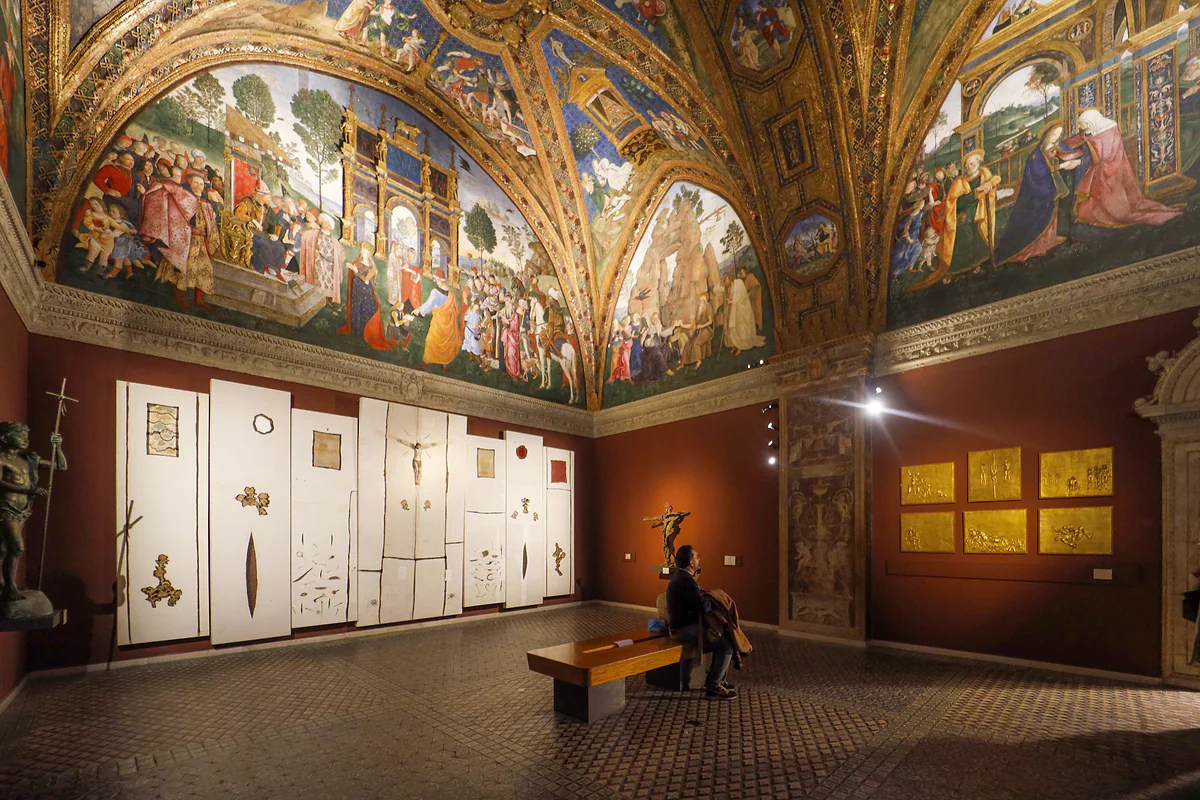
Works from the Modern and Contemporary Art Collection beneath the vaults Pinturicchio painted in the Borgia Apartment of the Vatican Museums.
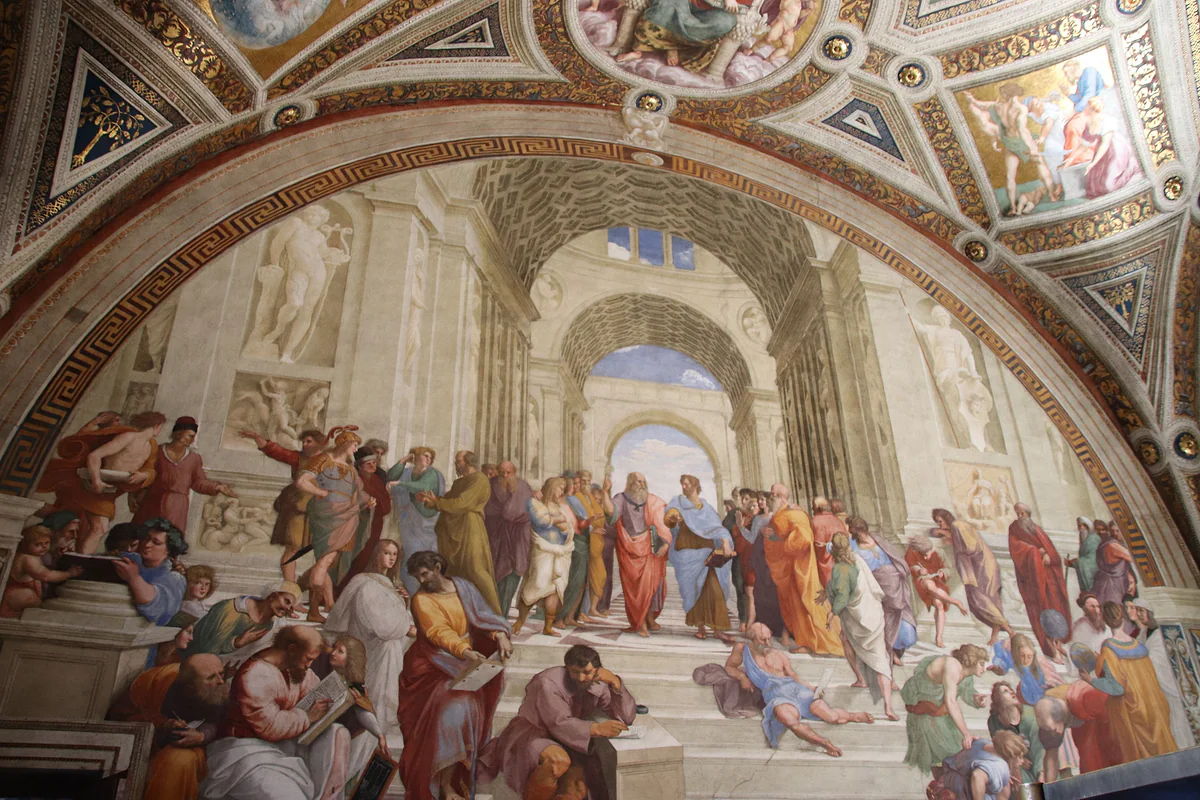
Raphael's School of Athens in the Room of the Segnatura in the Vatican Museums, with part of the painted vault above.
The rooms of the Borgia Apartment
| Room | Where it is | Open |
|---|---|---|
| Hall of the Sibyls | Borgia Tower | Yes |
| Hall of the Creed | Borgia Tower | Yes |
| Hall of the Liberal Arts | Nicholas V wing | Yes |
| Hall of the Saints | Nicholas V wing | Yes |
| Hall of the Mysteries | Nicholas V wing | Yes |
| Hall of the Popes | Nicholas III wing | Yes |
| Room of the Vestments, Galleriola, Room of the Falda and Nicholas V's cubicle | First level of the palace | No |
Vatican Museums. The three Nicholas V rooms are the ones the diary of Johannes Burckhardt, the pope's master of ceremonies, calls 'camere segrete'.
Who painted the apartment
| Who | Role |
|---|---|
| Bernardino di Betto, Pinturicchio | Lead painter |
| Piermatteo d'Amelia, Benedetto Bonfigli, Pietro d'Andrea and Antonio da Viterbo 'il Pastura' | Team |
| Bartolomeo di Giovanni and Raffaellino del Garbo | Added by recent scholarship |
| Annio da Viterbo | Possibly devised the scheme, say the Museums |
Vatican Museums, Borgia Apartment page.
Test yourself
True or false?
0/4 Pick before you peek.
-
The Borgia Apartment is named after Pope Alexander VI.
See the answer
True. Alexander VI was the Spaniard Rodrigo de Borja, Borgia in Italian, pope from 1492 to 1503, who had these rooms remodelled and decorated.
-
Julius II lived in the Borgia Apartment.
See the answer
False. He abandoned it so as not to be reminded of his predecessor and moved upstairs, to what are now the Raphael Rooms.
-
Pinturicchio painted these rooms almost entirely in true fresco.
See the answer
False. According to the Museums, he mostly painted on dry plaster over a layer of gypsum and glue, which was quicker and allowed more pigments.
-
The Borgia Apartment now displays 20th-century art.
See the answer
True. It houses part of the Modern and Contemporary Art Collection that Paul VI opened in 1973.
- Monumental rooms open to visitors
- 6
- Years Pinturicchio painted them
- 1492-1494
- Alexander VI's pontificate
- 1492-1503
- Year the modern art collection arrived
- 1973
0 of 88 Vatican City guides
Your next stamp
- Raphael Rooms
- Apostolic Palace
- Vatican Pinacoteca
- Sistine Chapel
- Gallery of Tapestries
- Papal Palace
- Modern art collection
- Who painted it
- Things to do
- One day
- Tickets
- Two days
- Vatican Museums
- St Peter's Basilica
- St Peter's Square
- St Peter's Dome
- Vatican Necropolis
- Vatican Gardens
- Swiss Guard
- Seeing the Pope
- How to visit
- Castel Gandolfo
- Where to eat
- Free and cheap
- Scams to avoid
- Getting there
- Money and payments
- Exclusive experiences
- Papal audience
- Angelus
- Where the Pope lives
- Where to stay
- Dress code
- Facts
- Opening hours
- Map
- Flag
- Post office and stamps
- Is it a country?
- Vatican Grottoes
- History
- Pietà
- Baldachin
- Ceiling
- Chair of St Peter
- Last Judgement
- Architecture and architects
- Gallery of Maps
- Holy Door
- Library and Archives
- Bramante Staircase
- Facade and balcony
- Mass at St Peter's
- Pio Clementino Museum
- Papal blessing
- Catacombs
- Gallery of the Candelabra
- Egyptian and Etruscan Museums
- Obelisk
- Vatican Museums map
- Bernini's colonnade
- How long you need
- Night opening
- Chiaramonti and Braccio Nuovo
- Christmas
- Anima Mundi Museum
- Easter
- Carriage Pavilion
- Gift shops and souvenirs
- With kids
- Best time to visit
- Courtyard of the Pine Cone
- Photography
- Train station
- Accessible travel
- Vatican Observatory
- Barberini Gardens
- Facts
- Getting there
- Holy See
- Lake Albano
- Police and army
- Passport
- Pharmacy, shop and petrol
- What Vatican means
- Papal tombs
- List of popes
Frequently asked questions
What is the Borgia Apartment in the Vatican?
Six rooms on the first level of the Apostolic Palace that Pope Alexander VI, Rodrigo de Borja, had remodelled and decorated during his pontificate, 1492 to 1503. Pinturicchio painted them with his team, and they're now part of the Vatican Museums.
Who painted the Borgia Apartment?
Bernardino di Betto, known as Pinturicchio, with a team including Piermatteo d'Amelia, Benedetto Bonfigli, Pietro d'Andrea and Antonio da Viterbo. They worked fast, from autumn 1492 to early 1494.
Can you visit the Borgia Apartment?
Yes, it's included in the Vatican Museums ticket, €20 at the desk or €25 booked online, and it's on the route to the Sistine Chapel. The Room of the Vestments, the Galleriola, the Room of the Falda and Nicholas V's cubicle aren't open.
Why didn't Julius II live in the Borgia Apartment?
According to the Vatican Museums, he didn't want a constant reminder of his hated predecessor, Alexander VI. He moved upstairs, to the rooms we now know as the Raphael Rooms.
Why was the painter called Pinturicchio?
It was a nickname, 'little painter', for his slight build, and he signed with it himself. His real name was Bernardino di Betto, and he trained in Perugino's workshop while Perugino was painting in the Sistine Chapel.
What's in the Borgia Apartment today?
Besides Pinturicchio's paintings, part of the Modern and Contemporary Art Collection that Paul VI opened in 1973. So the 15th and 20th centuries share the same rooms.
By
Tourism graduate with a master’s in Tourism Management and Planning from the University of Málaga, who has travelled across Europe. He writes every guide from official sources and his own judgement.
Published on . Facts checked on .
Sources
Photos: Fabrizio Garrisi (CC BY-SA 4.0); Fabrizio Garrisi (CC BY-SA 4.0); Gary Todd from Xinzheng, China (Public domain), via Wikimedia Commons.