Point CP on the map, open to the sky
The Courtyard of the Pine Cone, a Roman fountain and a modern sphere
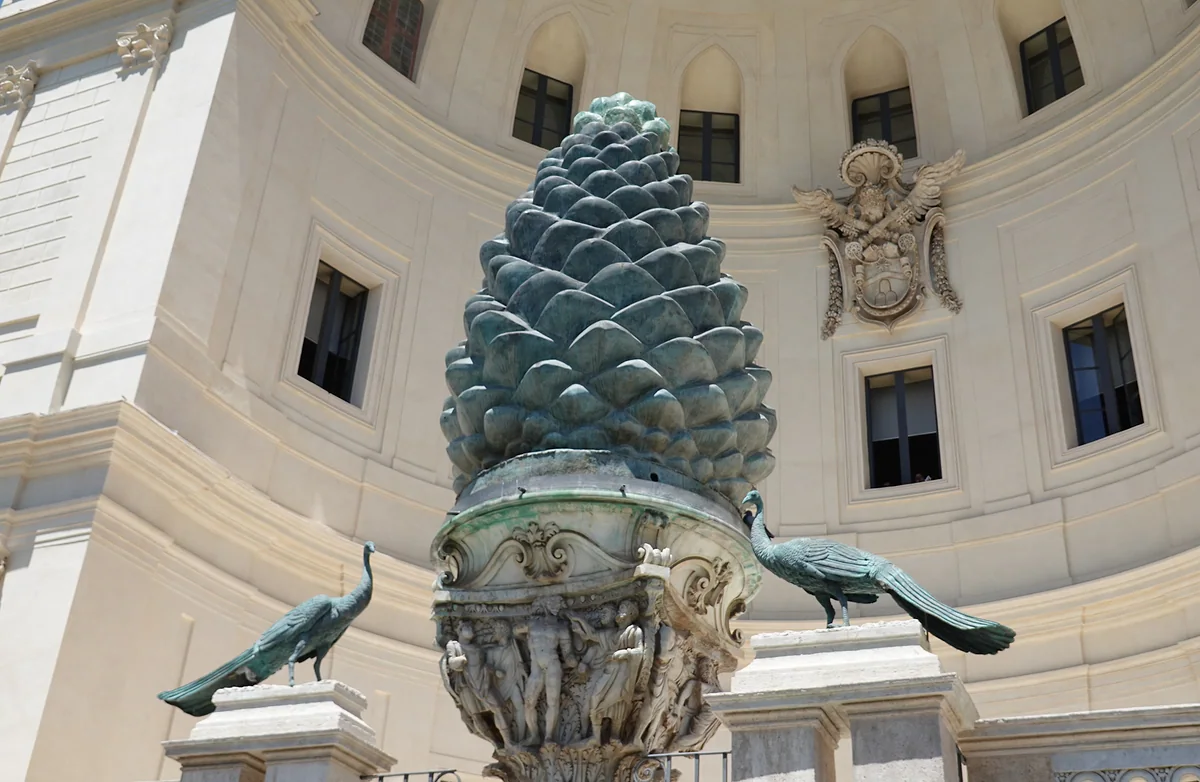
The Courtyard of the Pine Cone (Cortile della Pigna) is the big open-air courtyard of the Vatican Museums. It's named after a colossal bronze pine cone, a 2nd-century Roman fountain found in the Campus Martius that stood in the atrium of Old St Peter's and moved here in 1608. In the middle sits Arnaldo Pomodoro's Sphere Within Sphere. It's covered by the Museums ticket.
In 30 seconds
Full read: 3 min
- The Courtyard of the Pine Cone is the big open-air courtyard of the Vatican Museums, marked CP on the map.
- The Pine Cone is a 2nd-century Roman bronze fountain that stood in the atrium of Old St Peter's and reached the courtyard in 1608.
- It sits in the great niche Pirro Ligorio built in 1562, with the Egyptian lions of Nectanebo I at its feet.
- The sphere in the middle is Sfera con sfera, a bronze by Arnaldo Pomodoro.
- It's a rest area with panels on the Sistine Chapel, and I'd take my morning break here.
This is where I'd take my mid-morning break, before heading up to the galleries. Sit down, look at the Pine Cone with the Egyptian lions at its feet, read the Sistine Chapel panels in the courtyard, and then walk into the chapel knowing what you're about to see.

Before you go
What I would keep in mind
-
01 Most beautiful
A fountain medieval pilgrims already knew
The Pine Cone stood in the atrium of Old St Peter's, where it spouted water for ritual washing. Dante uses it in the Inferno to give the size of a giant's face.
-
02 My tip
Read up on the Sistine here, where talking is allowed
The museums put panels explaining the Sistine Chapel in the Cortile della Pigna, because inside the chapel silence is required and guides can't speak. I'd read them sitting in the courtyard.
Sistine Chapel -
03 To save money
An open-air break at no extra cost
The courtyard has no ticket of its own; it comes with the Museums, and the official website lists it as a rest area with seating. On the last Sunday of the month you're here for free.
Is the Sistine Chapel free? -
04 Worth the splurge
Table service in the courtyard itself
The Bistrot La Pigna, in the courtyard, is the only place in the museums with table service. It's where I'd treat myself to a proper sit-down lunch without leaving the route.
Restaurants near Vatican City
My priorities
Unmissable
- The bronze Pine Cone and the lions of Nectanebo at its feet
- The panels explaining the Sistine Chapel before you go in
If you have time
I would skip
- Swallowing the esoteric theories about the Pine Cone, which have no official source
- Snapping the sphere and moving on without looking at the courtyard around it
What I would book
- Places to stayBooking.com Prati, to reach the courtyard while it's calm First thing in the morning the courtyard is almost empty and the Pine Cone can be photographed with nobody in front. From Prati you can walk to the 08:00 slot.
- Tours and ticketsGetYourGuide A tour that briefs you on the Sistine outside Since nobody can talk inside the Sistine, guides explain it beforehand. I'd pick a tour that does it here, with entry included.
My ranking, scored
What I'd look at in the courtyard, in order
My own scores out of 10, weighing what each piece says about the Vatican's history. Facts about the Pine Cone, the Nicchione and the peacocks come from the official website; those about the sphere come from unofficial sources, and I say so.
0 of 5 seen
-
The bronze Pine Cone
A 2nd-century Roman fountain, found in the Campus Martius, that spent centuries in the atrium of Old St Peter's. It has named the courtyard since arriving in 1608.
9.3 out of 10
-
The lions of Nectanebo I
The two Egyptian lions at the Pine Cone's feet. They're the originals, brought into the museum in 1839.
8.6 out of 10
-
Pirro Ligorio's Nicchione
The huge 1562 niche on the north side of the courtyard, modelled on the apses of the Roman Forum. It replaced a low exedra designed by Bramante.
8.2 out of 10
-
Pomodoro's Sphere Within Sphere
A bronze by Arnaldo Pomodoro placed in the centre of the courtyard in 1990, according to unofficial sources. It's the photo everyone takes and the thing least often explained.
7.8 out of 10
-
The Braccio Nuovo portico
The portico of the Braccio Nuovo opens onto the courtyard, and that neoclassical gallery is where the bronze peacocks that once flanked the Pine Cone ended up.
7.2 out of 10
The Courtyard of the Pine Cone is where you finally get to breathe in the Vatican Museums. After a stretch of enclosed rooms you step out into a vast open courtyard, with a giant bronze pine cone in a niche and a sphere gleaming like gold in the middle that everyone photographs. For me it’s the best place in the museums to stop, and also one of the worst explained, because hardly anyone knows what they’re looking at. Here’s the lot, keeping what the official website says apart from what only other sources claim. To place it in your visit, see how I’d plan a day at the Vatican Museums.
So what is the Pine Cone?
It’s a fountain. The museums describe it as a colossal bronze pine cone that began life as a Roman fountain in the 2nd century AD. It was found in the Campus Martius, the area around the Pantheon, and later moved to the colonnaded atrium of Old St Peter’s, where pilgrims would have seen it on the way in. In 1608, with the new basilica going up, it was brought to this courtyard, which has carried its name ever since.
The official website gives no measurements. Encyclopaedias say it’s almost four metres tall, and I’d take that as a guide rather than a hard fact. What’s beyond doubt is how famous it was. Dante uses it in Canto XXXI of the Inferno to convey the size of the giant Nimrod’s face, which struck him as long and broad «come la pina di San Pietro a Roma».
As for what it means, this is where the internet gets carried away. All sorts of theories circulate, but the museums’ website says only that it was a Roman fountain, and I wouldn’t claim anything beyond that.
A niche from 1562 and two Egyptian lions
The Pine Cone sits in the Nicchione, the great niche that closes the courtyard on its north side. Pirro Ligorio built it in 1562 under Pius IV, modelled on the apses of the Roman Forum, replacing the low exedra Bramante had designed to finish off the old Belvedere Courtyard. Above it is the terrace of the Vatican Egyptian Museum, and at the Pine Cone’s feet lie the two lions of Pharaoh Nectanebo I.
Its long-time companions are missing. In the atrium of Old St Peter’s, the Pine Cone crowned a fountain for ritual washing, the Cantharus, flanked by two gilded bronze peacocks. In 1608 they came to the courtyard with it and were later moved, for safekeeping, into the Braccio Nuovo of the Chiaramonti Museum, whose portico opens onto the courtyard.
The sphere in the middle
The sculpture everyone photographs is Sfera con sfera, Sphere Within Sphere, by Arnaldo Pomodoro. The museums’ website has no page on it, so what follows comes from Wikipedia. It was placed in the centre of the courtyard in 1990 and belongs to a series of spheres the sculptor made in various sizes for sites around the world. According to the same source, the spheres stand for a kind of ideal city, and Pomodoro talked about breaking these perfect forms open to reveal the ferment inside, with parts that resemble gears.
It isn’t gold, however much it looks it. It’s polished bronze, and that’s where the shine comes from. I’d walk right round it rather than shooting it from the front, because the broken-open side, with its cogs and teeth, is far more interesting than the smooth one everybody photographs.
Making the most of the courtyard
The museums list it as a rest area with seating and put panels in it explaining the Sistine Chapel, because inside the chapel total silence is expected. I’d read them here, sitting down, before heading up to the galleries. If you want a sit-down meal without leaving the museums, the Bistrot La Pigna is in the courtyard itself. And one detail I love, beneath your feet lies a two-storey Vatican Archives bunker opened by John Paul II in 1980, which I cover in the Vatican Library and Archives.
The courtyard in numbers
| What | Detail | Source |
|---|---|---|
| The Pine Cone | 2nd-century Roman bronze fountain, found in the Campus Martius | Vatican Museums |
| Before | Atrium of Old St Peter's | Vatican Museums |
| In the courtyard | Since 1608 | Vatican Museums |
| Nicchione | Pirro Ligorio, 1562, under Pius IV | Vatican Museums |
| Sphere | «Sfera con sfera», Arnaldo Pomodoro, 1990 | Wikipedia (unofficial) |
| Pine Cone height | Almost four metres | Wikipedia (unofficial) |
The museums' website calls the Pine Cone colossal but gives no height, and has no page on the sphere. That's why those two rows carry their source.
Tickets and hours (2026)
| What | Detail |
|---|---|
| Standard ticket | €20 at the desk, €25 booked online |
| Reduced | €10 at the desk, €15 online |
| Monday to Saturday | 08:00-20:00, last entry 18:00 |
| Last Sunday of the month | 09:00-14:00, free, last entry 12:30 |
The courtyard is inside the Museums route and can't be reached from the street.
Test yourself
True or false?
0/4 Pick before you peek.
-
The Vatican's Pine Cone was cast in the Renaissance to decorate the courtyard.
See the answer
False. It's a 2nd-century Roman bronze fountain found in the Campus Martius. Before reaching the courtyard in 1608 it stood in the atrium of Old St Peter's.
-
The two lions at the Pine Cone's feet are Egyptian originals.
See the answer
True. They're the lions of Pharaoh Nectanebo I. They once stood outside the Pantheon and on the Acqua Felice fountain, where copies now stand, and Gregory XVI brought them to the museum in 1839.
-
The great niche framing the Pine Cone is by Bramante.
See the answer
False. It's by Pirro Ligorio, from 1562. It replaced a low exedra by Bramante that rose no higher than the façade.
-
The sphere in the middle of the courtyard is solid gold.
See the answer
False. It's polished bronze by Arnaldo Pomodoro, from his Sfera con sfera series. It shines, but it isn't gold.
- Age of the Pine Cone's Roman fountain
- 2nd century
- Year the Pine Cone reached the courtyard
- 1608
- Pirro Ligorio's Nicchione
- 1562
0 of 88 Vatican City guides
Your next stamp
- Pio Clementino Museum
- Sistine Chapel
- Egyptian and Etruscan Museums
- History
- Gallery of Maps
- Vatican Pinacoteca
- Map
- Gallery of Tapestries
- Things to do
- One day
- Tickets
- Two days
- Vatican Museums
- St Peter's Basilica
- St Peter's Square
- St Peter's Dome
- Vatican Necropolis
- Vatican Gardens
- Swiss Guard
- Seeing the Pope
- How to visit
- Castel Gandolfo
- Where to eat
- Free and cheap
- Apostolic Palace
- Scams to avoid
- Getting there
- Money and payments
- Exclusive experiences
- Papal audience
- Angelus
- Who painted it
- Where the Pope lives
- Where to stay
- Dress code
- Facts
- Opening hours
- Flag
- Post office and stamps
- Is it a country?
- Vatican Grottoes
- Pietà
- Baldachin
- Ceiling
- Chair of St Peter
- Last Judgement
- Raphael Rooms
- Architecture and architects
- Holy Door
- Library and Archives
- Bramante Staircase
- Facade and balcony
- Mass at St Peter's
- Papal blessing
- Catacombs
- Gallery of the Candelabra
- Obelisk
- Vatican Museums map
- Bernini's colonnade
- How long you need
- Night opening
- Chiaramonti and Braccio Nuovo
- Christmas
- Anima Mundi Museum
- Easter
- Carriage Pavilion
- Gift shops and souvenirs
- With kids
- Best time to visit
- Photography
- Train station
- Accessible travel
- Vatican Observatory
- Borgia Apartment
- Modern art collection
- Papal Palace
- Barberini Gardens
- Facts
- Getting there
- Holy See
- Lake Albano
- Police and army
- Passport
- Pharmacy, shop and petrol
- What Vatican means
- Papal tombs
- List of popes
Frequently asked questions
What is the sphere within a sphere in the Vatican?
It's Sfera con sfera, a bronze by Arnaldo Pomodoro, one of a series of spheres he made in different sizes for sites around the world. According to Wikipedia it was placed in the centre of the Cortile della Pigna in 1990. The museums' website has no page on it.
What does the sphere within a sphere at the Vatican mean?
The museums don't explain it. According to Wikipedia, Pomodoro's spheres stand for a kind of ideal city, and he spoke of breaking these perfect forms open to reveal the ferment inside, with parts that look like gears.
Is the Vatican sphere made of gold?
No. It's polished bronze, which is why it gleams as if it were gilded. The broken-open section shows the inner workings Pomodoro exposed across the whole series.
What is the giant pine cone at the Vatican?
According to the Vatican Museums, a 2nd-century Roman bronze fountain found in the Campus Martius that stood in the atrium of Old St Peter's before moving to this courtyard in 1608. The official website gives it no symbolic meaning, so the esoteric theories doing the rounds have no official backing.
Where is the Pine Cone Courtyard?
Inside the Vatican Museums, marked CP on the official map, next to the Egyptian Museum (1) and the Braccio Nuovo (3). You can't get in from the street, only with a Museums ticket.
Can you eat in the Cortile della Pigna?
Yes, at the Bistrot La Pigna in the courtyard itself, which has table service, Italian dishes and an American breakfast. Outside the cafés, eating isn't allowed in the galleries.
By
Tourism graduate with a master’s in Tourism Management and Planning from the University of Málaga, who has travelled across Europe. He writes every guide from official sources and his own judgement.
Published on . Facts checked on .
Sources
Photos: Richard Mortel (CC BY 2.0), via Wikimedia Commons.