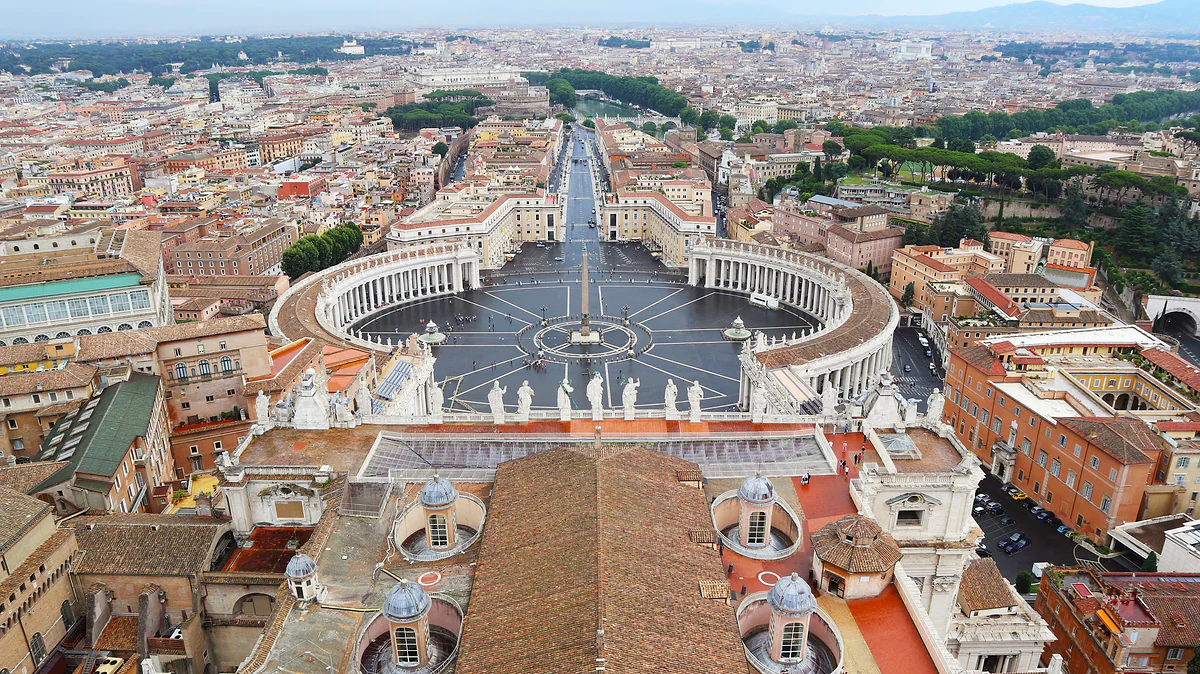
A country where nobody is born a citizen
Twelve Vatican City facts hardly anyone tells you, all with a source
Vatican City is a 0.44 km² country, half of it gardens, where nobody becomes a citizen by being born there, with no army since 1970 and a dialling code, +379, that's reserved and unused. In its square a wind rose spells 'west' in English, and a clock on St Peter's facade counts the hours from sunset. Here are twelve facts, each with its official source.
In 30 seconds
Full read: 4 min
- In Vatican City nobody is a citizen by birth; citizenship is tied to an office or job.
- Half its territory, about 22 of its 44 hectares, is the Vatican Gardens.
- It's been assigned the +379 dialling code but uses Italy's +39.
- In the square, the wind rose spells 'west' in English and a facade clock counts from sunset.
- It has had no army since 1970 and may mint at most a million euros a year in coins.
I like Vatican facts because they aren't random trivia; they're clues to how odd this country is. I'd pick three for dinner-table conversation, the 'west' in the square, the one-handed clock and the fact that nobody is born Vatican. Then I'd go and see them, because two are in the square and cost nothing.

Before you go
What I would keep in mind
-
01 Most beautiful
The 'west' in the wind rose
On the discs around the obelisk, the basilica side says 'west' in English and the opposite side 'est', not 'east'. The Holy See's own website points it out.
Vatican obelisk -
02 My tip
The clock that counts from sunset
One of the two clocks on St Peter's facade has a single hand and shows old Italian time, which started counting when the sun went down.
the pope's balcony on St Peter's facade -
03 My tip
Nobody is born Vatican
Citizenship isn't inherited or gained at birth. It's tied to living there because of an office or job, and it's lost when that ends.
passport for the Vatican -
04 To save money
Most of these facts are free to see
The wind rose, the meridian line, the clocks, the Angelus window and the Swiss Guard are all visible from the square, with no ticket.
Is the Sistine Chapel free?
My priorities
Unmissable
If you have time
I would skip
- Repeating unsourced legends, which the Vatican attracts in abundance
- Confusing the Vatican with the Holy See
My ranking, scored
My twelve Vatican City facts, most surprising first
My own scores out of 10, for how much each fact surprised me when I checked it against the official source. All are verified; the ones that only circulate unsourced are left out.
0 of 12 seen
-
Nobody is a citizen by birth
Citizenship is tied to residence for an office or job and lost when it ends. At 31-12-2024 there were 618 citizens, and only 246 lived inside.
9.6 out of 10
-
A one-handed clock
On St Peter's facade, the northern clock shows old Italian time, counted from sunset.
9.2 out of 10
-
An accidentally bilingual wind rose
It says 'west' in English on one side and 'est' on the other. The only foreign word in the square.
9.0 out of 10
-
Its own dialling code, unused
The ITU assigns it +379, reserved for future use. In practice Vatican numbers start with +39 06 698.
8.8 out of 10
-
Half the country is garden
The Vatican Gardens cover about 22 of the state's 44 hectares.
8.6 out of 10
-
No army since 1970
Paul VI abolished every military corps except the Swiss Guard. The police force is the Gendarmerie.
8.5 out of 10
-
Six bells that confirm a pope
When all six ring together after the white smoke, it's the final confirmation of a new pope.
8.3 out of 10
-
A cap on coins
It may mint at most a million euros' worth of coins a year, and they're struck in Italy.
8.0 out of 10
-
Vatican Radio, built by Marconi
Pius XI opened it on 12 February 1931, built by Guglielmo Marconi.
7.8 out of 10
-
An obelisk without hieroglyphs
The only one in Rome with no Egyptian inscriptions, and it already stood in Caligula's circus in Peter's day.
7.6 out of 10
-
An observatory in Arizona
The Vatican Observatory's telescope, the VATT, is on Mount Graham in the United States.
7.4 out of 10
-
A pharmacy open to all
Anyone with a paper prescription can buy at the Vatican Pharmacy, via the St Anne's Permit Office.
7.0 out of 10
Countless Vatican facts do the rounds, and a good share have no source beyond another website that copied them. I’ve done the opposite here. I’ve picked twelve I could check against official sources, ranked them by how much they surprised me, and told you where to see them, because several are in the square and free.
A country where nobody is born a citizen
This is my favourite. Nobody is Vatican by birth or by descent. It comes with residence for an office or job, and it’s lost when that job ends. The result is tiny numbers. At the end of 2024, of its 618 citizens only 246 lived inside, and 104 of those were Swiss Guards. Counting non-citizens, there were 882 inhabitants.
The territory is just as odd. It’s 0.44 km², 44 hectares, and the Vatican Gardens take up about 22 of them, half the state. You can only see them with a guide or from the open-top bus, as covered in the Vatican Gardens.
Facts you can see free in the square
St Peter’s Square hides two details almost nobody looks for. The first is in the paving around the obelisk. In 1817 sixteen marble discs were set there naming the winds, and on the basilica side someone carved ‘west’, in English, while the far side reads ‘est’ rather than ‘east’. The Holy See’s website mentions it with some amusement. It’s the only foreign word in the square, and I cover it with the meridian line on the page about the Vatican obelisk.
The second is up on the basilica facade. Its two clocks look like twins, but the right-hand one as you face it has only one hand, because it kept time the old Italian way, from dusk. On the same facade, to the left, hang six bells which, when they ring all at once, confirm there’s a new pope. It’s all on my page about St Peter’s facade.
A state with state-sized quirks
Since 1970 the only armed force the Vatican has kept is the Swiss Guard. It does have police, the Gendarmerie, and its own courts, with appeal and cassation, as I explain in Vatican police and army.
It also has its own dialling code, +379, assigned by the International Telecommunication Union but marked as reserved for future use. In practice it uses Italy’s +39, and its numbers start with +39 06 698. Online, its suffix is .va, which dates from 1995. And there’s a curious limit on money. It uses the euro by agreement with the European Union, but may mint at most a million euros’ worth of coins a year, and they’re struck in Italy.
History in small details
Vatican Radio was opened by Pius XI on 12 February 1931 and built by Guglielmo Marconi, the radio pioneer. The state’s anthem, the Pontifical March, has music by Charles Gounod written in 1869 and has been official since 1949, by decision of Pius XII. Another oddity hides in the list of popes, where there has never been a John XX.
The obelisk in the square, meanwhile, is the only one in Rome without hieroglyphs, and it was already here when Peter died, as it decorated Caligula’s circus. And the Vatican has a telescope in the United States. The Specola’s VATT sits high on Mount Graham in Arizona, and I tell the story on the Vatican Observatory page.
A state that spills beyond its walls
This one is my favourite to explain with numbers. The state covers 44 hectares, yet the extraterritorial zone at Castel Gandolfo, which belongs to the Holy See while sitting on Italian soil, covers 55, according to Vatican News. In other words, the papal villas by the lake take up more ground than the country itself. I go through it properly in Castel Gandolfo.
It isn’t the only case. The Lateran Treaty leaves three of Rome’s four major basilicas, the Lateran, St Mary’s and St Paul’s, owned by the Holy See along with their adjoining buildings, and the state’s website notes that its jurisdiction reaches parts of Rome and beyond. There’s even a Vatican Post branch at the Lateran University, right in Rome, using the Vatican’s 00120 postcode.
Flag, coins and cardinals
The yellow and white flag was raised for the first time on 8 June 1929, the day after the state came into being in practice. The colours are older, adopted in 1808 to replace the yellow and red used before. There’s more on the Vatican flag page.
Gold coins have a stop-start history. They were minted from 1929 to 1959, dropped, then revived in 1996 on the road to the 2000 Jubilee, and have come out every year since. Together with the silver ones, they’re the only Vatican coins that aren’t legal tender in Italy.
And a population figure I find telling. At the end of 2024, 66 cardinals held Vatican citizenship, but only 10 lived inside the state. Most people with a Vatican passport actually live abroad, mainly diplomatic staff.
A pharmacy, and a stamp that doesn’t exist
Two practical facts to finish. The Vatican Pharmacy isn’t just for residents. Anyone with a paper prescription can buy there, after getting a pass at St Anne’s. And the famous passport stamp doesn’t exist. No official website offers it. What you can take home is a Vatican postmark on a postcard.
If you’re after more, the Sistine Chapel facts have a list of their own, and the big underlying question I answer in is the Vatican a country?.
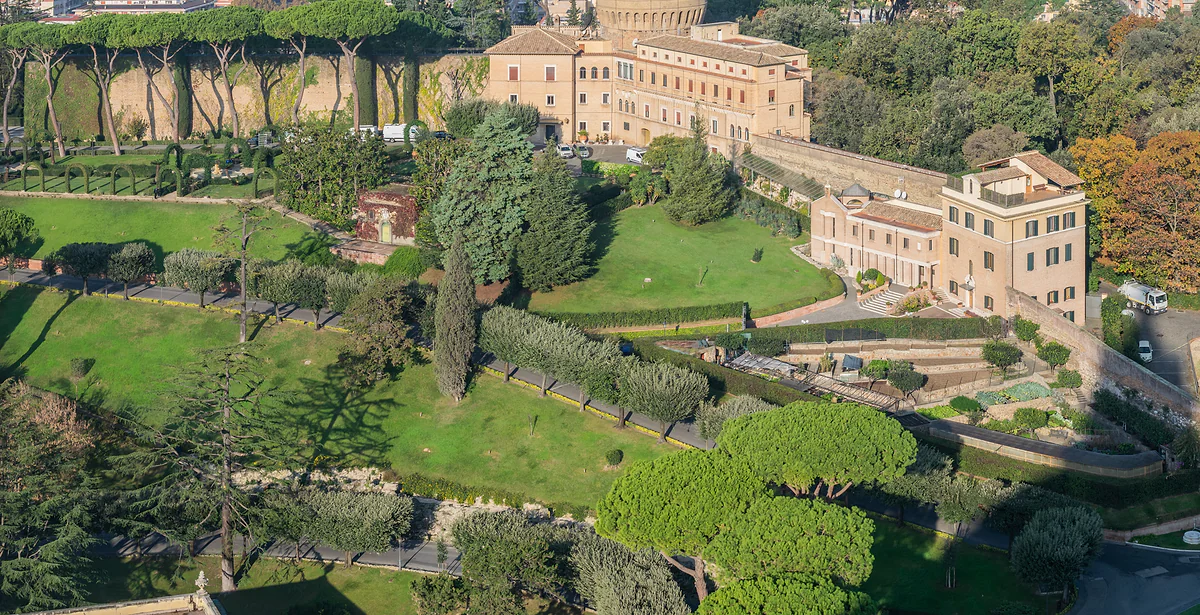
The Vatican Gardens seen from the dome of St Peter's, with lawns, pine trees and Vatican buildings.
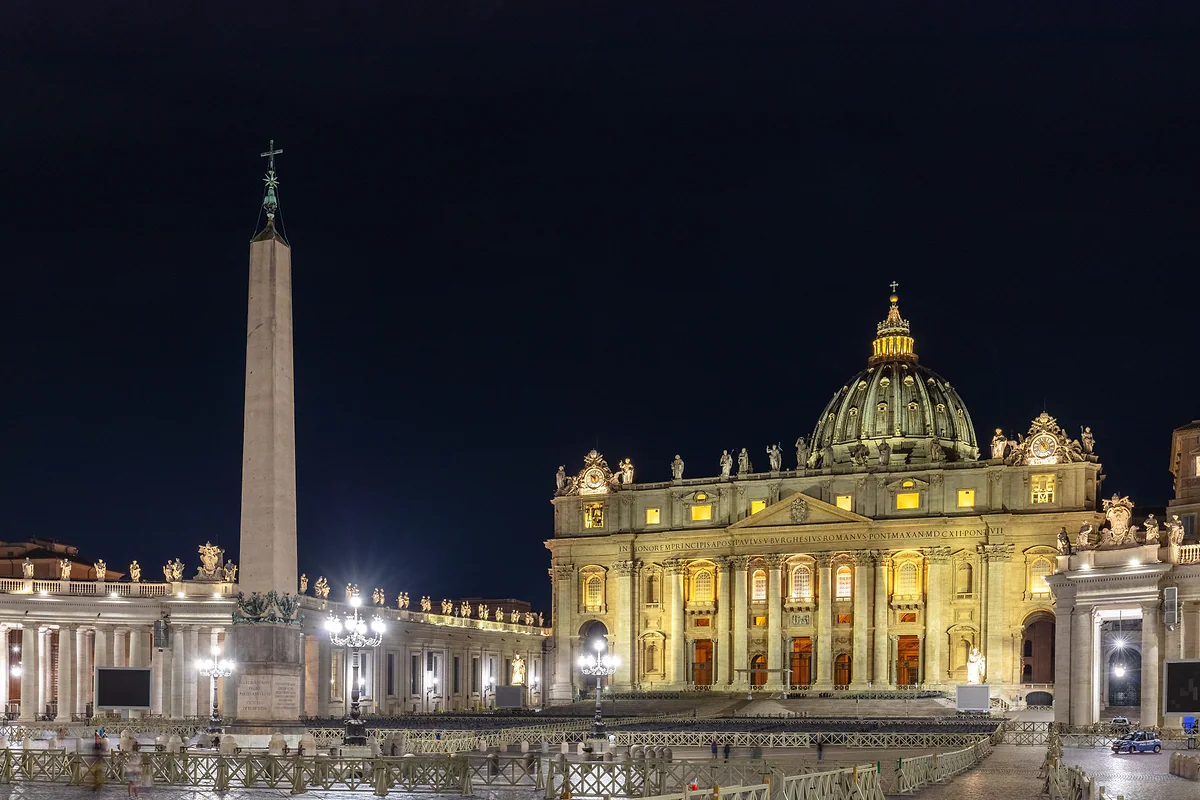
The obelisk in St Peter's Square and the illuminated basilica at night, with Bernini's colonnade on the left.
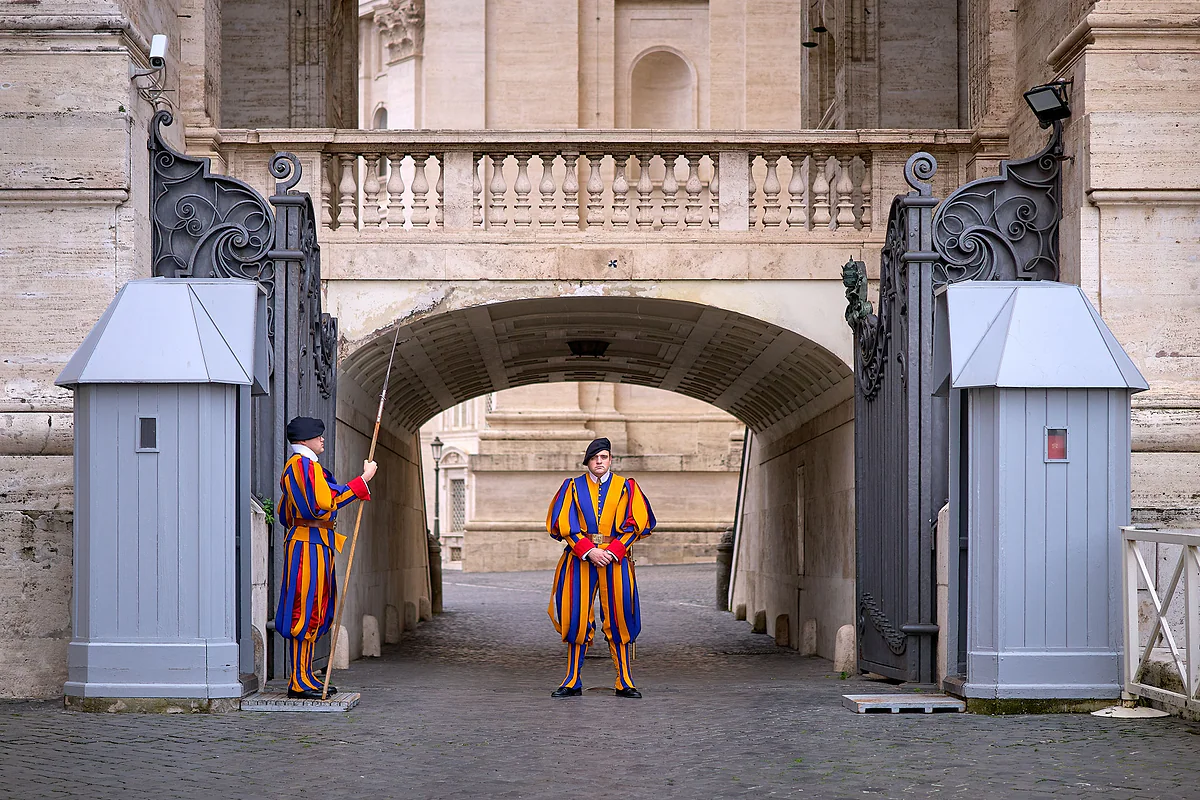
Two Swiss Guards in blue, yellow and red striped uniforms guard the Arch of the Bells, beside their sentry boxes.
Vatican City in curious numbers
| Fact | Figure | Source |
|---|---|---|
| Area | 0.44 km² (44 ha) | Governorate |
| Vatican Gardens | About 22 ha, half the state | Vatican Museums |
| Citizens | 618, of whom 246 resident | Governorate, 31-12-2024 |
| Resident Swiss Guards | 104 | Governorate, 31-12-2024 |
| Assigned dialling code | +379, reserved | ITU |
| Internet domain | .va, registered 11-09-1995 | IANA |
| Coin cap | €1 million a year | Governorate |
| Anthem | Gounod's Pontifical March, 1869; official since 1949 | Governorate |
All figures from official sources checked in September 2026.
Test yourself
True or false?
0/4 Pick before you peek.
-
If you're born in Vatican City, you're a Vatican citizen.
See the answer
False. Citizenship isn't acquired by birth. It's tied to residence for an office or job and lost when that ends.
-
The gardens take up about half of Vatican City.
See the answer
True. The Vatican Gardens cover about 22 hectares, half the state's 44.
-
Vatican phone numbers start with +379.
See the answer
False. +379 is assigned but reserved. In practice it uses Italy's +39, with numbers starting +39 06 698.
-
Guglielmo Marconi built Vatican Radio.
See the answer
True. Pius XI opened it on 12 February 1931, built by Marconi, according to Vatican News.
- Total area of the state
- 0.44 km²
- Vatican citizens at 31-12-2024
- 618
- Assigned, reserved and unused dialling code
- +379
- Gardens, half the territory
- 22 ha
0 of 88 Vatican City guides
Your next stamp
- Is it a country?
- History
- Bernini's colonnade
- Flag
- St Peter's Square
- Map
- Sistine Chapel
- Things to do
- One day
- Tickets
- Two days
- Vatican Museums
- St Peter's Basilica
- St Peter's Dome
- Vatican Necropolis
- Vatican Gardens
- Swiss Guard
- Seeing the Pope
- How to visit
- Castel Gandolfo
- Where to eat
- Free and cheap
- Apostolic Palace
- Scams to avoid
- Getting there
- Money and payments
- Exclusive experiences
- Papal audience
- Angelus
- Who painted it
- Where the Pope lives
- Where to stay
- Dress code
- Facts
- Opening hours
- Post office and stamps
- Vatican Grottoes
- Pietà
- Baldachin
- Ceiling
- Chair of St Peter
- Last Judgement
- Raphael Rooms
- Architecture and architects
- Gallery of Maps
- Holy Door
- Library and Archives
- Bramante Staircase
- Facade and balcony
- Mass at St Peter's
- Pio Clementino Museum
- Papal blessing
- Vatican Pinacoteca
- Catacombs
- Gallery of Tapestries
- Gallery of the Candelabra
- Egyptian and Etruscan Museums
- Obelisk
- Vatican Museums map
- How long you need
- Night opening
- Chiaramonti and Braccio Nuovo
- Christmas
- Anima Mundi Museum
- Easter
- Carriage Pavilion
- Gift shops and souvenirs
- With kids
- Best time to visit
- Courtyard of the Pine Cone
- Photography
- Train station
- Accessible travel
- Vatican Observatory
- Borgia Apartment
- Modern art collection
- Papal Palace
- Barberini Gardens
- Getting there
- Holy See
- Lake Albano
- Police and army
- Passport
- Pharmacy, shop and petrol
- What Vatican means
- Papal tombs
- List of popes
Frequently asked questions
What are some interesting facts about Vatican City?
Nobody becomes a citizen by being born there, it has had no army since 1970, half its territory is gardens and it has its own dialling code, +379, which it doesn't use. In the square, a wind rose spells 'west' in English and a clock on the facade tells time from sunset.
How many people live in Vatican City?
At 31 December 2024 it had 882 inhabitants, citizens and non-citizens, and 618 citizens, of whom 246 lived inside the walls. Of those 246, 104 were Swiss Guards.
Can you become a citizen of Vatican City by being born there?
No. Vatican citizenship isn't acquired by birth or inherited. It's tied to residence for an office or job and lost when that ends.
What is the country code for Vatican City?
The International Telecommunication Union assigns it +379, but marked as reserved for future use. In practice it uses Italy's +39, and its numbers start with +39 06 698.
What is the Vatican's national anthem?
The Pontifical March, with music by Charles Gounod written in 1869. It's been the official anthem since 16 October 1949, by decision of Pius XII, according to the Governorate.
What's the most curious thing in St Peter's Square?
For me, the 1817 wind rose that spells 'west' in English on one side and 'est' on the other, and the 70.79-metre meridian line that uses the obelisk as a sundial. Both are free to see.
By
Tourism graduate with a master’s in Tourism Management and Planning from the University of Málaga, who has travelled across Europe. He writes every guide from official sources and his own judgement.
Published on . Updated on . Facts checked on .
Sources
Photos: Maksim Sokolov (maxergon.com) (CC BY-SA 4.0); Krzysztof Golik (CC BY-SA 4.0); Diego Delso (CC BY-SA 4.0); Radek Kucharski (CC BY 4.0), via Wikimedia Commons.