From mould on the Flood to visitors' sweat
Sistine Chapel facts, sourced and legend-free
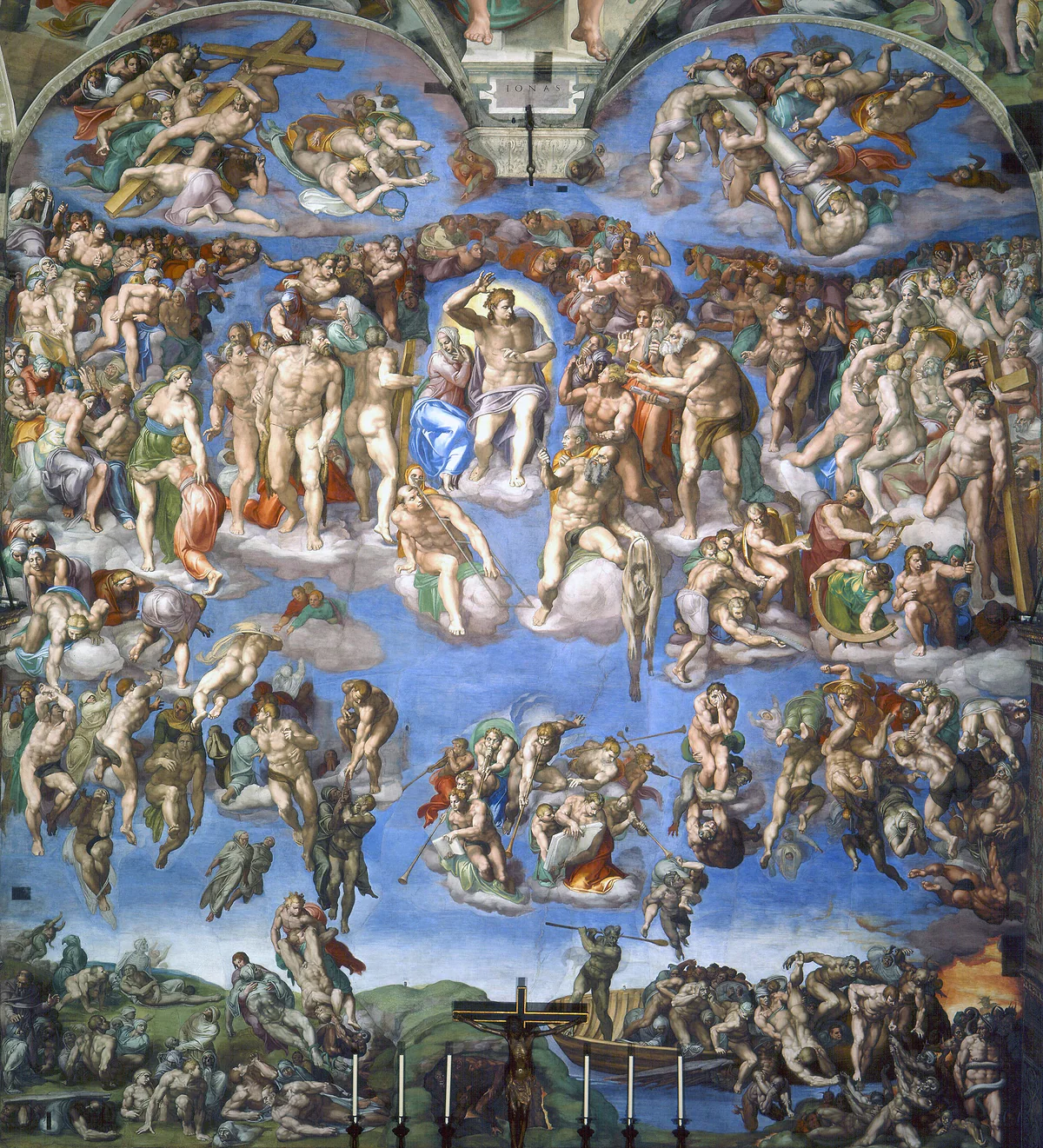
The Sistine Chapel is named after Sixtus IV, measures 40.23 by 13.40 metres and 20.70 high, and has hosted conclaves permanently since 1878, though Leo X was elected there back in 1513. Michelangelo had to repaint the Flood because of mould, painted the Genesis scenes in reverse biblical order, and in 2026 the Last Judgement had to be cleaned of visitors' sweat.
In 30 seconds
Full read: 3 min
- The Sistine Chapel is named after Sixtus IV and measures 40.23 by 13.40 metres and 20.70 high.
- Michelangelo repainted the Flood because of mould and painted Genesis starting with Noah, by the door.
- A crack in the vault in 1504 was the reason it was redecorated and given to him.
- In 2026 a haze of calcium lactate from visitors' sweat was cleaned off the Last Judgement.
- It's been the conclave venue since 1878, though Leo X was elected there in 1513.
The facts I find useful are the ones that change how you look. Knowing the Flood was repainted, that the stories run backwards and that the white haze on the Last Judgement came from people's sweat makes you look up with fresh eyes. Legends without a source I leave out.

Before you go
What I would keep in mind
-
01 My tip
Read the ceiling from the door
Michelangelo painted the Noah scenes first, those over the entrance, and worked towards the altar. Read it in that order and you watch him grow in confidence scene by scene.
Sistine Chapel ceiling -
02 Most beautiful
The walls Michelangelo didn't paint
Before him, Perugino, Botticelli, Ghirlandaio and Rosselli painted the walls in 1481-1482. They're half the chapel and hardly anyone looks at them.
who painted the Sistine Chapel -
03 Watch out
If they let you take photos, it isn't the Sistine
Photography and filming are banned inside, and guards can make you delete what you've shot. If someone sells a visit with photos inside, be suspicious.
Vatican photography rules -
04 To save money
The Sistine comes with the Museums
There's no ticket for the chapel alone. It's included in the Vatican Museums ticket, €20 at the desk or €25 booked online, and free on the last Sunday of the month.
Vatican tickets 2026
My priorities
Unmissable
- Read the ceiling from the door towards the altar, in the order it was painted
- Find the islet in the Flood that survived the mould
- Look at the 15th-century walls, which aren't Michelangelo's
If you have time
I would skip
- Reaching for your phone for a photo, banned and watched
- Repeating unsourced legends such as the one about painting on his back
What I would book
My ranking, scored
My favourite Sistine Chapel facts
My own scores out of 10. They weigh how surprising the fact is and whether it changes how you look at the chapel once inside. Only sourced facts make the list.
0 of 6 seen
-
Visitors' sweat on the Last Judgement
In 2026 a whitish haze of calcium lactate, linked to the lactic acid in visitors' perspiration, was cleaned off. The chapel never closed while the work went on.
9.4 out of 10
-
The mouldy Flood
Early on, mould appeared and Michelangelo had to redo much of the scene. The islet on the right survives from the first version.
9.1 out of 10
-
The crack of 1504
A long crack in the vault made Bramante fit reinforcing chains. That damage was the reason for redecorating, which is how Michelangelo got the job.
8.7 out of 10
-
Genesis painted backwards
The three Noah scenes by the door came first. Creation, over the altar, came last, the reverse of the Bible.
8.5 out of 10
-
Conclaves before 1878
It's been the fixed venue since 1878, but Leo X was elected here in 1513, Urban VIII in 1623 and twelve more popes up to 1775.
8.0 out of 10
-
The 'poor thing'
The contract asked for twelve apostles and decoration. Michelangelo called it a 'poor thing' and Julius II gave him a new brief.
7.6 out of 10
Dozens of Sistine Chapel facts do the rounds, and half of them don’t survive a check. These are the ones that do, mostly from the Vatican Museums and the Holy See’s fact sheet, plus the legends I’d rather not repeat. My rule is simple. I keep the facts that change how you look at the chapel once inside, which is a short spell, in silence, with your phone in your pocket.
A name, an older chapel and some measurements
The chapel is named after Sixtus IV della Rovere, who from 1477 rebuilt a chapel that already stood here, the Cappella Magna, dating from around 1377. The architects were Giovannino de’ Dolci and Baccio Pontelli, and it was consecrated on 15 August 1483, dedicated to the Assumption. It isn’t a separate building; it’s part of the popes’ palace.
The Holy See’s fact sheet gives it 40.23 metres long, 13.40 wide and 20.70 high. Plenty of sites say 40.93 metres, but I stick with the official one. Those are the proportions of a middling church, and to me that’s the biggest surprise the first time. You picture something vast, and it’s a long, tall, rather narrow room.
The crack, the ‘poor thing’ and the mould
Michelangelo didn’t turn up by chance. In spring 1504 the vault cracked badly, and Bramante had to put iron ties in the roof space. That damage led Julius II to redecorate the ceiling, which until then was a starry sky.
The 1508 contract asked for twelve apostles in the spandrels and decoration elsewhere. Michelangelo called it a ‘poor thing’ and secured a new brief with the freedom to paint what you see today. And he stumbled at the start. The Flood grew mould, because he was still learning fresco, and much of it had to be painted again. The islet on the right survives from the first attempt. Spotting it is one of my favourite small details.
Genesis, backwards
The nine central stories follow Genesis from the altar towards the door, but Michelangelo painted them in reverse. The three Noah scenes by the entrance came first, and the separation of light from darkness, over the altar, among the last. Read them from the door and you watch the figures grow and loosen up as he went. I go through it scene by scene on the page about the Sistine Chapel ceiling.
There’s also a widely shared theory that God’s cloak in the Creation of Adam is shaped like a brain. The official site doesn’t mention it, and I won’t pass it off as fact. What the Museums do say is that the focal point is the touch of the fingers, through which the breath of life passes.
Conclaves, bells and a haze of sweat
Since 1878 the Sistine Chapel has been the permanent conclave venue, but not the first time it was used. According to the Holy See, Leo X was elected here in 1513, Urban VIII in 1623, and twelve more popes up to 1775. It also used to host Vespers on the eve of Corpus Christi, Matins on Christmas Eve and Palm Sunday Mass. The latest conclave began on 7 May 2025 and elected Leo XIV the next day. The confirmation comes from the six bells on St Peter’s facade, which all ring together after the white smoke.
The most recent fact is from 2026 and I think it’s the best. Between 1 February and 27 March the Last Judgement was cleaned of a whitish haze of calcium lactate, linked to the lactic acid in visitors’ perspiration. Our sweat, in other words. The chapel didn’t close. A sheet printed with the fresco hung in front while the restorers worked behind it.
Twenty years of restoration
The great restoration of the frescoes ran from 1979 to 1999. Gianluigi Colalucci led it, working on Michelangelo’s paintings between 1980 and 1994. It removed centuries of soot and the glues of old restorations, and revealed bright colours nobody expected, such as Eleazar’s golden-blond hair. It caused a row, since some critics thought touches removed in the cleaning were by Michelangelo himself.
What I don’t buy
Three legends I won’t repeat. The one about him painting flat on his back, which no serious source supports. The one about him working entirely alone, when the sources argue over his helpers, something I set out in who painted the Sistine Chapel. And that Leonardo painted there, which no Museums source supports. For tickets and hours, my guide to the Sistine Chapel has it all.
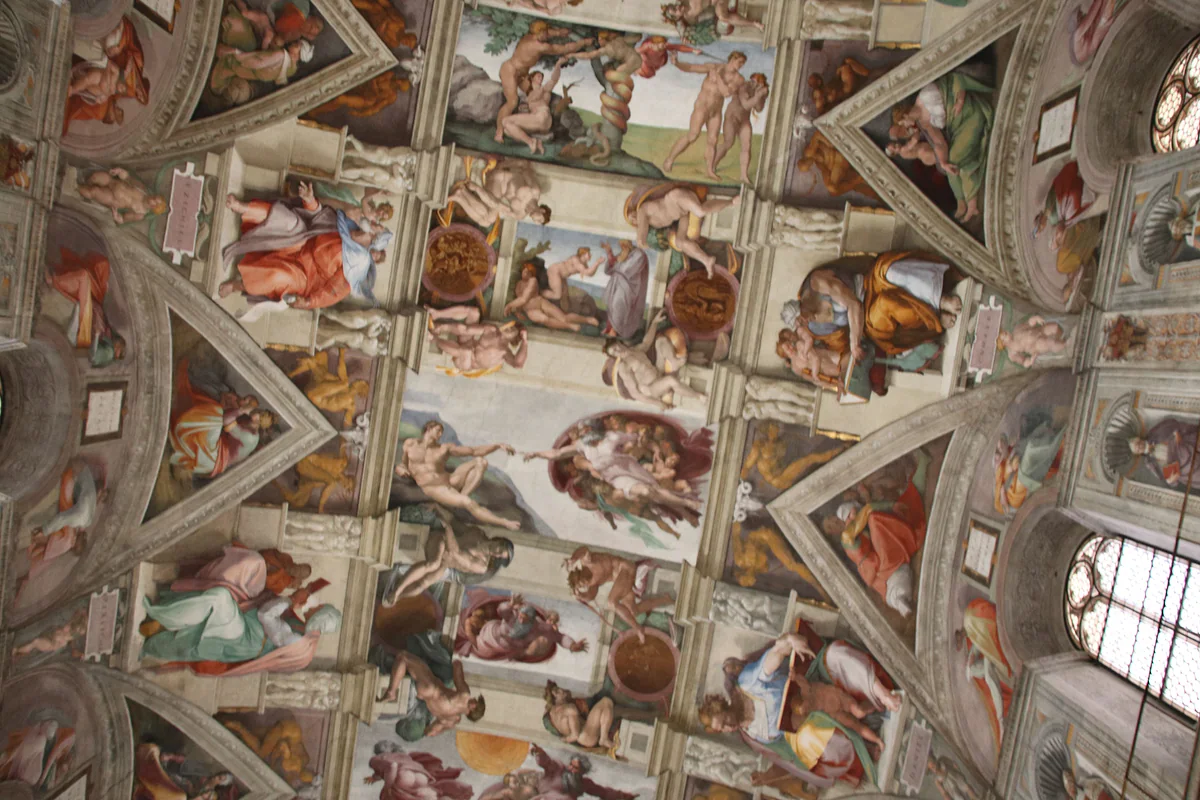
The Sistine Chapel ceiling painted by Michelangelo, with the Genesis scenes, including The Creation of Adam, and the prophets and sibyls.
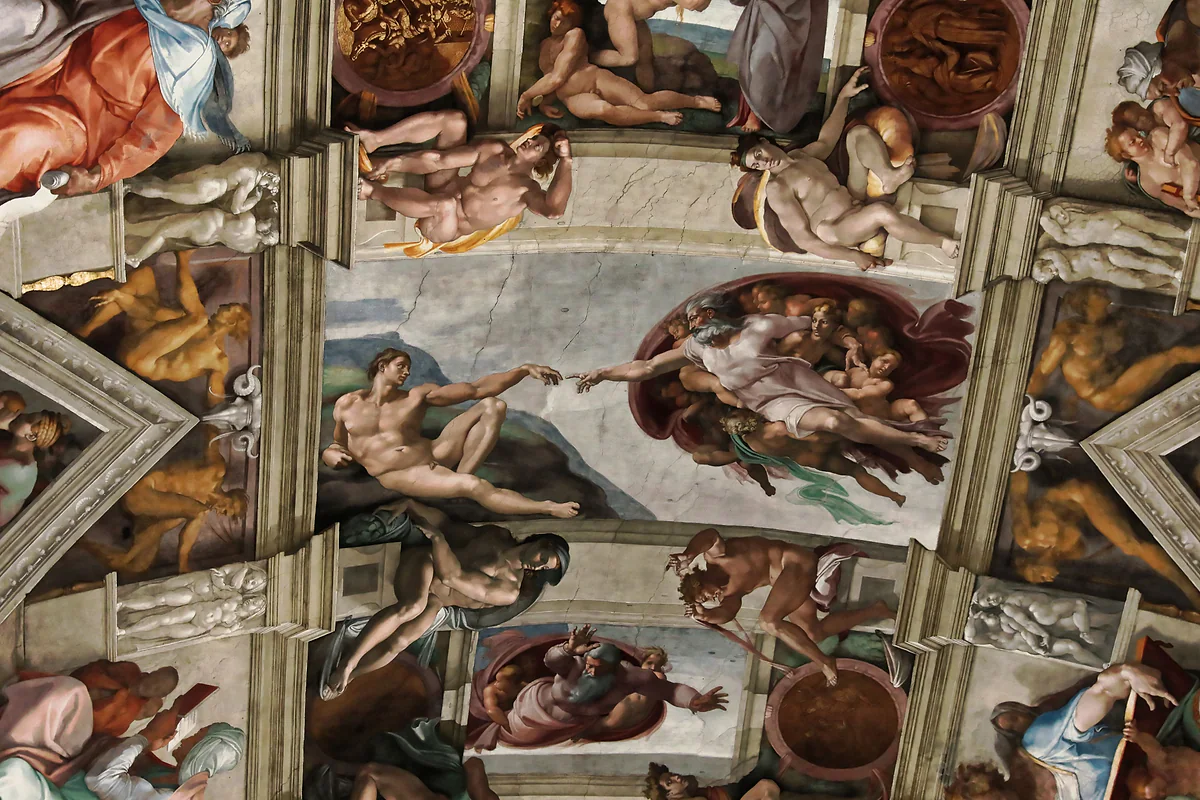
The Creation of Adam on the Sistine Chapel ceiling by Michelangelo, surrounded by painted ignudi and medallions.
The Sistine Chapel in figures
| Fact | Figure |
|---|---|
| Size | 40.23 m long, 13.40 m wide, 20.70 m high |
| Architects | Giovannino de' Dolci and Baccio Pontelli |
| Consecrated | 15-08-1483, to the Assumption |
| Ceiling painting | Over a thousand square metres of plaster, 1508-1512 |
| Full restoration | 1979-1999 |
| Cleaning of the Last Judgement | 01-02 to 27-03-2026 |
| Fixed conclave venue | Since 1878 |
Holy See, Vatican Museums and Benedict XVI (2012). Other sites give 40.93 × 13.41 m; I use the vatican.va figures.
Myths I don't repeat
| The claim | What the sources say |
|---|---|
| Michelangelo painted lying on his back | Not in any reliable source |
| He painted the ceiling entirely alone | Sources disagree about his assistants |
| The Creation of Adam hides a brain | A modern reading the Museums don't mention |
| Leonardo painted in the Sistine | He isn't among the chapel's painters |
My own summary from the Vatican Museums' pages and the Treccani encyclopaedia.
Test yourself
True or false?
0/4 Pick before you peek.
-
Michelangelo painted the ceiling starting with the Creation, over the altar.
See the answer
False. He began with the Noah scenes over the entrance and finished with the Creation, the reverse of the biblical order.
-
Visitors' sweat once left a haze on the Last Judgement.
See the answer
True. In 2026 a layer of calcium lactate linked to lactic acid in perspiration was removed, between 1 February and 27 March.
-
The first conclave in the Sistine Chapel was in 1878.
See the answer
False. 1878 is when it became the fixed venue, but Leo X was elected there in 1513 and Urban VIII in 1623.
-
A crack was the reason the ceiling was repainted.
See the answer
True. In May 1504 a long crack opened and Bramante fitted reinforcing chains. That damage led to the redecoration.
- Height of the chapel, per the Holy See
- 20.70 m
- Year it was consecrated to the Assumption
- 1483
- Since then the fixed conclave venue
- 1878
- Years of the great restoration of its frescoes
- 1979-1999
0 of 88 Vatican City guides
Your next stamp
- Sistine Chapel
- Ceiling
- Last Judgement
- Free and cheap
- Pio Clementino Museum
- Gallery of Tapestries
- Bernini's colonnade
- Things to do
- One day
- Tickets
- Two days
- Vatican Museums
- St Peter's Basilica
- St Peter's Square
- St Peter's Dome
- Vatican Necropolis
- Vatican Gardens
- Swiss Guard
- Seeing the Pope
- How to visit
- Castel Gandolfo
- Where to eat
- Apostolic Palace
- Scams to avoid
- Getting there
- Money and payments
- Exclusive experiences
- Papal audience
- Angelus
- Who painted it
- Where the Pope lives
- Where to stay
- Dress code
- Opening hours
- Map
- Flag
- Post office and stamps
- Is it a country?
- Vatican Grottoes
- History
- Pietà
- Baldachin
- Chair of St Peter
- Raphael Rooms
- Architecture and architects
- Gallery of Maps
- Holy Door
- Library and Archives
- Bramante Staircase
- Facade and balcony
- Mass at St Peter's
- Papal blessing
- Vatican Pinacoteca
- Catacombs
- Gallery of the Candelabra
- Egyptian and Etruscan Museums
- Obelisk
- Vatican Museums map
- How long you need
- Night opening
- Chiaramonti and Braccio Nuovo
- Christmas
- Anima Mundi Museum
- Easter
- Carriage Pavilion
- Gift shops and souvenirs
- With kids
- Best time to visit
- Courtyard of the Pine Cone
- Photography
- Train station
- Accessible travel
- Vatican Observatory
- Borgia Apartment
- Modern art collection
- Papal Palace
- Barberini Gardens
- Facts
- Getting there
- Holy See
- Lake Albano
- Police and army
- Passport
- Pharmacy, shop and petrol
- What Vatican means
- Papal tombs
- List of popes
Frequently asked questions
Why is it called the Sistine Chapel?
After Pope Sixtus IV della Rovere, who from 1477 rebuilt an older chapel, the Cappella Magna, dating from around 1377. It was consecrated on 15 August 1483 and dedicated to the Assumption.
How big is the Sistine Chapel?
40.23 metres long, 13.40 wide and 20.70 high, according to the Holy See's fact sheet. You'll see 40.93 metres elsewhere; I go with the official figure.
Is there really a brain hidden in the Creation of Adam?
It's a popular modern theory, but the Museums' official site doesn't mention it, so I won't present it as fact. What the Museums do say is that the focal point is the touch of the fingers, through which the breath of life passes.
Why can't you take photos in the Sistine Chapel?
The Vatican Museums ban photographing and filming with any device, using your phone and talking. Guards can ask you to delete anything you've taken. Elsewhere in the Museums, personal photos without flash are fine.
Since when have conclaves been held in the Sistine Chapel?
It's been the permanent venue since 1878, but it was used before, in 1513 to elect Leo X, in 1623 for Urban VIII and for twelve more elections up to 1775. The latest conclave, in May 2025, elected Leo XIV.
What happened to the Last Judgement in 2026?
Between 1 February and 27 March 2026 there was extraordinary maintenance to remove a whitish haze of calcium lactate, linked to lactic acid in visitors' sweat. The chapel stayed open, with a printed sheet reproducing the fresco.
What else was the Sistine Chapel used for?
Besides papal elections, the Holy See says it hosted Vespers on the eve of Corpus Christi, Matins on Christmas Eve and Mass on Palm Sunday.
By
Tourism graduate with a master’s in Tourism Management and Planning from the University of Málaga, who has travelled across Europe. He writes every guide from official sources and his own judgement.
Published on . Facts checked on .
Sources
Photos: Miguel Ángel (obra); reproducción de dominio público (Public domain); Gary Todd from Xinzheng, China (Public domain); Burkhard Mücke (fotografía); Miguel Ángel (obra) (Public domain), via Wikimedia Commons.