St Peter's Basilica is free and, on winter hours from 26 October 2026 to 28 March 2027, open every day from 7am to 7pm, with the dome from 7.30am to 5pm. The only things that cost money are an optional timed slot with an audio guide (€7), the official guided tour (€18) and the dome (from €17). Allow one to two hours and cover your shoulders and knees.
Who will enjoy it and who will not
✓Yes, if…
First-time visitors to Rome, whatever their faith
Art lovers after Michelangelo and Bernini
Early risers who want it quiet at 7am
×Better not, if…
Anyone in shorts or bare shoulders, who will be turned away
Visitors hoping to skip security, which everyone must pass
My viewSergio Lepone
On winter hours I'd be through security just after 7am and head for the dome as it opens at 7.30, because it shuts at 5pm and the afternoon queue builds quickly. Then the Pietà, the baldacchino and the Chair, and the free Grottoes on the way out.
If you only read this
Full read: 7 min
St Peter's Basilica charges nothing to get in and opens 7am to 7pm daily in winter, until 28 March 2027.
Security screening happens under the colonnade to the right of the basilica, and you'll need covered shoulders and legs covered to below the knee.
Only the extras cost money, €7 for the audio guide booking, €18 for the official guided tour and at least €17 to climb the dome.
I'd head straight for the Pietà, the baldacchino and Bernini's Chair of St Peter, then finish in the Vatican Grottoes, free from 9am to 6pm.
Wednesday mornings and Sunday lunchtimes are the busiest times, so I'd go in at 7am on any other day.
My key points
Before you go to Vatican City, this
01 Most beautiful
From the baldacchino to the dove in the window
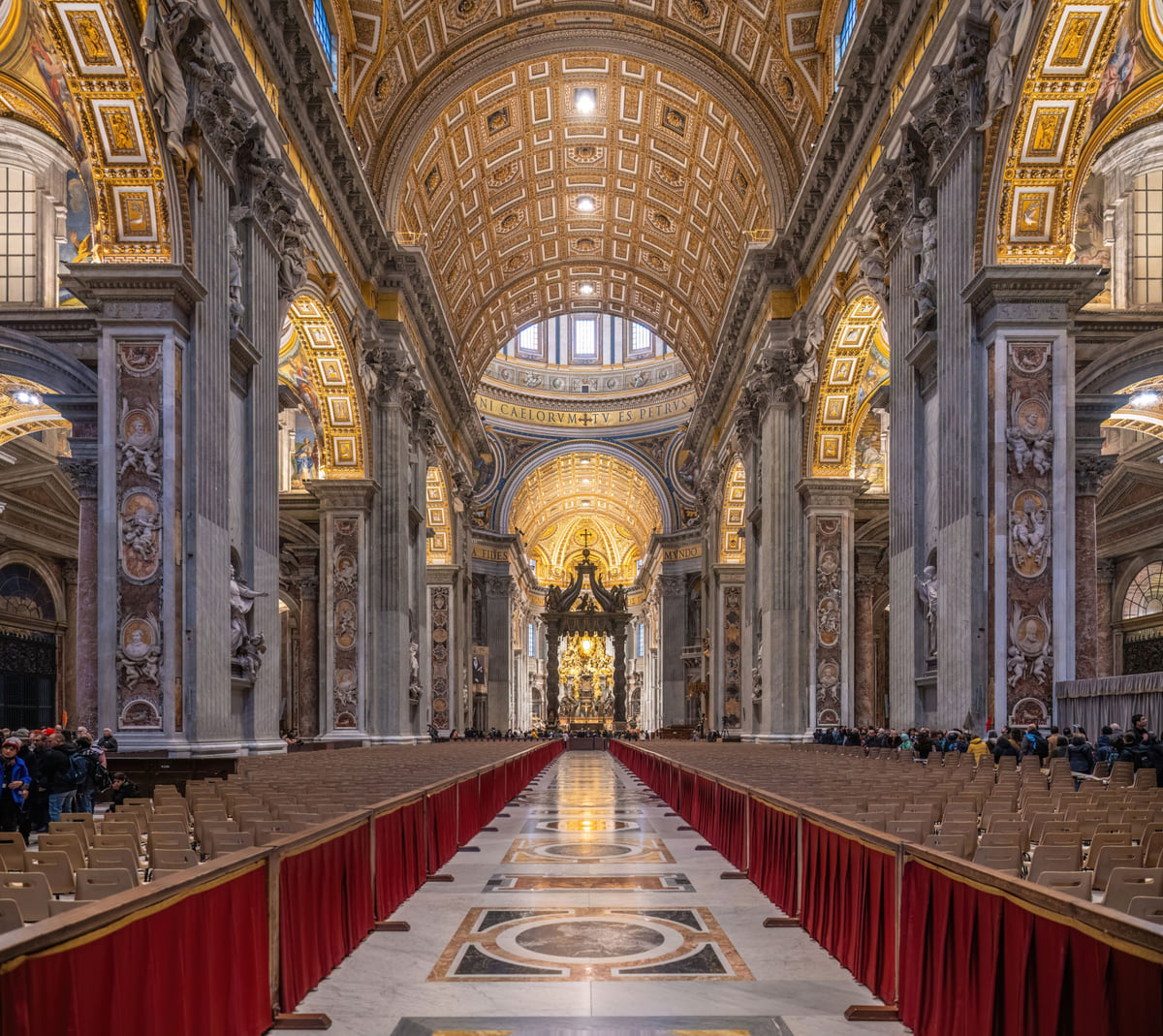
The loveliest thing in the basilica, for me, is the line that runs from Bernini's bronze baldacchino, over the apostle's tomb, to his Chair of St Peter in the apse, with the dove window about 20 metres up. Stand and take it in before heading off to any side chapel.
The basilica and the Vatican Grottoes cost nothing. The €7 booking buys a guaranteed slot and an audio guide, not entry. And if you're climbing the dome, that ticket already includes the basilica with the audio guide, so don't pay twice.
The Fabbrica di San Pietro states in writing that no skip-the-line service exists. Booked visitors get their own route, but everyone goes through the same security check. If someone on the street sells you queue-jumping, you're paying for nothing.
If I paid for anything here it would be the Fabbrica's own guided tour, an hour with an authorised guide in groups of about 20, for €18 (€12 for ages 7 to 17). That said, I'd put the €20 Scavi tour of the necropolis ahead of it.
Wednesday brings the papal audience and Sunday the Angelus at noon, and the basilica lists both as its busiest days. I'd go in at opening time on any other day and leave the packed square to the people who've come to see the Pope.
It's the station the basilica itself gives as the nearest. Buses 40 and 64 also run from Termini, though the US State Department's OSAC singles out the 64 as a route for skilled pickpockets.
My own scores out of 10. They weigh how much the work itself moves you, what it tells you about the place and what it costs in time and money. It isn't an art-history verdict, just the order in which I'd spend a one- or two-hour visit.
0 of 8 seen
1
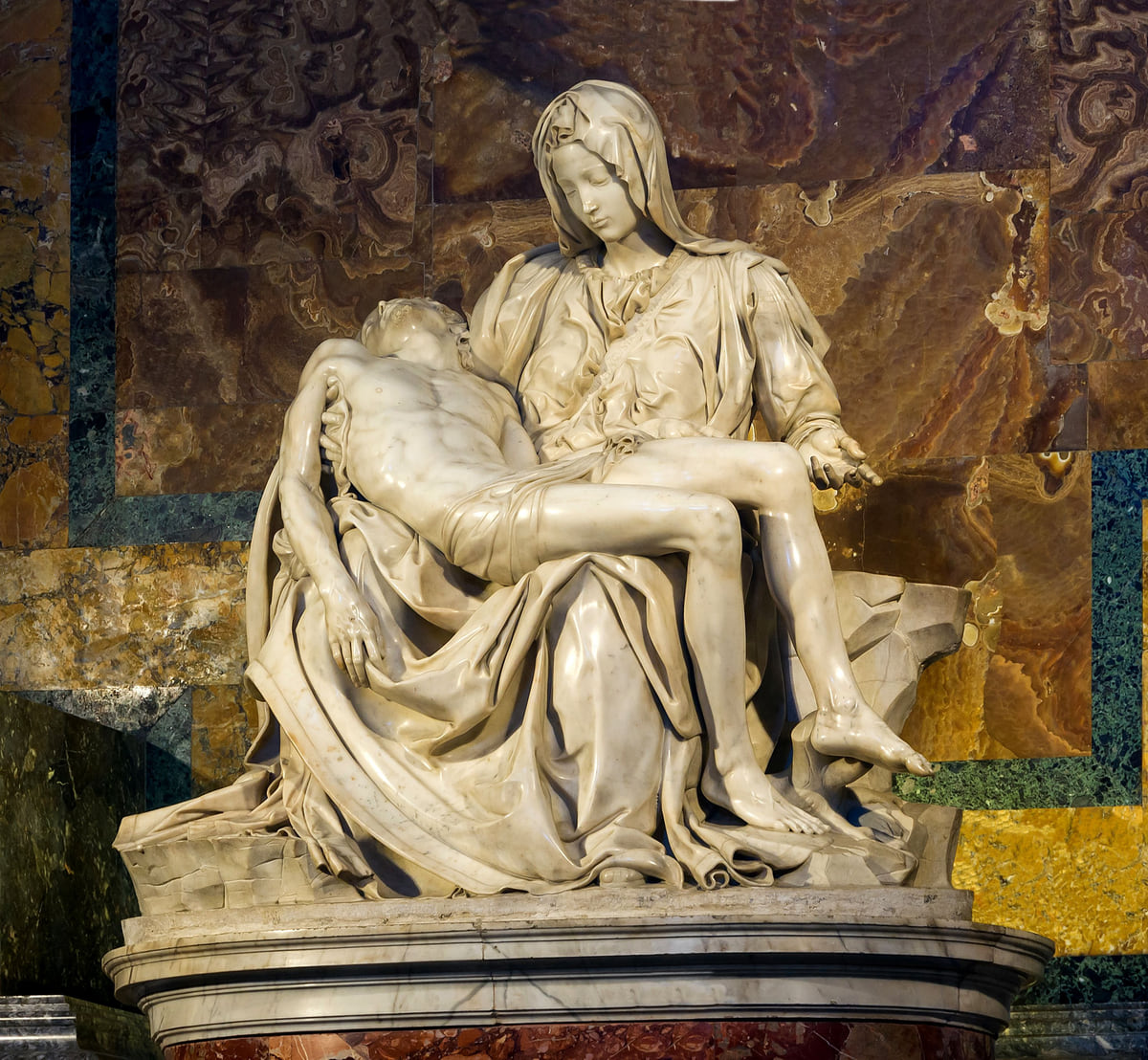
Michelangelo's Pietà
Carved in 1498 by a 23-year-old Michelangelo, in nine months, from a single block of Carrara marble, and the only work he ever signed. It rewards ten minutes of standing still more than anything else here.
Time: 10 minPrice: Free
9.8 out of 10
2
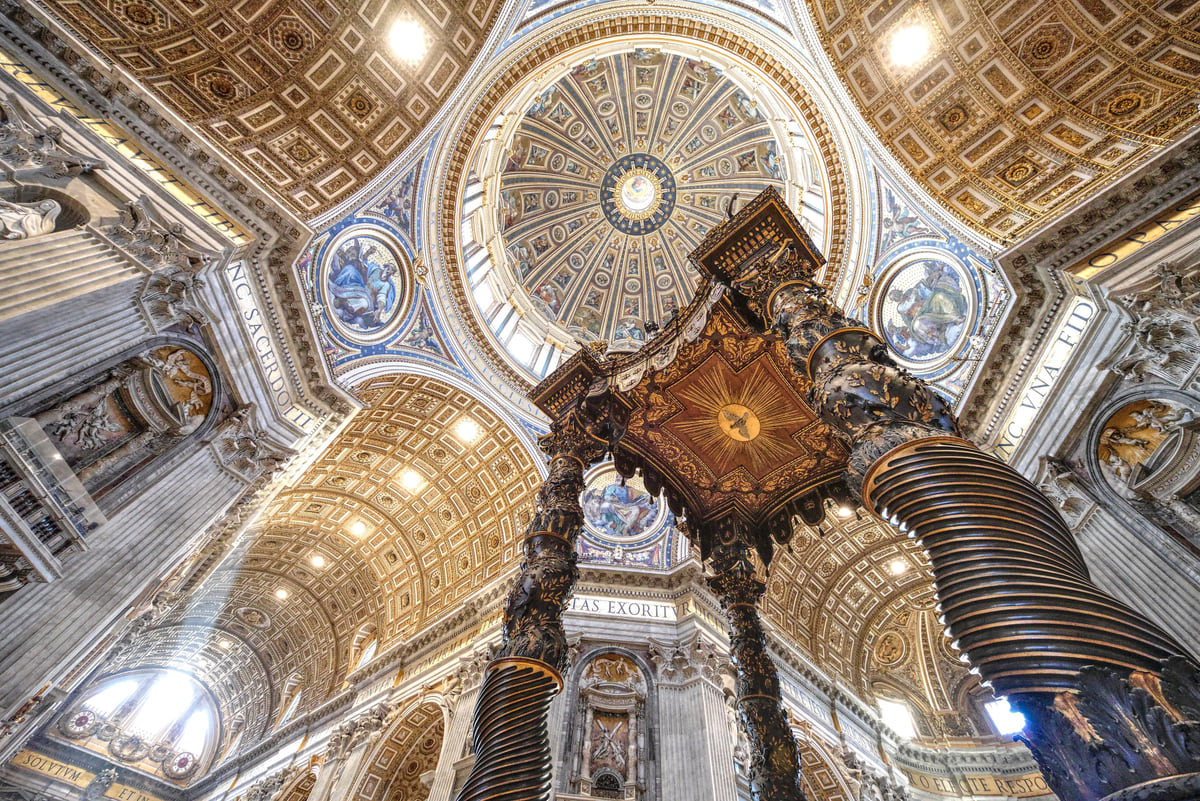
Bernini's baldacchino
Bronze, over the papal altar and directly above the apostle's tomb, and freshly restored in October 2024. It is the point the whole church is built around, and you feel it as soon as you stand in front of it.
Time: 10 minPrice: Free
9.4 out of 10
3
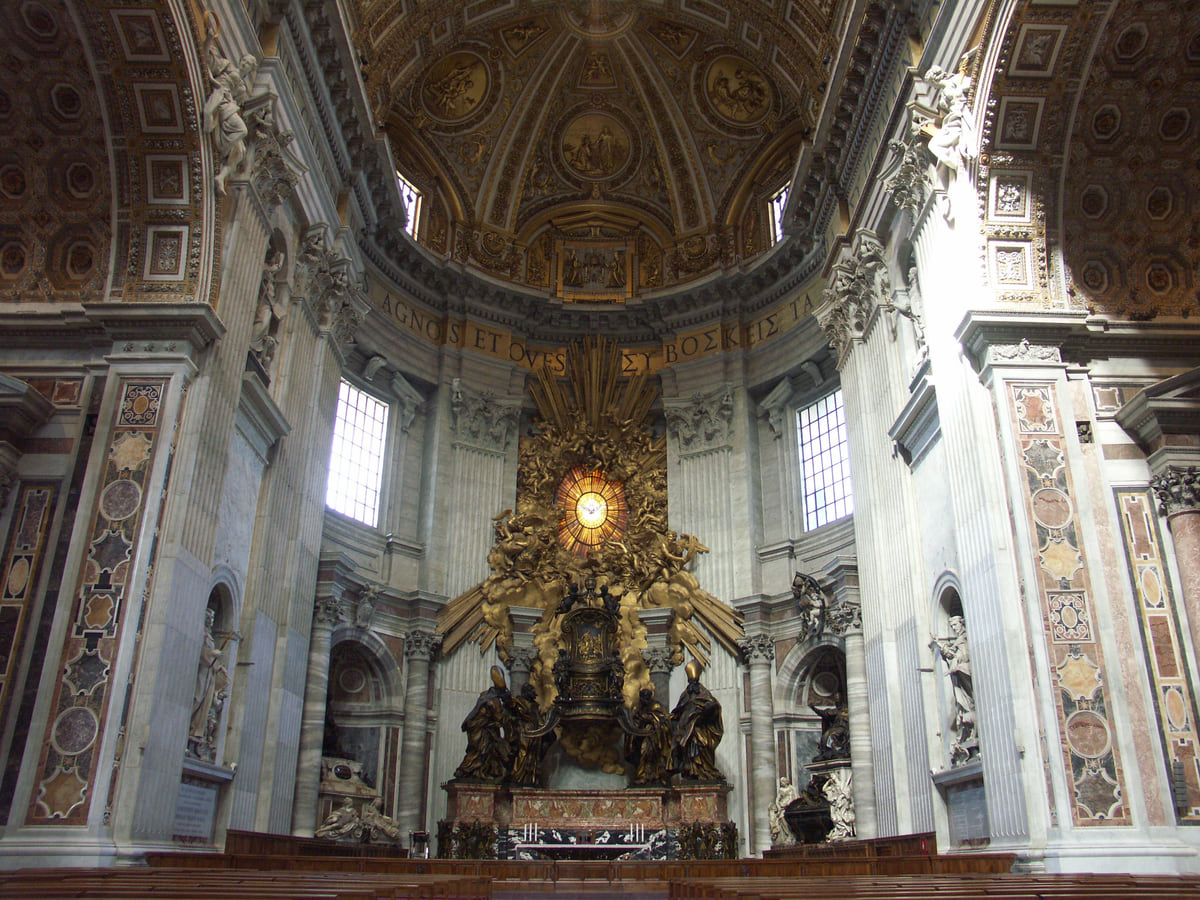
The Chair of St Peter
Bernini finished it in 1666 after ten years' work, with 74 tonnes of bronze rising 14.74 metres. It closes the view down the nave and, for me, is the right place to end the walk.
Roughly 3,000 square metres of mosaic in 16 sections, made between 1598 and 1613. You see them free from the floor, and they're the best argument I know for climbing up afterwards.
Time: 5 minPrice: Free
8.6 out of 10
5
The Vatican Grottoes
Free, open 9am to 6pm, with the tombs of Pius XII and Benedict XVI. No photos and no guided groups, which makes them one of the calmest corners of the whole site.
Time: 20 minPrice: Free
8.3 out of 10
6
The bronze St Peter
The 13th-century original attributed to Arnolfo di Cambio, with the foot pilgrims touch. Not the finest sculpture in the building, but the one that best reminds you it is still a working church.
It corresponds to the second-century shrine over Peter's tomb, between two gilded bronzes by Ambrogio Buonvicino from 1617. This is where the basilica you see meets the one buried below.
An immersive exhibition in the Octagonal Rooms, inside one of the dome's piers and open to the public for the first time. Interesting, but €22 feels steep if you haven't yet seen the basilica itself properly.
Time: 30 minPrice: €22 with the basilica
6.8 out of 10
Where I would start in St Peter's Basilica
✓Unmissable
Michelangelo's Pietà, the only work he signed, given ten unhurried minutes
The line from the baldacchino to the Chair of St Peter, with the dove window at the far end
Bringing a large rucksack, because there's no cloakroom or left luggage
Paying the €7 booking if you're climbing the dome, whose ticket already covers it
Counting on a direct route from the Sistine Chapel, which the museums' website doesn't list
Most people turn up at St Peter’s expecting to buy a ticket, and there isn’t one. No ticket office, no timed entry, no extra charge to see the Pietà. You reach the square, clear security and walk in. So the question I care about is a different one, which is what to look for inside a church roughly 187 metres long, where it is very easy to wander for an hour with your head tilted back and leave having missed the best of it. That’s what the ranking above is for, and this guide too.
Is St Peter’s Basilica free to enter?
Security is run by Italy’s state police, the Polizia di Stato, in the right-hand arm of the colonnade as you face the church. That’s where the queue forms in high season. The official site gives no waiting time and only warns that the checks can cause queues and delays. It also names Wednesday, because of the papal audience, and Sunday, because of the Angelus at noon, as its busiest days. I’d be there soon after the 7am opening and keep those two days for something else.
They will check what you’re wearing. Long trousers for men, a skirt below the knee or trousers for women, and covered shoulders for everyone. What to wear in high summer without overheating is in my Vatican dress code guide. There’s no cloakroom and no left-luggage, so the big rucksack stays at the hotel. Photos are fine without flash, and there are ramps and lifts. Everything else, from the metro to what you can’t carry, is in my guide on how to visit the Vatican.
As for the €7 booking, my view is that you’re paying for the audio guide and the peace of mind of a guaranteed slot, since entry is free anyway. The digital guide plays on your own phone in seven languages; the older hand-held one is hired at the desk in the portico, in eleven. And if anyone outside offers to get you past the basilica queue, the Fabbrica di San Pietro states in writing that no such service exists.
Worshippers have their own entrance, the Percorso Oranti. It starts in Via di Porta Angelica, is signposted in yellow, is staffed by the Fabbrica twelve hours a day and goes in through the Grottoes. Daily Masses at the altars of St Joseph and of the Chair, and in the Blessed Sacrament Chapel, are in the timetable above.
What to see inside St Peter’s
If I had to keep a single work from the entire Vatican, it would probably be Michelangelo’s Pietà. The official site dates it to 1498, when he was 23, and says he carved it in nine months from one block of Carrara marble, commissioned by Cardinal Jean de Bilhères Lagraulas. It is the only piece he ever signed, on the sash across the Virgin’s chest. In a building designed to overwhelm you by sheer scale, this is the piece that stops me in my tracks, and it asks for nothing more than ten quiet minutes.
The bronze statue of St Peter dates from the 13th century, is attributed to Arnolfo di Cambio and is the original. Pilgrims touch its foot as they pass. There’s finer sculpture a few metres away, but nothing else makes it quite so clear that this is a working church first and a museum second.
By the Altar of the Confession is the Niche of the Pallia, which corresponds to the small second-century shrine built over Peter’s grave. It is flanked by gilded bronze statues of St Peter and St Paul made by Ambrogio Buonvicino in 1617. This is where the church you’re standing in connects with the one beneath it, and with the name that heads the list of popes.
St Peter’s baldachin stands over the papal altar, directly above the apostle’s tomb, and went back on show after restoration on 27 October 2024. Other guides quote very exact heights and dates for it. I stick to what the official site confirms and to what you can see, which is that everything in the building points towards it.
At the far end, in the apse, is the Chair of St Peter, which for me is where the visit naturally ends. Bernini finished it in 1666, after ten years’ work for Alexander VII. Its bronzes weigh 74 tonnes, the whole piece rises 14.74 metres and the dove in the window sits about 20 metres up. Inside is a wooden chair with ninth-century ivory friezes. Its restoration was completed in November 2024, and every 22 February it is lit by more than a hundred candles.
Between the two, look up. Up there are around 3,000 square metres of mosaic, split into 16 sections and produced from 1598 to 1613 under the direction of Marcello Provenzale. If you want to see the dome from the top, climbing St Peter’s Dome is €17 by the stairs or €22 by lift, basilica included.
Who is buried in St Peter’s Basilica?
Around 91 popes, according to the Fabbrica, split between the basilica and the Vatican Grottoes below the nave. Entry to the Grottoes costs nothing, they’re open every day from 9am to 6pm, and they allow neither guided tours nor photos. Their vaults were built in 1590 and 1591 to carry the Renaissance floor, and 20th-century chapels were added, among them the Irish, Polish and Mexican ones. Pius XII lies here, and so, since 5 January 2023, does Benedict XVI, in the tomb John Paul II occupied from 2005 to 2011. They have their own exits to Largo Braschi and Largo di San Gregorio l’Illuminatore, which is why I’d leave them for last.
Pope Francis is not among them. He was buried in Santa Maria Maggiore on 26 April 2025, the first pope in more than a century laid to rest outside the Vatican. Deeper still, 3 to 11 metres below the nave, lies the Vatican necropolis and St Peter’s tomb, which you can only see on a booked tour and which I rate as the best hour you can spend anywhere in the Vatican. Which pope lies where is set out in my guide to the papal tombs.
Does a Vatican Museums ticket get you into St Peter’s?
You don’t need one, because the basilica is free and you walk in from the square. They are two separate visits, and the Sistine Chapel belongs to the Vatican Museums, which you do pay for. You’ll hear about a direct passage from the Sistine Chapel into St Peter’s, but the Museums’ official site doesn’t mention it and the sources that do say it’s used by guided groups, so I wouldn’t plan a day around it. To fit both into one morning, my one-day Vatican itinerary sets out the order I’d follow.
Who designed St Peter’s?
No one person, and I think that’s the most interesting thing about it. Julius II laid the first stone on 18 April 1506, where the pier of St Veronica now stands, to replace the fourth-century basilica built by Constantine. The work took more than a century and 20 pontificates. The Fabbrica lists Fra’ Giovanni Giocondo, Raphael, Giuliano and Antonio da Sangallo, Baldassarre Peruzzi, Michelangelo, Vignola, Giacomo della Porta and Carlo Maderno, and its FAQ adds Bramante and Bernini.
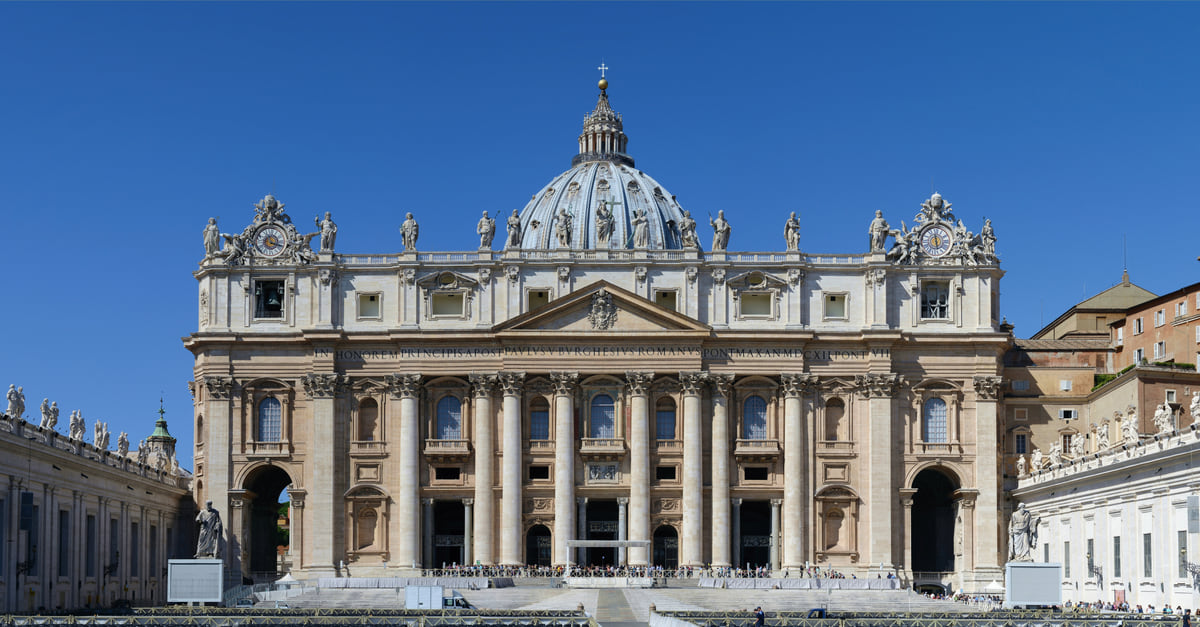
Maderno built the façade between 1608 and 1612. Along the top stand Christ, John the Baptist and eleven apostles; Peter is missing because he is represented inside. Urban VIII consecrated the church on 18 November 1626. There are more than 40 altars, and the Fabbrica gives the height as about 136 metres to the top of the dome.
The anniversary of the consecration runs through 2026 and closes on 18 November with a solemn Mass led by Leo XIV. The year has brought a new Way of the Cross by Manuel Dürr (unveiled on 20 February), an app that translates the liturgy into 60 languages and a booking system built into the basilica’s website. The opening of the Gregorian and Clementine domes and of the terraces, with multimedia displays, has been announced too, but as of 24 September 2026 the booking site shows no price or date.
What you can already see is Pétros ení, an immersive exhibition in the Octagonal Rooms, inside one of the piers that hold up the dome and open to the public for the first time. It grew out of the digital twin the Fabbrica launched with Microsoft in November 2024, built from more than 400,000 photographs. It costs €22 with the basilica and keeps the dome’s hours. I think it makes more sense on a second visit, and I compare the other ways to spend a bit more here in my guide to exclusive Vatican experiences.
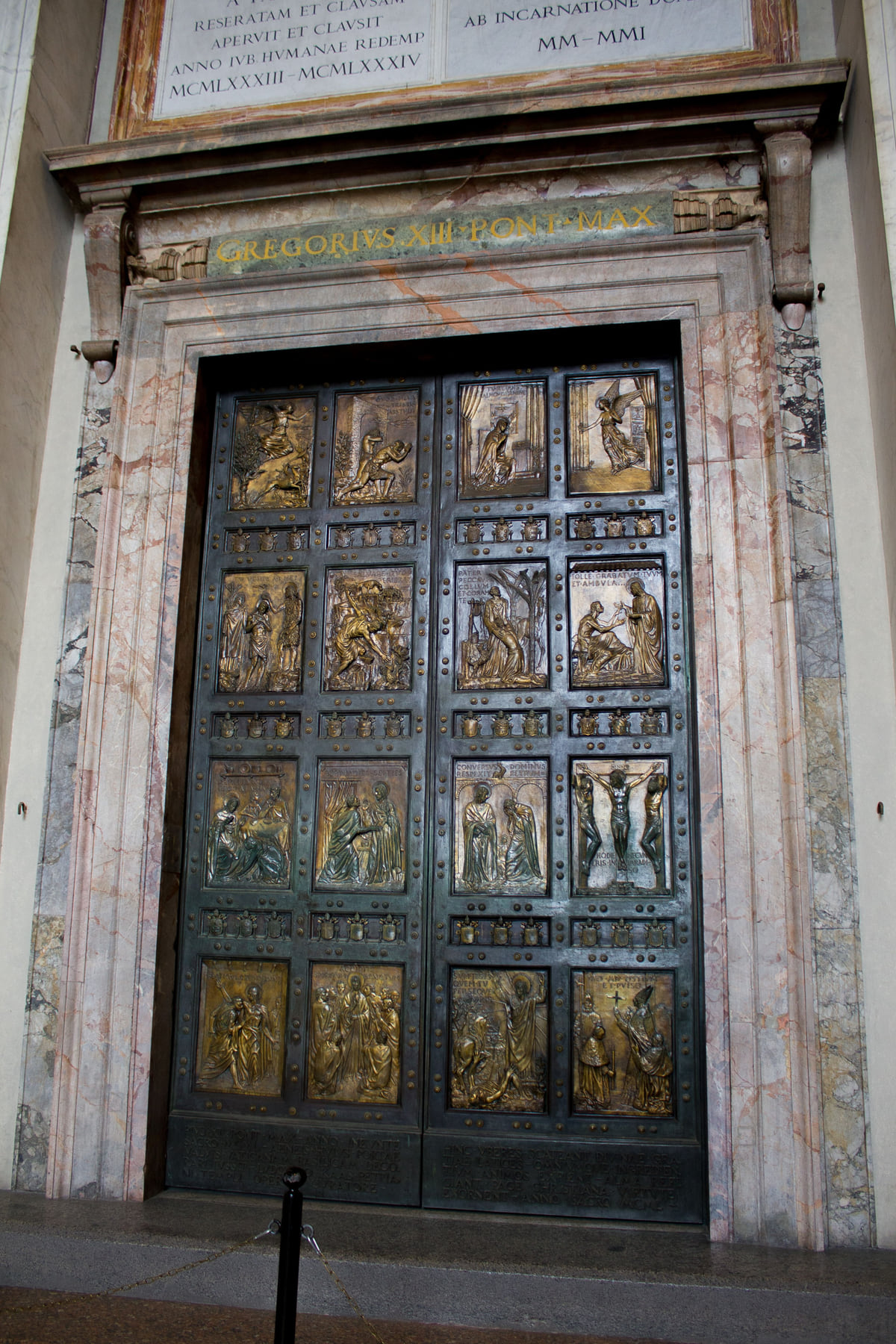
As for the doors, the Holy Door at the Vatican has been closed since 6 January 2026, when Leo XIV brought the Jubilee to an end, and it only reopens in a Holy Year. The Treasury Museum also remains temporarily closed while its new layout is finished.
7:00 to 19:00 (winter, 26 Oct 2026 to 28 Mar 2027)
Vatican Grottoes
Every day
9:00 to 18:00
Official guided tours
Monday to Saturday
9:30 to 16:00
Official guided tours
Sundays and solemnities
14:00 to 15:30
Confession
Monday to Saturday
7:00 to 12:30 and 16:00 to 19:00
Confession
Sundays
7:00 to 13:00 and 16:00 to 19:00
For winter, 26 October 2026 to 28 March 2027, the basilica's opening-times page gives 7am to 7pm for the basilica and 7.30am to 5pm for the dome; in summer it stays open until 8pm. Guided tour times are those on the booking page; the general timetable page shows a longer window.
What each option costs in 2026
Option
Price
What you get
Basilica, no booking
Free
Entry after the security check
Timed slot ('Basilica')
€7
Guaranteed time slot and a digital audio guide on your phone
Official guided tour
€18 (€12 for ages 7 to 17)
One hour with an authorised guide, groups of about 20
Pétros ení + basilica
€22
Immersive exhibition in the Octagonal Rooms
Dome by stairs
€17
Dome plus basilica with audio guide
Dome by lift
€22
Dome plus basilica with audio guide
Online prices from the Fabbrica di San Pietro's official booking site, checked on 24-09-2026. Full price applies from age 18. Guided tours are payable by credit card only.
Mass times
Days
Time
Where
Weekdays
7:00, 7:30, 9:00 and 10:00
Altar of St Joseph
Weekdays
8:30
Blessed Sacrament Chapel
Weekdays
11:00, 12:00, 17:00 and 18:00
Altar of the Chair
Sundays and feast days
7:00 and 8:00
Altar of St Joseph
Sundays and feast days
9:00, 10:30 (capitular), 12:30, 16:00 and 17:00
Altar of the Chair
Timetable published on the basilica's official website. Masses celebrated by the Pope need a free ticket requested in advance.
Height to the top of the dome, according to the Fabbrica
About 136 m
Bronze in Bernini's Chair of St Peter, finished in 1666
74 tonnes
Popes buried between the basilica and the Grottoes
Around 91
Frequently asked questions
Is St Peter's Basilica free to enter?
Yes, entry is free for everyone. You only pay for a guaranteed time slot (€7, which includes a digital audio guide), the official guided tour (€18) or the dome (€17 by stairs, €22 by lift). I'd only book the €7 slot if you want the audio guide.
Is St Peter's Basilica included in the Vatican Museums ticket?
You don't need it to be. The basilica is a separate, free visit that you enter from St Peter's Square after the security check on the right-hand colonnade. The Museums, with the Sistine Chapel, are a different visit with their own ticket.
Is the Sistine Chapel inside St Peter's Basilica?
No. The Sistine Chapel is part of the Vatican Museums, which are ticketed. St Peter's Basilica is the church on the square, and it is free.
What is the dress code for St Peter's Basilica?
The basilica asks for long trousers for men, and skirts below the knee or trousers for women, with shoulders covered for everyone. There is no cloakroom or left-luggage, so leave large bags at your hotel.
Who is buried in St Peter's Basilica?
According to the Fabbrica di San Pietro, around 91 popes are buried in the basilica and the Vatican Grottoes beneath it, and St Peter's tomb lies under the high altar. Benedict XVI and Pius XII are in the Grottoes. Pope Francis is not here; he was buried in Santa Maria Maggiore on 26 April 2025.
Is St Peter's Basilica open on Sundays?
Yes, every day, from 7am to 7pm in winter (26 October 2026 to 28 March 2027) and until 8pm in summer, though access can be limited at Christmas and Easter. Sunday is one of its two busiest days because of the Angelus at noon, so I'd go early or pick another day.
Can you take photos inside St Peter's Basilica?
Yes, as long as you don't use the flash. Photography is not allowed in the Vatican Grottoes below, and both photos and video are banned on the necropolis tour.
Tourism graduate with a master’s in Tourism Management and Planning from the University of Málaga, who has travelled across Europe. He writes every guide from official sources and his own judgement.