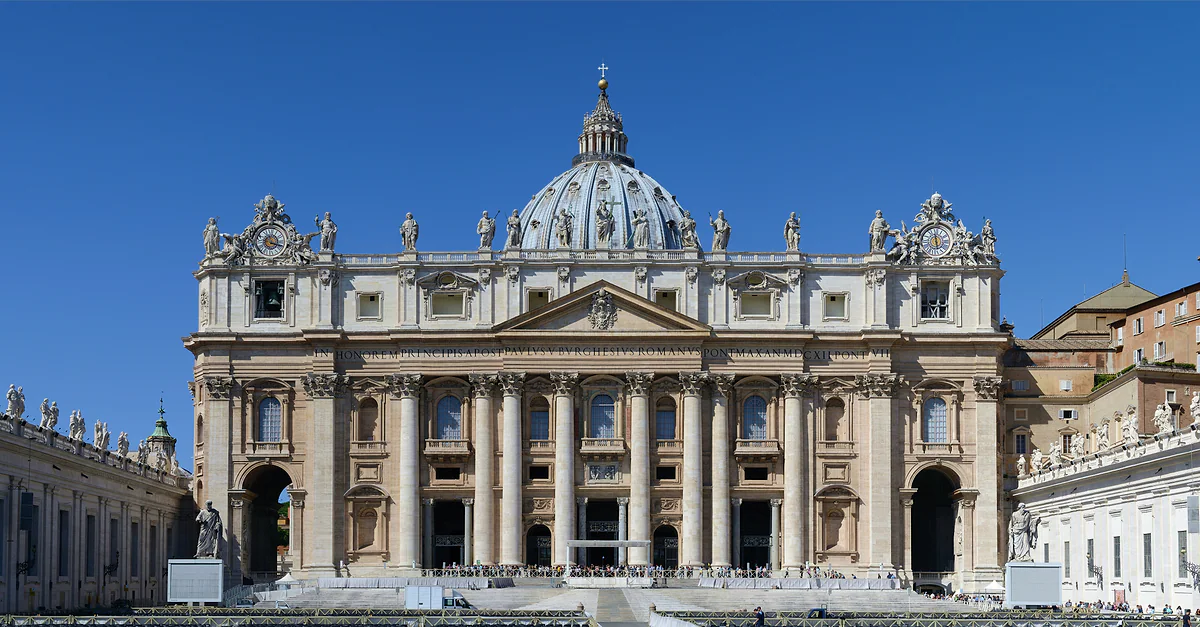
Twenty centuries in 44 hectares
Vatican City history, told through what you can still see
Vatican City was established as a state on 7 June 1929, when ratifications of the Lateran Pacts were exchanged. Its story starts far earlier, by a circus of Caligula and Nero where, by tradition, Peter was martyred around AD 64. Constantine built a basilica over his tomb around 324, and today's replaced it between 1506 and 1626.
In 30 seconds
Full read: 5 min
- Vatican City was established on 7 June 1929, when ratifications of the Lateran Pacts, signed that February, were exchanged.
- Its story begins much earlier, by a circus of Caligula and Nero where, by tradition, Peter was martyred around AD 64.
- Constantine built a basilica over the tomb around 324, and today's was built between 1506 and 1626 by Bramante, Michelangelo and Maderno among others.
- The popes' temporal power ended on 20 September 1870, when Italian troops broke into Rome at Porta Pia.
- I think the best way to grasp this history is to visit it from the bottom up, from the necropolis to the dome.
I wouldn't read Vatican history as a list of popes. I'd read it from the bottom up, the way it was built, with Peter's tomb at the base, Constantine's basilica buried above it and Michelangelo's and Bernini's work on top. Go down to the necropolis and the rest falls into place.

Before you go
What I would keep in mind
-
01 Most beautiful
Down to the first century, beneath the altar
The cemetery Constantine buried to raise his basilica can be visited with a guide and a booking. To me it's the only way to touch the start of this story, the tomb that gives meaning to everything built above it.
Vatican Necropolis -
02 To save money
Half the history is free to see
Bernini's square, the obelisk from Nero's circus, the basilica consecrated in 1626 and the Grottoes with their papal tombs cost nothing. The centuries you pay for are the art ones inside the Museums.
Is the Sistine Chapel free? -
03 My tip
A fire from 847, painted by Raphael
One of the Raphael Rooms shows the Borgo fire that, according to the Liber Pontificalis, Leo IV put out with a blessing. He's the same pope who built the Leonine walls between 848 and 852.
Raphael Rooms -
04 Worth the splurge
The Passetto, a pope's escape route
The 800-metre raised corridor linking the Apostolic Palace to Castel Sant'Angelo reopened for guided visits on 23 December 2024. Clement VII fled along it during the Sack of 1527.
Castel Sant'Angelo
My priorities
Unmissable
If you have time
- Walking through the free Vatican Grottoes, with papal tombs beneath the basilica floor
- Reading the popes' history as they told it themselves in the Raphael Rooms
- Understanding why 1929 turned 44 hectares into a country with its own passport
- See how the basilica was built, architect by architect
- Find out where the word Vatican comes from
I would skip
- Trusting exact dates for Peter's martyrdom, which no official source pins down
- Mixing up the free Grottoes with the necropolis, which needs a guide and an application
- Assuming the Vatican was always the papal home, when popes lived at the Lateran for centuries
What I would book
- Places to stayBooking.com Staying in Borgo, beneath the Passetto Borgo has the Passetto running above its streets and the basilica a short walk away. If history is why you're coming, I'd stay here and reach the necropolis without crossing Rome.
- Tours and ticketsGetYourGuide The Passetto with a guide, as a fallback It's the stretch of this story I most enjoy walking. I'd check the castle's official visit first, and if it's full, operators with guides show up here.
My ranking, scored
What you can still see from each era
My own scores out of 10. I'm rating how close each place brings you to a specific moment in this story when you're standing in front of it, not its artistic value. That's why the necropolis, which few people see, comes out on top.
0 of 7 seen
-
The necropolis and Peter's tomb
Where it all starts. A first-century grave with a small 2nd-century shrine above it, mentioned late in that century by a priest called Gaius, beneath the more than 40,000 m³ of earth Constantine moved.
9.7 out of 10
-
Sistine Chapel
The papal Renaissance in a single room. Walls from 1481-1482, ceiling from 1508-1512 and Last Judgement from 1536-1541, commissioned by different popes over sixty years.
9.5 out of 10
-
St Peter's Basilica
A hundred and twenty years of building, from 1506 to 1626, with Michelangelo's dome closed by Giacomo della Porta and Maderno's façade. In 2026 it marks 400 years since its consecration.
9.3 out of 10
-
Raphael Rooms
Julius II's apartment, but also a history book in paint, with the Borgo fire of 847, Constantine at the Milvian Bridge and Leo III crowning Charlemagne.
8.8 out of 10
-
St Peter's Square and obelisk
Two eras in one spot. The obelisk comes from Caligula and Nero's circus, and Bernini built the colonnade between 1656 and 1667. In the paving, the travertine strip marks the 1929 border.
8.6 out of 10
-
Swiss Guard
At the Pope's side since 22 January 1506, when the first 150 Swiss marched into Rome. And the only armed force to survive the 1970 abolition of the military corps.
8.0 out of 10
-
Castel Sant'Angelo and the Passetto
It's in Rome, not the Vatican, but it's the other half of the popes' story. The raised Passetto corridor served as an escape route in 1527 and has been open for guided visits since December 2024.
7.8 out of 10
What I love about Vatican history is that you can read it vertically. Each era is built on top of the one before, and a good deal of it is still there, on show or under your feet. So rather than a list of popes, I’ll take you through it era by era and tell you what’s left of each one as you cross the square. The bare dates are in the table, and this is the thread that ties them together. If what you’re really after is why it counts as a proper state today, that’s in is Vatican City a country?.
A circus, some gardens and a grave
Before churches and palaces, this was the Ager Vaticanus, an area outside Rome with villas, roadside cemeteries and the gardens of Agrippina, Caligula’s mother. Caligula, emperor from 37 to 41, built a small circus there for training charioteers, and Nero remodelled it. By tradition, Peter was martyred beside that circus during the persecution of AD 64. No document fixes the date, and the official website says as much, speaking of what «tradition holds».
The grave itself is better documented. It’s a simple burial on the southern slope of the hill, facing the circus, over which a small shrine was raised a century later and mentioned in the late 2nd century by a priest called Gaius. Today you see it in the Vatican necropolis, and the circus has left something almost nobody connects with it, the obelisk in the middle of the square.
Constantine buries the cemetery
Around 324, shortly after the Edict of Milan in 313, Constantine began a great five-aisled church with Peter’s tomb at its exact centre. To level the site he filled in the slope and buried the cemetery, while the circus slowly fell apart, partly because its stone went into the new building. For me this is the most decisive moment of all, because it fixes the spot. Everything that followed, including the basilica you’ll walk into, was built to keep that altar above that grave.
Nothing of Constantine’s basilica still stands. It was pulled down from 1506 onwards to make way for the new one, so its footprint lies underneath rather than on view.
Walls, raids and an exile in Avignon
In 846 a Saracen raid sacked St Peter’s, and Leo IV answered with about three kilometres of walls, towers and battlements, inaugurated on 27 June 852. The area became known as the Leonine City. The Liber Pontificalis also credits the same pope with putting out the Borgo fire of 847 with a blessing, a scene Raphael’s workshop painted centuries later in one of the Raphael Rooms, for another pope named Leo.
The popes didn’t actually live here, though. Home was the Lateran. A first palace went up beside St Peter’s between the 12th and 13th centuries, and in 1309 the papacy moved to Avignon until 1377. The Vatican as a settled residence dates from the return.
When was the Vatican you see today built?
Nearly everything you’ll photograph is Renaissance or Baroque, put up in little more than a century and a half. Sixtus IV formally founded the Vatican Library in 1475 and built the chapel that bears his name between 1477 and 1480. Julius II, pope from 1503 to 1513, sped everything up. In 1506 he laid the first stone of the new basilica, welcomed the first Swiss Guards and gathered in a courtyard the ancient statues that are the seed of the Museums. Then he called in Raphael for his rooms and Michelangelo for the ceiling of the Sistine Chapel.
The basilica took a hundred and twenty years. Giacomo della Porta closed Michelangelo’s dome, Maderno lengthened the nave and raised the façade between 1608 and 1612, and Urban VIII consecrated it on 18 November 1626. Bernini laid out the square between 1656 and 1667. If you can only pick one place for this chapter, I’d choose St Peter’s Basilica, which marks its 400th anniversary with a Mass on 18 November 2026.
From the Papal States to the breach at Porta Pia
All the while, the popes were also kings of half of Italy. Historians place the first territorial core in 728, with the gift of the castles of Sutri and Blera, and by 1816, after the Congress of Vienna, the state covered Emilia-Romagna, the Marche, Umbria and Lazio. It all ended on 20 September 1870, when the bersaglieri entered Rome through the breach at Porta Pia. Rome became Italy’s capital and the Pope withdrew into the Vatican.
Italy tried to settle matters with the Law of Guarantees of 1871, granting the Pope inviolability and an annual allowance, but Pius IX rejected it two days later. So began the Roman Question, almost sixty years in which the Pope refused to recognise the state surrounding him.
1929, the year the country was born
The Lateran Pacts, signed that February by Gasparri for the Holy See and Mussolini for Italy, closed that chapter. Italy recognised the State of Vatican City under the Pope’s sovereignty, declared it neutral and inviolable for good and paid financial compensation for 1870. Ratifications were exchanged on 7 June and the Vatican flag went up the following day. The most visible trace of that deal for a visitor is the travertine strip marking the border in the square. Via della Conciliazione, which leads you there today, was cut later by demolishing the Spina di Borgo and, according to unofficial sources, finished for the 1950 Jubilee.
The 20th century and the story so far
Then came dates that still shape a visit. Pius XII ordered excavations beneath St Peter’s from 1939 to 1949, which gave us the necropolis you can tour. The Second Vatican Council opened on 11 October 1962 and closed on 8 December 1965. In 1970 Paul VI left the Swiss Guard as the only armed corps and disbanded the rest, and in 1984 UNESCO listed the whole complex as World Heritage.
The latest chapter fits into two years. Francis opened the Holy Door on 24 December 2024 and died on 21 April 2025. On 8 May 2025 Leo XIV was chosen, and he closed the Jubilee on 6 January 2026 and on 31 July brought in a new Fundamental Law. For me that’s a good reminder that this story isn’t finished, and that the world’s smallest state is still rewriting its rules in 2026. If you’d rather follow it pope by pope, from Peter onwards, there’s the list of popes.
And if you’re wondering about the Vatican catacombs, I explain why there aren’t any and where Rome’s are.
For lighter reading, there are the Vatican City facts.
Key dates in Vatican history
| Date | What happened | What you see today |
|---|---|---|
| AD 37-68 | Caligula builds a circus in Agrippina's gardens and Nero remodels it | The obelisk in the square comes from that circus |
| Around 64 | By tradition, Peter is martyred beside the circus | His tomb, in the necropolis under the basilica |
| Around 324 | Constantine begins a five-aisled basilica over the tomb | Nothing standing; the build buried the necropolis |
| 848-852 | Leo IV encloses the area with about 3 km of walls, the «Leonine City» | His name in the Fire in the Borgo fresco |
| 1309-1377 | The popes live in Avignon | No visible trace in the Vatican |
| 1475 | Sixtus IV formally founds the Vatican Library | Scholars only, with occasional exhibitions |
| 1477-1483 | Sixtus IV builds the Sistine Chapel | The chapel, at the end of the Museums |
| 1506 | First stone of today's basilica and arrival of the Swiss Guard | The basilica, and the Guard at its gates |
| 1508-1512 | Michelangelo paints the Sistine ceiling | The ceiling, with the Creation of Adam |
| 1626 | Urban VIII consecrates the basilica on 18 November | 400th anniversary on 18-11-2026 |
| 1656-1667 | Bernini builds the square for Alexander VII | The colonnade and open piazza |
| 20-09-1870 | Italian troops enter Rome, ending papal temporal power | Nothing; the «Roman Question» begins |
| 11-02-1929 | Lateran Pacts signed | The state, its flag and its border in the square |
| 1962-1965 | Second Vatican Council | Opened 11-10-1962, closed 08-12-1965 |
| 08-05-2025 | Leo XIV elected | The pope at today's audiences |
| 31-07-2026 | New Fundamental Law of the State | In force since it was issued |
The date of Peter's martyrdom is the traditional one, with no document to fix it. «Around 324» for the first basilica is the state's own wording. The 1870 dates come from the Treccani encyclopaedia.
- Peter martyred beside Nero's circus, by tradition
- c. AD 64
- Constantine begins the first basilica over the tomb
- c. 324
- Building of today's basilica, first stone to consecration
- 1506-1626
- End of papal temporal power with the capture of Rome
- 1870
- Lateran Pacts and the birth of the state
- 1929
0 of 88 Vatican City guides
Your next stamp
- Flag
- Facts
- Is it a country?
- Map
- Where to stay
- Christmas
- Sistine Chapel
- Things to do
- One day
- Tickets
- Two days
- Vatican Museums
- St Peter's Basilica
- St Peter's Square
- St Peter's Dome
- Vatican Necropolis
- Vatican Gardens
- Swiss Guard
- Seeing the Pope
- How to visit
- Castel Gandolfo
- Where to eat
- Free and cheap
- Apostolic Palace
- Scams to avoid
- Getting there
- Money and payments
- Exclusive experiences
- Papal audience
- Angelus
- Who painted it
- Where the Pope lives
- Dress code
- Facts
- Opening hours
- Post office and stamps
- Vatican Grottoes
- Pietà
- Baldachin
- Ceiling
- Chair of St Peter
- Last Judgement
- Raphael Rooms
- Architecture and architects
- Gallery of Maps
- Holy Door
- Library and Archives
- Bramante Staircase
- Facade and balcony
- Mass at St Peter's
- Pio Clementino Museum
- Papal blessing
- Vatican Pinacoteca
- Catacombs
- Gallery of Tapestries
- Gallery of the Candelabra
- Egyptian and Etruscan Museums
- Obelisk
- Vatican Museums map
- Bernini's colonnade
- How long you need
- Night opening
- Chiaramonti and Braccio Nuovo
- Anima Mundi Museum
- Easter
- Carriage Pavilion
- Gift shops and souvenirs
- With kids
- Best time to visit
- Courtyard of the Pine Cone
- Photography
- Train station
- Accessible travel
- Vatican Observatory
- Borgia Apartment
- Modern art collection
- Papal Palace
- Barberini Gardens
- Getting there
- Holy See
- Lake Albano
- Police and army
- Passport
- Pharmacy, shop and petrol
- What Vatican means
- Papal tombs
- List of popes
Frequently asked questions
When was Vatican City established?
As a state, on 7 June 1929, the day ratifications of the Lateran Pacts were exchanged; the Pacts themselves were signed on 11 February that year. The Holy See existed long before, but not a state by that name. Its flag was raised for the first time the next day.
When was the Vatican built?
It depends which building you mean. Today's basilica was begun on 18 April 1506 and consecrated on 18 November 1626, the Sistine Chapel dates from 1477-1480 and Bernini's square from 1656-1667. The first basilica, Constantine's, was started around 324 and disappeared when the new one went up.
Why does the Pope live in the Vatican?
Because after losing Rome in 1870 the Pope withdrew there, next to Peter's tomb. For centuries popes actually lived at the Lateran, and the first palace beside St Peter's was built between the 12th and 13th centuries. Exactly where inside the Vatican has changed from pope to pope.
What were the Papal States?
The territory the popes ruled in central Italy until 1870. Treccani places its first core in the gift of Sutri by the Lombard king Liutprand in 728. By 1816 it covered Emilia-Romagna, the Marche, Umbria and Lazio, and it was lost when Italian troops entered Rome on 20 September 1870.
What were the Lateran Pacts?
Three documents, a Treaty with four annexes, a Concordat and a Financial Convention, signed on 11 February 1929 by Cardinal Gasparri and Mussolini. They created the State of Vatican City and settled the Roman Question. Italy also paid 750 million lire plus 1,000 million in 5 % bonds for what happened in 1870.
Why is it called the Vatican?
Because under Rome's kings and the Republic the area was called the Ager Vaticanus, and the name Vaticanum is recorded from the 2nd century. Where the word itself comes from is unclear. An old explanation links it to prophecy, while modern scholars trace it to an ancient settlement called Vaticum.
By
Tourism graduate with a master’s in Tourism Management and Planning from the University of Málaga, who has travelled across Europe. He writes every guide from official sources and his own judgement.
Published on . Facts checked on .
Sources
Photos: Alvesgaspar (CC BY-SA 4.0), via Wikimedia Commons.