Numbers 2 and 3 on the map, first floor
The Chiaramonti Museum and Braccio Nuovo, sculpture as Canova arranged it
The Chiaramonti Museum fills the old loggia between the Belvedere Palazzetto and the Vatican palaces, with about a thousand ancient sculptures that Pius VII began buying in 1806 and Canova arranged. Its extension, the Braccio Nuovo, opened in February 1822 and houses Augustus of Prima Porta and the Nile. They're numbers 2 and 3 on the official map.
In 30 seconds
Full read: 4 min
- The Chiaramonti Museum and Braccio Nuovo are numbers 2 and 3 on the Vatican Museums map, on the first floor.
- The Chiaramonti holds about a thousand ancient sculptures bought from 1806 and arranged by Antonio Canova.
- The Braccio Nuovo, from 1822, is a 68-metre neoclassical gallery with 28 niches.
- It houses Augustus of Prima Porta, the Nile and the bronze peacocks that once flanked the Pine Cone.
- Both are covered by the Museums ticket, and I'd give them about twenty minutes.
If I had to choose, I'd take the Braccio Nuovo. It's a neoclassical hall built so the statues feel back at home, and Augustus of Prima Porta makes sense without a guide once you study his breastplate. The Chiaramonti I'd walk more briskly, hunting for two or three specific pieces.

Before you go
What I would keep in mind
-
01 Most beautiful
Augustus's breastplate tells of a victory without a battle
In the relief, the Parthian king hands back to a Roman general the standards Crassus lost at Carrhae in 53 BC. Above are the Sky and the chariots of Apollo and Dawn, below lies the Earth.
-
02 My tip
The Braccio's peacocks came from the Pine Cone
The two gilded bronze peacocks once decorated the Pine Cone fountain outside the old basilica. In 1608 they moved to the Cortile della Pigna, then to the Braccio Nuovo for safekeeping.
the Courtyard of the Pine Cone -
03 Worth the splurge
A concert in the Braccio Nuovo at no extra cost
On 27 November 2026 at 18:00 the Musica ai Musei series ends in the Braccio Nuovo with Mozart and the Misa Criolla. It's included in the Museums ticket until seats run out.
Vatican Museums night opening -
04 Watch out
No separate ticket for these rooms
The Chiaramonti and the Braccio Nuovo come with the standard Museums ticket. Nobody legitimately sells access to them alone, and the only official online seller is tickets.museivaticani.va.
Vatican scams and tourist traps to avoid in 2026
My priorities
Unmissable
- Augustus of Prima Porta's breastplate, seen up close
- The Nile and its sixteen children
- The gilded bronze peacocks
If you have time
- Gradiva, the relief that fascinated Freud
- The lunette on wall XXI of the Chiaramonti, celebrating the works' return from France
What I would book
- Places to stayBooking.com Prati, a stroll from the Museums entrance For the first morning slot, or for walking back after the November concert, Prati puts Viale Vaticano within easy reach.
- Tours and ticketsGetYourGuide A small-group tour with time for sculpture Many tours rush past the first floor. I'd look for one that stops in the Braccio Nuovo and check entry is included.
My ranking, scored
The pieces I'd look for, in order
My own scores out of 10, weighing what you can follow without a guide and the story behind it. Facts come from the museums' official pages; the scores are opinion.
0 of 5 seen
-
Augustus of Prima Porta
Found at the villa of his wife Livia and dated to the early 1st century. The pose borrows from Polykleitos's Doryphoros, a copy of which stands in the same hall.
9.4 out of 10
-
The Nile
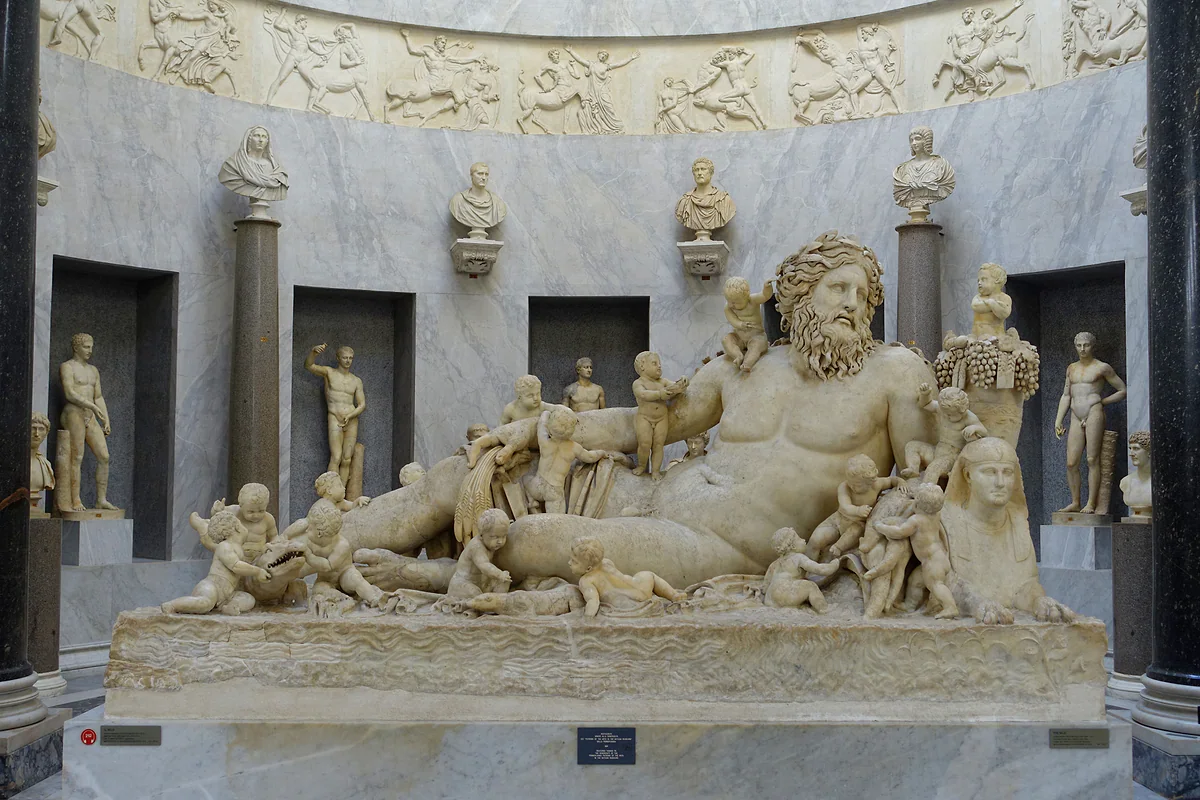
Dug up in 1513 in the Campus Martius. Sixteen children clamber over the river god, one for each cubit the water rose in flood.
9.0 out of 10
-
The gilded bronze peacocks
Early medieval sources place them by Hadrian's Mausoleum. For centuries they stood beside the Pine Cone in the atrium of the old basilica.
8.5 out of 10
-
Gradiva
A relief of walking girls, named after a 1903 novel. Freud wrote about it and hung a cast next to his couch.
8.1 out of 10
-
Hercules with the infant Telephus
Already in Julius II's Statue Court, so among the very first things the popes collected. A replica from the early 2nd century.
7.6 out of 10
The Chiaramonti Museum and the Braccio Nuovo are the ancient sculpture most visitors miss without noticing. They’re on the first floor, not far from the Pio Clementino, and the crowd tends to bypass them on the way to the upper galleries. For me they’re one of the best surprises in the whole complex, the Braccio Nuovo above all, and they tell a story no other room tells quite as well, of how the Vatican rebuilt itself after Napoleon walked off with its finest pieces. Here’s what to see in both and how to fit them into my route through the Vatican Museums.
A museum born out of looting
The 1797 Treaty of Tolentino forced the Papal States to surrender the masterpieces of the Pio Clementino Museum to Napoleon’s France. Pius VII didn’t wait to get them back. From 1806 he bought from Roman dealers and from the excavators working across the Papal States, and used the haul to fill a new museum in the loggia linking the Belvedere Palazzetto to the rest of the palaces. It carries his surname, Chiaramonti.
The man who decided how it all went together was Antonio Canova. He wanted to unite what he called the three sister arts, with sculpture in the ancient pieces, architecture in brackets made from old cornices and painting in frescoes by young artists that he paid for himself. The return of the looted works, after the Congress of Vienna, gets its own lunette on wall XXI.
What should you look for in the Chiaramonti?
There are around a thousand sculptures, including one of the largest collections of Roman portraits anywhere, so it pays to know what you’re after. The display doesn’t isolate the masterpieces; it sets them among lesser pieces so you can compare, an idea taken from Quatremère de Quincy. It’s a fine principle and an exhausting one if you try to take everything in.
I’d look for two pieces. Hercules with the infant Telephus was found near Campo de’ Fiori and was already in Julius II’s Statue Court, making it one of the first things the popes ever collected. The other is Gradiva, a relief of girls walking. Its name comes from a 1903 novel by Wilhelm Jensen; Jung recommended the book to Freud, Freud wrote an essay on it in 1906 and bought a cast in Rome that hung in his study beside the famous couch. I rate that chain of events among the best anecdotes in the museums.
The Braccio Nuovo, a hall built to make statues feel at home
Once the works came back, more space was needed. Pius VII commissioned the Roman architect Raffaele Stern to build a new wing for the Chiaramonti, and after Stern’s death in 1820 Pasquale Belli completed it. It opened in February 1822, with a commission chaired by Canova overseeing the display. The museums describe it as one of the most significant examples of neoclassical architecture in Rome, and I’d agree.
It’s a 68-metre gallery under a coffered vault with skylights, clad in coloured marble taken from Roman buildings, with ancient mosaics set into the floor between large slabs and stucco friezes modelled on classical reliefs. Halfway along it opens into an apse on one side and, on the other, onto steps leading to a portico over the Courtyard of the Pine Cone. Its 28 niches hold larger-than-life statues.
Augustus, the Nile and a pair of peacocks
Augustus of Prima Porta is the reason to come. He was found at the villa of his wife Livia and dates from the early 1st century. He’s addressing his troops in armour and cloak, and the politics are on the breastplate, where the Parthian king returns the standards Rome lost at Carrhae in 53 BC, with the Sky above and the Earth below. The pose borrows from Polykleitos’s Doryphoros, and there’s a copy in the same hall so you can compare.
The Nile is the other star, a reclining old man with a cornucopia and a sphinx, climbed over by sixteen children, one for each cubit the river rose. And don’t miss the two gilded bronze peacocks. Early medieval sources place them by Hadrian’s Mausoleum, now Castel Sant’Angelo, and for centuries they decorated the Pine Cone fountain outside the old basilica.
When to fit them in
I’d see them early, while you’re still on the first floor, because the route then climbs to the galleries and doesn’t come back. I’d give them about twenty minutes. If 27 November 2026 suits you, the Musica ai Musei series finishes here at 18:00 on a standard ticket, which I cover in the Vatican Museums at night.
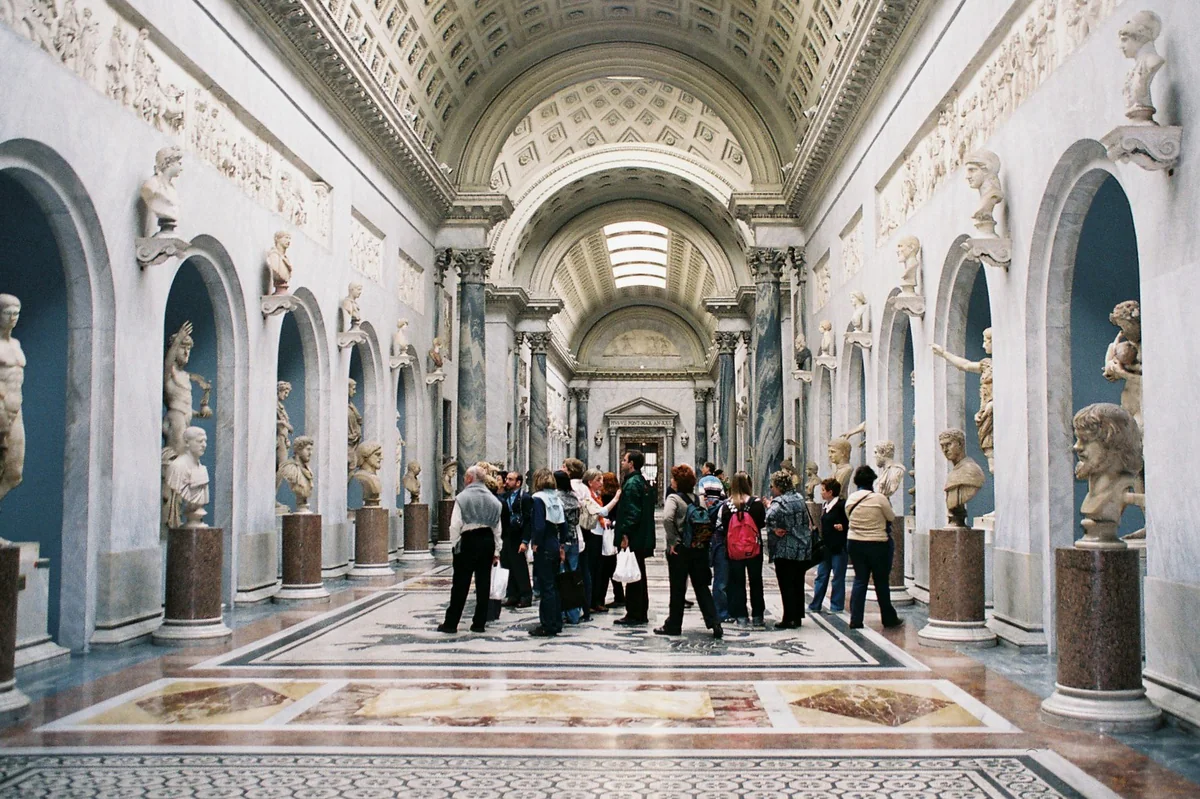
The Braccio Nuovo in the Vatican Museums, a neoclassical gallery with statues in niches, busts on brackets, a coffered vault and a mosaic floor.
The two rooms in numbers
| What | Chiaramonti Museum | Braccio Nuovo |
|---|---|---|
| Official map | No. 2, first floor | No. 3, first floor |
| Origin | Pius VII, purchases from 1806 | Pius VII, opened February 1822 |
| Designed by | Arranged by Antonio Canova | Raffaele Stern and, from 1820, Pasquale Belli |
| What's there | About 1,000 ancient sculptures, many Roman portraits | Larger-than-life statues in 28 niches, plus busts |
| Highlights | Hercules and Telephus, Gradiva | Augustus of Prima Porta, the Nile, the peacocks |
From the official pages for the Chiaramonti Museum and the Braccio Nuovo on the Vatican Museums website.
Tickets and hours (2026)
| What | Detail |
|---|---|
| Standard ticket | €20 at the desk, €25 booked online |
| Reduced | €10 at the desk, €15 online |
| Monday to Saturday | 08:00-20:00, last entry 18:00 |
| Last Sunday of the month | 09:00-14:00, free, last entry 12:30 |
| Concert | 27-11-2026, 18:00, in the Braccio Nuovo, included in the ticket |
No ticket of its own. The concert is from the official Musica ai Musei 2026 programme, first come, first served.
Test yourself
True or false?
0/4 Pick before you peek.
-
Canova paid for the Chiaramonti Museum's frescoes himself.
See the answer
True. According to the official page, the frescoes were painted by young artists at Canova's own expense, as part of his aim to unite sculpture, architecture and painting.
-
The Braccio Nuovo is a Renaissance hall by Bramante.
See the answer
False. It's neoclassical. Raffaele Stern designed it for Pius VII, Pasquale Belli finished it after Stern died in 1820, and it opened in February 1822.
-
The sixteen children on the Nile statue refer to the river's flood.
See the answer
True. They stand for the sixteen cubits the Nile rose during the flood season, as the museums' page explains.
-
The Braccio Nuovo's peacocks were made for the Vatican in the 17th century.
See the answer
False. They're ancient bronzes that early medieval sources place by Hadrian's Mausoleum. They decorated the Pine Cone fountain at Old St Peter's and moved to the Cortile della Pigna in 1608.
- Ancient sculptures, roughly, in the Chiaramonti
- 1,000
- Length of the Braccio Nuovo
- 68 m
- Niches with larger-than-life statues
- 28
- Braccio Nuovo opened, in February
- 1822
0 of 88 Vatican City guides
Your next stamp
- Pio Clementino Museum
- Modern art collection
- Sistine Chapel
- Vatican Pinacoteca
- Anima Mundi Museum
- Bramante Staircase
- Egyptian and Etruscan Museums
- Vatican Museums map
- Things to do
- One day
- Tickets
- Two days
- Vatican Museums
- St Peter's Basilica
- St Peter's Square
- St Peter's Dome
- Vatican Necropolis
- Vatican Gardens
- Swiss Guard
- Seeing the Pope
- How to visit
- Castel Gandolfo
- Where to eat
- Free and cheap
- Apostolic Palace
- Scams to avoid
- Getting there
- Money and payments
- Exclusive experiences
- Papal audience
- Angelus
- Who painted it
- Where the Pope lives
- Where to stay
- Dress code
- Facts
- Opening hours
- Map
- Flag
- Post office and stamps
- Is it a country?
- Vatican Grottoes
- History
- Pietà
- Baldachin
- Ceiling
- Chair of St Peter
- Last Judgement
- Raphael Rooms
- Architecture and architects
- Gallery of Maps
- Holy Door
- Library and Archives
- Facade and balcony
- Mass at St Peter's
- Papal blessing
- Catacombs
- Gallery of Tapestries
- Gallery of the Candelabra
- Obelisk
- Bernini's colonnade
- How long you need
- Night opening
- Christmas
- Easter
- Carriage Pavilion
- Gift shops and souvenirs
- With kids
- Best time to visit
- Courtyard of the Pine Cone
- Photography
- Train station
- Accessible travel
- Vatican Observatory
- Borgia Apartment
- Papal Palace
- Barberini Gardens
- Facts
- Getting there
- Holy See
- Lake Albano
- Police and army
- Passport
- Pharmacy, shop and petrol
- What Vatican means
- Papal tombs
- List of popes
Frequently asked questions
What is the Chiaramonti Museum in the Vatican?
A gallery of ancient sculpture in the Vatican Museums named after Pope Pius VII Chiaramonti. It fills the loggia that linked the Belvedere Palazzetto with the Vatican palaces and holds about a thousand pieces, including one of the most important collections of Roman portraits.
What is the Braccio Nuovo in the Vatican Museums?
The new wing of the Chiaramonti Museum, a 68-metre neoclassical gallery designed by Raffaele Stern and finished by Pasquale Belli. It opened in February 1822 and houses Augustus of Prima Porta and the statue of the Nile.
Where is the Augustus of Prima Porta statue?
In the Braccio Nuovo of the Vatican Museums, number 3 on the official map. The early 1st-century statue was found at Livia's villa at Prima Porta, on the Via Flaminia.
What did Canova have to do with the Chiaramonti Museum?
He decided how the collection was arranged, bringing sculpture, architecture and painting together, and paid out of his own pocket for frescoes by young artists. He also chaired the commission that oversaw the Braccio Nuovo.
Do you need a separate ticket for the Chiaramonti?
No. The Chiaramonti Museum and the Braccio Nuovo are covered by the standard Vatican Museums ticket, €20 at the desk or €25 online, and entry is free on the last Sunday of each month.
How long do the Chiaramonti and Braccio Nuovo take?
There's no official figure. I'd give them about twenty minutes, fifteen for the Braccio Nuovo and the rest for walking the Chiaramonti in search of Gradiva and Hercules.
By
Tourism graduate with a master’s in Tourism Management and Planning from the University of Málaga, who has travelled across Europe. He writes every guide from official sources and his own judgement.
Published on . Facts checked on .
Sources
Photos: Daderot (Public domain); Jesús Moreno (CC BY-SA 3.0), via Wikimedia Commons.