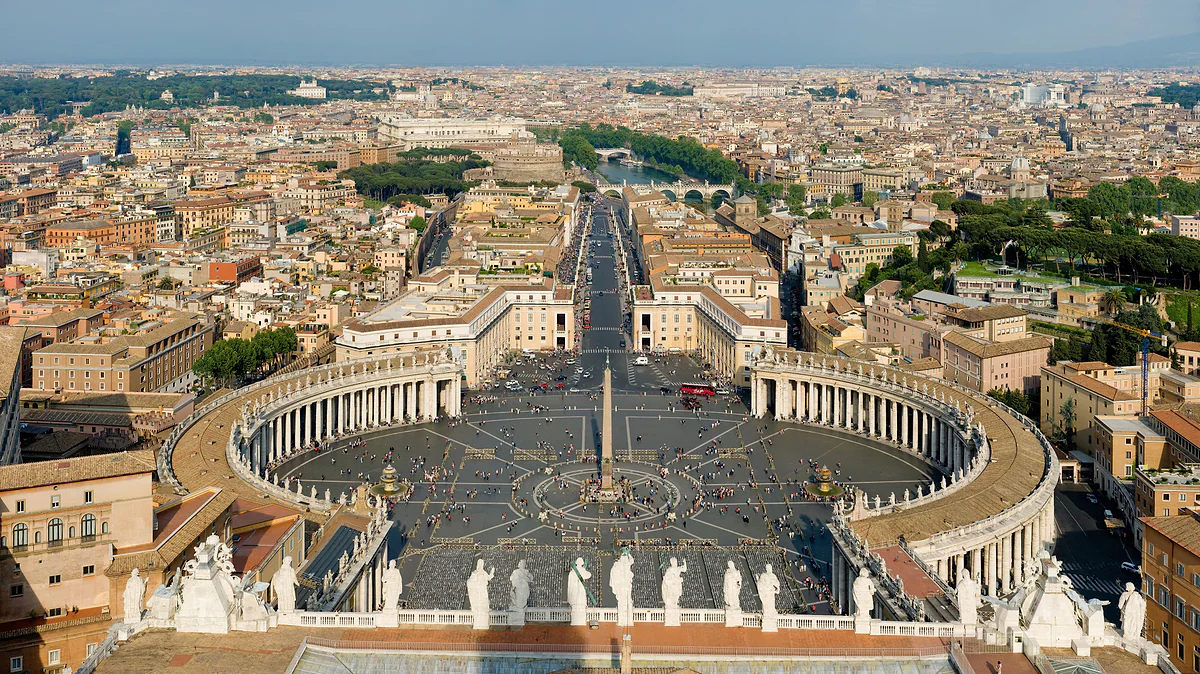
Apostolic Palace, Santa Marta and Castel Gandolfo
The Pope's home, from the Third Loggia to Santa Marta
Since 14 March 2026 Pope Leo XIV has lived in the papal apartment on the Third Loggia of the Apostolic Palace, the same apartment whose study window he uses for the Sunday Angelus. Before that he lived in the Palace of the Holy Office. Francis preferred Casa Santa Marta. In summer the Pope moves to Castel Gandolfo.
In 30 seconds
Full read: 4 min
- Since Saturday 14 March 2026, Leo XIV's home has been the Third Loggia apartment, high up in the Apostolic Palace beside St Peter's.
- His study is the room with the Angelus window, so at 12:00 on Sundays the Pope's home quite literally looks out over the square.
- Francis broke with custom and lived from 2013 to 2025 in the Casa Santa Marta, a residence built for cardinals during a conclave.
- The apartment isn't open. The closest you can get is the Raphael Rooms, once the private rooms of Julius II, included with a Museums ticket.
- He spends summers at Castel Gandolfo, 5 to 27 July in 2026, and its Papal Palace welcomes visitors in the other months, Tuesdays apart.
You can't visit the Pope's home, but you can visit his palace, or part of it. I wouldn't waste time hunting for the window on a Tuesday afternoon. I'd walk through the Raphael Rooms knowing they were Julius II's apartment, which is the closest you'll get to how a pope lives.

Before you go
What I would keep in mind
-
01 Most beautiful
Julius II's rooms, painted by Raphael
The Raphael Rooms were four rooms of the apartment Julius II chose on the palace's second floor. Today you walk through them inside the Vatican Museums, and for me they're the best of the palace you can actually enter.
Vatican Museums -
02 Worth the splurge
The Niccoline Chapel, by special opening only
It isn't on the normal route. You see it by booking the Museums' closed-areas opening, €300 per group of up to 10 plus each person's ticket. Expensive, but it's a palace chapel with almost nobody else in it.
Private Vatican tours and what's worth paying for -
03 My tip
The window you will see
The apartment's study is the Angelus window, on the top floor. Sunday at 12:00 is the one moment the Pope's home opens onto the square.
The Angelus -
04 Getting there
The summer house, about 40 minutes by train
Castel Gandolfo is around 20 km from Rome on the FL4 regional from Termini. Its Papal Palace is open to visitors, except on Tuesdays and during the month the Pope spends there.
Castel Gandolfo
My priorities
Unmissable
If you have time
- The Borgia Apartment, where Pinturicchio decorated the rooms of Alexander VI, now home to modern art
- The Niccoline Chapel, reached only by booking a private opening of closed areas at €300 a group
- The Papal Palace at Castel Gandolfo, a regional train ride of about 20 km from Rome
- See which parts of the palace you can visit
I would skip
- Hunting for the window on a weekday, when it's just another closed window on the façade
- Hoping for the Sala Regia or Pauline Chapel, since no official ticket covers either
- Going to Castel Gandolfo on a Tuesday or during the Pope's month there, as the palace is shut
What I would book
- Tours and ticketsGetYourGuide The Raphael Rooms with a guide They were Julius II's apartment, the closest you'll get to how a pope lives. With a guide you walk in knowing that. Check whether entry is included and compare it with the official tour.
- Places to stayBooking.com Staying in Borgo, below the Apostolic Palace For a trip built around the Vatican, I'd stay in Borgo, a few minutes' walk from the square and St Anne's Gate.
My ranking, scored
What you can see of the Apostolic Palace, my ranking
My own scores out of 10. I weigh how impressive each room is and what it tells you about how popes lived in this palace. The Third Loggia apartment, the Sala Regia and the Pauline Chapel aren't on sale in any product at the official ticket office, so they don't feature.
0 of 5 seen
-
Sistine Chapel
The palace chapel, where conclaves are held, and part of the Museums route. Where a pope is chosen tells you more than where he sleeps.
9.6 out of 10
-
Raphael Rooms
Four rooms of Julius II's second-floor apartment, painted by Raphael and his workshop. The nearest thing to stepping inside a pope's home.
9.2 out of 10
-
Niccoline Chapel
Only with the Museums' closed-areas opening. I score it for what it is, an intimate corner of the palace, and knock points off for the price.
7.8 out of 10
-
Borgia Apartment
Six rooms of Alexander VI decorated by Pinturicchio. Julius II moved upstairs to avoid living with his predecessor's memory, and today they hold modern and contemporary art.
7.3 out of 10
-
The study window, from the square
You don't go in, but it's the part of the Pope's home everyone sees. At noon on Sunday it opens and means something; the rest of the week it's just another window.
6.5 out of 10
It sounds like a simple question, and for twelve years it had an unusual answer. Now it’s the traditional one again. Leo XIV lives in the Apostolic Palace, in the apartment on the Third Loggia that his predecessors used for more than a century and that Francis left empty. Here’s where it is, why it took so long to move in, what Santa Marta was about, and which bits of all this you can see for yourself.
Leo XIV moves back into the Apostolic Palace
The move happened on the afternoon of Saturday 14 March 2026, when the Pope took possession of the papal apartment with his closest staff, according to L’Osservatore Romano. The apartment is on the Third Loggia of the Apostolic Palace, newly renovated, and includes his private study, a library and a small chapel.
That study is the one with the window. It’s where the Pope appears every Sunday at 12:00 for the Angelus over St Peter’s Square, so his home and his weekly public appearance are, quite literally, the same room. I find that the loveliest detail of the whole story.
The first pope to live in those rooms was Pius X, who reigned from 1903 to 1914. Francis broke the habit in March 2013 and Leo XIV has picked it up again.
Ten months at the Palace of the Holy Office
Leo XIV was elected on 8 May 2025, and until March 2026 he stayed where he already lived, the Palace of the Holy Office, his home since he was Prefect of the Dicastery for Bishops. He had reopened the papal apartment on 11 May 2025, as it had been closed since Francis’s death, but more than ten months went by before the move.
The official source describes the apartment as now renovated, and I wouldn’t read more into it. What matters to a visitor is that since March 2026 the Angelus window is once again the window of the Pope’s home.
Why Francis lived at Casa Santa Marta
Francis was the first pope not to live in the papal apartment. He lived in the Domus Sanctae Marthae, Casa Santa Marta, a residence John Paul II created in 1996 for a very specific purpose, housing the cardinal electors during a conclave. Francis moved in as a cardinal in March 2013 and, once elected, simply stayed.
He gave his reasons himself on the flight back from Rio on 28 July 2013. He said he couldn’t live alone or with a small group; he needed people. Asked whether it was about austerity, he said no, it was for psychological reasons, and added that the papal apartment wasn’t all that luxurious. I like that answer far more than the romantic poverty story that grew up afterwards, because it’s human and it’s his.
What you can see from outside
Looking from St Peter’s Square, the Apostolic Palace is the building rising to the right of the basilica, above the colonnade. Domenico Fontana rebuilt it in 1589 and 1590 on the orders of Sixtus V, and Taddeo Landini finished it under Clement VIII. The apartment takes up the top floor, and the study window is on that façade.
Some guides count it as the second window from the right. The Holy See doesn’t go into that detail and sticks to the third floor and the study. I wouldn’t go looking for it on an ordinary day. Midweek it’s just another closed window, and it only means something when you see it open on a Sunday.
Which parts of the palace you can visit
This is the useful bit, and the ranking above puts it in my order. The apartment where the Pope lives isn’t open. Nor are the Sala Regia or the Pauline Chapel, which weren’t on sale in any product at the Museums’ official ticket office on 24 September 2026.
What you can walk through, on a normal Vatican Museums ticket, are other parts of the same building. The Raphael Rooms were four rooms of the apartment Julius II chose on the second floor. Below them, on the first level, is the Borgia Apartment, six rooms of Alexander VI decorated by Pinturicchio. Julius II left them so as not to live with his predecessor’s memory and moved upstairs to the rooms Raphael would paint. The Borgia Apartment now holds part of the modern and contemporary art collection, and Leo XIII opened it to the public at the end of the nineteenth century. The Sistine Chapel is on the route too.
To go a step further, the Niccoline Chapel can be seen through the Museums’ special closed-areas opening, for a flat €300 per group (up to ten people), with each person’s ticket on top. The Raphael Loggias, according to unofficial sources, are only shown on request.
Castel Gandolfo, the summer house
Outside Rome the Pope spends part of the summer at Castel Gandolfo, a Holy See estate above Lake Albano. In 2026 he was there from 5 to 27 July and returned for 15 and 16 August, leading the Angelus in Piazza della Libertà. It isn’t his permanent home, and the palace there is open to visitors for the rest of the year, except on Tuesdays.
The press reported that from autumn 2025 the Pope spent Monday evening to Tuesday evening at Castel Gandolfo most weeks. I have no official confirmation that this has continued in 2026, since his move into the Apostolic Palace, so I’m not claiming it.
One last thing, since the searches go hand in hand. The Pope is far from the only resident. At 31 December 2024 there were 246 citizens living inside the walls, and 104 of them belonged to the Swiss Guard.
Where recent popes have lived
| Pope | Vatican residence | Note |
|---|---|---|
| Francis (2013-2025) | Casa Santa Marta | The first pope not to live in the papal apartment |
| Leo XIV, May 2025 to March 2026 | Palace of the Holy Office | His home as Prefect of the Dicastery for Bishops |
| Leo XIV, since 14 March 2026 | Third Loggia apartment, Apostolic Palace | Renovated, with study, library and chapel |
Sources: L'Osservatore Romano, Vatican News and the Holy See's website, checked on 24 September 2026.
- Day Leo XIV moved into the Third Loggia apartment
- 14 Mar 2026
- Pius X's reign began, the first Pope to live in these rooms
- 1903
- Year John Paul II founded the Casa Santa Marta
- 1996
- Swiss Guards among Vatican resident citizens at 31 December 2024
- 104 of 246
0 of 88 Vatican City guides
Your next stamp
- Papal Palace
- Apostolic Palace
- Castel Gandolfo
- Seeing the Pope
- Borgia Apartment
- Train station
- Papal tombs
- Angelus
- Sistine Chapel
- Things to do
- One day
- Tickets
- Two days
- Vatican Museums
- St Peter's Basilica
- St Peter's Square
- St Peter's Dome
- Vatican Necropolis
- Vatican Gardens
- Swiss Guard
- How to visit
- Where to eat
- Free and cheap
- Scams to avoid
- Getting there
- Money and payments
- Exclusive experiences
- Papal audience
- Who painted it
- Where to stay
- Dress code
- Facts
- Opening hours
- Map
- Flag
- Post office and stamps
- Is it a country?
- Vatican Grottoes
- History
- Pietà
- Baldachin
- Ceiling
- Chair of St Peter
- Last Judgement
- Raphael Rooms
- Architecture and architects
- Gallery of Maps
- Holy Door
- Library and Archives
- Bramante Staircase
- Facade and balcony
- Mass at St Peter's
- Pio Clementino Museum
- Papal blessing
- Vatican Pinacoteca
- Catacombs
- Gallery of Tapestries
- Gallery of the Candelabra
- Egyptian and Etruscan Museums
- Obelisk
- Vatican Museums map
- Bernini's colonnade
- How long you need
- Night opening
- Chiaramonti and Braccio Nuovo
- Christmas
- Anima Mundi Museum
- Easter
- Carriage Pavilion
- Gift shops and souvenirs
- With kids
- Best time to visit
- Courtyard of the Pine Cone
- Photography
- Accessible travel
- Vatican Observatory
- Modern art collection
- Barberini Gardens
- Facts
- Getting there
- Holy See
- Lake Albano
- Police and army
- Passport
- Pharmacy, shop and petrol
- What Vatican means
- List of popes
Frequently asked questions
Where does the Pope live?
Leo XIV lives in the papal apartment on the Third Loggia of the Apostolic Palace in Vatican City, and has done since the afternoon of Saturday 14 March 2026. It has been renovated and includes the study he uses for the Angelus, a library and a small chapel.
Does the Pope live in Vatican City?
Yes. His residence is the Apostolic Palace, next to St Peter's Basilica. He spends part of the summer at Castel Gandolfo, a Holy See property outside Rome, but that isn't his permanent home.
Where did Pope Leo live before the Apostolic Palace?
In the Palace of the Holy Office, where he already lived as Prefect of the Dicastery for Bishops. More than ten months passed between his election on 8 May 2025 and the move.
Why did Pope Francis live in Casa Santa Marta?
He explained it himself in July 2013. He said he couldn't live alone or with a small group and needed people around him, and when asked if it was about austerity he said no, it was for psychological reasons. He added that the papal apartment wasn't all that luxurious.
What is Casa Santa Marta?
The Domus Sanctae Marthae, a residence inside the Vatican built to house the cardinal electors during a conclave. John Paul II set up its foundation in 1996. Francis moved in as a cardinal for the 2013 conclave and stayed.
Can you see inside the Pope's house?
Not the apartment he lives in. What you can visit, inside the Vatican Museums, are other parts of the same palace, such as the Raphael Rooms, the Borgia Apartment and the Sistine Chapel. At Castel Gandolfo the Papal Palace is open to visitors.
By
Tourism graduate with a master’s in Tourism Management and Planning from the University of Málaga, who has travelled across Europe. He writes every guide from official sources and his own judgement.
Published on . Updated on . Facts checked on .
Sources
Photos: Diliff (CC BY-SA 3.0), via Wikimedia Commons.