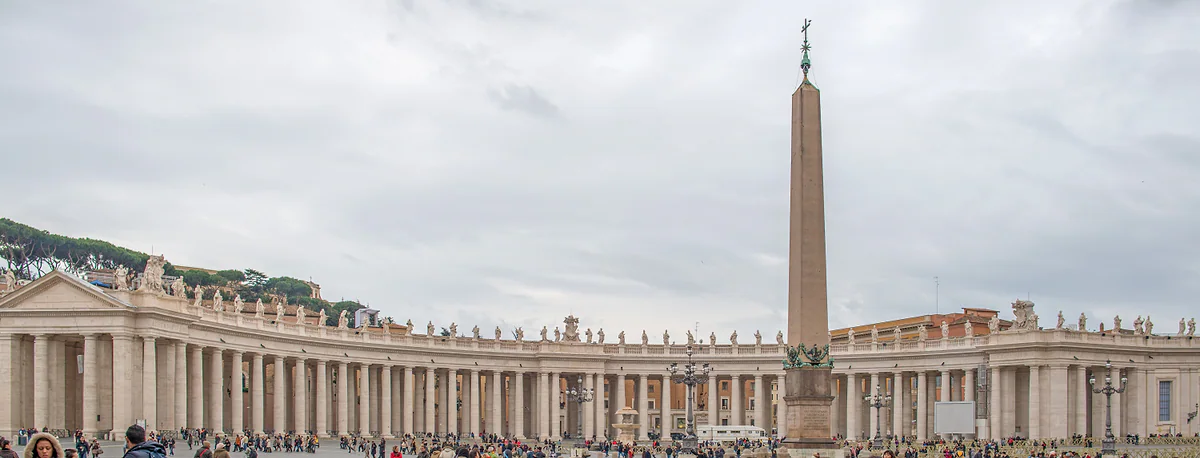
284 columns in four rows that turn into one
Bernini's colonnade, the open arms of St Peter's Square
Bernini built the colonnade of St Peter's Square for Alexander VII between 1656 and 1667. It has 284 columns and 88 pillars in four rows, topped by 140 statues of saints placed between 1662 and 1703. From the two marble discs marking the centre of each curve, the four rows line up and look like one. It's free to walk through at any hour.
In 30 seconds
Full read: 4 min
- St Peter's colonnade is Bernini's work for Alexander VII, built between 1656 and 1667.
- It has 284 columns and 88 pillars in four rows, and 140 statues of saints about three metres tall.
- From the two 'centro del colonnato' discs, the four rows look like a single one.
- Bernini planned a third arm to close the square, but the pope's death in 1667 left it unbuilt.
- It's free to walk through at any hour, and under its porticoes you'll find the post office, a pharmacy counter and the security check.
The first thing I'd do is find one of the two 'centro del colonnato' discs and stand still for half a minute. Watching four rows of columns melt into one is the best optical trick in the Vatican, and it costs nothing and needs no guide.

Before you go
What I would keep in mind
-
01 Most beautiful
The disc where the columns vanish
Between the obelisk and each fountain there's a white marble disc inscribed 'centro del colonnato'. Stand on it and the colonnade in front of you goes from four rows to one.
Vatican obelisk -
02 My tip
Shelter under the porticoes
The colonnade is roofed, so in summer heat or rain it's the best place to wait while the security queue, in the right-hand curve, shuffles forward.
Best time to visit Vatican City -
03 To save money
Post office and pharmacy counter on the square
The left-hand curve has the Vatican Post office on the square, and the Charlemagne Wing has a Vatican parapharmacy. Neither needs a ticket.
Vatican pharmacy -
04 My tip
The 1981 marker in the paving
Near the Bronze Door, at the end of the right-hand colonnade, a stone with John Paul II's coat of arms marks the spot where he was shot on 13 May 1981.
Apostolic Palace in Vatican City
My priorities
Unmissable
- Stand on a 'centro del colonnato' disc and watch the four rows line up
- Walk at least one stretch inside the portico, between the columns
- See it from above, from the terrace of the dome
If you have time
- Find the 1981 marker near the Bronze Door
- Read up on the obelisk at its centre
- Post a card from the office in the left-hand curve
I would skip
- Quoting a column height as fact, since two official sites give different figures
- Walking it mid-morning on a Wednesday, when the audience fills the square with barriers
What I would book
My ranking, scored
What I'd look at in the colonnade, in order
My own scores out of 10. They weigh what you can see for free without a guide and what it tells you about Bernini's design. All of it fits into a twenty-minute stroll round the square.
0 of 6 seen
-
The view from 'centro del colonnato'
From each disc the four rows of columns line up and look like one. It's the proof that Bernini designed the square to be seen from particular spots.
9.7 out of 10
-
The 140 statues of saints
They face the square from the balustrade. Each arm has its own group, with popes and doctors of the Church to the south and founders of orders to the north.
9.0 out of 10
-
Walking inside the portico
Strolling between the four rows under the roof is how you feel the real scale of the thing. Hardly anyone does it, because they head straight for the queue.
8.6 out of 10
-
Alexander VII's coats of arms
Six of them on the projecting sections, the signature of the pope who paid. Same idea as Urban VIII's bees on the baldachin.
7.8 out of 10
-
The Constantine Wing and the Bronze Door
The straight right-hand arm runs from the Bronze Door to the Scala Regia. Papal processions used it, and the pope's funeral cortege still does.
7.7 out of 10
-
The Charlemagne Wing
The straight left-hand arm, with an equestrian statue of Charlemagne from 1725. It hosts exhibitions now, and below it is the Swiss Guard post for the Arch of the Bells.
7.3 out of 10
The colonnade of St Peter’s Square is in every photo of the Vatican, and almost nobody really looks at it. It’s a portico of four rows of columns wrapped round the square, yes, but it’s also an optical machine built so that from two particular spots on the paving everything falls into place. For me it’s the Bernini you enjoy most without spending a penny. This is how I would approach it, with the official figures alongside.
Eleven years to embrace a square
Alexander VII, pope from 1655 to 1667, commissioned it, and the idea was largely his. On 31 July 1656 he asked Bernini for preliminary designs, and they were rejected one after another. After debate and changes, work started in March 1657, and the final design was settled between spring 1659 and spring 1660. The colonnade was complete in 1667, eleven years after the first brief.
The result is 284 columns and 88 pillars in four rows, in travertine and marble, under a pitched roof with a balustrade on top. The official sheet gives each portico a width of 16.77 metres and inner and outer lengths of 163 and 202 metres. The column height is a problem I’d rather tell you about straight. The Holy See says 13 metres and the Fabbrica di San Pietro says 16. Until they agree, I’m not giving you a number.
The intention, though, is clear. Bernini wrote that the colonnade should receive ‘with open arms’, like a mother, Catholics to confirm them in the faith, heretics to reunite them with the Church and unbelievers to enlighten them. That’s where the image of the square as an embrace comes from.
Where do the four rows line up?
It’s the best moment of the visit and it takes thirty seconds. Between the obelisk and each of the two fountains there’s a white marble disc inscribed ‘centro del colonnato’, marking the geometric centre of the curve in front of you. Stand on it and look. The four rows of columns hide behind the first, and the portico seems to be a single line.
From anywhere else the columns look endless and jumbled, and that contrast is exactly what Bernini was after. To see how everything is organised around the axis, start with the obelisk in St Peter’s Square, the point from which the ellipse was drawn.
140 saints looking down on the square
Along the balustrade stand 140 statues of saints, each a little over three metres tall, placed between 1662 and 1703, well after the columns were finished. They’re not random. The northern curve has defenders of the faith and founders of the oldest religious orders. The southern curve has popes, bishops, doctors of the Church and reformers. The straight arms carry martyrs, saints of the Catholic Reformation and those venerated as wonder-workers.
On the projecting sections are six coats of arms of Alexander VII, the paying client’s signature. And there’s something you can’t see. Bernini planned a third arm closing the square on the city side. The pope’s death in 1667 stopped the work and it was never built, so the square stayed open towards Rome, a gap the 20th century finally finished off with Via della Conciliazione.
The two straight wings
Where the colonnade meets the facade, two straight wings 70 metres long join the basilica. On the right is the Constantine Wing. It runs from the Bronze Door to the Scala Regia and has always been the main way into the basilica and the palaces, the route of papal processions. The pope’s funeral cortege still uses it, and on 11 October 1962 the 2,498 bishops of the Second Vatican Council walked along it. At its end is Bernini’s statue of Constantine.
On the left is the Charlemagne Wing, with an equestrian statue of the emperor by Agostino Cornacchini from 1725. It now hosts exhibitions backed by the Vatican, and its lower floor holds offices and the Swiss Guard post for the Arch of the Bells, built by Giuseppe Momo in 1930. How to see the guards without getting in their way is on my Swiss Guard page.
The colonnade for practical travellers
Beyond the art, the colonnade gets things done. The basilica’s security check, run by the Italian police, is in the right-hand curve and builds queues in high season, and the porticoes let you wait in the shade. The left-hand curve houses the square’s Vatican Post office, open daily, and the Charlemagne Wing a little-known parapharmacy, which I describe with the rest on the Vatican pharmacy page.
One detail always gets me. Close to the Bronze Door, set in the paving, a stone bearing John Paul II’s arms shows where the gunman hit him on 13 May 1981, at 17:19, mid-audience. It’s easy to walk over it without noticing. Everything else about the square is gathered in my main guide to St Peter’s Square.
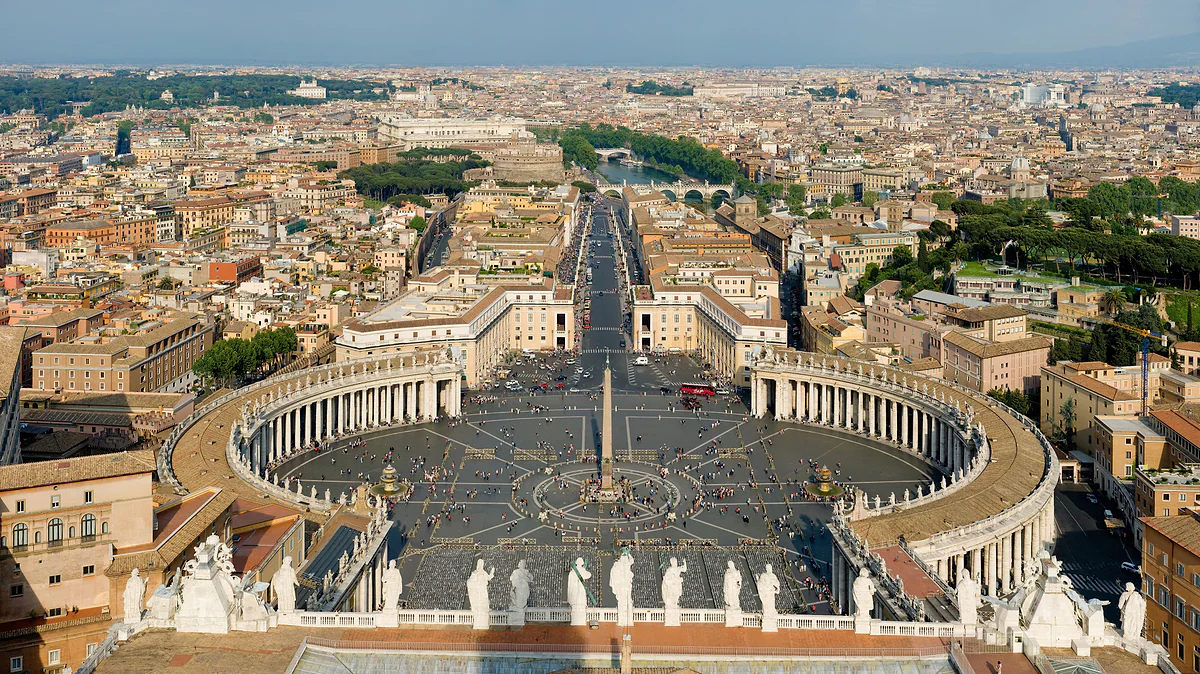
St Peter's Square seen from the basilica dome, with Bernini's colonnade, the central obelisk and Via della Conciliazione leading towards Rome.
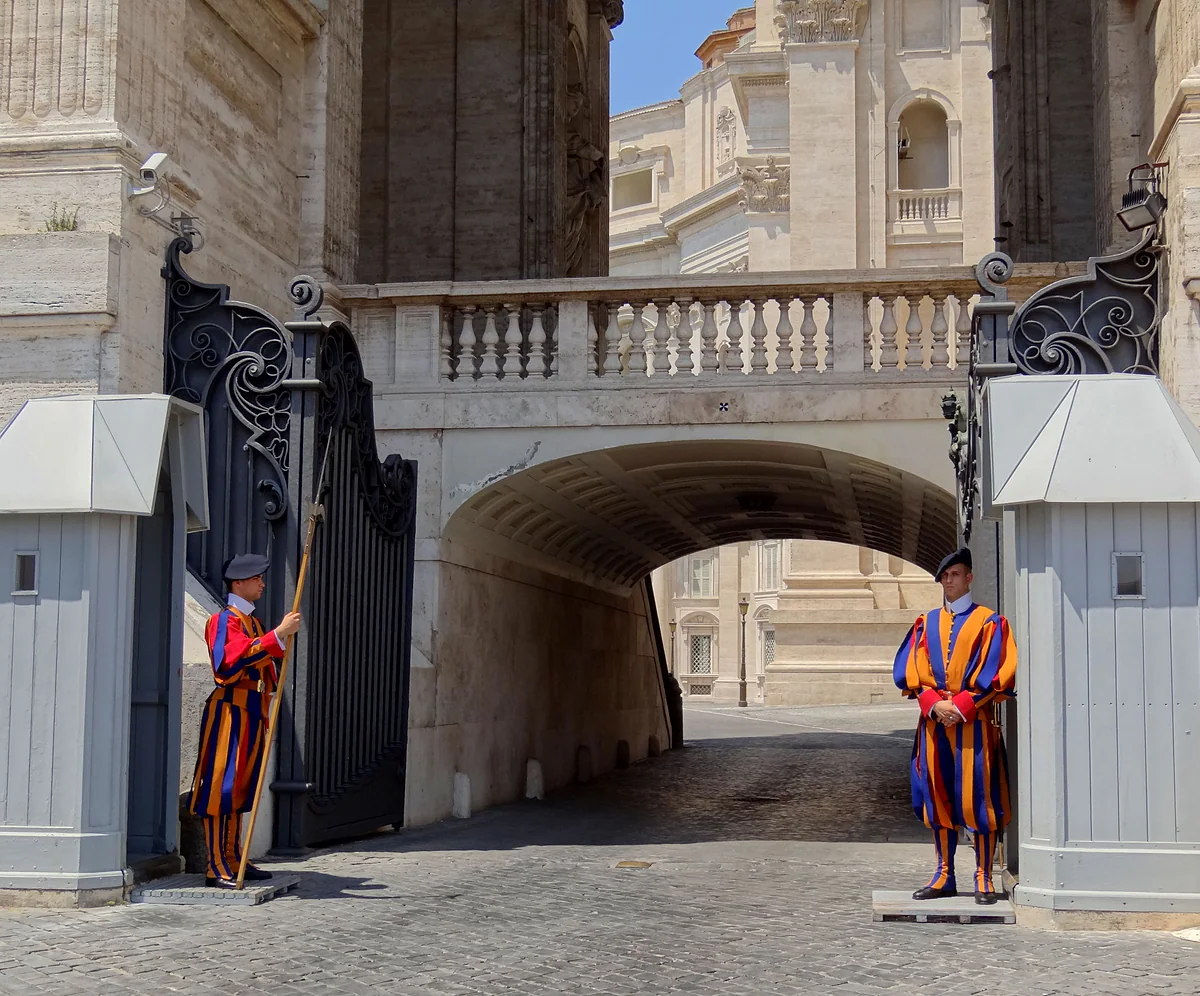
Two uniformed Swiss Guards, one holding a halberd, on duty on either side of the Arch of the Bells beside their sentry boxes.
The colonnade in figures
| Fact | Figure |
|---|---|
| Architect | Gian Lorenzo Bernini |
| Commissioned by | Alexander VII (pope 1655-1667) |
| Built | 1656-1667, statues 1662-1703 |
| Materials | Travertine and marble |
| Columns and pillars | 284 columns and 88 pillars in 4 rows |
| Width of the portico | 16.77 m |
| Inner and outer length | 163 m and 202 m |
| Statues | 140, about 3.10 m each |
Holy See official fact sheet (vatican.va). The column height differs between official sources, 13 m on vatican.va and 16 m on basilicasanpietro.va, so I don't give it as settled.
Who stands on which section
| Section | Saints |
|---|---|
| Northern curve | Defenders of the faith and founders of the oldest religious orders |
| Southern curve | Popes, bishops, doctors of the Church and reformers |
| Straight arms | Martyrs, saints of the Catholic Reformation and wonder-workers |
Arrangement given in the colonnade's official fact sheet.
Test yourself
True or false?
0/4 Pick before you peek.
-
Bernini's colonnade has more than 250 columns.
See the answer
True. It has 284 columns plus 88 pillars in four rows, according to the Holy See's official fact sheet.
-
The statues went up at the same time as the columns.
See the answer
False. The colonnade was finished in 1667, but the statues were placed between 1662 and 1703, nearly forty years later.
-
Bernini wanted to close the square with a third arm.
See the answer
True. He designed one, but Alexander VII's death in 1667 halted the work and the third arm was never built.
-
The four rows of columns line up from anywhere in the square.
See the answer
False. Only from the two 'centro del colonnato' discs. Elsewhere the columns look countless and jumbled.
- Columns, plus 88 pillars, in four rows
- 284
- Statues of saints on the balustrade
- 140
- Of building, from 1656 to 1667
- 11 years
- Width of each portico
- 16.77 m
0 of 88 Vatican City guides
Your next stamp
- St Peter's Square
- Facts
- Obelisk
- Map
- Facade and balcony
- Sistine Chapel
- St Peter's Basilica
- Gallery of Tapestries
- Things to do
- One day
- Tickets
- Two days
- Vatican Museums
- St Peter's Dome
- Vatican Necropolis
- Vatican Gardens
- Swiss Guard
- Seeing the Pope
- How to visit
- Castel Gandolfo
- Where to eat
- Free and cheap
- Apostolic Palace
- Scams to avoid
- Getting there
- Money and payments
- Exclusive experiences
- Papal audience
- Angelus
- Who painted it
- Where the Pope lives
- Where to stay
- Dress code
- Facts
- Opening hours
- Flag
- Post office and stamps
- Is it a country?
- Vatican Grottoes
- History
- Pietà
- Baldachin
- Ceiling
- Chair of St Peter
- Last Judgement
- Raphael Rooms
- Architecture and architects
- Gallery of Maps
- Holy Door
- Library and Archives
- Bramante Staircase
- Mass at St Peter's
- Pio Clementino Museum
- Papal blessing
- Vatican Pinacoteca
- Catacombs
- Gallery of the Candelabra
- Egyptian and Etruscan Museums
- Vatican Museums map
- How long you need
- Night opening
- Chiaramonti and Braccio Nuovo
- Christmas
- Anima Mundi Museum
- Easter
- Carriage Pavilion
- Gift shops and souvenirs
- With kids
- Best time to visit
- Courtyard of the Pine Cone
- Photography
- Train station
- Accessible travel
- Vatican Observatory
- Borgia Apartment
- Modern art collection
- Papal Palace
- Barberini Gardens
- Getting there
- Holy See
- Lake Albano
- Police and army
- Passport
- Pharmacy, shop and petrol
- What Vatican means
- Papal tombs
- List of popes
Frequently asked questions
How many columns are there in St Peter's Square?
284 columns and 88 pillars, in four rows. That's the figure on the Holy See's official sheet. The colonnade went up between 1656 and 1667.
How many statues are there on the colonnade?
There are 140 statues of saints on top, each just over three metres tall, facing the square. At the foot of the basilica steps there are also two colossal statues of St Peter and St Paul, placed there in 1847.
Who designed the colonnade of St Peter's Square?
Gian Lorenzo Bernini, for Pope Alexander VII. Work began in March 1657 after several earlier designs were turned down, and the colonnade was finished in 1667. The statues went up until 1703.
What does Bernini's colonnade symbolise?
Bernini himself described it as arms that receive, like a mother, Catholics to confirm them in the faith, heretics to reunite them with the Church and unbelievers to enlighten them. That's where the idea of the square's embrace comes from.
Where do the columns line up into one row?
Between the obelisk and each of the two fountains there's a white marble disc inscribed 'centro del colonnato'. From there the four rows of the curve in front of you look like a single one.
Was the colonnade meant to have a third arm?
Yes. Bernini planned a third arm of portico closing the square on the city side, but Alexander VII's death in 1667 stopped the work and it was never built.
By
Tourism graduate with a master’s in Tourism Management and Planning from the University of Málaga, who has travelled across Europe. He writes every guide from official sources and his own judgement.
Published on . Facts checked on .
Sources
Photos: Bengt Nyman (CC BY 2.0); Diliff (CC BY-SA 3.0); Bjørn Christian Tørrissen (CC BY-SA 3.0), via Wikimedia Commons.