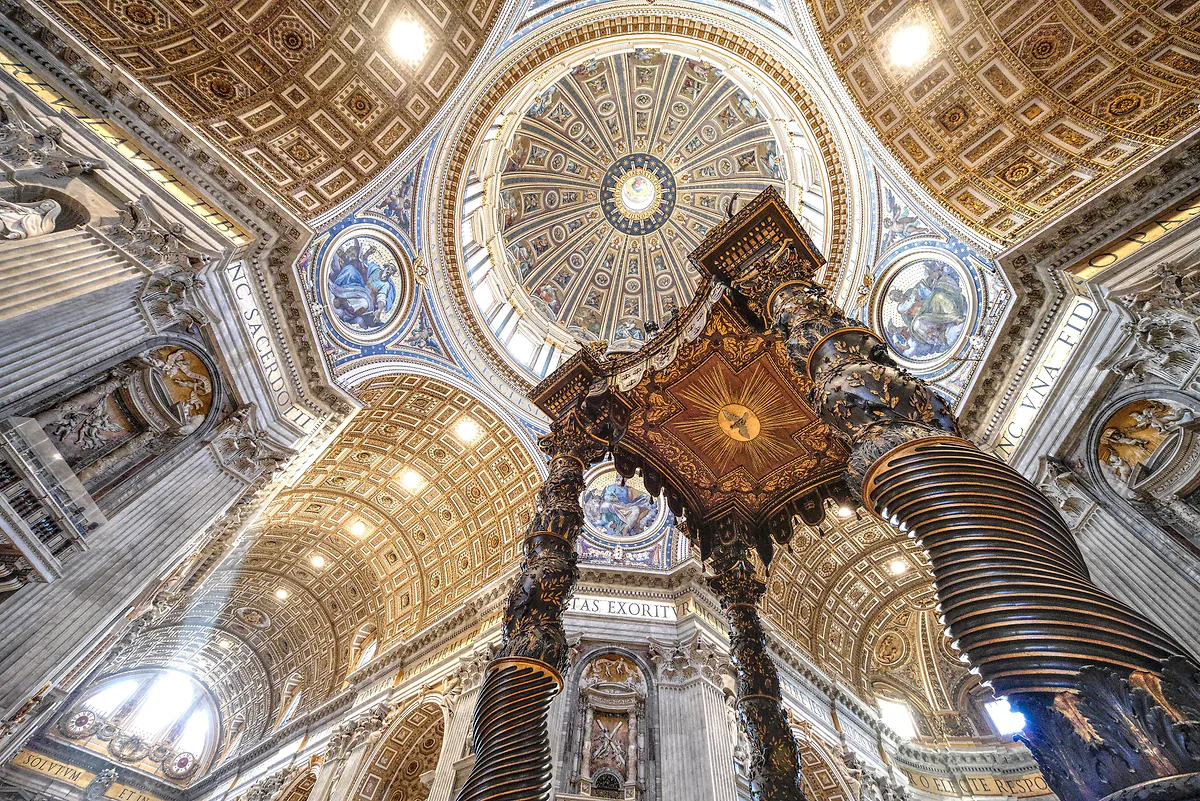
Back on view, restored, since October 2024
St Peter's baldachin, Bernini's canopy over the apostle's tomb
Gian Lorenzo Bernini made the baldachin in St Peter's for Urban VIII between 1624 and 1635. Almost 29 metres high on four twisted columns, it stands over the papal altar, directly above Peter's tomb. It's made of bronze, gold, wood and copper, was restored over nine months in 2024 and is free to see inside the basilica, 07:00 to 20:00.
In 30 seconds
Full read: 3 min
- Bernini made St Peter's baldachin for Urban VIII between 1624 and 1635, and it stands almost 29 metres high.
- It covers the papal altar, directly above Peter's tomb, on four twisted bronze columns.
- It's bronze, gold, wood and copper, and the bees on it are the Barberini emblem.
- It was restored over nine months in 2024 and went back on view on 27 October that year.
- It's free to see inside the basilica, 07:00 to 20:00, and from above if you climb the dome.
I'd look at it twice. First from well back in the nave, to see that the whole church is built to lead your eye to it, then up close from one side, hunting for the bees and the leather-brown poles the 2024 clean revealed. With the Chair of St Peter framed between the columns behind, that's the finest view in the basilica.

Before you go
What I would keep in mind
-
01 Most beautiful
The Chair framed between the columns
For me the best view in St Peter's comes from standing in the nave in front of the altar, with Bernini's Chair of St Peter at the far end of the apse framed by the baldachin's twisted columns. They're two of his works meant to be seen together.
St Peter's Basilica -
02 My tip
Look for the bees from the sides
Bees were the emblem of the Barberini, Urban VIII's family, and they're scattered across the bronze. From the middle of the nave they're lost, so I'd move round to one side of the altar to spot them.
Visiting Vatican City in 2026 -
03 To save money
Free, and the dome shows it from above
Seeing it costs nothing, since it's inside the basilica. If you do spend money, make it the dome, €17 by the stairs with the basilica included, because from the inner gallery you look straight down on it.
St Peter's Dome -
04 Watch out
No tour gets you up to the altar
The papal altar and the baldachin are seen from the nave, the same for everyone. The Fabbrica states in writing that there's no way to skip the basilica queue, so be wary of anyone offering to.
Vatican scams and tourist traps to avoid in 2026
My priorities
Unmissable
- View it from the nave with Bernini's Chair of St Peter framed behind
- Move to one side for the twisted columns and the bees
- Look into the Confessio, where Peter's tomb lies beneath the altar
If you have time
I would skip
- Trusting very precise heights that come from no official source
- Paying to skip a basilica queue the Fabbrica says can't be skipped
- Using flash, which is banned throughout the basilica
What I would book
- Places to stayBooking.com Borgo, for the baldachin first thing With the basilica just open at seven, the nave is almost empty and you can see the baldachin from every angle.
- Tours and ticketsGetYourGuide Basilica and dome with a guide If you want someone to walk you through Bernini, this pairs the nave with the dome. Compare it with the Fabbrica's own €18 tour first.
My ranking, scored
What I'd look for on the baldachin, in order
My own scores out of 10. They weigh what you can really see from the floor of the nave and what it tells you about the work and its 2024 restoration. It's a running order for a quarter of an hour, not a study of Bernini.
0 of 7 seen
-
The four twisted columns
Spiralling bronze, modelled on the marble columns that surrounded Peter's tomb in the old basilica. They're what gives the whole structure its movement.
9.6 out of 10
-
The view with the Chair behind
From the nave, Bernini's Chair of St Peter, finished in 1666, sits framed between the columns. It's the photo I'd take before moving closer.
9.4 out of 10
-
The leather-coloured poles
The restoration brought out a leather tone deliberately achieved at the foundry, not a patina. The idea was a processional canopy carried on leather-covered poles.
8.9 out of 10
-
The Barberini bees
The emblem of Urban VIII's family, the pope who paid for it. It's the client's signature on the work, and spotting them is a good game.
8.7 out of 10
-
The dove of the Holy Spirit
Painted on the underside of the canopy, right above the papal altar. To see it you have to stand almost beneath and look straight up.
8.2 out of 10
-
Angels, tiara and keys
Up top, colossal angels, putti, foliage and the papal tiara with the keys. It's where the gold shines brightest since the clean.
8.0 out of 10
-
The Niche of the Pallia below
Beneath the altar you can see the area of Peter's tomb, flanked by two gilded bronzes by Ambrogio Buonvicino from 1617. It's the reason the baldachin stands where it does.
7.6 out of 10
Some works you admire and some organise an entire building. Bernini’s baldachin is one of the second kind. It stands at the exact centre of St Peter’s, over the papal altar and above the apostle’s tomb, and the whole church seems built to funnel you towards it. Here’s what to look for, what the 2024 clean turned up and which stories I don’t buy for lack of a source.
A bronze canopy over Peter’s tomb
The idea behind it is simple. A baldachin is the fabric canopy carried over the most sacred object in a procession, and Bernini turned it into a fixed structure almost 29 metres high, roughly the height of a ten-storey building. He made it for Urban VIII between 1624 and 1635 and set it over the papal altar, which in turn stands over Peter’s grave. The dove of the Holy Spirit is painted on the underside of the canopy.
The four columns twist, and not on a whim. Bernini based them on the marble columns that had surrounded the apostle’s tomb in the old basilica, so the new monument recalled the one that had stood there for centuries. For me that’s the cleverest decision in the whole work, because it ties the Baroque to the memory of the place.
What is Bernini’s baldachin made of?
More than you’d think. According to the Fabbrica di San Pietro, it combines bronze, gold, wood and copper. The great canopy on top is wood and copper, and much of the rest is gilded bronze. Above that runs a whole world of figures, with putti, foliage, colossal angels, the papal tiara and the keys.
And the bees. They were the emblem of the Barberini, Urban VIII’s family, and they’re scattered over the bronze like the client’s signature. From the middle of the nave they disappear, so I’d move round to one side of the altar to find them.
What the 2024 clean revealed
The previous restoration dated from 1758, when a team of around sixty people a day worked on it for three months. Since then a layer of damp dust had dulled the gold and the tone of the bronze. In 2024 scaffolding went up for nine months, designed not to touch the baldachin and to let the liturgy continue, and on 27 October it was unveiled at the closing Mass of the Synod. The Knights of Columbus paid for the work.
The surprise, according to the Fabbrica’s head of technical works, Alberto Capitanucci, was the colour. The bronze has a leather tone that isn’t a patina but a deliberate foundry treatment, so the whole thing would read as a processional canopy held up on leather-covered poles. The restorer Giuseppe Mantella added that in 1758 the original fire gilding, done with mercury and practically indelible, gave way to gilding with gold leaf.
My favourite detail is something else. About twenty metres up, the team found graffiti and signatures left by earlier restorers and sampietrini, the sole of a child’s shoe, probably from a youngster learning the trade from a father who worked there, and an eighteenth-century shopping list. To me that’s the best reminder that as well as a masterpiece, this has been somebody’s workplace for centuries.
Figures that do the rounds, and that I don’t trust
In other guides you’ll read a height of 28.74 metres and dates of 1623-1634. I haven’t found either in an official source, and the Fabbrica gives almost 29 metres and 1624 to 1635, so that’s what I go with. Nor will I repeat the story that the bronze was stripped from the Pantheon, because however often it’s told, it doesn’t appear on the basilica’s website or in Vatican News. If a guide presents it as certain, it’s fair to ask where it comes from.
How to see it well, from afar and up close
The baldachin is inside St Peter’s Basilica, which is free and open from 07:00 to 20:00. I’d look at it first from the nave, well back, with Bernini’s Chair framed between the columns at the far end. Then I’d move to one side and, time permitting, look down into the Confessio, where the Niche of the Pallia sits beneath the altar.
Coming from Michelangelo’s Pietà in the first chapel on the right, the baldachin is the natural next stop along the nave. For the view from above, climbing St Peter’s Dome costs €17 by the stairs and already includes the basilica. And to see what lies underneath, the Vatican necropolis is the tour that takes you down to the apostle’s tomb.
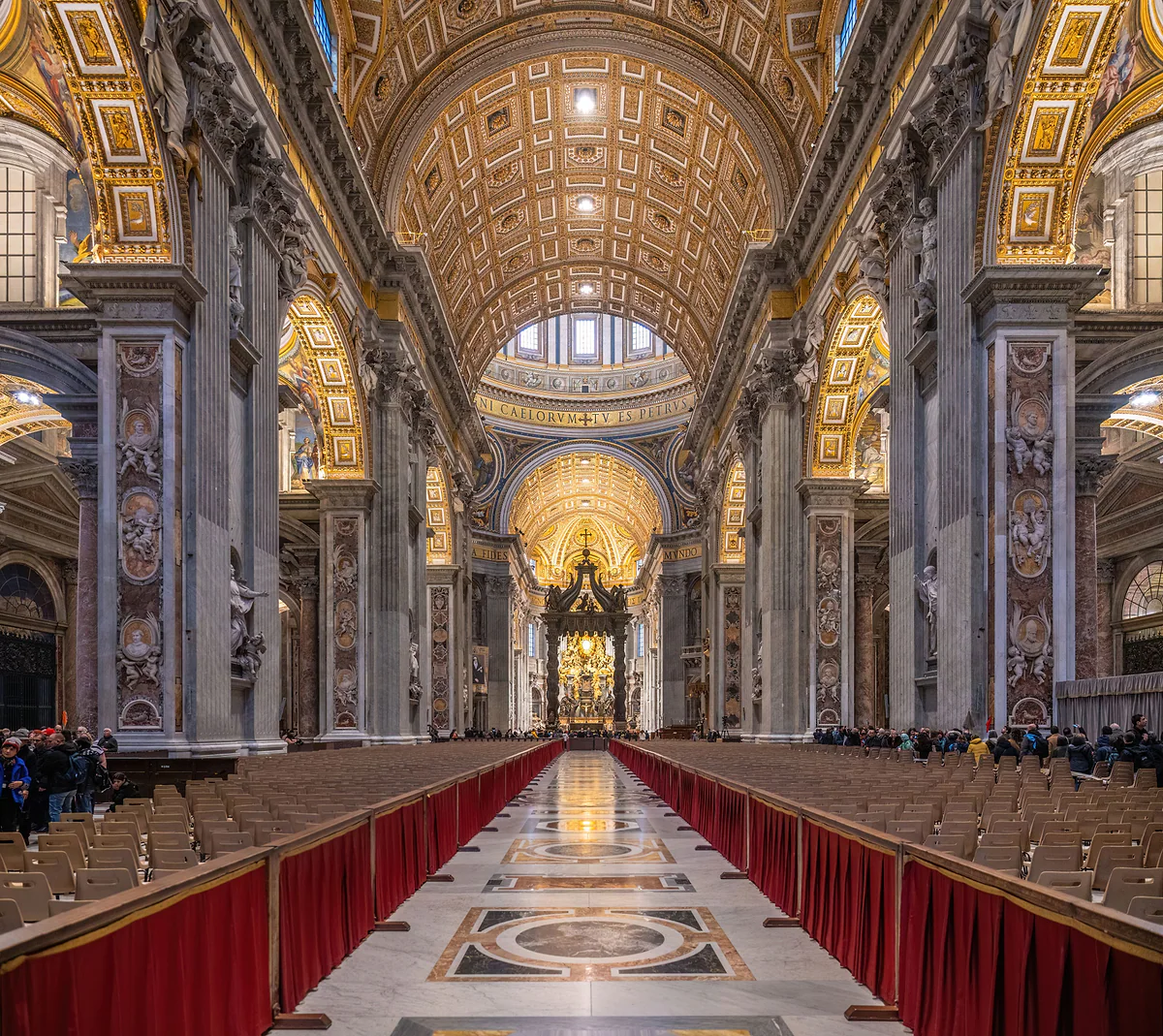
Central nave of St Peter's Basilica with its gilded coffered vault and Bernini's baldachin at the far end.
The baldachin at a glance
| What | Detail |
|---|---|
| Artist and patron | Gian Lorenzo Bernini, for Urban VIII |
| Dates | 1624-1635 |
| Height | Almost 29 metres |
| Materials | Bronze, gold, wood and copper |
| Previous restoration | 1758, three months, around sixty people a day |
| 2024 restoration | Nine months, funded by the Knights of Columbus |
| Back on view | 27 October 2024, closing Mass of the Synod |
From Vatican News (October 2024), reporting the Fabbrica di San Pietro. Elsewhere you'll see 28.74 m and 1623-1634, figures I haven't found in any official source.
Seeing it in 2026
| What | Detail |
|---|---|
| Price | Free, inside the basilica |
| Basilica hours | 07:00 to 20:00 every day |
| From above | The dome, €17 by stairs or €22 by lift, basilica included |
| Photos | Yes, without flash |
| Masses at the Altar of the Chair | Weekdays at 11:00, 12:00, 17:00 and 18:00 |
Mass times from the basilica's official website. Winter opening hours for the basilica aren't published, so check between October and March.
Test yourself
True or false?
0/4 Pick before you peek.
-
St Peter's baldachin is made entirely of bronze.
See the answer
False. According to the Fabbrica di San Pietro it combines bronze, gold, wood and copper. The great canopy on top is wood and copper.
-
Before 2024, the baldachin was last restored in 1758.
See the answer
True. In 1758 a team of around sixty people a day worked on it for three months. The next restoration came in 2024.
-
The bees on the baldachin are the emblem of the pope who commissioned it.
See the answer
True. They're the Barberini bees, the family of Urban VIII, who commissioned the work from Bernini.
-
Mass couldn't be said at the high altar during the 2024 restoration.
See the answer
False. The scaffolding was designed not to rest on the baldachin and to let the liturgy carry on throughout the works.
- Height of the baldachin, per the Fabbrica
- Almost 29 m
- Years Bernini worked on it for Urban VIII
- 1624-1635
- Length of the 2024 restoration
- 9 months
- Year of the restoration before 2024
- 1758
0 of 88 Vatican City guides
Your next stamp
- Chair of St Peter
- St Peter's Basilica
- Facade and balcony
- Pietà
- Obelisk
- Architecture and architects
- St Peter's Square
- Sistine Chapel
- Things to do
- One day
- Tickets
- Two days
- Vatican Museums
- St Peter's Dome
- Vatican Necropolis
- Vatican Gardens
- Swiss Guard
- Seeing the Pope
- How to visit
- Castel Gandolfo
- Where to eat
- Free and cheap
- Apostolic Palace
- Scams to avoid
- Getting there
- Money and payments
- Exclusive experiences
- Papal audience
- Angelus
- Who painted it
- Where the Pope lives
- Where to stay
- Dress code
- Facts
- Opening hours
- Map
- Flag
- Post office and stamps
- Is it a country?
- Vatican Grottoes
- History
- Ceiling
- Last Judgement
- Raphael Rooms
- Gallery of Maps
- Holy Door
- Library and Archives
- Bramante Staircase
- Mass at St Peter's
- Pio Clementino Museum
- Papal blessing
- Vatican Pinacoteca
- Catacombs
- Gallery of Tapestries
- Gallery of the Candelabra
- Egyptian and Etruscan Museums
- Vatican Museums map
- Bernini's colonnade
- How long you need
- Night opening
- Chiaramonti and Braccio Nuovo
- Christmas
- Anima Mundi Museum
- Easter
- Carriage Pavilion
- Gift shops and souvenirs
- With kids
- Best time to visit
- Courtyard of the Pine Cone
- Photography
- Train station
- Accessible travel
- Vatican Observatory
- Borgia Apartment
- Modern art collection
- Papal Palace
- Barberini Gardens
- Facts
- Getting there
- Holy See
- Lake Albano
- Police and army
- Passport
- Pharmacy, shop and petrol
- What Vatican means
- Papal tombs
- List of popes
Frequently asked questions
Who made the baldachin in St Peter's Basilica?
Gian Lorenzo Bernini, for Pope Urban VIII of the Barberini family. Vatican News dates the work to 1624-1635. That's why bees, the Barberini emblem, are dotted across the bronze.
How tall is Bernini's baldachin?
Almost 29 metres, according to what the Fabbrica di San Pietro said when the 2024 restoration finished. Vatican News compares it to a building of about ten storeys. The 28.74 m figure that circulates online isn't one I've found in any official source.
What is St Peter's baldachin made of?
Bronze, gold, wood and copper. The great canopy on top is wood and copper, and the 2024 restoration showed that the bronze was given a leather colour on purpose, to imitate a processional canopy on leather-covered poles.
What is under the baldachin in St Peter's?
The papal altar and, beneath it, the tomb of St Peter, which you glimpse from the Confessio in what's called the Niche of the Pallia. Lower still, 3 to 11 metres under the nave, lies the necropolis, which you can only visit on a booked, guided tour.
Why are the baldachin's columns twisted?
Because Bernini modelled them on the marble columns that surrounded Peter's tomb in the old basilica, which were of that spiralling type. The new canopy was meant to echo the monument that had stood over the same spot.
Was the baldachin made from bronze taken from the Pantheon?
It's a much-repeated story, but I haven't found it in any official Vatican source, neither the Fabbrica nor Vatican News. So I won't give it to you as fact. What they do confirm is the artist, the pope, the dates and the materials.
When was the baldachin restored?
In 2024, over about nine months, with scaffolding that didn't rest on it and allowed Mass to carry on. It was unveiled on 27 October 2024. The previous restoration dated from 1758.
By
Tourism graduate with a master’s in Tourism Management and Planning from the University of Málaga, who has travelled across Europe. He writes every guide from official sources and his own judgement.
Published on . Facts checked on .
Sources
Photos: Lviatour (CC BY-SA 4.0); Wilfredor (CC0), via Wikimedia Commons.