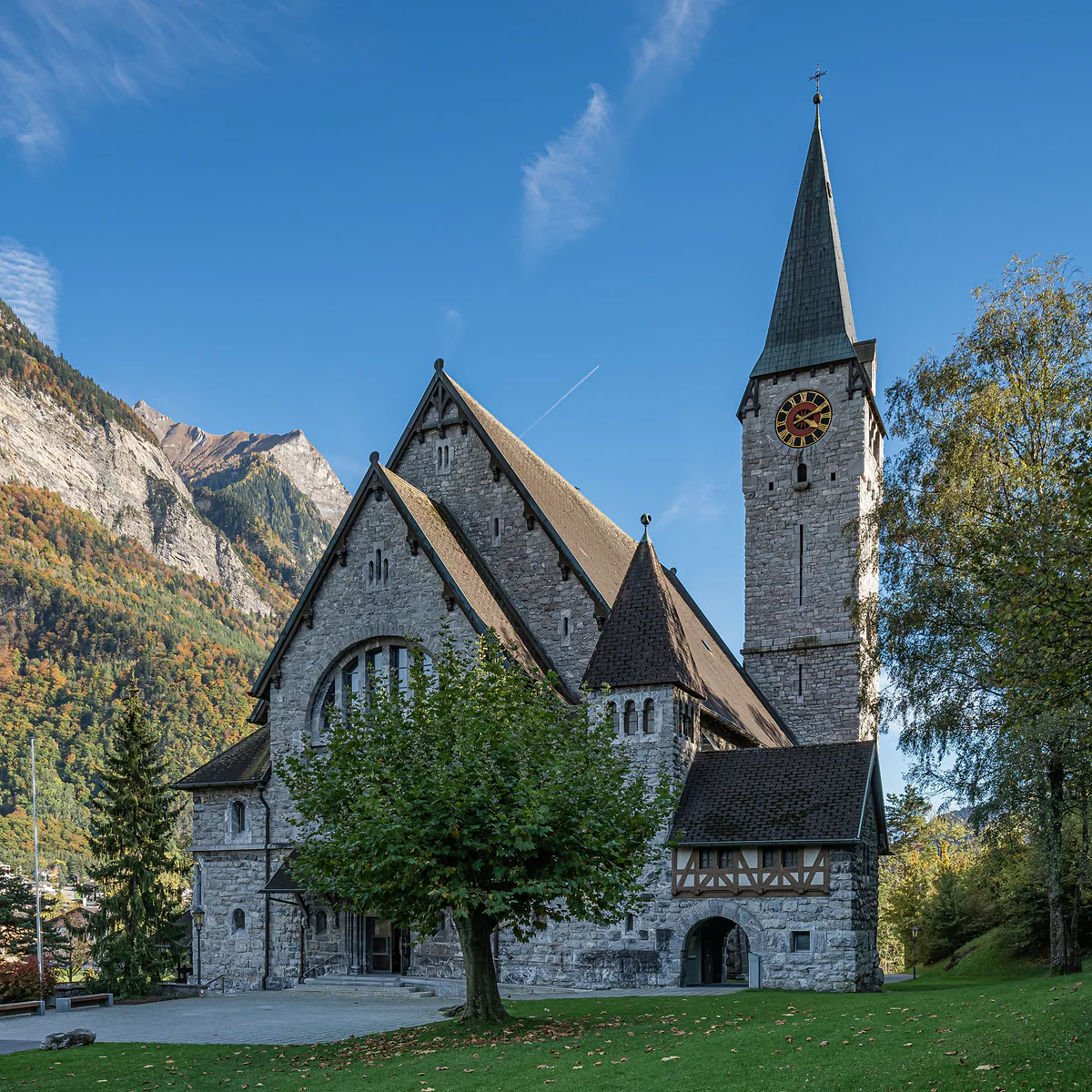
Six in the Oberland, five in the Unterland
The eleven municipalities of Liechtenstein, one by one
Liechtenstein has eleven municipalities, six in the Oberland (Vaduz, Schaan, Triesen, Balzers, Triesenberg and Planken) and five in the Unterland (Eschen, Mauren, Gamprin, Ruggell and Schellenberg). Strictly speaking it has no cities. The most populous is Schaan, with 6,294 people, and Malbun, Steg and Nendeln aren't municipalities but villages within them.
In 30 seconds
Full read: 3 min
- Liechtenstein has eleven municipalities, six in the Oberland and five in the Unterland.
- Schaan (6,294 residents) is the most populous, ahead of the capital, Vaduz (6,108).
- Triesenberg is the largest and highest; Schellenberg the smallest by area; Planken the least populated.
- Malbun, Steg, Nendeln and Bendern aren't municipalities but villages within them.
If you only set foot in three, I'd pick Vaduz for the museums, Triesenberg for the mountains and the Walser, and Balzers for Gutenberg. But the one I most enjoy recommending to repeat visitors is Schellenberg, the smallest, with its two ruined castles looking over the Unterland.

Before you go
What I would keep in mind
-
01 My tip
Malbun isn't a municipality
Malbun and Steg, in the Samina valley, belong to Triesenberg. The same goes for Nendeln (Eschen), Schaanwald (Mauren), Bendern (Gamprin), Mäls (Balzers) and Hinterschellenberg (Schellenberg).
Triesenberg, the Walser mountain village -
02 Most beautiful
The village where the country began
On the church hill at Bendern, in Gamprin, allegiance was sworn to the Prince on 16 March 1699. The tourist board says the spot symbolises the start of today's Liechtenstein.
Bendern and its 1699 oath hill -
03 Getting there
The bus reaches all eleven
LIEmobil runs lines to every municipality, from the 26 climbing from Schaan to Planken to the 33 from Mauren to Schellenberg. You pay by card or app, never in cash.
Liechtenstein's buses -
04 To save money
Walk through them all for free
The Liechtenstein Trail passes through every village over about 75 km, split into five stages. Finish it and you collect a certificate at the Liechtenstein Center in Vaduz.
the Liechtenstein Trail across the whole country
What I would book
My ranking, scored
The municipalities I'd visit, in order
My own scores out of 10, thinking of visitors rather than residents. They weigh what you can see and do in each place, backed by official sources, and how easy it is to get there. It's my opinion, not an official ranking.
0 of 11 seen
-
Vaduz
The capital, with the Städtle, six museums, the Prince's castle from outside and the princely family's winery. It's where almost every trip begins.
9.2 out of 10
-
Triesenberg
The Walser village on the hillside and, over the ridge, Steg and Malbun. It's the largest and highest municipality, with its church at 886 m.
9.0 out of 10
-
Balzers
Gutenberg Castle on its vine-clad rock, open by appointment from May to October, and the old quarter of Mäls with its chapels.
8.5 out of 10
-
Schellenberg
The country's smallest municipality, with two ruined castles and a log house from 1518 now run as a rural museum.
7.9 out of 10
-
Schaan
The most populous, with the Roman fort and St Peter's chapel, the baroque Dux chapel and the TAK theatre. It also has the country's railway station.
7.8 out of 10
-
Planken
499 residents on a terrace at 786 m below the Drei Schwestern, an hour and a half's walk from the Gafadurahütte mountain hut.
7.7 out of 10
-
Triesen
An old centre among vineyards, St Mamertus chapel, one of the oldest in the country, and the way into the Lawena valley.
7.6 out of 10
-
Gamprin
Home to Bendern and its 1699 oath hill, and to the Gampriner Seelein, the country's largest natural lake, formed in the Rhine flood of 1927.
7.4 out of 10
-
Ruggell
The self-styled cycling village, and the Ruggeller Riet, the protected fen that fills with irises in May.
7.3 out of 10
-
Eschen
The Pfrundbauten beside St Martin's church, the 1778 mill and, in Nendeln, the remains of a 2nd-century Roman villa.
7.0 out of 10
-
Mauren
The herb garden by the Weiherring and, in Schaanwald, the border village facing Feldkirch with its Roman villa and baths.
6.8 out of 10
Liechtenstein doesn’t have cities, it has municipalities. Eleven of them, no more, and the constitution names each one. Some are little more than a village and its church, none tops 6,300 people, but each has its own character, and I find they’re the best way to understand the country. Here they are with their villages, their figures and the score I’d give each as a visitor.
Eleven municipalities, two regions
Article 1 of the constitution speaks of a state of two «Landschaften» and eleven municipalities. In the south is the Oberland, the former county of Vaduz, with six, and in the north the Unterland, the old lordship of Schellenberg, with five. The split isn’t an administrative whim. It comes from the two purchases that created the country, in 1699 and 1712, and they’re still the two electoral constituencies today. I tell each half’s story on the Oberland of Liechtenstein and the Unterland of Liechtenstein.
Each municipality has its own council and a surprising degree of independence. Article 4 of the constitution even gives them the right to break away from the state by majority vote. None ever has, but it says a lot about how much local identity matters here. Before going village by village, you may want the big picture first, and that’s what the Liechtenstein travel guide is for.
The six in the south
Vaduz is the capital, with 6,108 residents, the Prince’s castle, the parliament and nearly all the museums. Schaan, adjoining it to the north, has more people, 6,294, and has been the largest by population since 1989. The national figures, with the share of foreign residents, are in Liechtenstein’s population. Triesen and Balzers follow the Rhine southwards, the first with its old centre among the vines and the second at the foot of Gutenberg Castle, with the old quarter of Mäls included.
Triesenberg is the odd one out. It’s the largest, at 29.7 km², and the highest, with its church at 886 m, and it’s spread across Walser hamlets on the Rhine-facing slope, such as Masescha, Rotenboden (Rotaboda) and Wangerberg (Wangerbärg), and across the ridge, where Steg and Malbun sit. Planken, the sixth, is the least populated in the country, with 499 residents on a terrace below the Drei Schwestern.
The five in the north
The Unterland clusters around the Eschnerberg, an isolated hill that touches all five. Eschen is the biggest, with 4,781 residents, and includes the village of Nendeln, where a Roman villa was found. Mauren, with Schaanwald on the border facing Feldkirch, is the most densely populated in the country. Gamprin is one village plus a hamlet, Bendern, home to the parish church and the hill where allegiance was sworn to the Prince in 1699.
Ruggell, the most northerly, calls itself the cycling village and has the country’s lowest point, the Ruggeller Riet, at 430 m. Schellenberg, at 3.6 km², is the smallest by area, and it packs in the ruins of two castles and a rural museum in a house from 1518.
Villages that look like towns
This is where plenty of people get muddled. Malbun, the mountain village in every winter photo, isn’t a municipality, it’s a hamlet belonging to Triesenberg. The same goes for Steg, Nendeln, Schaanwald and Bendern. The official statistics don’t even publish how many people live in each. The table on this page shows which municipality each village with its own page in the guide belongs to.
And there are boundary quirks I love. Vaduz has six exclaves, detached pieces of its territory, including mountain pastures. The Gaflei alp belongs to Vaduz but lies within Triesenberg. And since 1915 Gamprin has owned an alp, Rauz, in Austria’s Vorarlberg.
Where to sleep, municipality by municipality
Hotels aren’t spread the way people are. In summer 2025, according to the Office of Statistics, the Unterland had an average of 9.3 hotels open, Triesenberg with Malbun and Steg 8.0, Vaduz 5.0, Schaan and Planken 4.0, and Balzers and Triesen 3.0. On a first visit I’d stay in Vaduz or Malbun, and how to choose between them is explained on where to stay in Liechtenstein. Either way, one night gets you the free bus pass from many hotels.
Getting between them
LIEmobil buses serve all eleven. There are lines such as the 26, climbing from Schaan to Planken, the 21 from Vaduz to Malbun and the 33 from Mauren to Schellenberg. You pay by card or app, and a day pass for three zones or more costs CHF 9. If you’d rather walk, the Liechtenstein Trail passes through every village over about 75 km.
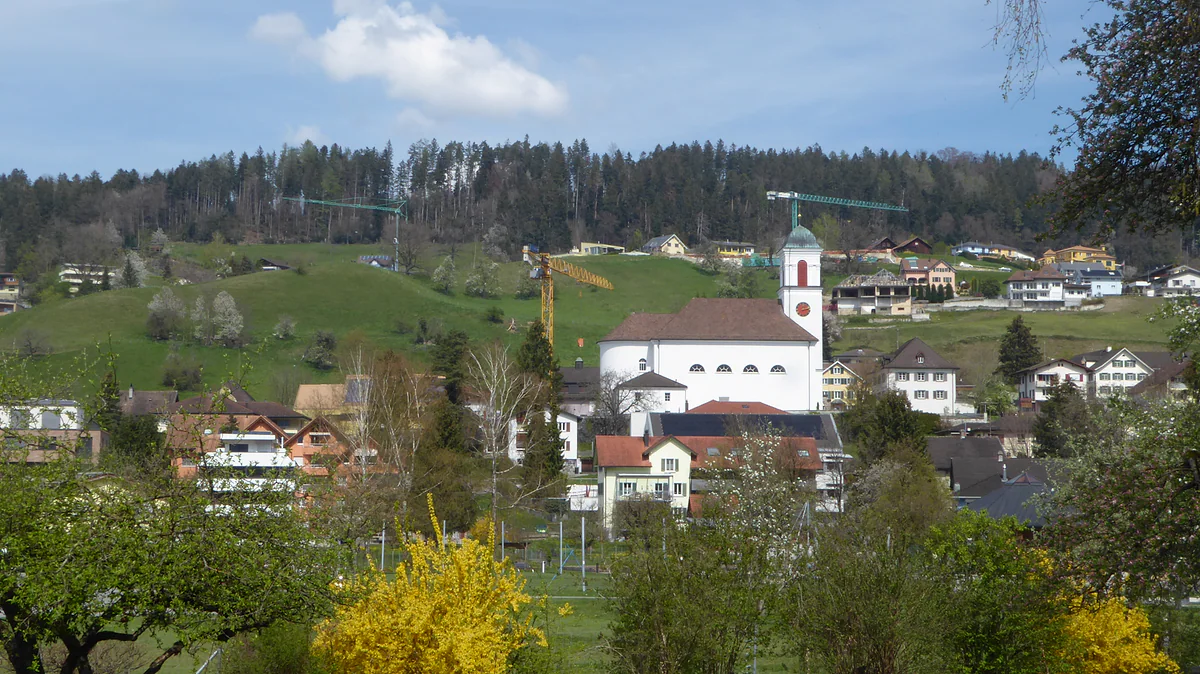
Mauren seen from the south, with the white church on the hill, the houses among the trees and the forest behind.
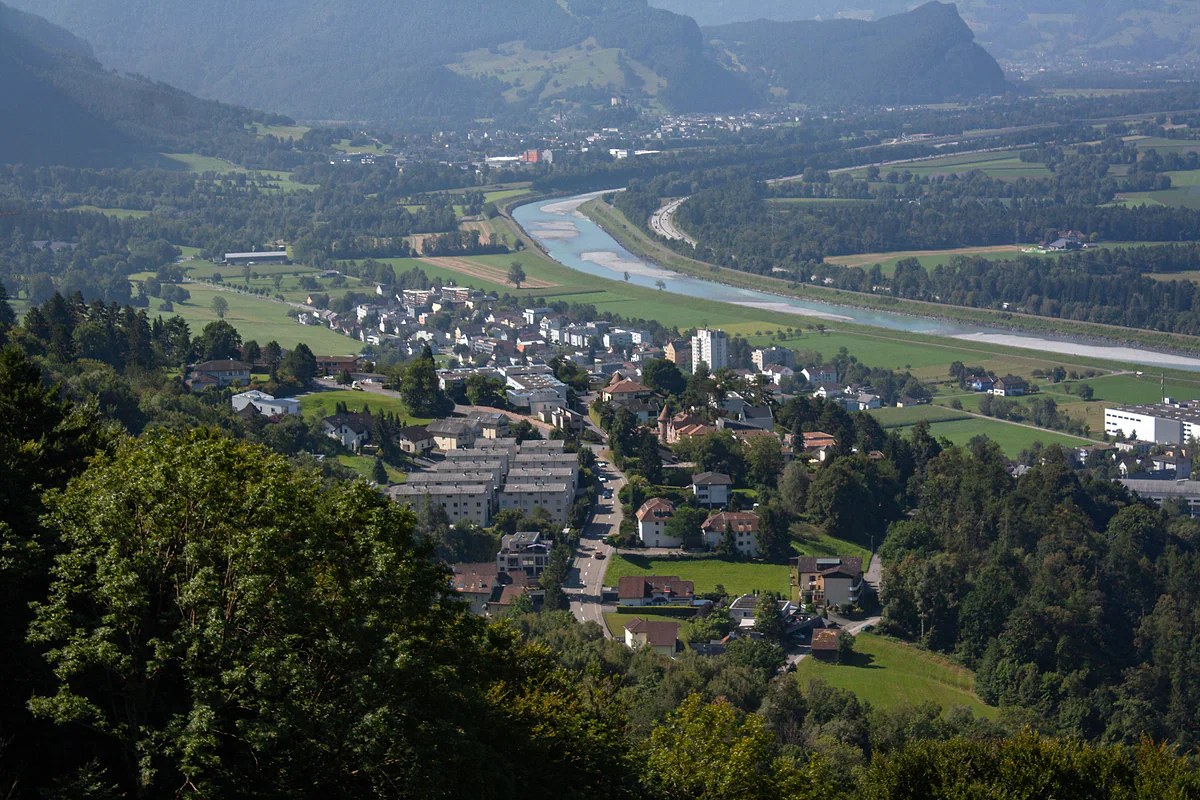
Triesen seen from the hillside, with houses below the forest, the Rhine winding through the valley and the Swiss mountains behind.
The eleven municipalities in figures
| Municipality | Region | Residents (2025) | Area | Altitude | Villages and districts with a page |
|---|---|---|---|---|---|
| Vaduz | Oberland | 6,108 | 17.3 km² | 460 m | Städtle, Mitteldorf |
| Schaan | Oberland | 6,294 | 26.9 km² | 462 m | Dux |
| Triesen | Oberland | 5,785 | 26.5 km² | 512 m | Lawena valley |
| Balzers | Oberland | 4,835 | 19.7 km² | 477 m | Mäls |
| Triesenberg | Oberland | 2,742 | 29.7 km² | 886 m | Malbun, Steg, Masescha, Gaflei, Silum, Rotenboden, Wangerberg |
| Planken | Oberland | 499 | 5.3 km² | 786 m | (Oberplanken, no page) |
| Eschen | Unterland | 4,781 | 10.4 km² | 457 m | Nendeln |
| Mauren | Unterland | 4,663 | 7.5 km² | 472 m | Schaanwald |
| Gamprin | Unterland | 1,773 | 6.2 km² | 468 m | Bendern |
| Ruggell | Unterland | 2,568 | 7.4 km² | 433 m | Ruggeller Riet |
| Schellenberg | Unterland | 1,180 | 3.6 km² | 630 m | Hinterschellenberg |
Permanent population at 31-12-2025 (Office of Statistics, final figure). Area and altitude from Liechtenstein in Zahlen 2026; the altitude matches that of each village's parish church.
Test yourself
True or false?
0/4 Pick before you peek.
-
Malbun is one of Liechtenstein's eleven municipalities.
See the answer
False. Malbun is a village within the municipality of Triesenberg, in the high Malbun valley at about 1,600 m.
-
Gamprin owns a mountain pasture on Austrian soil.
See the answer
True. According to the Historisches Lexikon, Gamprin has owned the Rauz alp, in Austria's Vorarlberg, since 1915.
-
Vaduz has pieces of territory detached from the rest.
See the answer
True. It has six exclaves, including the Vaduzer Riet, several forests and mountain pastures such as Pradamee and Hahnenspiel.
-
Vaduz is the highest municipality in the country.
See the answer
False. The highest is Triesenberg, with its parish church at 886 m. Vaduz sits at 460 m in the Rhine valley.
- Municipalities in the country
- 11
- Residents of Schaan, the most populous
- 6,294
- Altitude of Triesenberg, the highest
- 886 m
- Residents of Planken, the least populated
- 499
0 of 168 Liechtenstein guides
Your next stamp
- Population
- Oberland
- Balzers
- Planken
- Vaduz
- Liechtenstein Trail
- Things to do
- One day
- Two days
- Unterland
- Map
- Städtle
- Mitteldorf
- Vaduz Castle
- Vaduz Cathedral
- Parliament
- Government Building
- Vaduz Town Hall
- Red House
- Prince's Winery
- Old Rhine Bridge
- Schaan
- Schalun Castle Ruin
- Citytrain
- Triesen
- Triesenberg
- Walser Museum
- Gutenberg Castle
- The Rhine
- Schaan Roman fort
- Dux
- St Mamertus chapel
- Lawena valley
- Mäls
- DoMuS
- TAK Theatre
- Castles
- Churches and chapels
- Viewpoints
- Mountains
- Museums
- Kunstmuseum
- Mountain huts
- Hilti Art Foundation
- Pfälzerhütte
- Gafadura hut
- National Museum
- Treasure Chamber
- Postage Stamp Museum
- Kunstraum Engländerbau
- Eschen
- Masescha
- Gaflei
- Nendeln
- Mauren
- Silum
- Rotenboden
- Schaanwald
- Gamprin
- Wangerberg
- Bendern
- Steg
- Ruggell
- Samina valley
- Schellenberg Farmhouse Museum
- Cross-country skiing at Steg
- Küefer-Martis-Huus
- Ruggeller Riet
- Schellenberg
- Hinterschellenberg
- Fürstensteig
- Is it a country?
- Malbun
- Schellenberg castles
- Eschnerberg
- Malbun in summer
- Stage 1: Balzers - Triesenberg
- Lakes
- Sareis
- Size
- Stage 2: Triesenberg - Vaduz
- Malbun Peace Chapel
- Political system
- Stage 3: Vaduz - Nendeln
- Swimming pools
- Language
- Skiing in Malbun
- Stage 4: Nendeln - Ruggell
- Dialect
- Malbun ski pass
- Stage 5: Ruggell - Schaanwald
- Hotels in Malbun
- Stamps
- Princess Gina Trail
- Hut-to-hut Route 66
- Hiking
- Getting there
- In winter
- Weather
- Airport
- Best time to visit
- In summer
- Events
- With kids
- Zurich to Liechtenstein
- National day
- Sargans to Vaduz
- Christmas
- Feldkirch to Vaduz
- By train
- Traditions
- Carnival
- Getting around
- Buses
- Funken Sunday
- Alpine cattle drive
- Driving and vignette
- Parking
- Bike hire
- Cycling
- EU and Schengen
- Entry requirements
- Borders and customs
- The prince
- The princely house
- The flag
- The coat of arms
- The national anthem
- History
- Second World War
- No army
- Facts
- Why so rich?
- Banks and tax haven
- Where to stay
- Hilti
- Hotels in Vaduz
- False teeth
- Hostel and camping
- Rent the country?
- Where to eat
- Restaurants in Vaduz
- Swiss invasions
- Bars and nightlife
- Food
- Käsknöpfle
- Wine
- Casinos
- Adventure Pass
- Rainy days
- Guided tours
- Tourist office
- Day trips
- Passport stamp
- Music festivals
- Phone and roaming
- Currency and payments
- Prices and budget
- Tipping
- Plugs and sockets
- Tap water
- Opening hours
- Public holidays
- Safety
- Accessibility
- With a dog
- Shopping and souvenirs
Frequently asked questions
How many towns are there in Liechtenstein?
Eleven municipalities. The constitution describes the country as two regions made up of eleven municipalities, six in the Oberland and five in the Unterland. Each has its own council and even a constitutional right to leave the state.
What is the largest city in Liechtenstein?
Schaan, with 6,294 residents at the end of 2025, slightly more than the capital, Vaduz, with 6,108. Neither is a city in the British sense; in German they're Gemeinden, municipalities.
What are the most beautiful places in Liechtenstein?
For me, the vine-covered Mitteldorf in Vaduz, Triesenberg on its hillside above the Rhine, Malbun in its high valley and Balzers beneath Gutenberg. In the Unterland, Schellenberg with its ruins.
Is Malbun a town in Liechtenstein?
It's a village, but not a municipality. Malbun belongs to Triesenberg and sits at about 1,600 m in the high valley of the same name. Steg, Masescha and Gaflei are also part of Triesenberg.
Which is the smallest municipality in Liechtenstein?
It depends how you measure. By area, Schellenberg, at 3.6 km². By population, Planken, with 499 residents at the end of 2025.
How do you get between the towns?
On LIEmobil buses, which serve all eleven. Line 26 climbs from Schaan to Planken, the 21 runs from Vaduz to Malbun and the 33 from Mauren to Schellenberg.
By
Tourism graduate with a master’s in Tourism Management and Planning from the University of Málaga, who has travelled across Europe. He writes every guide from official sources and his own judgement.
Published on . Facts checked on .
Sources
Photos: A.Savin (FAL); Plutowiki (CC0); Lucas Kendall (CC BY-SA 4.0), via Wikimedia Commons.