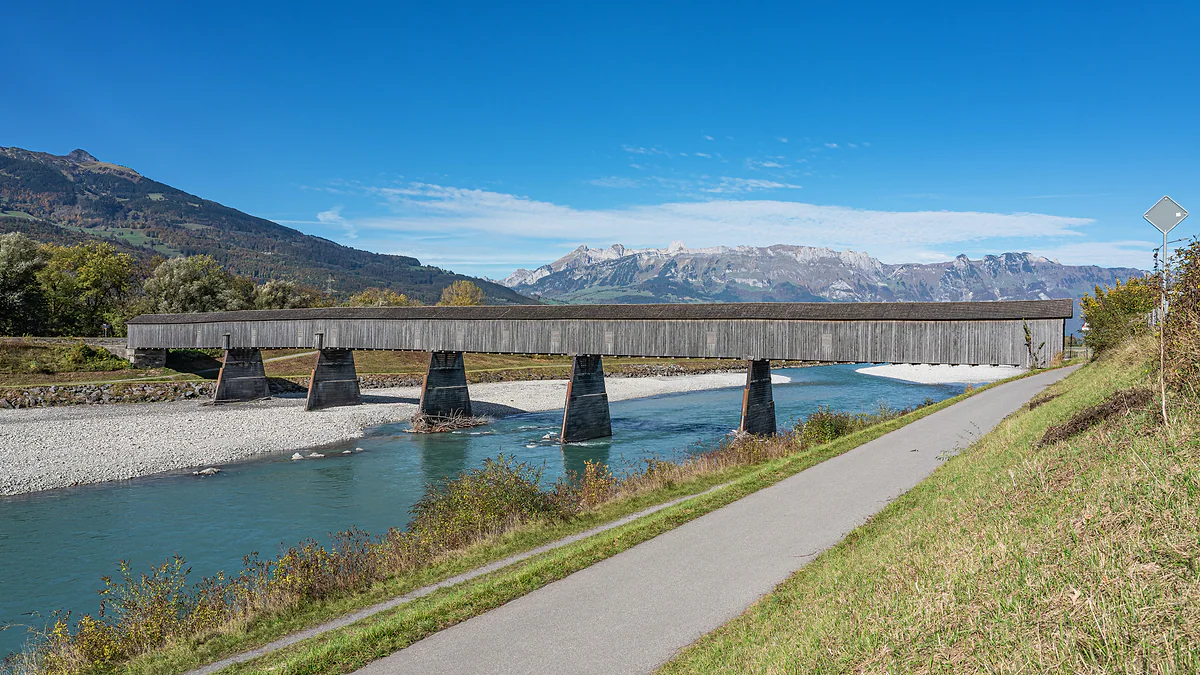
The last wooden bridge on the Rhine
The old Rhine bridge, 135 metres of timber to Switzerland
The Alte Rheinbrücke links Vaduz with Sevelen in Switzerland. It's a covered wooden bridge 135 m long, finished in 1901, listed since 1981 and the only one of the old wooden Rhine bridges still standing. Since its 2009-2010 renovation it has been open to walkers and cyclists only, free to cross and with no fixed border check.
In 30 seconds
Full read: 3 min
- The Alte Rheinbrücke links Vaduz with Sevelen, Switzerland, and is the last wooden bridge over the Rhine.
- It's 135 m long and covered, finished in 1901 and listed since 1981.
- Since 2009-2010 only walkers and cyclists use it; it's free and has no fixed border check.
I'd walk it there and back just for the pleasure of stepping into Switzerland over a wooden bridge with the Rhine beneath your feet. It takes ten minutes, and on a bike it's the loveliest crossing between the two countries.

Before you go
What I would keep in mind
-
01 Most beautiful
Switzerland, 135 metres of timber away
It's a covered bridge, a type that has all but vanished, and it spans the whole Rhine. Halfway across you have the river below and the mountains of both countries either side.
the Rhine in Liechtenstein -
02 Getting there
No check crossing into Switzerland
Liechtenstein and Switzerland have had no customs border since 1924 and both are in Schengen, so there's no fixed check on the bridge. Carry your ID all the same.
Liechtenstein borders and customs -
03 My tip
Watch your phone on the Sevelen side
Liechtenstein is in the EEA roaming zone but Switzerland isn't, and UK networks set their own charges for each. Near the Rhine your phone may latch on to a Swiss network, so I'd pick the Liechtenstein one manually before crossing.
phone and roaming in Liechtenstein -
04 To save money
An international stroll that costs nothing
Crossing is free, and the nearby Rheinpark Stadion car park charges CHF 0.50 an hour with the first hour free.
parking in Vaduz
There are few simpler ways of changing country. You leave Vaduz heading west, reach the Rhine and cross it on a covered wooden bridge into Sevelen, Switzerland, in a couple of minutes. I think it’s one of the loveliest things in the capital, and hardly anybody puts it on their list.
The last of its kind
For centuries the Rhine had no fixed bridges round here, because it kept changing course and swept away whatever stood in its path. People crossed by ferry or at fords. The first lasting bridges arrived between 1867 and 1871, one for each main crossing, and every one of them was wooden. Vaduz had a ferry from 1850 and its first bridge from 1870-1871.
The one you see today was finished in 1901. According to the Historical Lexicon, it’s the only one of those wooden bridges left; the rest mostly burnt down, like the Bendern bridge, which collapsed after a fire in 1974. It has been listed since 1981 and, together with the Balzers footbridge, it’s the only Rhine bridge still owned by its municipality. The tourist board calls it a landmark of the capital, and that’s no exaggeration.
A bridge that had to grow taller
My favourite part of its story is how it had to keep up with the river. The tourist board says the first wooden bridge, from 1870, was raised twice as the Rhine was straightened and the dykes built up. And after the dyke burst at Schaan in 1927, in the great flood, the 1901 bridge was raised too, to cope with more water. That flood and the river as a whole are covered on my page about the Rhine in Liechtenstein.
In 2009 and 2010 it was thoroughly renovated. Since then only walkers and cyclists use it, while cars cross on the 1975 concrete bridge a little further on. Since 2002 the Rheinstrasse, alongside the Zollstrasse, has led there, built to ease traffic in central Vaduz.
There’s another detail I like. In the 19th century the municipalities asked to charge tolls on the bridges to pay for their upkeep, and the government refused in 1875 and 1903 so as not to hold up traffic. The 1924 customs treaty then ruled out charging to cross between Liechtenstein and Switzerland. That’s why the stroll is free, as it always has been.
Crossing on foot or by bike
It’s covered and 135 m long, so you’re across in a couple of minutes, but I’d stop in the middle, with the Rhine below and the mountains of both countries on either side. The tourist board recommends it for a walk or a bike ride for the river views, and it’s especially popular with cyclists. If you’re after routes on two wheels, they’re in my guide to cycling in Liechtenstein.
What about the border?
The far bank is Switzerland, but there’s no fixed check. Liechtenstein and Switzerland have had no customs border since their treaty came into force in 1924, and both are in Schengen. I’d carry ID anyway. What does change is your phone. Liechtenstein is in the EEA roaming area and Switzerland isn’t, and since Brexit UK networks price each according to their own tariffs, so close to the river your phone may pick up a Swiss network. I’d set the network manually before crossing; I explain how in the guide to phones and roaming in Liechtenstein. The crossing rules are in borders and customs.
Getting there from the centre
The bridge lies west of central Vaduz, in the Rheinpark Stadion area, so from the Städtle you walk out across the valley floor. If you’re driving, the stadium car park costs CHF 0.50 an hour, first hour free, with no time limit. The Citytrain passes nearby, along the Binnendamm and past the stadium, but doesn’t cross. I’d pair the bridge with a stroll along the Städtle and head back into town for lunch. If you’re driving onwards into Switzerland, remember cars have to use the concrete bridge further along, not this one. With children or little time, it’s one of the best-value things in Vaduz, because in a good half hour you’ve walked to another country and back and have a story to tell.
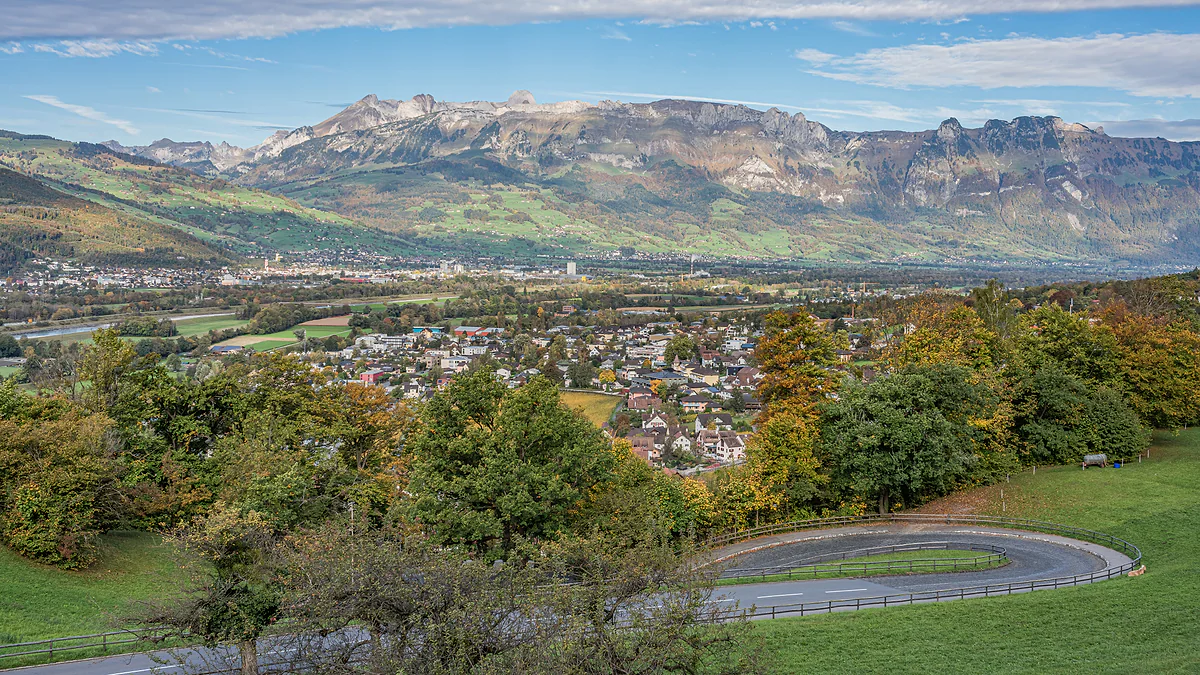
The Rhine valley seen from Vaduz Castle, with the town among autumn trees and the Swiss mountains on the horizon.
Liechtenstein's Rhine bridges
| Crossing | First fixed bridge | What's there today |
|---|---|---|
| Vaduz-Sevelen | 1870-1871 | The 1901 wooden bridge (walkers and bikes) and a 1972-1975 concrete bridge |
| Schaan-Buchs | 1867-1868 | 1975-1977 bridge and a 2009 suspension footbridge for walkers and bikes |
| Bendern-Haag | 1867-1868 | 1963-1964 concrete; the wooden one collapsed after a fire in 1974 |
| Balzers-Trübbach | 1870-1871 | 1967-1968 concrete and a 1975 footbridge |
| Ruggell-Sennwald | 1929 | 1965-1966 concrete |
From the Historical Lexicon (Rheinbrücken entry). Only the Vaduz wooden bridge and the Balzers footbridge still belong to their municipalities.
Test yourself
True or false?
0/3 Pick before you peek.
-
Cars still use the wooden bridge at Vaduz.
See the answer
False. Since the 2009-2010 renovation it has been open to walkers and cyclists only; cars use the 1975 concrete bridge.
-
Today's bridge was the first ever built at that point on the Rhine.
See the answer
False. There was a ferry from 1850 and a first wooden bridge in 1870-1871, which had to be raised twice during the river works.
-
After the 1927 flood, the Vaduz wooden bridge was raised.
See the answer
True. Once the dyke burst at Schaan in 1927, the 1901 bridge was raised again to cope with more water, according to the tourist board.
- Length of the covered bridge
- 135 m
- Year it was completed
- 1901
- Year it was listed
- 1981
Map
Where Old Rhine Bridge is
The dashed line is the border: Switzerland across the Rhine, Austria to the north and east. Every number opens its guide.
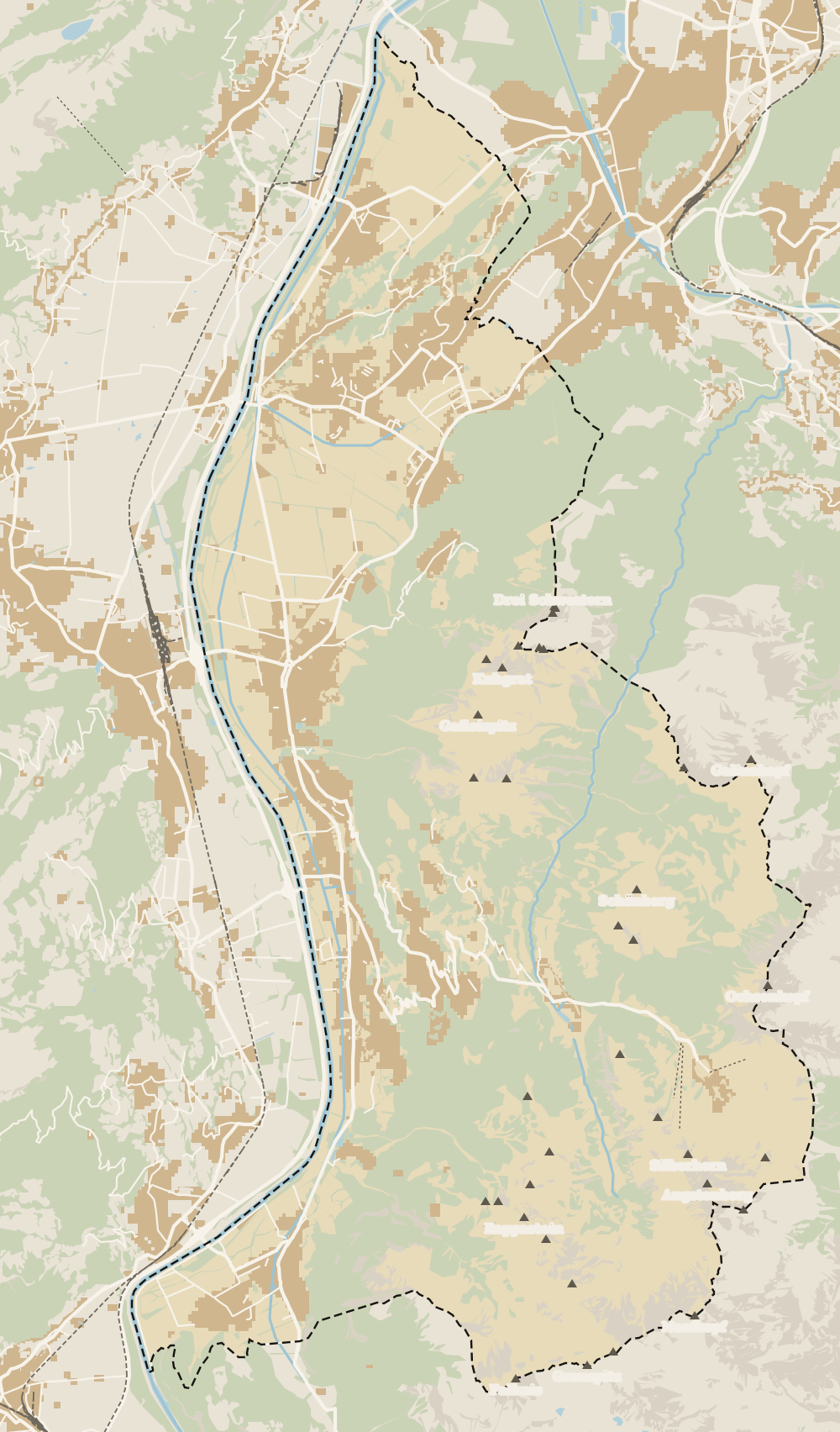 1Vaduz 2Städtle 3Mitteldorf 4Vaduz Castle 5Vaduz Cathedral 6Parliament 7Government Building 8Vaduz Town Hall 9Prince's Winery 10Old Rhine Bridge 11Schalun Castle Ruin 12Citytrain
 Map data © OpenStreetMap contributors (ODbL)
- 1VaduzA capital since 1719, home to 6,108 people
- 2StädtleCar-free since 28 June 2004
- 3MitteldorfVineyards protected until 2081
- 4Vaduz CastleThe Prince's residence, closed to visitors
- 5Vaduz CathedralA cathedral since 2 December 1997
- 6ParliamentNext sitting, 30 September to 2 October
- 7Government BuildingOpened on 28 December 1905
- 8Vaduz Town HallOpened on 19 November 1933
- 9Prince's WineryDaily tasting at 15:00, Saturdays at 14:00
- 10Old Rhine BridgeThe last wooden bridge on the Rhine
- 11Schalun Castle RuinAt 862 m, an hour's walk from Vaduz
- 12Citytrain2026 season runs until 31 October
0 of 168 Liechtenstein guides
Your next stamp
- The Rhine
- Getting there
- Schalun Castle Ruin
- Städtle
- Feldkirch to Vaduz
- Accessibility
- Guided tours
- Mitteldorf
- Things to do
- One day
- Two days
- Municipalities
- Oberland
- Unterland
- Map
- Vaduz
- Vaduz Castle
- Vaduz Cathedral
- Parliament
- Government Building
- Vaduz Town Hall
- Red House
- Prince's Winery
- Schaan
- Balzers
- Citytrain
- Triesen
- Triesenberg
- Walser Museum
- Planken
- Gutenberg Castle
- Schaan Roman fort
- Dux
- St Mamertus chapel
- Lawena valley
- Mäls
- DoMuS
- TAK Theatre
- Castles
- Churches and chapels
- Viewpoints
- Mountains
- Museums
- Kunstmuseum
- Mountain huts
- Hilti Art Foundation
- Pfälzerhütte
- Gafadura hut
- National Museum
- Treasure Chamber
- Postage Stamp Museum
- Kunstraum Engländerbau
- Eschen
- Masescha
- Gaflei
- Nendeln
- Mauren
- Silum
- Rotenboden
- Schaanwald
- Gamprin
- Wangerberg
- Bendern
- Steg
- Ruggell
- Samina valley
- Schellenberg Farmhouse Museum
- Cross-country skiing at Steg
- Küefer-Martis-Huus
- Ruggeller Riet
- Schellenberg
- Hinterschellenberg
- Fürstensteig
- Is it a country?
- Liechtenstein Trail
- Malbun
- Schellenberg castles
- Eschnerberg
- Malbun in summer
- Population
- Stage 1: Balzers - Triesenberg
- Lakes
- Sareis
- Size
- Stage 2: Triesenberg - Vaduz
- Malbun Peace Chapel
- Political system
- Stage 3: Vaduz - Nendeln
- Swimming pools
- Language
- Skiing in Malbun
- Stage 4: Nendeln - Ruggell
- Dialect
- Malbun ski pass
- Stage 5: Ruggell - Schaanwald
- Hotels in Malbun
- Stamps
- Princess Gina Trail
- Hut-to-hut Route 66
- Hiking
- In winter
- Weather
- Airport
- Best time to visit
- In summer
- Events
- With kids
- Zurich to Liechtenstein
- National day
- Sargans to Vaduz
- Christmas
- By train
- Traditions
- Carnival
- Getting around
- Buses
- Funken Sunday
- Alpine cattle drive
- Driving and vignette
- Parking
- Bike hire
- Cycling
- EU and Schengen
- Entry requirements
- Borders and customs
- The prince
- The princely house
- The flag
- The coat of arms
- The national anthem
- History
- Second World War
- No army
- Facts
- Why so rich?
- Banks and tax haven
- Where to stay
- Hilti
- Hotels in Vaduz
- False teeth
- Hostel and camping
- Rent the country?
- Where to eat
- Restaurants in Vaduz
- Swiss invasions
- Bars and nightlife
- Food
- Käsknöpfle
- Wine
- Casinos
- Adventure Pass
- Rainy days
- Tourist office
- Day trips
- Passport stamp
- Music festivals
- Phone and roaming
- Currency and payments
- Prices and budget
- Tipping
- Plugs and sockets
- Tap water
- Opening hours
- Public holidays
- Safety
- With a dog
- Shopping and souvenirs
Frequently asked questions
Where is the wooden bridge in Vaduz?
Over the Rhine, west of central Vaduz, linking the capital with Sevelen in the Swiss canton of St Gallen. It's in the Rheinpark Stadion area.
Can you walk across the old Rhine bridge?
Yes. Since the 2009-2010 renovation it has been open only to non-motorised traffic, meaning walkers and cyclists. Cars use the new concrete bridge, opened in 1975.
Is there a border check on the bridge?
No fixed one. Liechtenstein and Switzerland have been in a customs union since 1924 and both are in the Schengen Area. I'd still carry a passport.
When was the Vaduz wooden bridge built?
The current bridge was finished in 1901. An earlier wooden bridge from 1870-1871 stood on the same spot and had to be raised twice during the Rhine works. After the dyke burst at Schaan in 1927, the 1901 bridge was raised again.
Why is it the last wooden bridge on the Rhine?
Because the other wooden bridges in Liechtenstein mostly burnt down, according to the Historical Lexicon. The Bendern one, for example, collapsed after a fire on 26 June 1974. The Vaduz bridge has been listed since 1981.
By
Tourism graduate with a master’s in Tourism Management and Planning from the University of Málaga, who has travelled across Europe. He writes every guide from official sources and his own judgement.
Published on . Facts checked on .
Sources
Photos: A.Savin (FAL); A.Savin (FAL), via Wikimedia Commons.