Tower timber dated to 1347
St Mamertus, the stone tower keeping watch over Triesen
St Mamertus chapel (St. Mamerten) sits on a ledge above Triesen's upper village at 561 m. It is one of Liechtenstein's oldest chapels, with its tower timber dated to 1347, its roof to 1439 and frescoes from the mid-15th century. According to the council website, it opens inside for visitors who ask in advance.
In 30 seconds
Full read: 3 min
- St Mamertus chapel stands above Triesen's upper village at 561 m.
- It's one of the oldest in the country, with tower timber dated to 1347 and a first record in 1415.
- Inside are mid-15th-century frescoes and a copy of a 14th-century Pietà.
- You can always see it from outside and go in by arrangement with the council.
I'd look at it from outside first, with the tower and the valley behind, and only ask for it to be opened if the frescoes really interest me. If you're walking stage 1 of the Liechtenstein Trail, it's the best stop on the valley section.

Before you go
What I would keep in mind
-
01 Most beautiful
The unrendered stone tower
Bare masonry, an open timber belfry and an octagonal spire clad in wooden shingles. For me it's the most recognisable silhouette in Triesen.
Triesen, chapels and old village -
02 My tip
Ask for it to be opened, with notice
Triesen's website says St Mamertus and the Marienkapelle open for visitors who request it beforehand. Turn up unannounced and expect to see it from outside.
churches and chapels in Liechtenstein -
03 Getting there
A stop on stage 1 of the Liechtenstein Trail
The 15.7 km stage from Balzers to Triesenberg starts at Gutenberg Castle and passes the Roman road, Triesen's textile mill and this chapel.
stage 1 of the Liechtenstein Trail, Balzers to Triesenberg -
04 To save money
The Gothic altarpiece is in another church
The altarpiece Ludwig von Brandis gave in 1492 is now in St Gallus parish church, a few minutes' walk away. You can see both on the same stroll.
Triesen, chapels and old village
Some chapels are worth it for what’s inside, others for where they stand. St Mamertus has both, but if I could keep only one, it would be the picture of its stone tower high above Triesen with the Rhine valley behind. Here’s what it is, why the sources argue over its age, and how to get inside without meeting a locked door.
A tower you can date by its timber
The chapel sits on a ledge above Triesen’s Oberdorf, at 561 m. The Historisches Lexikon describes it as probably the village’s first church and gives its first written record as 1415. The most interesting evidence came from the beams during the 2003 to 2005 restoration. Timber in the tower shaft was dated to 1347, and the roof over the tower and nave to 1439.
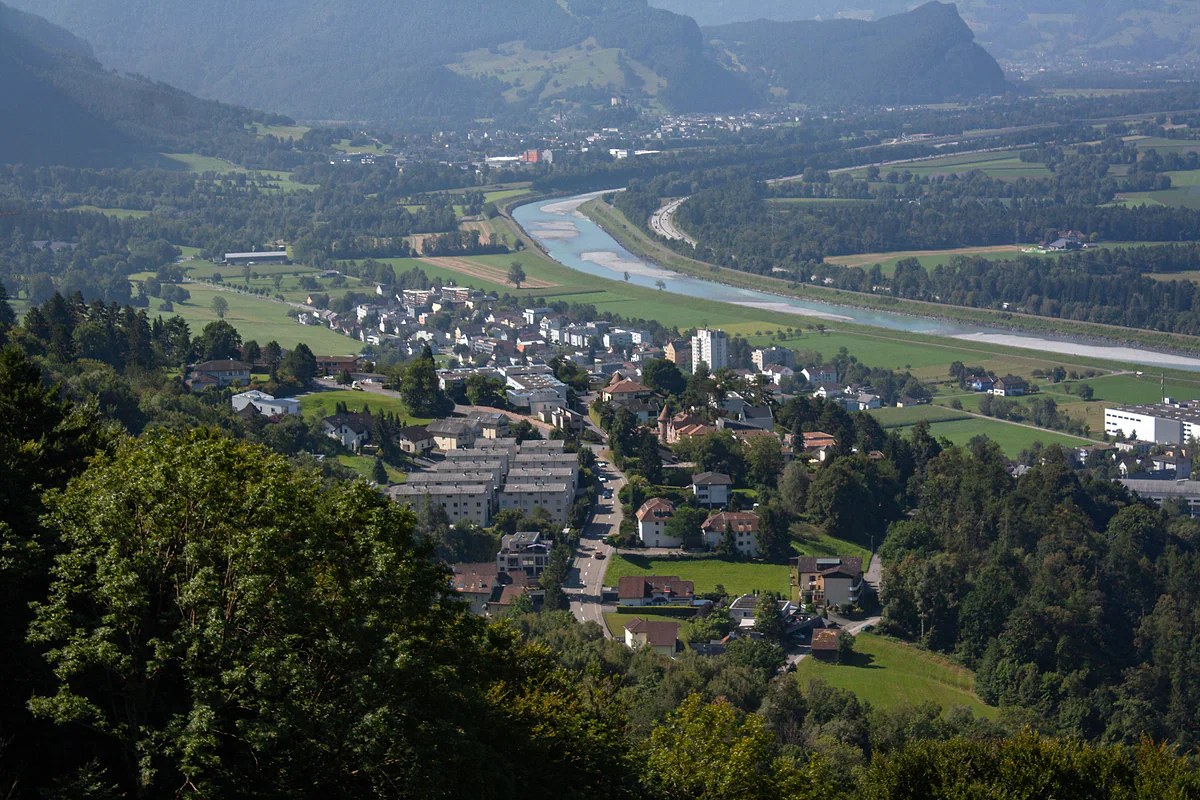
From outside it’s unmistakable. The tall medieval nave faces east and ends in a raised semicircular apse. The entrance has a porch with a single-pitch roof, and everything is clad in wooden shingles, the traditional mountain roofing. The tower, on the north side, is unrendered stone with an open timber belfry and an octagonal spire, also shingled. To my eye it’s one of the most photogenic buildings in the south of the country, and it looks best from slightly below, with the vineyards of the upper village in the foreground and the Swiss mountains across the valley behind.
Is it the oldest chapel in Liechtenstein?
The sources don’t agree, and I’d rather give it to you straight. The tourist board calls it Liechtenstein’s oldest chapel, and Triesen council’s website dates it probably to the 9th century and says it’s older than the Marienkapelle in the lower village. The Historisches Lexikon, on the other hand, starts its recorded history in 1415 and keeps the title of oldest church in the country for St Peter’s in Schaan, which is built on a Roman fort.
My take is simple. St Mamertus is among the oldest chapels in the country, and if you want to see the rival claimant, it’s at Schaan’s Roman fort. Digs in 1901 and 1933 found a boundary wall plus remains of buildings and graves here, and further excavations in 1967, 1968 and 1985 couldn’t fully explain what they were for.
What’s inside
The treasure is the frescoes. During the 1967 and 1968 restoration, a cycle painted in the mid-15th century came to light after centuries hidden away. There’s also a wooden Pietà, though it’s worth knowing that it’s a copy. The original, from the second half of the 14th century, is in the LandesMuseum in Vaduz.
The most valuable piece is missing, but it hasn’t gone far. In 1492, or possibly 1494, Ludwig von Brandis gave St Mamertus a late Gothic altarpiece that now stands in St Gallus parish church, in the same upper village. I’d see both on one walk. St Gallus is worth a look in its own right. The present church was built between 1841 and 1843 by the Viennese architect Georg Wingelmüller; in 1942 Johannes Hugentobler painted the 91 panels of its wooden ceiling with a battle between good and evil spirits; and a remodelling from 1991 to 1994 turned it into a near-square hall while keeping the old tower.
The chapel has had lean times too. A bishop’s visitation in 1640 already complained about its state, and it wasn’t put right until 1730.
Getting inside without finding it locked
There are no published opening hours that I could find. What Triesen council’s website does say is that St Mamertus and the Marienkapelle open for interested visitors who ask in advance. I’d email the town hall a few days ahead, especially for a weekend, and if I heard nothing I’d enjoy it from outside, which is reward enough. While you’re at it, I’d ask for the Marienkapelle in the lower village to be opened too, since a recent restoration there uncovered baroque frescoes that, in the council’s words, make a surprising contrast with the plain building. Two chapels, one email.
Walking there
From Vaduz it’s a few minutes south. If you like walking, stage 1 of the Liechtenstein Trail sets off from Gutenberg Castle in Balzers, follows the old Roman road, passes Triesen’s textile mill and the Gasometer, and reaches St Mamertus before climbing towards Triesenberg. The rest of the village is in my guide to Triesen, and the country’s other chapels, compared, are in churches and chapels in Liechtenstein.
St Mamertus through time
| Date | What happened |
|---|---|
| Probably 9th century | Date given by Triesen council |
| 1347 | Tree-ring date of the tower shaft |
| 1415 | First written record |
| 1439 | Tree-ring date of the tower and nave roof |
| 1492 (1494?) | Ludwig von Brandis donates a Gothic altarpiece |
| 1640 | A bishop's visitation finds it dilapidated |
| 1730 | Finally repaired |
| 1967 to 1968 | Mid-15th-century frescoes uncovered |
| 2003 to 2005 | Most recent major restoration |
Dates from the Historisches Lexikon, except the 9th-century date, which comes from Triesen council's website.
How to see it
| What | How |
|---|---|
| Exterior | Open access, in Triesen's Oberdorf |
| Interior | By arrangement with Triesen council |
| On foot | Stage 1 of the Liechtenstein Trail, Balzers to Triesenberg |
| Published hours | None in the official sources I've read |
Based on Triesen council's website and the tourist board.
Test yourself
True or false?
0/4 Pick before you peek.
-
The Gothic altarpiece of St Mamertus is still in the chapel.
See the answer
False. It's in St Gallus parish church in Triesen. Ludwig von Brandis gave it to St Mamertus in 1492 (or 1494).
-
The timber in the St Mamertus tower has been dated to 1347.
See the answer
True. Tree-ring dating carried out during the 2003 to 2005 restoration gave 1347 for the tower shaft and 1439 for the roof.
-
The Pietà inside is the 14th-century original.
See the answer
False. It's a copy. The original, carved in the second half of the 14th century, is in the LandesMuseum in Vaduz.
-
Every source agrees it's the oldest chapel in the country.
See the answer
False. The tourist board says so, but the Historisches Lexikon names St Peter's in Schaan as older. The safe line is that it's one of the oldest.
- Altitude of the chapel
- 561 m
- Tree-ring date of the tower
- 1347
- First written record
- 1415
- Fresco cycle uncovered in 1967 to 1968
- 15th c.
Map
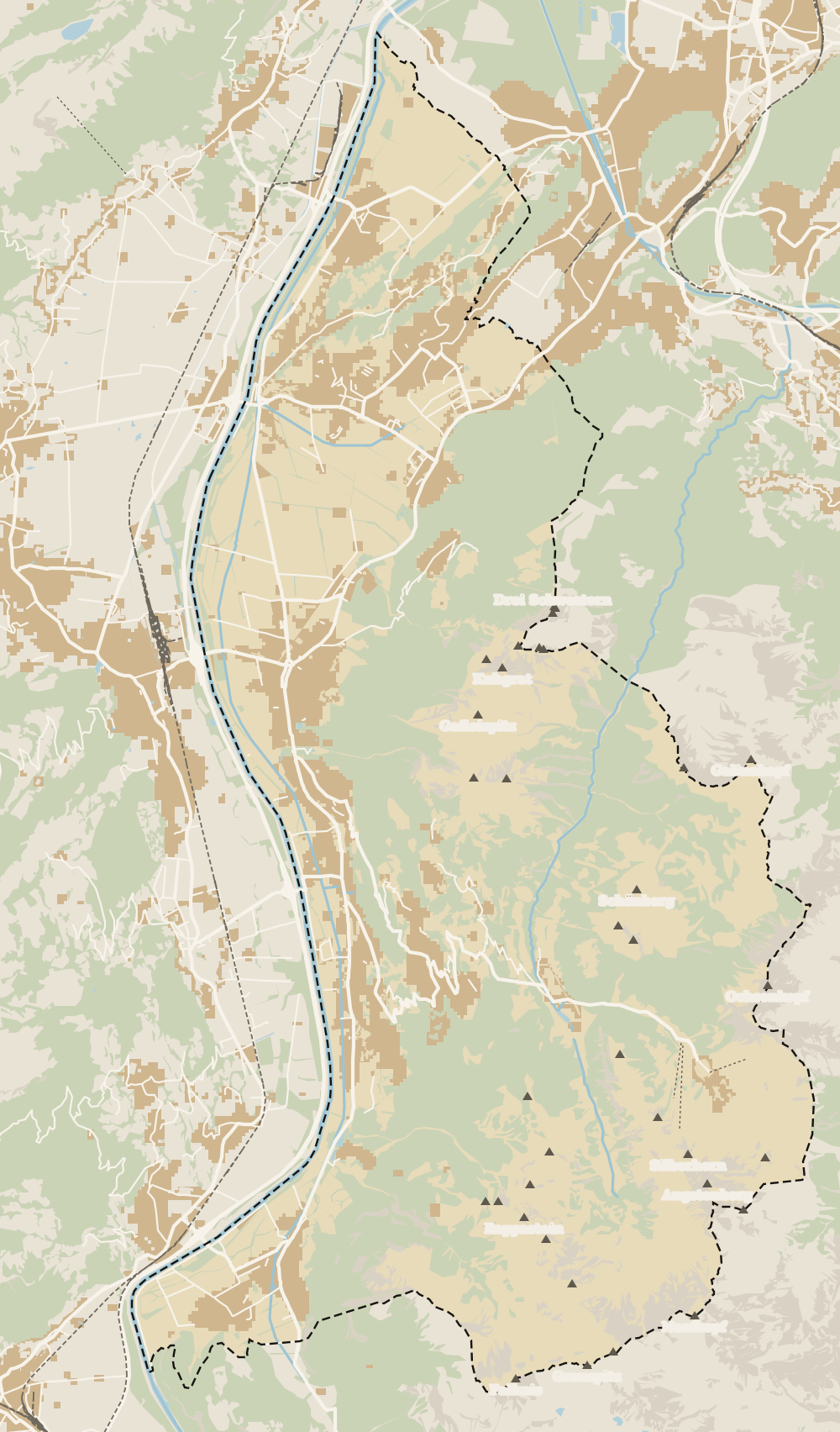
Where St Mamertus chapel is
The dashed line is the border: Switzerland across the Rhine, Austria to the north and east. Every number opens its guide.
0 of 168 Liechtenstein guides
Your next stamp
- Triesen
- Churches and chapels
- Stage 1: Balzers - Triesenberg
- Masescha
- Malbun Peace Chapel
- Mäls
- Hostel and camping
- Nendeln
- Things to do
- One day
- Two days
- Municipalities
- Oberland
- Unterland
- Map
- Vaduz
- Städtle
- Mitteldorf
- Vaduz Castle
- Vaduz Cathedral
- Parliament
- Government Building
- Vaduz Town Hall
- Red House
- Prince's Winery
- Old Rhine Bridge
- Schaan
- Schalun Castle Ruin
- Balzers
- Citytrain
- Triesenberg
- Walser Museum
- Planken
- Gutenberg Castle
- The Rhine
- Schaan Roman fort
- Dux
- Lawena valley
- DoMuS
- TAK Theatre
- Castles
- Viewpoints
- Mountains
- Museums
- Kunstmuseum
- Mountain huts
- Hilti Art Foundation
- Pfälzerhütte
- Gafadura hut
- National Museum
- Treasure Chamber
- Postage Stamp Museum
- Kunstraum Engländerbau
- Eschen
- Gaflei
- Mauren
- Silum
- Rotenboden
- Schaanwald
- Gamprin
- Wangerberg
- Bendern
- Steg
- Ruggell
- Samina valley
- Schellenberg Farmhouse Museum
- Cross-country skiing at Steg
- Küefer-Martis-Huus
- Ruggeller Riet
- Schellenberg
- Hinterschellenberg
- Fürstensteig
- Is it a country?
- Liechtenstein Trail
- Malbun
- Schellenberg castles
- Eschnerberg
- Malbun in summer
- Population
- Lakes
- Sareis
- Size
- Stage 2: Triesenberg - Vaduz
- Political system
- Stage 3: Vaduz - Nendeln
- Swimming pools
- Language
- Skiing in Malbun
- Stage 4: Nendeln - Ruggell
- Dialect
- Malbun ski pass
- Stage 5: Ruggell - Schaanwald
- Hotels in Malbun
- Stamps
- Princess Gina Trail
- Hut-to-hut Route 66
- Hiking
- Getting there
- In winter
- Weather
- Airport
- Best time to visit
- In summer
- Events
- With kids
- Zurich to Liechtenstein
- National day
- Sargans to Vaduz
- Christmas
- Feldkirch to Vaduz
- By train
- Traditions
- Carnival
- Getting around
- Buses
- Funken Sunday
- Alpine cattle drive
- Driving and vignette
- Parking
- Bike hire
- Cycling
- EU and Schengen
- Entry requirements
- Borders and customs
- The prince
- The princely house
- The flag
- The coat of arms
- The national anthem
- History
- Second World War
- No army
- Facts
- Why so rich?
- Banks and tax haven
- Where to stay
- Hilti
- Hotels in Vaduz
- False teeth
- Rent the country?
- Where to eat
- Restaurants in Vaduz
- Swiss invasions
- Bars and nightlife
- Food
- Käsknöpfle
- Wine
- Casinos
- Adventure Pass
- Rainy days
- Guided tours
- Tourist office
- Day trips
- Passport stamp
- Music festivals
- Phone and roaming
- Currency and payments
- Prices and budget
- Tipping
- Plugs and sockets
- Tap water
- Opening hours
- Public holidays
- Safety
- Accessibility
- With a dog
- Shopping and souvenirs
Frequently asked questions
Is St Mamertus the oldest chapel in Liechtenstein?
It's one of the oldest. The tourist board calls it the oldest in the country and the council dates it probably to the 9th century, but the Historisches Lexikon gives 1415 as its first record and considers St Peter's in Schaan older.
Can you go inside St Mamertus chapel?
Yes, by arrangement. Triesen council's website says the chapel opens for interested visitors who ask in advance. You can always see it from outside.
Where is St Mamertus chapel?
In Triesen, on a ledge above the upper village at 561 m, near St Gallus parish church and the Lindenplatz. It's a few minutes south of Vaduz.
What's inside the chapel?
A tall medieval nave with a raised semicircular apse, a cycle of mid-15th-century frescoes uncovered in 1967 and 1968, and a copy of a 14th-century wooden Pietà whose original is in the LandesMuseum.
Where is the chapel's Gothic altarpiece?
In St Gallus parish church in Triesen. Ludwig von Brandis gave it to St Mamertus in 1492 (or 1494), and it now stands in the village church a few minutes away on foot.
By
Tourism graduate with a master’s in Tourism Management and Planning from the University of Málaga, who has travelled across Europe. He writes every guide from official sources and his own judgement.
Published on . Facts checked on .
Sources
Photos: Lucas Kendall (CC BY-SA 4.0), via Wikimedia Commons.