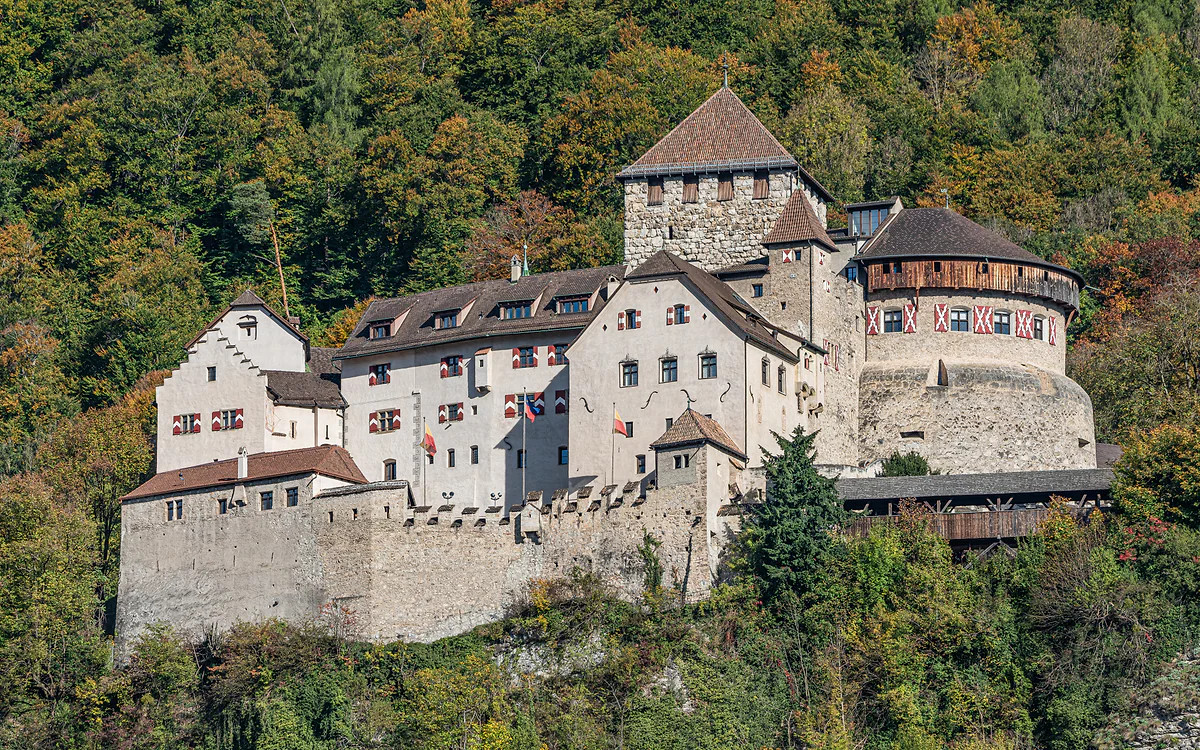
At 862 m, an hour's walk from Vaduz
Schalun, the wild castle in the woods above Vaduz
Schalun castle ruin, also called the Wildschloss, is a medieval castle on a rocky ridge between Schaan and Vaduz, at 862 m and within Vaduz's boundaries. It was first built in the 12th century and abandoned in the 14th. You reach it from Vaduz in about an hour on a forest track past the castle and a new viewing platform, and entry is free.
In 30 seconds
Full read: 3 min
- Schalun, or the Wildschloss, is the ruin of a 12th-century castle at 862 m in the woods between Vaduz and Schaan.
- You walk up from the Städtle in about an hour, passing Vaduz Castle and a viewing platform.
- It's free to enter and has belonged to the municipality of Vaduz since 1933.
I'd treat it as the natural finale to the climb to Vaduz Castle. If you've already reached the castle walls, another hour through the woods to Schalun gives you what the castle can't, the chance to walk into the ruin and have the Rhine valley at your feet, well away from the bustle of the Städtle.

Before you go
What I would keep in mind
-
01 Most beautiful
The castle you can actually walk into
Vaduz Castle is closed to visitors, but this ruin isn't. Striking walls of the core and keep survive on three platforms, with the Rhine valley spread out below.
Vaduz Castle -
02 My tip
Walking shoes, even on a track
The tourist board describes a forest track that climbs steadily for an hour. You don't need mountain gear, but I'd wear walking shoes and bring water, especially in summer.
hiking in Liechtenstein -
03 To save money
A free medieval castle
No ticket office, no opening hours. It's an open ruin in the woods, owned by the municipality of Vaduz since 1933, so the outing costs nothing.
-
04 Getting there
It starts on the Städtle, on foot
The path begins in central Vaduz and passes the castle. Take the bus to Vaduz, Post or Vaduz, Städtle and start climbing.
Liechtenstein's buses
Nearly everyone heading up towards Vaduz Castle turns round at its walls. I’d keep going. Another hour through the woods brings you to Schalun, a medieval ruin you can actually walk into, on a rocky ridge with the Rhine valley below and far fewer people than in town.
A castle older than Vaduz’s
Schalun stands at 862 m on a rocky ridge between Schaan and Vaduz, inside Vaduz’s boundaries. The Historical Lexicon dates the first building work to the 12th century, with 13th-century alterations to strengthen it, and says it was completely cleared in the 14th century and then destroyed by fire. A knight named Ulrich von Schalun appears in 1237, and the ruin itself is first mentioned in 1616. The Lexicon admits that very little is known about the lords of Schalun.
The name has a nice twist. According to the Lexicon, Schalun probably comes from a Rhaeto-Romance word meaning «great staircase». Its popular name, Wildschloss, the wild castle, suits what you find better, walls standing in the middle of the forest.
Passed from hand to hand, then back to Vaduz
Its string of owners is a curious one. In the early 19th century it belonged to the Prince, then to the municipality of Vaduz, and in 1880 it was bought by the architect Ignaz Bankó, the man who ran the building of St Florin’s Cathedral. His son Julius sold it back to the municipality in 1933. Since then it has been excavated and restored in 1939, 1982-1985 and 1990-1993.
What still stands
The remains are spread over three separate man-made platforms. You entered via the northern platform, guarded by a V-shaped ditch. The upper platform held the castle core with the keep, and that’s where the most impressive walls survive. The western platform is cut off from the rest by another ditch. This isn’t a rebuilt castle like Vaduz or Gutenberg; it’s a genuine ruin, and that’s what I like about it. For comparison, the full round-up is in my guide to castles in Liechtenstein.
It helps me to think about what it overlooked. Vaduz sits on a through route recorded since Roman times, from Lake Constance over the Alps to Italy, and in the Middle Ages the imperial road ran through the village along today’s Städtle. I imagine a ridge like this kept watch over much of that traffic and the valley. When you’re up there, look down and judge for yourself.
The walk up from the Städtle
The tourist board says you reach it from Vaduz in about an hour on a forest track that climbs steadily, with a new viewing platform on the way. The route leaves the Städtle and passes Vaduz Castle, so the two go together. The second stage of the Liechtenstein Trail, which comes down from Triesenberg to the capital, also passes Schalun before dropping down to the castle, if you’d rather arrive from above; it’s covered in Liechtenstein Trail stage 2.
You don’t need mountain kit, but it is proper hillside, and the climb from the valley floor is steady all the way to the top. I’d wear walking shoes, carry water and avoid the hottest part of a summer day, as the track keeps climbing.
A detail below the ruin
In the 1880s a local spinning mill built a pond below Schalun to generate its own electricity, the Spoerry-Weiher, and a municipal power station there went on to supply Vaduz from 1901 to 1927. It’s the kind of story I enjoy, the medieval ruin above and, at its feet, the beginnings of the village’s industry.
I’d do the walk early in the morning, come down for lunch in town and leave the museums for the afternoon. To my mind a clear, dry day is what matters most, because the whole point of the climb is the view over the valley, and on a cloudy day you lose most of it. It’s one of the few outings where Vaduz genuinely feels like a mountain village.
If you’re left wanting more, Liechtenstein has other ruins you can wander just as freely, such as the two Schellenberg castles in the Unterland. And if walking is your thing, Schalun is a good warm-up for more serious routes in the country’s mountains.
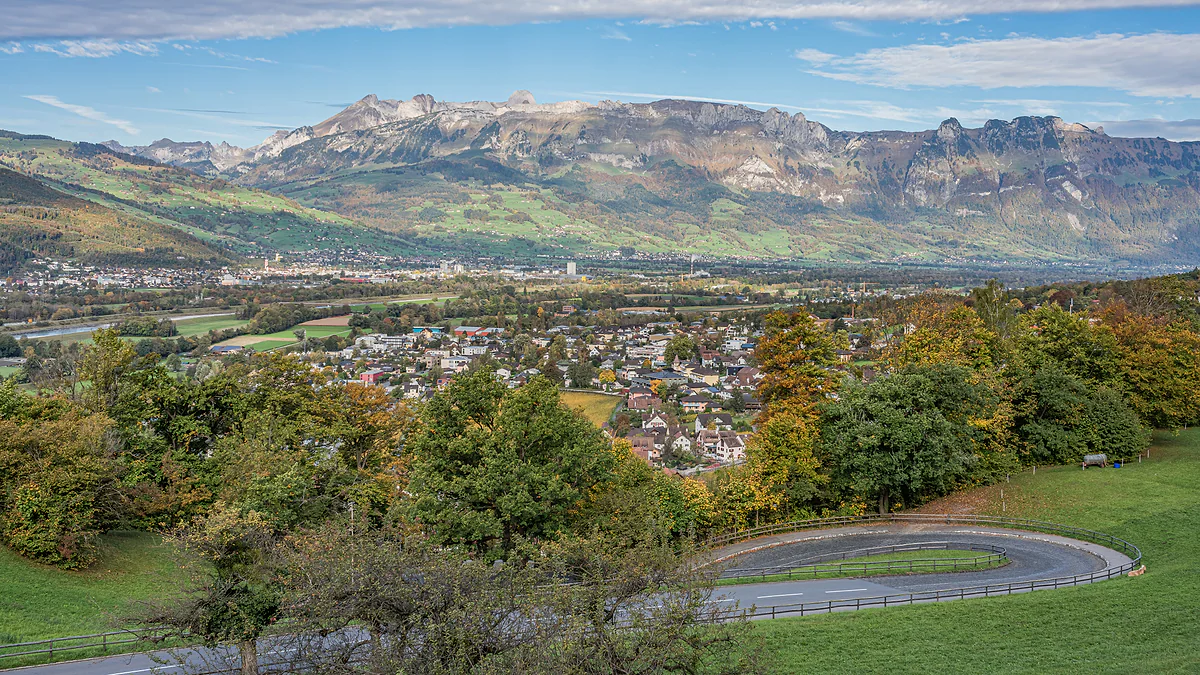
The Rhine valley seen from Vaduz Castle, with the town among autumn trees and the Swiss mountains on the horizon.
Schalun through the centuries
| Date | What happened |
|---|---|
| 12th century | First building work on the castle |
| 1237 | A knight, Ulrich von Schalun, is recorded |
| 13th century | Alterations and extensions to secure it |
| 14th century | Completely abandoned, then destroyed by fire |
| 1616 | First mention of the ruin |
| 1880 | Bought by the architect Ignaz Bankó |
| 1933 | His son sells it back to the municipality of Vaduz |
| 1939, 1982-1985 and 1990-1993 | Excavations and restoration |
From the Historical Lexicon (Schalun entry) and the official tourist board.
The walk up
| Stage | Details |
|---|---|
| Start | Städtle, Vaduz |
| On the way | Past Vaduz Castle |
| Path | Forest track climbing steadily |
| Stop | New viewing platform part-way up |
| Time | About an hour from Vaduz |
Test yourself
True or false?
0/3 Pick before you peek.
-
Schalun ruin lies within the municipality of Schaan.
See the answer
False. It's on a ridge between Schaan and Vaduz, but within Vaduz's boundaries, according to the Historical Lexicon.
-
An architect once owned the ruined castle.
See the answer
True. Ignaz Bankó bought it in 1880 and his son Julius sold it back to the municipality of Vaduz in 1933.
-
Schalun was destroyed in a siege and then abandoned.
See the answer
False. According to the Lexicon, it was entirely cleared in the 14th century and then destroyed by fire. There's no mention of a siege.
- Altitude of the ruin
- 862 m
- Walk up from Vaduz
- 1 h
- First recorded knight of Schalun
- 1237
Map
Where Schalun Castle Ruin is
The dashed line is the border: Switzerland across the Rhine, Austria to the north and east. Every number opens its guide.
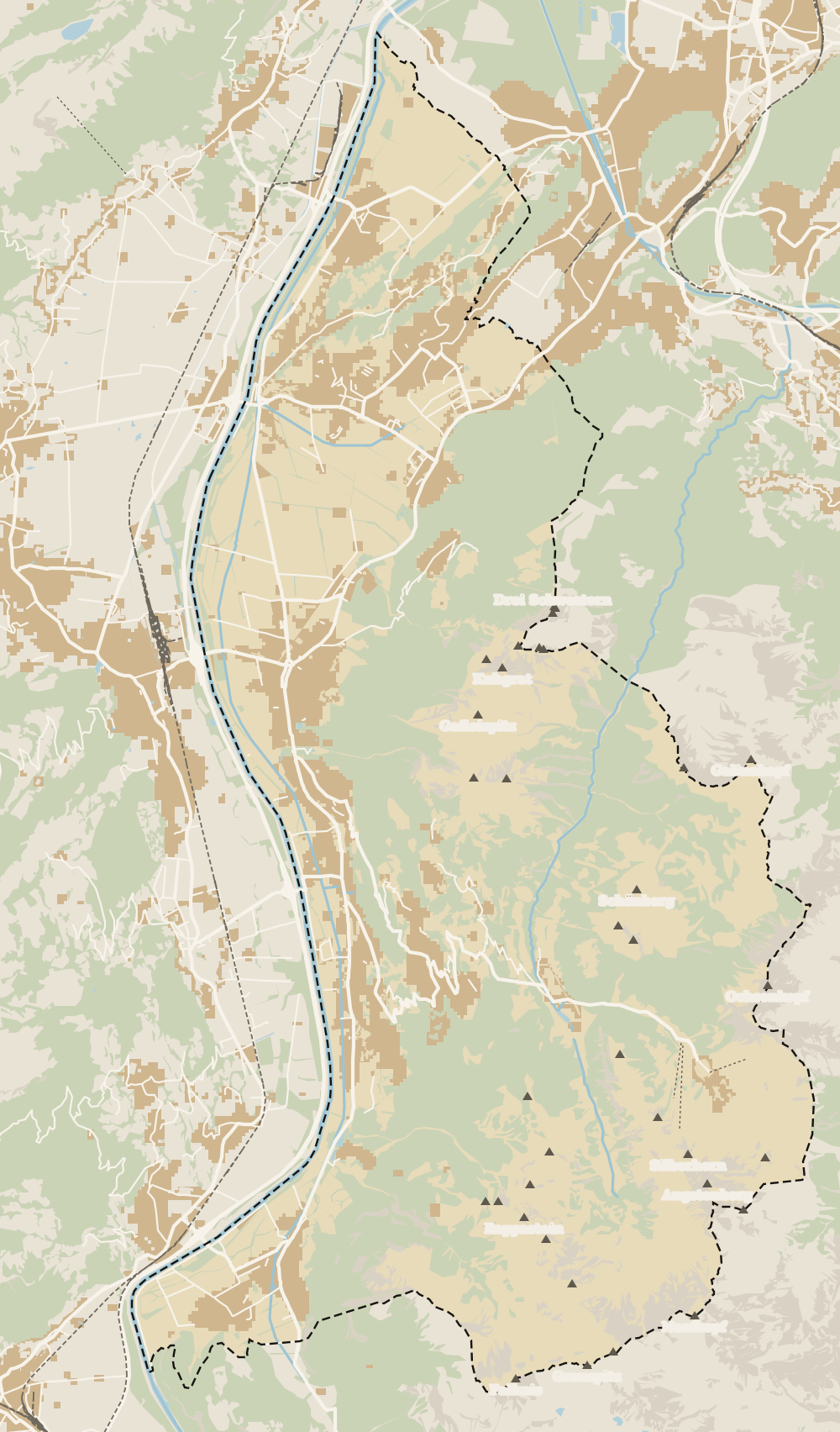 1Vaduz 2Städtle 3Mitteldorf 4Vaduz Castle 5Vaduz Cathedral 6Parliament 7Government Building 8Vaduz Town Hall 9Prince's Winery 10Old Rhine Bridge 11Schalun Castle Ruin 12Citytrain
 Map data © OpenStreetMap contributors (ODbL)
- 1VaduzA capital since 1719, home to 6,108 people
- 2StädtleCar-free since 28 June 2004
- 3MitteldorfVineyards protected until 2081
- 4Vaduz CastleThe Prince's residence, closed to visitors
- 5Vaduz CathedralA cathedral since 2 December 1997
- 6ParliamentNext sitting, 30 September to 2 October
- 7Government BuildingOpened on 28 December 1905
- 8Vaduz Town HallOpened on 19 November 1933
- 9Prince's WineryDaily tasting at 15:00, Saturdays at 14:00
- 10Old Rhine BridgeThe last wooden bridge on the Rhine
- 11Schalun Castle RuinAt 862 m, an hour's walk from Vaduz
- 12Citytrain2026 season runs until 31 October
0 of 168 Liechtenstein guides
Your next stamp
- Stage 2: Triesenberg - Vaduz
- Schellenberg castles
- Castles
- Feldkirch to Vaduz
- Mitteldorf
- Städtle
- Things to do
- Old Rhine Bridge
- One day
- Two days
- Municipalities
- Oberland
- Unterland
- Map
- Vaduz
- Vaduz Castle
- Vaduz Cathedral
- Parliament
- Government Building
- Vaduz Town Hall
- Red House
- Prince's Winery
- Schaan
- Balzers
- Citytrain
- Triesen
- Triesenberg
- Walser Museum
- Planken
- Gutenberg Castle
- The Rhine
- Schaan Roman fort
- Dux
- St Mamertus chapel
- Lawena valley
- Mäls
- DoMuS
- TAK Theatre
- Churches and chapels
- Viewpoints
- Mountains
- Museums
- Kunstmuseum
- Mountain huts
- Hilti Art Foundation
- Pfälzerhütte
- Gafadura hut
- National Museum
- Treasure Chamber
- Postage Stamp Museum
- Kunstraum Engländerbau
- Eschen
- Masescha
- Gaflei
- Nendeln
- Mauren
- Silum
- Rotenboden
- Schaanwald
- Gamprin
- Wangerberg
- Bendern
- Steg
- Ruggell
- Samina valley
- Schellenberg Farmhouse Museum
- Cross-country skiing at Steg
- Küefer-Martis-Huus
- Ruggeller Riet
- Schellenberg
- Hinterschellenberg
- Fürstensteig
- Is it a country?
- Liechtenstein Trail
- Malbun
- Eschnerberg
- Malbun in summer
- Population
- Stage 1: Balzers - Triesenberg
- Lakes
- Sareis
- Size
- Malbun Peace Chapel
- Political system
- Stage 3: Vaduz - Nendeln
- Swimming pools
- Language
- Skiing in Malbun
- Stage 4: Nendeln - Ruggell
- Dialect
- Malbun ski pass
- Stage 5: Ruggell - Schaanwald
- Hotels in Malbun
- Stamps
- Princess Gina Trail
- Hut-to-hut Route 66
- Hiking
- Getting there
- In winter
- Weather
- Airport
- Best time to visit
- In summer
- Events
- With kids
- Zurich to Liechtenstein
- National day
- Sargans to Vaduz
- Christmas
- By train
- Traditions
- Carnival
- Getting around
- Buses
- Funken Sunday
- Alpine cattle drive
- Driving and vignette
- Parking
- Bike hire
- Cycling
- EU and Schengen
- Entry requirements
- Borders and customs
- The prince
- The princely house
- The flag
- The coat of arms
- The national anthem
- History
- Second World War
- No army
- Facts
- Why so rich?
- Banks and tax haven
- Where to stay
- Hilti
- Hotels in Vaduz
- False teeth
- Hostel and camping
- Rent the country?
- Where to eat
- Restaurants in Vaduz
- Swiss invasions
- Bars and nightlife
- Food
- Käsknöpfle
- Wine
- Casinos
- Adventure Pass
- Rainy days
- Guided tours
- Tourist office
- Day trips
- Passport stamp
- Music festivals
- Phone and roaming
- Currency and payments
- Prices and budget
- Tipping
- Plugs and sockets
- Tap water
- Opening hours
- Public holidays
- Safety
- Accessibility
- With a dog
- Shopping and souvenirs
Frequently asked questions
What is Schalun castle ruin?
A ruined medieval castle on a rocky ridge between Schaan and Vaduz, at 862 m, also known as the Wildschloss, the wild castle. It was built in the 12th century and abandoned in the 14th.
How do you get to Schalun ruin?
On foot from Vaduz, in about an hour, on a forest track that climbs steadily through the woods. The path leaves the Städtle, passes Vaduz Castle and a new viewing platform.
Can you go inside Schalun ruin?
Yes, it's an open ruin in the woods with no ticket office. The walls of the core and keep survive, spread across three platforms separated by ditches.
Why is it called the Wildschloss?
Wildschloss means wild castle and is Schalun's popular name. The name Schalun probably comes from a Rhaeto-Romance word meaning «great staircase», according to the Historical Lexicon.
Who owns Schalun ruin?
The municipality of Vaduz, which bought it back in 1933. Before that it belonged to the Prince, then the municipality and, from 1880, the architect Ignaz Bankó, who also ran the building of St Florin's Cathedral.
By
Tourism graduate with a master’s in Tourism Management and Planning from the University of Málaga, who has travelled across Europe. He writes every guide from official sources and his own judgement.
Published on . Facts checked on .
Sources
Photos: A.Savin (FAL); A.Savin (FAL), via Wikimedia Commons.