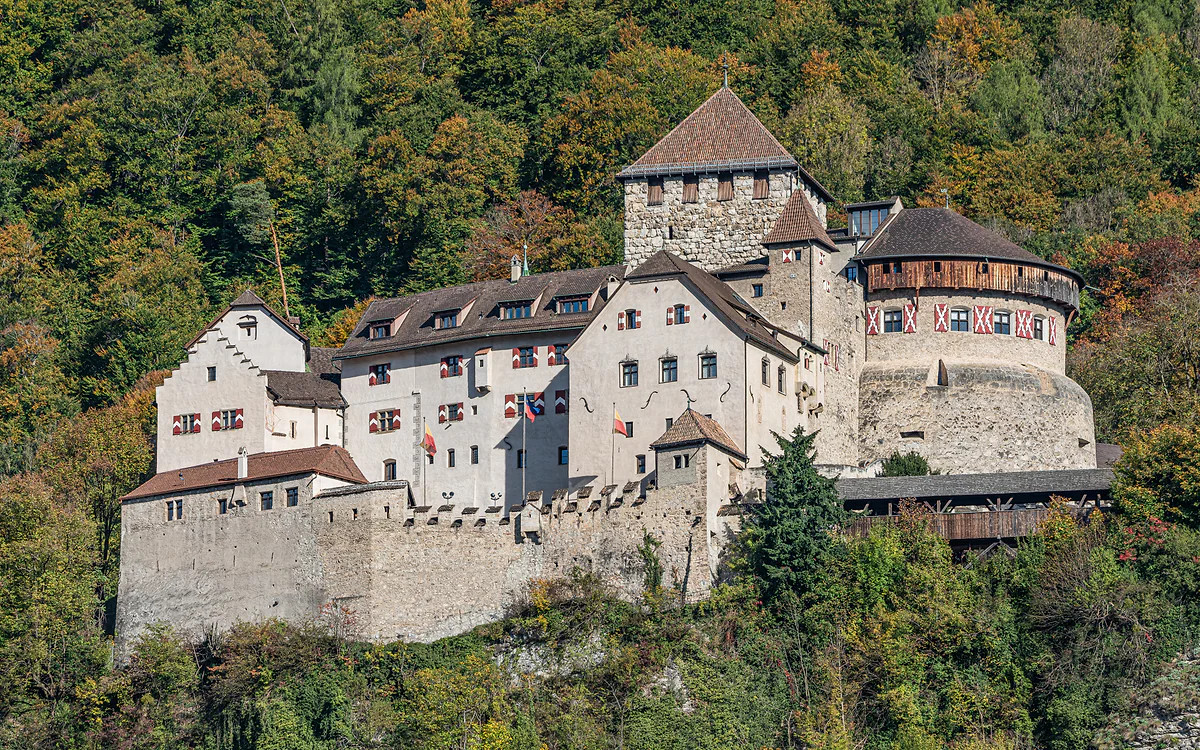
Name first recorded around 1136
The House of Liechtenstein, an Austrian family with a country of its own
The House of Liechtenstein is a noble family of Austrian origin named after Liechtenstein Castle, south of Vienna, first recorded around 1136. It became princely in 1608, bought Schellenberg and Vaduz in 1699 and 1712, and since 1719 has given the country both its name and its head of state. In 2021 it had 122 adult members.
In 30 seconds
Full read: 4 min
- The House of Liechtenstein is an Austrian noble family named after a castle south of Vienna, first recorded around 1136.
- It has been princely since 1608 and bought the country's two territories in 1699 and 1712.
- Its art collections are shown in two Vienna palaces, on guided tours.
- From 15 August 2026 the first-born will inherit regardless of sex, but only among those not yet born.
If the family interests you more than the country, the real trip is to Vienna, where two palaces show its collections on guided tours. In Vaduz, the parts of the house you can actually get close to are its wine, at the prince's winery, and the crypt on 1 November.

On the calendar
The date at a glance
-
Princely crypt open day
Princely crypt, next to Vaduz Cathedral
Before you go
What I would keep in mind
-
01 Worth the splurge
The prince's art is in Vienna, not Vaduz
Part of one of the world's largest private art collections is on show in Vienna, at the Garden Palace (early Renaissance to Baroque) and the City Palace (Neoclassical and Biedermeier), reopened in 2004 and 2013 and visited only with a guide.
-
02 Most beautiful
Taste the family's wine in Vaduz
The Hofkellerei, the princes' winery, runs guided tastings from Monday to Saturday beside the Herawingert vineyard in Vaduz. According to the winery, the family has been tied to winemaking since 1436.
the Prince's winery in Vaduz (Hofkellerei) -
03 My tip
The castle behind the country's name is in Austria
Hugo of Liechtenstein probably took his name from Liechtenstein Castle, south of Vienna. So the country is named after a castle that sits outside its borders.
castles in Liechtenstein
What I would book
In most monarchies the ruling family is named after somewhere in its own country. Liechtenstein turns that on its head. Here the country carries the family’s name, and the family took it from a castle that isn’t even in Liechtenstein. For me that’s the best way into the principality, because it explains why the place exists, why its princes spent centuries in Vienna and why their great art collection isn’t on show in Vaduz.
A name borrowed from outside Vienna
The name first turns up around 1136. Hugo of Liechtenstein probably called himself after Liechtenstein Castle, near Mödling, just south of Vienna. The Historisches Lexikon explains that the word refers to a pale rock or a castle hill, and that several unrelated noble families in central Europe carried it. The family’s gold-and-red shield survives as the centre of the Liechtenstein coat of arms.
The line that runs unbroken to the present begins with Heinrich I, who was given the lordship of Nikolsburg, today’s Mikulov in Moravia, in 1249. From there the family grew across Austria, Bohemia and Moravia, and in 1608 Karl of Liechtenstein was made a hereditary prince. What it still lacked was land held directly from the emperor, the ticket to a vote in the Imperial Diet. Johann Adam Andreas bought it in two instalments, first Schellenberg and then, thirteen years later, Vaduz, and in 1719 the emperor merged them under the family’s name. The full sequence is in my history of Liechtenstein.
Absentee princes
For well over a century the principality was a distant possession. The Lexikon notes that Alois II, in 1842, was the first reigning prince ever to visit. The one who really played his hand well was Johann I, a field marshal in the wars against Napoleon. The Lexikon reckons his standing with the French emperor is probably why the principality wasn’t swallowed up by a larger neighbour, as so many small territories were, and instead joined the Confederation of the Rhine in 1806 as a sovereign state. Every living member of the house descends from him.
The 20th century was brutal for the family. After 1918 Czechoslovak land reform halved its estates in Bohemia and Moravia, and in 1945 everything left there was confiscated. In 1938, after Germany annexed Austria, Franz Joseph II moved into Vaduz Castle, becoming the first ruler of the house to make his home there. The picture gallery was saved by bringing it to Vaduz in 1944 and 1945.
What the family owns today, and where to see it
The house says it holds one of the largest and most important private art collections in the world. After the war it had to sell major works, and under Hans-Adam II it went back to buying, with more than a thousand acquisitions. The collection has no permanent home in Liechtenstein. You see it in Vienna, at the Garden Palace, with art from the early Renaissance to the Baroque, and at the City Palace, with Neoclassical and Biedermeier works, restored and reopened in 2004 and 2013 and always visited with a guide.
In Vaduz, what you can sample is the family’s wine. The Hofkellerei runs tastings from Monday to Saturday next to the Herawingert vineyard, and I cover it on the prince’s winery page. The castle is their home and stays shut, and the crypt of the princes, beside Vaduz Cathedral, opens on 1 November only. The asset that matters most to the family’s finances is the LGT bank, bought in 1930 and described by the Lexikon as the core of the princely fortune.
Who inherits? The 2026 reform
The house is governed by its own family statute, the Hausgesetz, which it adopts itself, has had in written form for more than 400 years and which the constitution recognises. On 15 August 2026 its voting members approved a reform by a two-thirds majority, with two changes. Women in the family now have the same say as men in matters under that law. And the succession moves from male-preference to absolute primogeniture, so the eldest child takes the throne regardless of sex.
The small print matters. The new rule covers only those born in future to the children of Hereditary Prince Alois and Sophie. Everyone already born stays under the old rule, so today’s order doesn’t change. Alois justified it by saying the throne should go to whoever has been best prepared for it, the ruler’s children who grow up in Vaduz. Who holds the head-of-state role now, and with what powers, is on my page about the Prince of Liechtenstein.
What strikes me
That a family with palaces in Vienna, lost estates in what is now Czechia and one of Europe’s great art collections ended up living in a castle above a town of 6,108 people. And that the house itself credits the prince who moved there in 1938 with keeping the country independent through the Second World War. If you’re coming for the family, my advice is to see it for what it is, a central European dynasty that chose to stay in the Rhine valley.
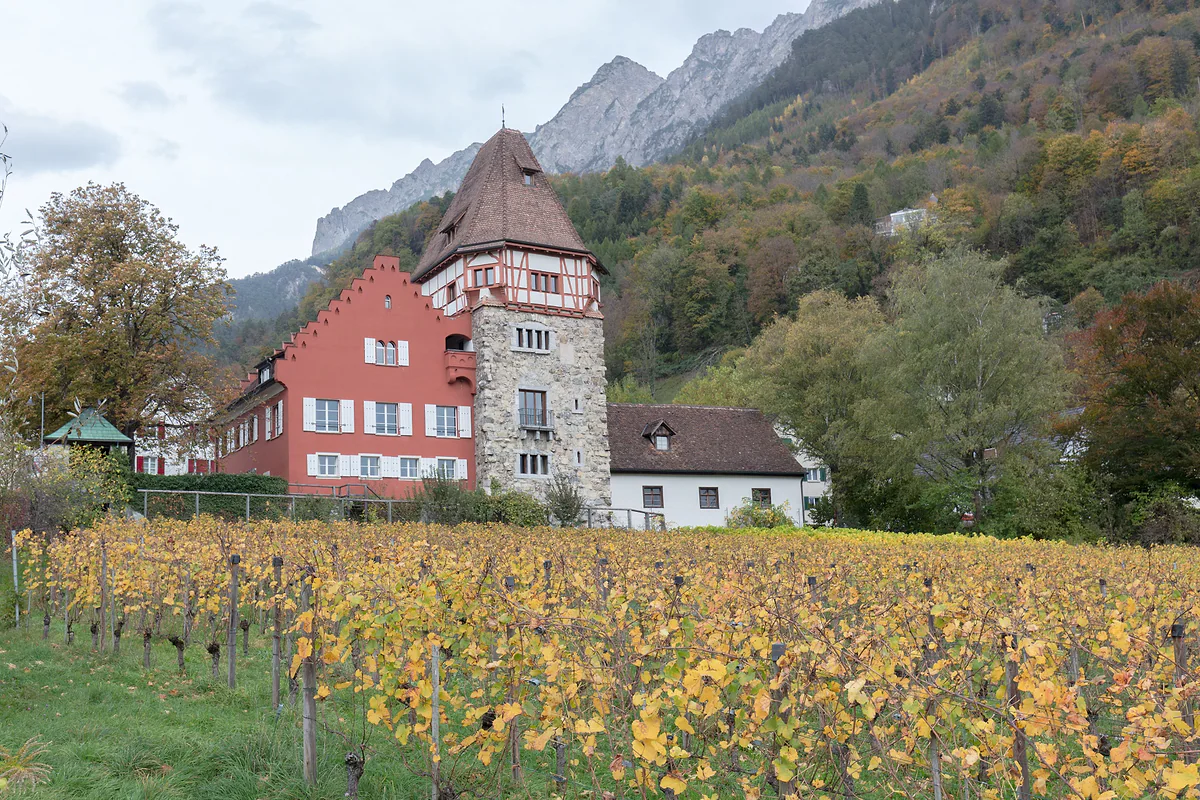
The Rotes Haus, a red house with a stone tower and half-timbered top, behind an autumn vineyard with the mountains behind.
Seven dates that explain the family
| Year | What happened |
|---|---|
| Around 1136 | First mention of the name, after Liechtenstein Castle south of Vienna |
| 1249 | Heinrich I receives Nikolsburg (Mikulov) in Moravia; the unbroken line starts with him |
| 1608 | Karl of Liechtenstein is made a hereditary prince |
| 1699 and 1712 | Johann Adam Andreas buys Schellenberg and then Vaduz |
| 1842 | Alois II becomes the first reigning prince to visit Liechtenstein |
| 1938 | Franz Joseph II moves into Vaduz Castle |
| 2026 | Absolute primogeniture for those born in future to Hans-Adam II's grandchildren |
Sources: the princely house (history and statement of 15 August 2026) and the Historisches Lexikon.
Where to see the family's heritage
| Place | What it is | Open to visitors? |
|---|---|---|
| Vaduz Castle | The prince's home | No, except on special occasions |
| Princely crypt, Vaduz | Family tombs | 1 November only |
| Hofkellerei, Vaduz | The family winery | Yes, tastings Monday to Saturday |
| Garden Palace and City Palace, Vienna | Art collections | Yes, on guided tours |
Sources: the princely house's FAQ and collections pages; the Hofkellerei website.
Test yourself
True or false?
0/4 Pick before you peek.
-
The castle that gives Liechtenstein its name is in Liechtenstein.
See the answer
False. It stands south of Vienna, in Austria. Hugo of Liechtenstein probably took his name from it around 1136.
-
No reigning prince set foot in Liechtenstein until the 19th century.
See the answer
True. According to the Historisches Lexikon, Alois II was the first reigning prince to visit the country, in 1842, more than a century after the principality was created.
-
The 2026 reform makes the family's existing daughters heirs to the throne.
See the answer
False. No. Absolute primogeniture applies only to those born in future to the children of Alois and Sophie. Members already born are unaffected.
-
In 1945 the family lost everything it owned in Czechoslovakia.
See the answer
True. The Historisches Lexikon records that all its property on Czechoslovak soil was confiscated in 1945. The picture gallery had been saved by moving it to Vaduz in 1944 and 1945.
- First mention of the Liechtenstein name
- 1136
- Hereditary title of prince
- 1608
- Adult members of the house in 2021
- 122
- Years of written family rules, says the house
- 400
0 of 168 Liechtenstein guides
Your next stamp
- Political system
- History
- Is it a country?
- The coat of arms
- Facts
- The prince
- Banks and tax haven
- Castles
- Things to do
- One day
- Two days
- Municipalities
- Oberland
- Unterland
- Map
- Vaduz
- Städtle
- Mitteldorf
- Vaduz Castle
- Vaduz Cathedral
- Parliament
- Government Building
- Vaduz Town Hall
- Red House
- Prince's Winery
- Old Rhine Bridge
- Schaan
- Schalun Castle Ruin
- Balzers
- Citytrain
- Triesen
- Triesenberg
- Walser Museum
- Planken
- Gutenberg Castle
- The Rhine
- Schaan Roman fort
- Dux
- St Mamertus chapel
- Lawena valley
- Mäls
- DoMuS
- TAK Theatre
- Churches and chapels
- Viewpoints
- Mountains
- Museums
- Kunstmuseum
- Mountain huts
- Hilti Art Foundation
- Pfälzerhütte
- Gafadura hut
- National Museum
- Treasure Chamber
- Postage Stamp Museum
- Kunstraum Engländerbau
- Eschen
- Masescha
- Gaflei
- Nendeln
- Mauren
- Silum
- Rotenboden
- Schaanwald
- Gamprin
- Wangerberg
- Bendern
- Steg
- Ruggell
- Samina valley
- Schellenberg Farmhouse Museum
- Cross-country skiing at Steg
- Küefer-Martis-Huus
- Ruggeller Riet
- Schellenberg
- Hinterschellenberg
- Fürstensteig
- Liechtenstein Trail
- Malbun
- Schellenberg castles
- Eschnerberg
- Malbun in summer
- Population
- Stage 1: Balzers - Triesenberg
- Lakes
- Sareis
- Size
- Stage 2: Triesenberg - Vaduz
- Malbun Peace Chapel
- Stage 3: Vaduz - Nendeln
- Swimming pools
- Language
- Skiing in Malbun
- Stage 4: Nendeln - Ruggell
- Dialect
- Malbun ski pass
- Stage 5: Ruggell - Schaanwald
- Hotels in Malbun
- Stamps
- Princess Gina Trail
- Hut-to-hut Route 66
- Hiking
- Getting there
- In winter
- Weather
- Airport
- Best time to visit
- In summer
- Events
- With kids
- Zurich to Liechtenstein
- National day
- Sargans to Vaduz
- Christmas
- Feldkirch to Vaduz
- By train
- Traditions
- Carnival
- Getting around
- Buses
- Funken Sunday
- Alpine cattle drive
- Driving and vignette
- Parking
- Bike hire
- Cycling
- EU and Schengen
- Entry requirements
- Borders and customs
- The flag
- The national anthem
- Second World War
- No army
- Why so rich?
- Where to stay
- Hilti
- Hotels in Vaduz
- False teeth
- Hostel and camping
- Rent the country?
- Where to eat
- Restaurants in Vaduz
- Swiss invasions
- Bars and nightlife
- Food
- Käsknöpfle
- Wine
- Casinos
- Adventure Pass
- Rainy days
- Guided tours
- Tourist office
- Day trips
- Passport stamp
- Music festivals
- Phone and roaming
- Currency and payments
- Prices and budget
- Tipping
- Plugs and sockets
- Tap water
- Opening hours
- Public holidays
- Safety
- Accessibility
- With a dog
- Shopping and souvenirs
Frequently asked questions
Does Liechtenstein have a royal family?
It has a princely family, the House of Liechtenstein, which has provided the head of state since 1719. Members are styled 'von und zu Liechtenstein' and addressed as 'Serene Highness', according to the house itself.
Where does the name Liechtenstein come from?
From Liechtenstein Castle near Mödling, south of Vienna. Hugo of Liechtenstein, recorded around 1136, probably took his name from it, and the country inherited the family name in 1719.
How many members does Liechtenstein's princely family have?
In March 2021 the house had 122 adult members, according to its website. Everyone alive today descends from Prince Johann I, who took the country into Napoleon's Confederation of the Rhine in 1806.
What changed in the line of succession in 2026?
On 15 August 2026 the house voted by a two-thirds majority for the first-born child, son or daughter, to inherit. It applies only to children born in future to Alois and Sophie's children; anyone already born keeps the old rule.
Where can I see the Prince of Liechtenstein's art collection?
In Vienna, at the Garden Palace and the City Palace, which Hans-Adam II restored and reopened in 2004 and 2013. Visits are guided. There's no permanent gallery of the collection in Liechtenstein itself.
Why did the princes live in Austria rather than Liechtenstein?
Their estates and court life were in Vienna, Bohemia and Moravia. Alois II was the first reigning prince to visit the country, in 1842, and Franz Joseph II the first to live there, from 1938.
By
Tourism graduate with a master’s in Tourism Management and Planning from the University of Málaga, who has travelled across Europe. He writes every guide from official sources and his own judgement.
Published on . Facts checked on .
Sources
Photos: A.Savin (FAL); Diego Delso (CC BY-SA 4.0), via Wikimedia Commons.