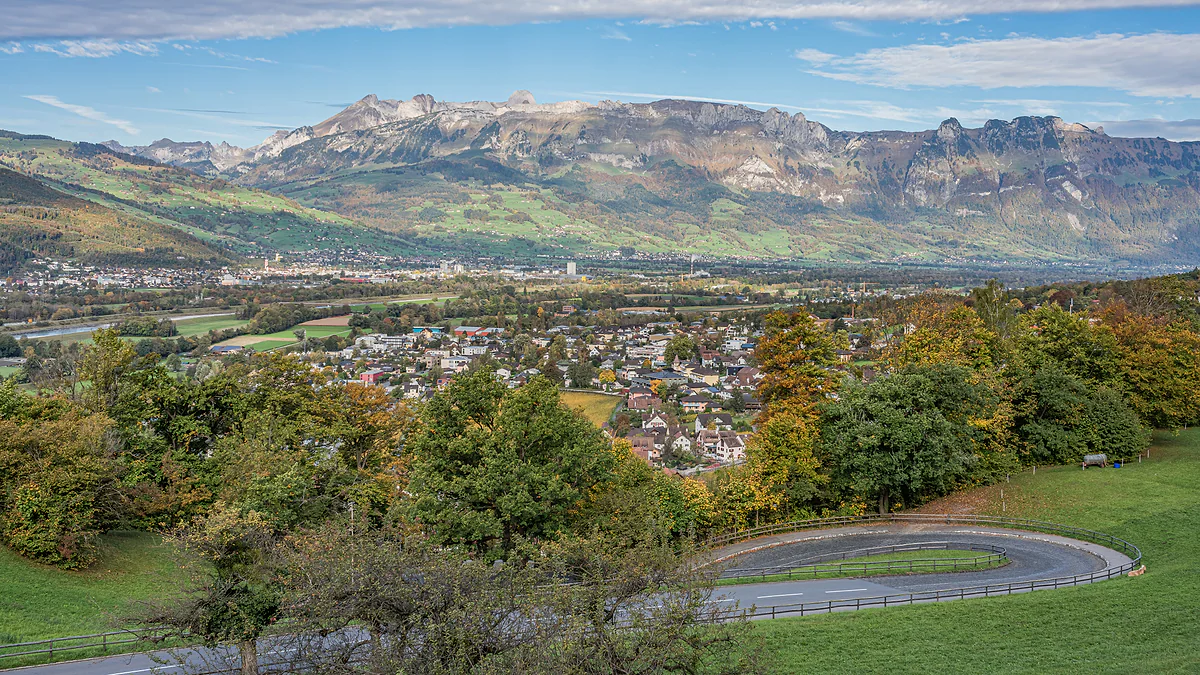
Mild in the valley, thanks to the Föhn
Liechtenstein weather, from the Rhine valley to Malbun at 2,000 m
Liechtenstein has a mild climate for a mountain country, shaped by the Föhn, a warm, dry wind. In Vaduz the monthly average runs from 1.4°C in January to 19.4°C in July, according to MeteoSwiss, with about 960 mm of rain a year and over four times as much in August as in February. Up in Malbun and Sareis it's considerably colder.
In 30 seconds
Full read: 3 min
- In Vaduz the average runs from 1.4°C in January to 19.4°C in July, according to MeteoSwiss.
- About 960 mm of rain falls a year, mostly in summer.
- The Föhn, a warm, dry wind, keeps the valley mild.
- The mountains are much colder: Malbun sits at about 1,600 m.
I'd always check two forecasts, Vaduz and Malbun, because everything changes between the valley and Sareis at 2,000 m. And in summer I'd pack a waterproof even on a clear morning, as July and August are the wettest months.

Before you go
What I would keep in mind
-
01 My tip
Summer is the wettest season
Vaduz averages 148 mm of rain in August and 134 mm in July, against 35 mm in February. It doesn't rule out sunshine, but bring a waterproof.
Liechtenstein in summer -
02 Most beautiful
The Föhn stretches spring and autumn
The national statistics office says this warm, dry wind lengthens the growing season in spring and autumn. That's why there are vineyards on the valley floor.
the best time to visit Liechtenstein -
03 Watch out
Don't trust the valley thermometer
Between Vaduz, at around 460 m, and Sareis, at 2,000 m, there's over 1,500 m of height difference. If you're heading up to walk, take a warm layer even when it's hot below.
mountains in Liechtenstein -
04 Getting there
Reliable snow means Malbun
The 2026-27 ski season in Malbun runs from 19 December to 4 April. Down in the valley, lying snow is the exception.
skiing in Malbun
What I would book
Whenever someone asks me about the weather in Liechtenstein, the first thing I say is that the question has two answers. One for the Rhine valley, where Vaduz and almost every village sit, and another for the mountains, which start a few kilometres away and climb to 2,600 m. The weather changes so much between the two that it’s worth looking at them separately.
Milder than you’d expect
The Amt für Statistik, the national statistics office, describes the climate as mild despite the mountains, and puts it down to the Föhn, a warm, dry wind that drops off the Alps. The same source says the wind lengthens the growing season in spring and autumn. That’s why there are vineyards on the valley floor, and why autumn in Vaduz is often so pleasant.
According to that office, the thermometer rarely falls below minus 10 in winter, while summer daytime temperatures usually sit between 20 and 28 degrees. The tourist board quotes a colder winter figure, but I’d go with the statistics office, which is the official one.
What’s the temperature in Vaduz each month?
For the detail I’ve used open data from MeteoSwiss, the Swiss weather service, which runs a station in Vaduz at 457 m. Averaged over 1991 to 2020, January is the coldest month at 1.4°C across day and night, and July the warmest at 19.4°C, neck and neck with August. The annual mean works out at 10.6°C.
Bear in mind those are 24-hour averages. July and August afternoons are noticeably warmer, and the station logs around 17 days of 25°C or more in July and about four that pass 30°C. At the other end, January and December bring around 19 and 18 frosty days respectively.
Summer is wetter than winter
This one surprises plenty of visitors, though a Brit may shrug. Vaduz averages about 960 mm of rain a year, and most of it falls between May and September. August is the wettest month at 148 mm and February the driest at 35 mm. I think it’s worth knowing before you book, because plenty of people pick July expecting a dry Alpine summer and meet a few wet days. It’s no reason to stay away, just a reason to keep an indoor plan up your sleeve, such as the Städtle museums.
It’s wetter still higher up. The statistics office gives 900 to 1,200 mm a year for the country and up to 1,900 mm in the mountains. That doesn’t make summer grey, mind you. The sunshine figures prove it rather neatly, as July is also the sunniest month, with about 197 hours of sunshine against 55 in December.
The mountains are another climate altogether
This is where people get caught out. Starting from Vaduz at around 460 m, you climb to Triesenberg at 886 m, then to the Steg valley, which spans 1,310 to 1,450 m, on to Malbun at roughly 1,600 m and finally the top of the Sareis chairlift at about 2,000 m. Every stretch of hillside knocks the temperature down, so a 25°C day in the Städtle can be cool and breezy on the ridge.
Snow is also about altitude. The 2026-27 season for skiing in Malbun runs from 19 December to 4 April, and the cross-country trails at Steg are kept open each year from December to mid-March. On high routes such as the Fürstensteig, the tourist board warns there may be snowfields until late spring.
What I’d pack
For the valley, normal town clothes for the season and a waterproof from May to September. Layers work better than one heavy coat, because a Föhn day can feel unseasonably warm and the next can be damp and grey, and you’ll be ducking in and out of museums either way. For the mountains, a warm layer and a windproof even in high summer, proper walking boots and a forecast checked the night before. In winter you only need serious cold-weather kit if you’re going up to Malbun; in Vaduz, what you’d wear for a British city in January will do.
If your real question is when to go, I cover that in the best time to visit Liechtenstein, and I’ve got ideas for each season in Liechtenstein in winter and Liechtenstein in summer.
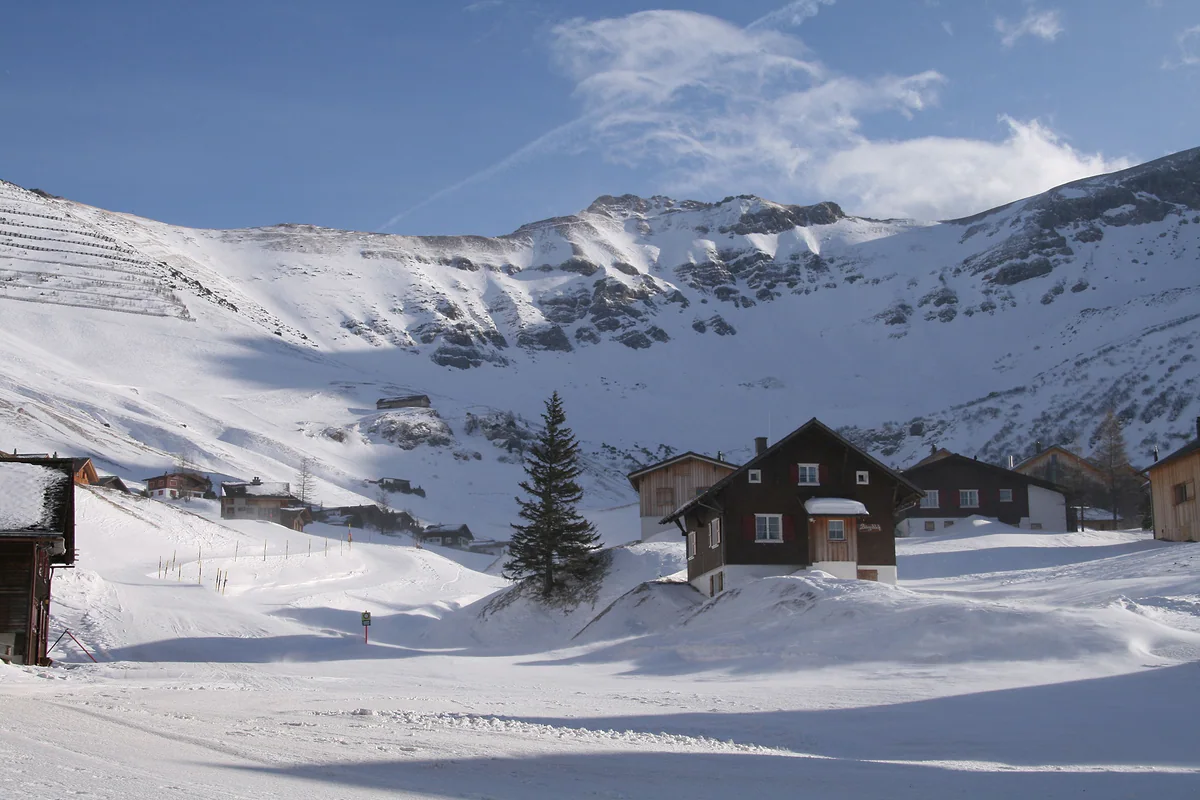
Snow-covered Malbun, with wooden chalets, a fir tree and the ski slopes below the white peaks.
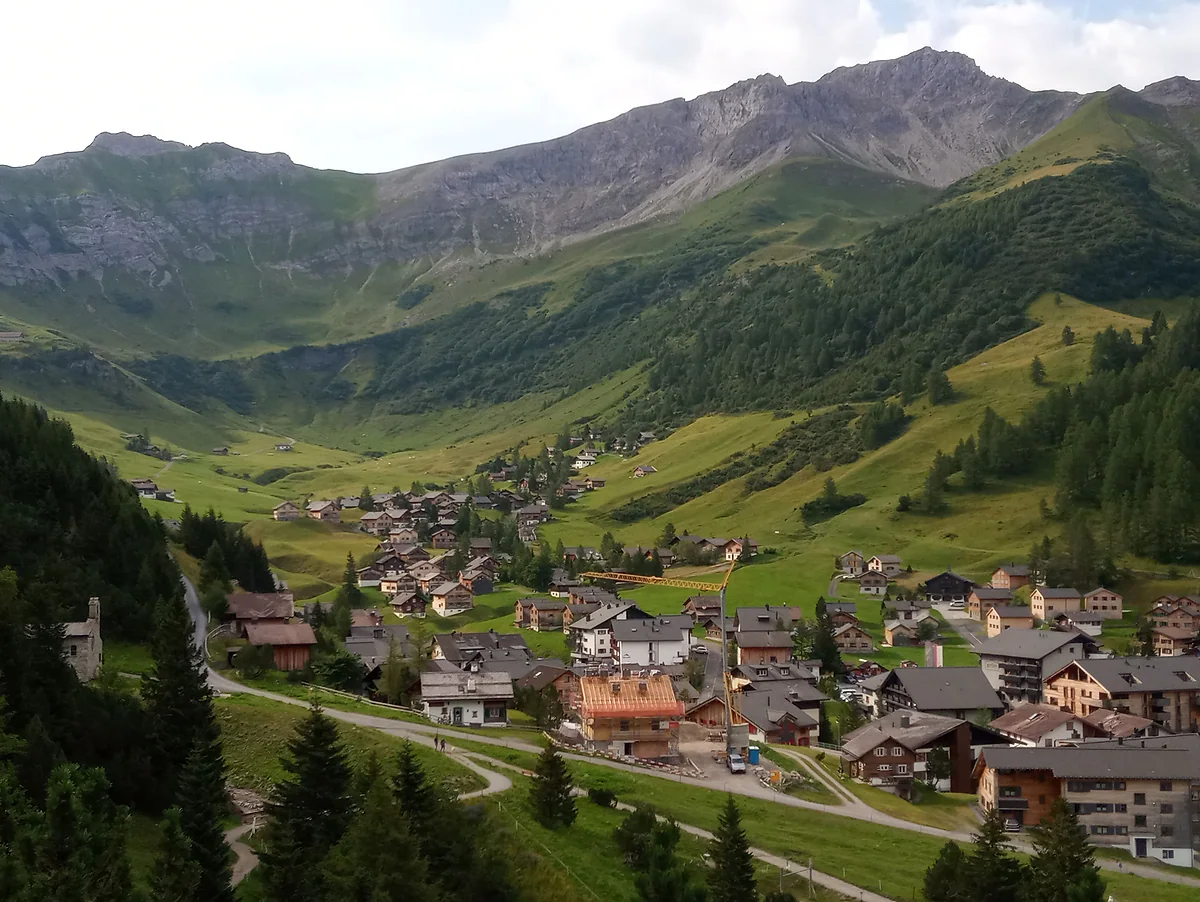
Malbun in summer, with the chalet village on the valley floor, green meadows and rocky peaks above.
Vaduz weather month by month (1991-2020 averages)
| Month | Mean temperature | Rain | Sunshine hours | Frost days |
|---|---|---|---|---|
| January | 1.4°C | 42 mm | 72 | 19 |
| February | 2.7°C | 35 mm | 92 | 16 |
| March | 6.8°C | 56 mm | 131 | 9 |
| April | 10.7°C | 58 mm | 156 | 2 |
| May | 14.7°C | 92 mm | 168 | 0 |
| June | 17.9°C | 119 mm | 181 | 0 |
| July | 19.4°C | 134 mm | 197 | 0 |
| August | 19.1°C | 148 mm | 183 | 0 |
| September | 15.1°C | 98 mm | 147 | 0 |
| October | 11.1°C | 70 mm | 114 | 1 |
| November | 5.7°C | 57 mm | 67 | 9 |
| December | 2.2°C | 55 mm | 55 | 18 |
Averages worked out from MeteoSwiss open monthly data for its Vaduz station (457 m). Mean temperature over the whole day, not the daytime high.
Altitude is what changes the weather
| Place | Altitude |
|---|---|
| Ruggeller Riet (lowest point) | 430 m |
| Vaduz | 460 m |
| Triesenberg | 886 m |
| Steg | 1,310 to 1,450 m |
| Malbun | About 1,600 m |
| Sareis | About 2,000 m |
| Grauspitz (highest point) | About 2,600 m |
Test yourself
True or false?
0/4 Pick before you peek.
-
It rains more in Liechtenstein in summer than in winter.
See the answer
True. Vaduz averages 148 mm in August and 35 mm in February, according to MeteoSwiss data for 1991 to 2020.
-
The Föhn is a cold wind from the north.
See the answer
False. It's a warm, dry wind coming down off the Alps and, according to the statistics office, it lengthens the growing season.
-
In winter Vaduz regularly drops below -15°C.
See the answer
False. The statistics office says the thermometer rarely falls below -10°C. The January average in Vaduz is 1.4°C.
-
Vaduz gets more than three times as much sunshine in July as in December.
See the answer
True. About 197 hours in July against about 55 in December, on average.
- Annual mean temperature in Vaduz
- 10.6°C
- Average August rain, the wettest month
- 148 mm
- Sunshine hours a year in Vaduz
- 1,563 h
- Winter low rarely exceeded
- -10°C
0 of 168 Liechtenstein guides
Your next stamp
- Viewpoints
- Rainy days
- In summer
- In winter
- Events
- Music festivals
- Things to do
- One day
- Two days
- Municipalities
- Oberland
- Unterland
- Map
- Vaduz
- Städtle
- Mitteldorf
- Vaduz Castle
- Vaduz Cathedral
- Parliament
- Government Building
- Vaduz Town Hall
- Red House
- Prince's Winery
- Old Rhine Bridge
- Schaan
- Schalun Castle Ruin
- Balzers
- Citytrain
- Triesen
- Triesenberg
- Walser Museum
- Planken
- Gutenberg Castle
- The Rhine
- Schaan Roman fort
- Dux
- St Mamertus chapel
- Lawena valley
- Mäls
- DoMuS
- TAK Theatre
- Castles
- Churches and chapels
- Mountains
- Museums
- Kunstmuseum
- Mountain huts
- Hilti Art Foundation
- Pfälzerhütte
- Gafadura hut
- National Museum
- Treasure Chamber
- Postage Stamp Museum
- Kunstraum Engländerbau
- Eschen
- Masescha
- Gaflei
- Nendeln
- Mauren
- Silum
- Rotenboden
- Schaanwald
- Gamprin
- Wangerberg
- Bendern
- Steg
- Ruggell
- Samina valley
- Schellenberg Farmhouse Museum
- Cross-country skiing at Steg
- Küefer-Martis-Huus
- Ruggeller Riet
- Schellenberg
- Hinterschellenberg
- Fürstensteig
- Is it a country?
- Liechtenstein Trail
- Malbun
- Schellenberg castles
- Eschnerberg
- Malbun in summer
- Population
- Stage 1: Balzers - Triesenberg
- Lakes
- Sareis
- Size
- Stage 2: Triesenberg - Vaduz
- Malbun Peace Chapel
- Political system
- Stage 3: Vaduz - Nendeln
- Swimming pools
- Language
- Skiing in Malbun
- Stage 4: Nendeln - Ruggell
- Dialect
- Malbun ski pass
- Stage 5: Ruggell - Schaanwald
- Hotels in Malbun
- Stamps
- Princess Gina Trail
- Hut-to-hut Route 66
- Hiking
- Getting there
- Airport
- Best time to visit
- With kids
- Zurich to Liechtenstein
- National day
- Sargans to Vaduz
- Christmas
- Feldkirch to Vaduz
- By train
- Traditions
- Carnival
- Getting around
- Buses
- Funken Sunday
- Alpine cattle drive
- Driving and vignette
- Parking
- Bike hire
- Cycling
- EU and Schengen
- Entry requirements
- Borders and customs
- The prince
- The princely house
- The flag
- The coat of arms
- The national anthem
- History
- Second World War
- No army
- Facts
- Why so rich?
- Banks and tax haven
- Where to stay
- Hilti
- Hotels in Vaduz
- False teeth
- Hostel and camping
- Rent the country?
- Where to eat
- Restaurants in Vaduz
- Swiss invasions
- Bars and nightlife
- Food
- Käsknöpfle
- Wine
- Casinos
- Adventure Pass
- Guided tours
- Tourist office
- Day trips
- Passport stamp
- Phone and roaming
- Currency and payments
- Prices and budget
- Tipping
- Plugs and sockets
- Tap water
- Opening hours
- Public holidays
- Safety
- Accessibility
- With a dog
- Shopping and souvenirs
Frequently asked questions
What is the weather like in Liechtenstein?
Mild for the Alps. The national statistics office says the thermometer rarely drops below -10°C in winter and summer daytime temperatures usually sit between 20 and 28°C. The Föhn, a warm, dry wind, takes the edge off.
How much does it rain in Liechtenstein?
In the valley, 900 to 1,200 mm a year according to the statistics office, and up to 1,900 mm in the Alpine area. MeteoSwiss data for Vaduz give an average of about 960 mm, with August the wettest month.
Is Liechtenstein cold in winter?
In Vaduz the January average is 1.4°C, with around 19 frosty days that month. Malbun, at about 1,600 m, is far colder and has snow for skiing from December to April.
Does it snow in Vaduz?
It can, but snow doesn't tend to stay in the valley. For reliable snow head to Malbun, where the 2026-27 season runs from 19 December 2026 to 4 April 2027.
What is the Föhn?
A warm, dry wind that comes down off the Alps. According to the statistics office it shapes the country's climate and lengthens the growing season in spring and autumn.
What is the hottest month in Liechtenstein?
July, with a 19.4°C average in Vaduz, closely followed by August. They're also the months with the most days of 25°C or more, around 17 in July.
By
Tourism graduate with a master’s in Tourism Management and Planning from the University of Málaga, who has travelled across Europe. He writes every guide from official sources and his own judgement.
Published on . Facts checked on .
Sources
Photos: A.Savin (FAL); böhringer friedrich (CC BY-SA 2.5); Mislep (CC BY 4.0), via Wikimedia Commons.