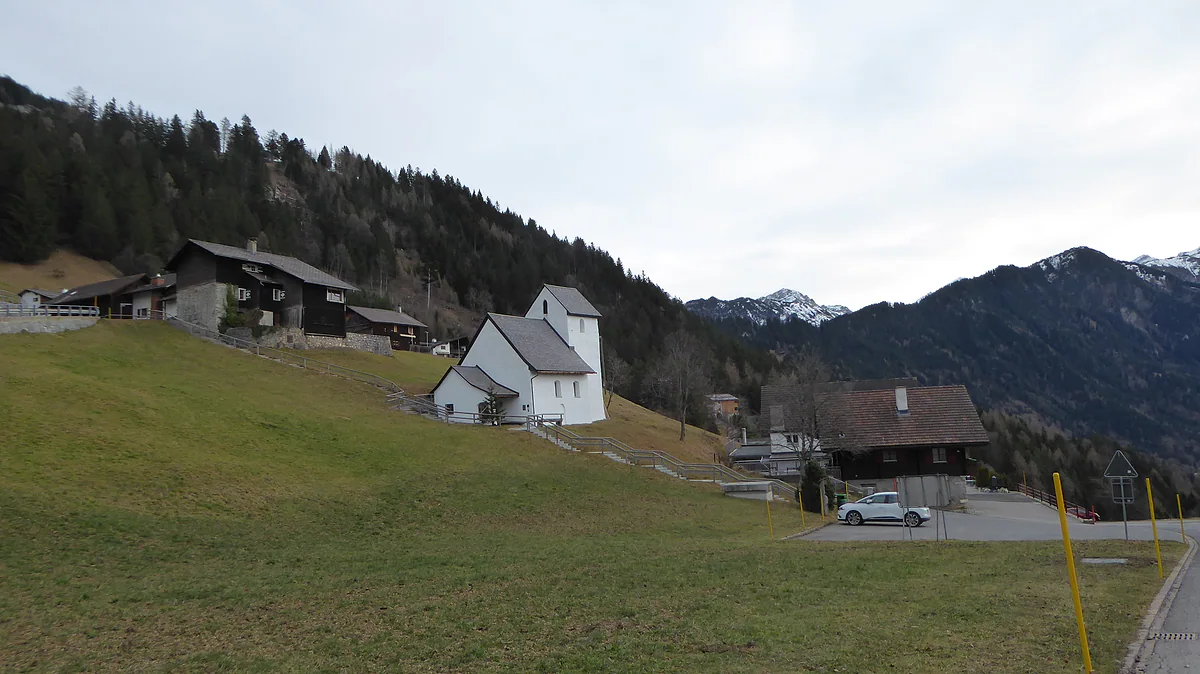
Triesenberg hamlet at 1,250 m
Masescha, where the Walser story begins
Masescha is a hamlet of Triesenberg at 1,250 m on the road to Gaflei, and the Historisches Lexikon reckons it was the Walser settlers' first centre after they arrived around 1300. Its chapel of St Theodul, first recorded in 1465, was their first church. Bus 22 gets you there in about 8 minutes from Triesenberg centre.
In 30 seconds
Full read: 3 min
- Masescha is a Triesenberg hamlet at 1,250 m on the road to Gaflei.
- The Historisches Lexikon sees it as the first Walser centre in the country, around 1300.
- St Theodul's chapel was the first Walser church and has 15th-century frescoes.
- Bus 22 gets there in about 8 minutes from Triesenberg centre.
I'd ride the 22 up, step into the chapel for the choir frescoes and carry on to Gaflei before dropping back down for lunch at the Berggasthaus. In a couple of hours you get the Walser story and the best view in the valley.

Before you go
What I would keep in mind
-
01 Most beautiful
A chapel with a tower like a keep
St Theodul's was built in two phases, first the choir with its tower and then a broad nave. The tower rose to four storeys and looks like a small fortified keep. Inside are frescoes from the second half of the 15th century.
churches and chapels in Liechtenstein -
02 Worth the splurge
13 Gault-Millau points at 1,250 m
Berggasthaus Masescha, which opened as a tavern in 1877, now holds 13 Gault-Millau points and is on the tourist board's list of places to eat Käsknöpfle.
Käsknöpfle, Liechtenstein's national dish -
03 Getting there
Route 22, stop Masescha, Kapelle
It leaves Triesenberg centre once an hour and takes about 8 minutes, reaching Gaflei four minutes later. Pay by card or app, because the buses don't take cash.
Liechtenstein's buses -
04 My tip
Add Gaflei on the same bus
Masescha and Gaflei are on the same route, four minutes apart. I'd go to the Gaflei tower first and walk back down to Masescha for lunch, since it's all downhill.
Gaflei, the lookout above Vaduz
What I would book
Masescha is a small hamlet perched at 1,250 m above Triesenberg, with a white chapel on a sloping meadow and an inn next door. It doesn’t look like much, but to me it’s where the story of Liechtenstein’s mountains starts, which is why it gets a page of its own.
The Walser settlers’ first home
The Historisches Lexikon thinks Masescha was the Walser settlers’ first centre in what is now Liechtenstein, after they arrived around 1300. The hamlet turns up in writing in 1355 as Museschen, and in 1397 a noble couple sold part of their land here to a Walser. Nobody is sure where the name comes from, and the Lexikon says so plainly.
It sits on the Rhine side of the ridge, above Rotenboden, below the Silum alp and on the road up to Gaflei. Over the centuries people moved down to easier ground. Between 1771 and 1814 the area around Masescha and Prufatscheng lost 69% of its population while today’s Triesenberg centre grew by 122%. Now it’s partly lived in all year, with holiday homes and a retreat house belonging to the Adorers of the Blood of Christ.
St Theodul’s chapel, the reason I’d come
The chapel was the Walser settlers’ first church in Triesenberg. It was probably built soon after 1300, although the first document to mention it dates from 1465, when it was a Lady chapel. It has switched saints more than once. In 1595 it was St Theodore’s, with three altars; during the plagues of 1620 and 1628 it became a shrine to St Sebastian; and since 2005, when the Walser marked 650 years here, it has been dedicated to St Theodul, the patron saint of the Valais.
What I like is that you can see it was built in two goes. First came a south-facing choir with a tower, then a broad rectangular nave, and the tower went up to four storeys with the look of a small keep. Inside, the Lexikon picks out the choir frescoes from the second half of the 15th century, a side altar from around 1620 that was once the high altar, and 15 hand-coloured engravings of the Stations of the Cross by the Klauber brothers of Augsburg, from around 1800. The arm reliquary of about 1500 and the originals of the 1661 altar are in the National Museum in Vaduz. If chapels are your thing, I compare it with the rest on my page about churches and chapels in Liechtenstein.
A place people climbed to in prayer
For centuries Masescha was a pilgrimage stop. Triesenberg’s villagers came up in procession on 16 August, St Theodul’s day, and from the 17th century, the Lexikon says, the villages of the county of Vaduz climbed here in penitence on 20 January for St Sebastian and on 16 August for St Roch, the two plague saints. Until 1768 Masescha belonged to Triesen parish, like Wangerberg, the Triesenberg hamlet above Triesen further south, and from 1689 an endowment required a Triesen priest to say Mass here once a week.
From gypsum quarries to summer holidays
The hamlet has had a livelier past than you’d guess. In the early 19th century gypsum was quarried at Masescha and Erbi, and a 1902 plan for a goods cableway down to Schaan fell through for lack of money. Then the visitors came. The road from Triesenberg dates from 1874-1875 and Berggasthaus Masescha opened in 1877 as a tavern before becoming a guesthouse for spa guests. From 1931 to 1943 there was a silver fox farm here, and in 1947 and 1948 motorcycle races ran from Vaduz up to Masescha. There’s a piece of engineering here too. According to the Lexikon, water from the reservoir at Steg travels through a pressure tunnel under the ridge to a surge chamber at Masescha, at 1,270 m, before plunging down a pipeline to the power station in Vaduz.
How to get there, and what to add
Bus 22 runs hourly from Triesenberg centre and drops you at the Masescha, Kapelle stop, right by the chapel, in about 8 minutes. Have a contactless card or the app ready, as cash isn’t accepted.
I’d pair Masescha with Gaflei, four minutes further up on the same bus, then come back down for lunch. Berggasthaus Masescha has 13 Gault-Millau points and is on the official list of places serving Käsknöpfle, the cheesy pasta I cover on my page about the national dish. If you’d rather walk, head up to Silum, the alp above Masescha, between 1,400 and 1,700 m.
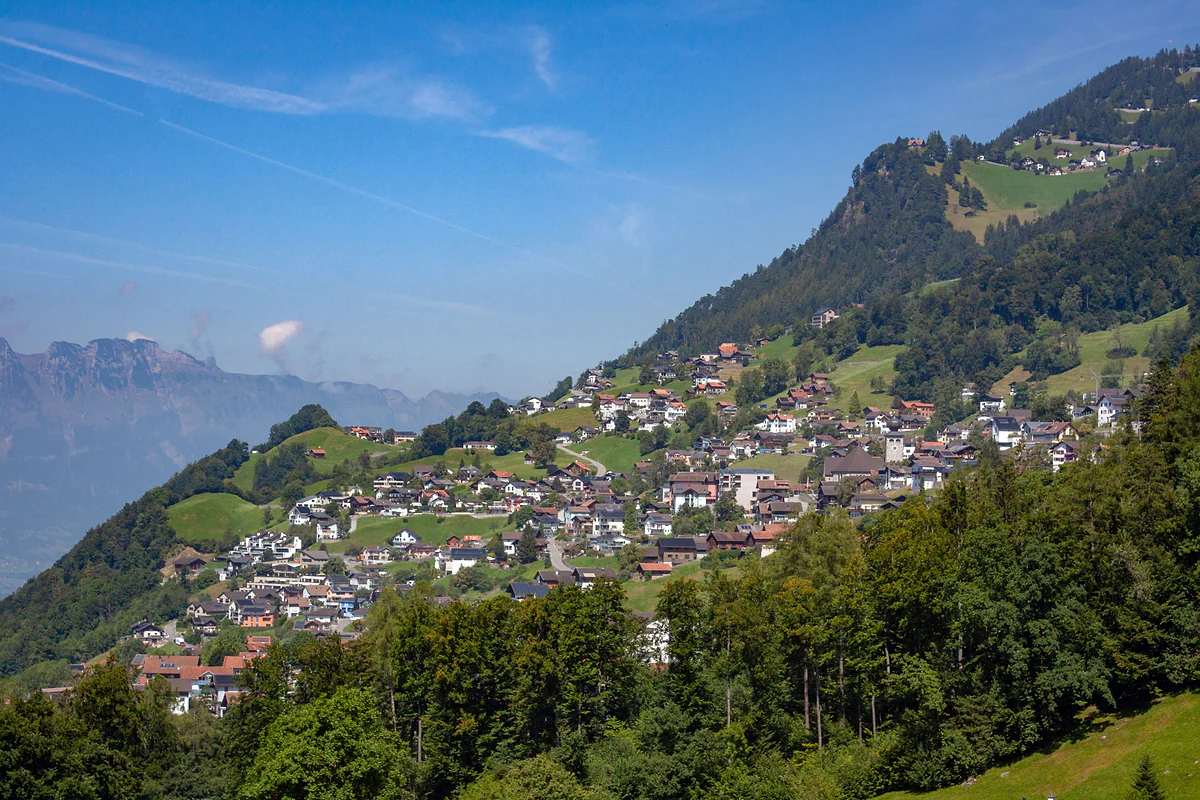
The houses of Triesenberg scattered across the green hillside above the Rhine valley, under a blue sky.
Masescha at a glance
| Fact | Figure | Source |
|---|---|---|
| Altitude | 1,250 m | Historisches Lexikon |
| First record | 1355, Museschen | Historisches Lexikon |
| Road from Triesenberg | 1874-1875 | Historisches Lexikon |
| Berggasthaus Masescha | Since 1877 | Historisches Lexikon |
| Bus | Route 22, about 8 min from Triesenberg | LIEmobil timetable 2026 |
St Theodul's chapel through the years
| Year | What happened |
|---|---|
| Around 1300 | Probably built, the first Walser church |
| 1465 | First written mention, as a Lady chapel |
| 1595 | Recorded as St Theodore's, with three altars |
| 1620 and 1628 | A shrine to St Sebastian in the plague years |
| 2005 | Rededicated to St Theodul for 650 years of the Walser |
Dates from the Historisches Lexikon. The reliquary of around 1500 and the originals of the 1661 altar are in the National Museum in Vaduz.
Test yourself
True or false?
0/3 Pick before you peek.
-
The chapel at Masescha has always been dedicated to St Theodul.
See the answer
False. It was a Lady chapel, then St Theodore's, and during the plagues of 1620 and 1628 St Sebastian's. It has only been St Theodul's since 2005.
-
Masescha was probably the Walser settlers' first centre in Liechtenstein.
See the answer
True. That's the view of the Historisches Lexikon, which records the hamlet in 1355 as Museschen.
-
There was once a silver fox farm at Masescha.
See the answer
True. According to the Lexikon, Guntram Fehr bred silver foxes at Masescha from 1931 to 1943.
- Altitude of the hamlet
- 1,250 m
- First written record, as Museschen
- 1355
- First mention of the chapel
- 1465
- By bus from Triesenberg centre
- 8 min
Map
Where Masescha is
The dashed line is the border: Switzerland across the Rhine, Austria to the north and east. Every number opens its guide.
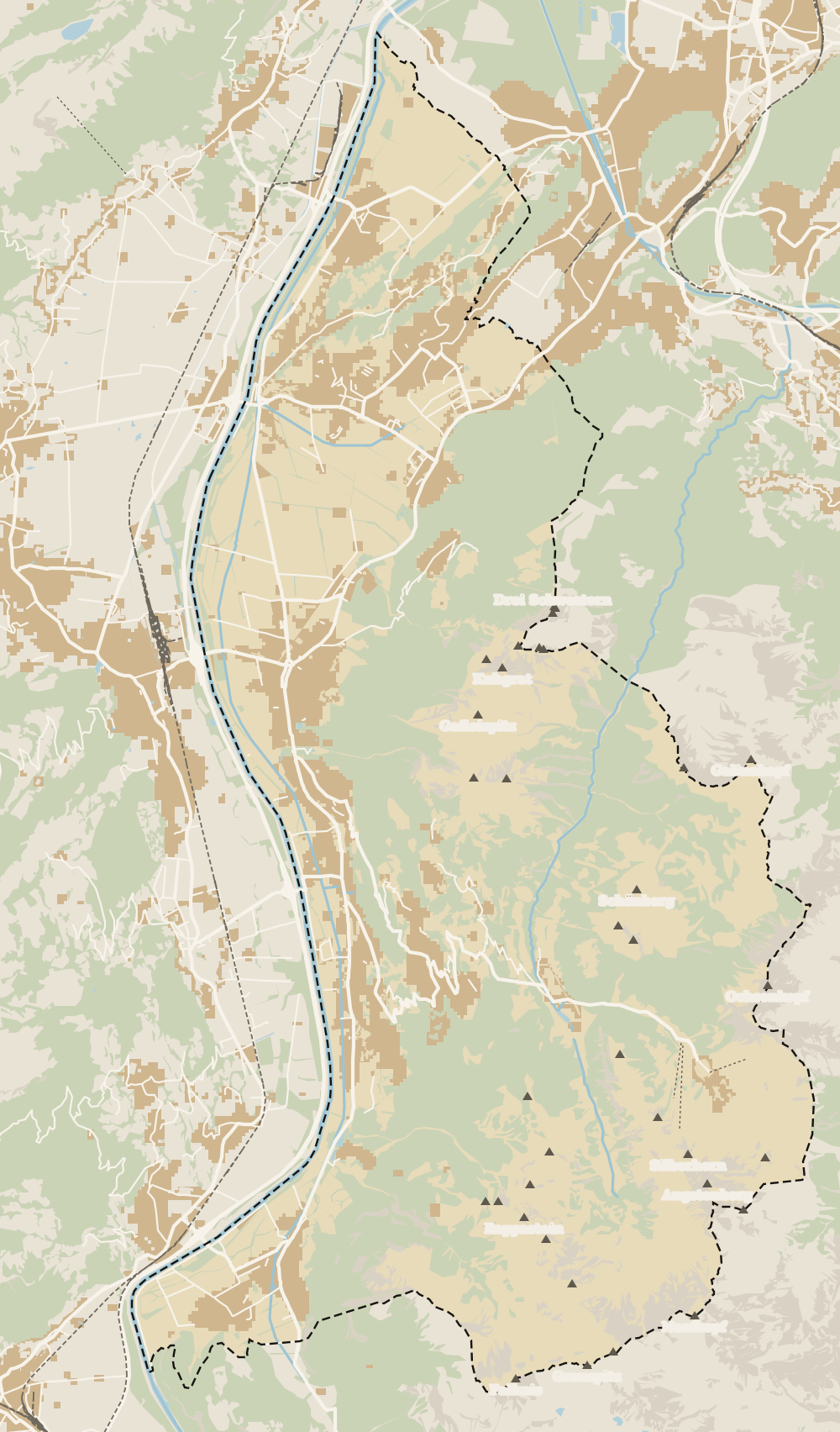 1Triesenberg 2Walser Museum 3Masescha 4Gaflei 5Silum 6Rotenboden 7Wangerberg 8Steg 9Samina valley 10Malbun
 Map data © OpenStreetMap contributors (ODbL)
- 1TriesenbergLargest and highest municipality in the country
- 2Walser MuseumClosed from 12:00 to 15:00
- 3MaseschaTriesenberg hamlet at 1,250 m
- 4GafleiHome of the country's first spa hotel, in 1875
- 5SilumWalser alp between 1,400 and 1,700 m
- 6RotenbodenTriesenberg hamlet, Rotaboda in dialect
- 7WangerbergTriesenberg hamlet, Wangerbärg in dialect
- 8StegTriesenberg summer pasture at about 1,300 m
- 9Samina valleyThe inner valley behind the Kulm ridge
- 10MalbunAt 1,600 m, with an hourly bus from Vaduz
0 of 168 Liechtenstein guides
Your next stamp
- Silum
- Stage 1: Balzers - Triesenberg
- Triesenberg
- Rotenboden
- St Mamertus chapel
- Triesen
- Stage 2: Triesenberg - Vaduz
- Steg
- Things to do
- One day
- Two days
- Municipalities
- Oberland
- Unterland
- Map
- Vaduz
- Städtle
- Mitteldorf
- Vaduz Castle
- Vaduz Cathedral
- Parliament
- Government Building
- Vaduz Town Hall
- Red House
- Prince's Winery
- Old Rhine Bridge
- Schaan
- Schalun Castle Ruin
- Balzers
- Citytrain
- Walser Museum
- Planken
- Gutenberg Castle
- The Rhine
- Schaan Roman fort
- Dux
- Lawena valley
- Mäls
- DoMuS
- TAK Theatre
- Castles
- Churches and chapels
- Viewpoints
- Mountains
- Museums
- Kunstmuseum
- Mountain huts
- Hilti Art Foundation
- Pfälzerhütte
- Gafadura hut
- National Museum
- Treasure Chamber
- Postage Stamp Museum
- Kunstraum Engländerbau
- Eschen
- Gaflei
- Nendeln
- Mauren
- Schaanwald
- Gamprin
- Wangerberg
- Bendern
- Ruggell
- Samina valley
- Schellenberg Farmhouse Museum
- Cross-country skiing at Steg
- Küefer-Martis-Huus
- Ruggeller Riet
- Schellenberg
- Hinterschellenberg
- Fürstensteig
- Is it a country?
- Liechtenstein Trail
- Malbun
- Schellenberg castles
- Eschnerberg
- Malbun in summer
- Population
- Lakes
- Sareis
- Size
- Malbun Peace Chapel
- Political system
- Stage 3: Vaduz - Nendeln
- Swimming pools
- Language
- Skiing in Malbun
- Stage 4: Nendeln - Ruggell
- Dialect
- Malbun ski pass
- Stage 5: Ruggell - Schaanwald
- Hotels in Malbun
- Stamps
- Princess Gina Trail
- Hut-to-hut Route 66
- Hiking
- Getting there
- In winter
- Weather
- Airport
- Best time to visit
- In summer
- Events
- With kids
- Zurich to Liechtenstein
- National day
- Sargans to Vaduz
- Christmas
- Feldkirch to Vaduz
- By train
- Traditions
- Carnival
- Getting around
- Buses
- Funken Sunday
- Alpine cattle drive
- Driving and vignette
- Parking
- Bike hire
- Cycling
- EU and Schengen
- Entry requirements
- Borders and customs
- The prince
- The princely house
- The flag
- The coat of arms
- The national anthem
- History
- Second World War
- No army
- Facts
- Why so rich?
- Banks and tax haven
- Where to stay
- Hilti
- Hotels in Vaduz
- False teeth
- Hostel and camping
- Rent the country?
- Where to eat
- Restaurants in Vaduz
- Swiss invasions
- Bars and nightlife
- Food
- Käsknöpfle
- Wine
- Casinos
- Adventure Pass
- Rainy days
- Guided tours
- Tourist office
- Day trips
- Passport stamp
- Music festivals
- Phone and roaming
- Currency and payments
- Prices and budget
- Tipping
- Plugs and sockets
- Tap water
- Opening hours
- Public holidays
- Safety
- Accessibility
- With a dog
- Shopping and souvenirs
Frequently asked questions
What is Masescha?
A hamlet of Triesenberg at 1,250 m on the hillside above the Rhine valley. The Historisches Lexikon believes it was the Walser settlers' first centre after they arrived around 1300, and it holds their first church, St Theodul's chapel.
How do I get to Masescha?
Take LIEmobil route 22 from Triesenberg centre; it runs hourly and takes about 8 minutes to the Masescha, Kapelle stop. Route 21 brings you up to Triesenberg from Vaduz.
What is there to see in Masescha?
St Theodul's chapel, with late 15th-century choir frescoes and Stations of the Cross engraved around 1800, plus the views over the Rhine valley. The Silum alp sits just above and Gaflei is four minutes on by bus.
Where can I eat in Masescha?
At Berggasthaus Masescha, which opened in 1877 and has 13 Gault-Millau points according to the tourist board. It's also on the official list of places serving Käsknöpfle.
How high is Masescha?
1,250 m according to the Historisches Lexikon, with the chapel at 1,235 m. The tourist board puts the Berggasthaus at around 1,200 m.
Who is the chapel at Masescha dedicated to?
St Theodul, the patron of the Valais, since 2005. Before that it was a Lady chapel, then St Theodore's and, during the 17th-century plagues, St Sebastian's.
By
Tourism graduate with a master’s in Tourism Management and Planning from the University of Málaga, who has travelled across Europe. He writes every guide from official sources and his own judgement.
Published on . Facts checked on .
Sources
Photos: Plutowiki (CC0); Lucas Kendall (CC BY-SA 4.0), via Wikimedia Commons.