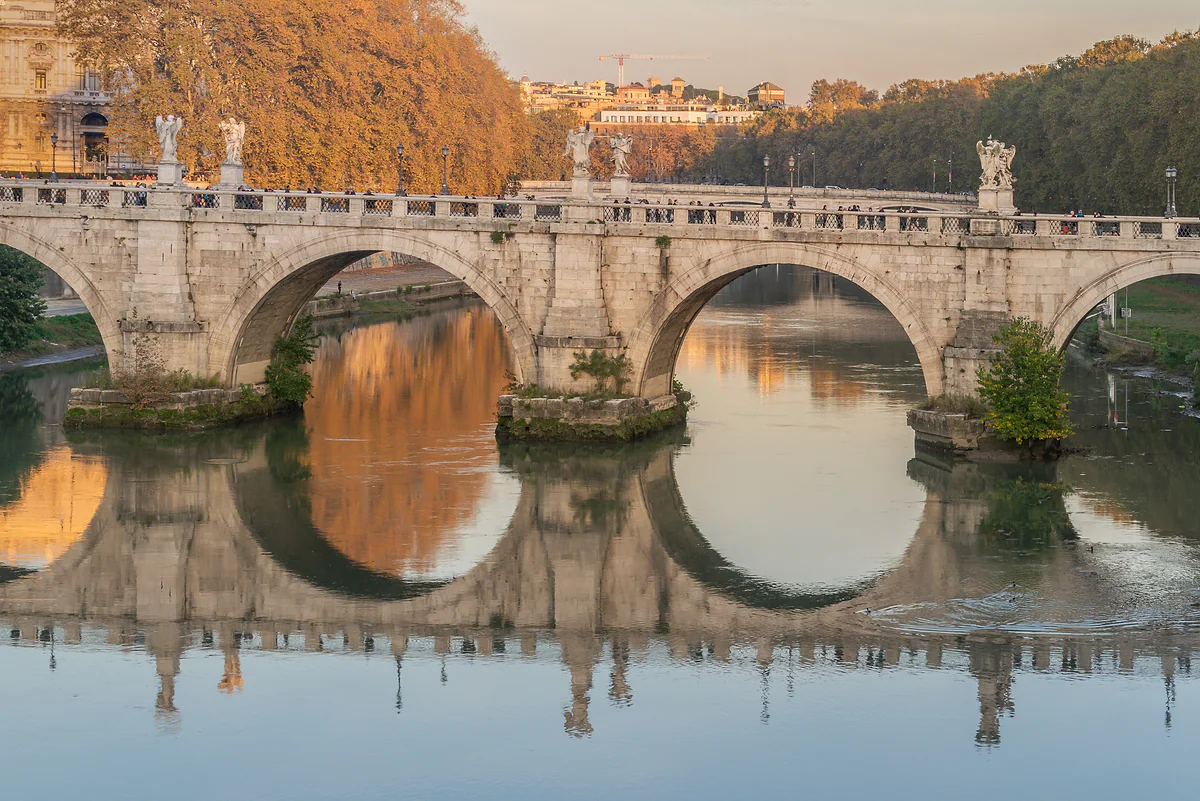
Ten marble angels, and two missing
Ponte Sant'Angelo, the bridge of ten angels facing the castle
Ponte Sant'Angelo crosses the Tiber right in front of the castle of the same name. Hadrian had it built in AD 136 to reach his mausoleum, and between 1667 and 1669 Clement IX lined it with ten marble angels bearing the symbols of the Passion, designed by Bernini and carved by his workshop. It's free to cross at any hour and has looked as it does now since 1882.
I'd always cross from the old-town bank towards the castle, slowly, stopping at every angel, because that's how it was meant to be walked. Then I'd head to Sant'Andrea delle Fratte to see the two Bernini carved himself, which are what really make the outing worthwhile.

Before you go
What I would keep in mind
-
01 Most beautiful
The two best angels are in another church
Bernini carved two of the angels himself, and they were thought too beautiful to leave out in the weather. Since 1729 they've been in the basilica of Sant'Andrea delle Fratte.
-
02 To save money
The castle is free on the first Sunday
The bridge costs nothing, and the Castel Sant'Angelo in front of you opens free on the first Sunday of every month. If the dates work, pair the two that day.
Castel Sant'Angelo -
03 My tip
From the bridge to St Peter's in a straight line
Borgo starts on the far side of the bridge. Along Piazza Pia and Via della Conciliazione you can walk to St Peter's Square without any transport.
Borgo Pio -
04 Getting there
Metro Lepanto or the number 40 bus
The castle's ticket office suggests Lepanto on line A, or the 40 from Termini to Ponte Vittorio Emanuele. From either, the bridge is a short walk.
How to get to Vatican City from Rome and the airports
What I would book
- Places to stayBooking.com Stay in Borgo, by the castle and the bridge The bridge sits at Borgo's front door. It's the base I'd pick to combine the castle, St Peter's and a Tiber walk without any transport.
- TicketsTiqets Tickets for Castel Sant'Angelo If you're crossing the bridge, the castle is the natural next step. The official ticket office is museiitaliani.it; a reseller only makes sense if it adds something.
Of all Rome’s bridges, this is the one I’d cross for its own sake, with no need to reach the other side. Ponte Sant’Angelo is nearly nineteen centuries old, lands you at the door of an imperial tomb turned fortress and carries ten Baroque angels that keep you company all the way over. Turismo Roma calls it the most fascinating of the Tiber’s seven iconic bridges, and I won’t argue.
What Ponte Sant’Angelo is, and where the name comes from
It’s the bridge that takes you from the old-town bank of the Tiber to the entrance of Castel Sant’Angelo. Hadrian had it built in AD 136, a year after starting his tomb, with one clear idea, that you should reach his mausoleum by crossing the river head on. That’s why it was first called the Pons Aelius, Ponte Elio in Italian, after the emperor’s family name.
The present name is borrowed. The castle became Sant’Angelo after the legend of the Archangel Michael, whom Pope Gregory the Great is said to have seen sheathing his sword above it in 590, and the bridge ended up with the same name. If you want the full story of the building in front of you, it’s in my guide to Castel Sant’Angelo.
Ten angels, and the two that aren’t here
What turns a Roman bridge into an open-air gallery arrived in the seventeenth century. Clement IX commissioned ten marble angels, each holding a symbol of the Passion, and Bernini designed the lot. The carving he left to his workshop, which is worth knowing before you start hunting for the master’s hand in every figure.
Because the master’s hand isn’t here. Bernini, by then around seventy, carved two of the angels himself, and Turismo Roma says they were judged too beautiful to leave out in the weather, so they stayed in his studio. In 1729 his heirs gave them to the basilica of Sant’Andrea delle Fratte, where they still stand. On the bridge you’re looking at his workshop’s versions.
At the old-town end you’re also greeted by St Peter and St Paul, two statues that arrived before the angels, during an earlier makeover. I like to read the whole bridge as a procession, apostles at the gate and angels leading you on towards the castle.
Dante, a mule and Rome’s executioner
Few bridges carry this much history. In the Jubilee of 1300, the very first, so many pilgrims crossed here on their way to St Peter’s that traffic had to be split into two directions, and Dante wrote it into Canto XVIII of the Inferno. The Holy Year of 1450 turned to tragedy. An accident caused by the white mule carrying Nicholas V broke the parapets, and dozens were drowned in the river.
Between 1488 and 1534 the square and the bridge were used to display executed prisoners, which left Rome with a proverb claiming there were more severed heads on the parapets than melons at the market. Turismo Roma rounds it all off with a legend. Before dawn, they say, you might meet Mastro Titta, Rome’s most famous executioner, wrapped in his scarlet cloak and offering a pinch of tobacco to anyone passing.
How to cross it and actually see it
My advice is to start from the old-town bank with the castle ahead of you. That way you have the apostles at the entrance, angels on both sides and the castle’s bronze angel at the far end, which is the photo everyone’s after. Cross it the other way and you turn your back on the best view.
I’d stop at each angel without hurrying, because the bridge is short and over in no time if you don’t look. I’d cross at the very start or the very end of the day, when fewer people are standing about mid-span. And if you’re after a picture of the whole bridge with the castle behind, it works better from the riverbank than from on top.
Fitting it in with the castle and the Vatican
The bridge falls on the way for almost any plan round here. Cross it and you’re in the Borgo district, and from there, along Piazza Pia and Via della Conciliazione, you walk to St Peter’s Square. If you’re staying in Prati, it’s a stroll along the Lungotevere.
My favourite order is the afternoon one. The Museums and the basilica in the morning, the castle after lunch and the bridge on the way out, with low light on the river. If you like your days planned hour by hour, it’s all laid out in my two-day Vatican itinerary.
The bridge in five dates
| Year | What happened |
|---|---|
| 136 | Hadrian builds it as the Pons Aelius to reach his mausoleum |
| 1300 | First Jubilee, traffic is split into two directions and Dante records it |
| 1450 | The parapets give way as Nicholas V's mule passes and dozens drown |
| 1667-1669 | Clement IX commissions the ten angels, designed by Bernini |
| 1882 | Works that give it its present appearance |
Facts from Turismo Roma, checked on 24 and 29 September 2026.
Test yourself
True or false?
0/3 Pick before you peek.
-
Bernini carved every angel on the bridge with his own hands.
See the answer
False. Bernini designed the figures and his workshop carved them. The two he did himself, in his seventies, were never put up and have been in Sant'Andrea delle Fratte since 1729.
-
The bridge is older than the castle it leads to.
See the answer
False. Hadrian began his mausoleum in AD 135 and the bridge dates from 136. They were conceived together, the bridge as the way to the emperor's tomb.
-
Dante mentions this bridge in the Divine Comedy.
See the answer
True. In Canto XVIII of the Inferno he describes the pilgrims of the 1300 Jubilee crossing it in two lines, one facing the castle on the way to St Peter's and the other heading back.
Map
Everything within a short walk
Green for Rome, black for the Vatican. Every number opens its guide.
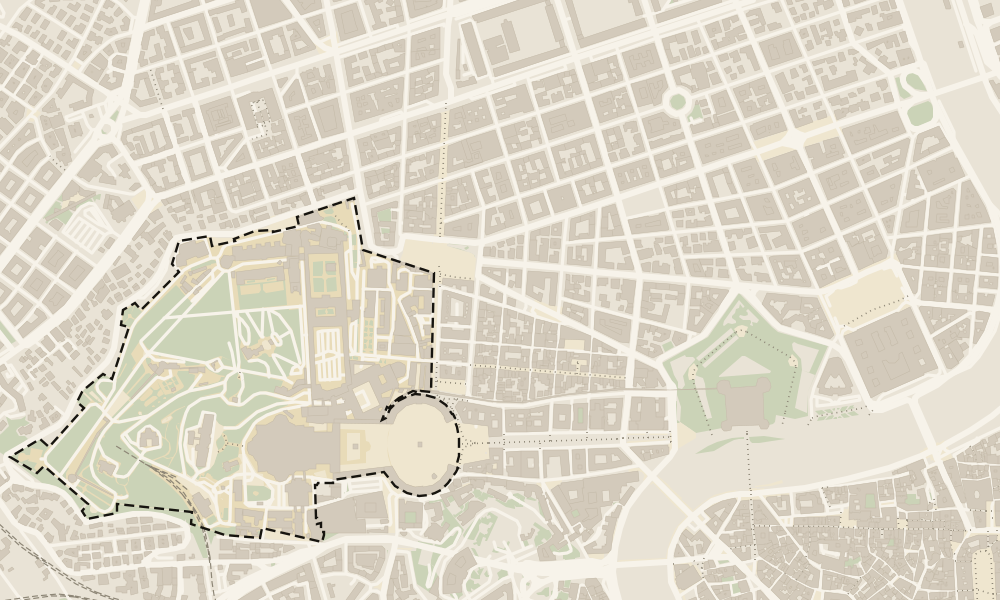 1Castel Sant'Angelo 2Borgo 3Sistine Chapel 4Prati 5Ponte Sant'Angelo 6Vatican Museums 7St Peter's Basilica 8St Peter's Square 9St Peter's Dome 10Vatican Necropolis 11Vatican Gardens 12Swiss Guard 13Seeing the Pope 14Apostolic Palace 15Papal audience 16Angelus 17Who painted it 18Where the Pope lives 19Facts 20Vatican Grottoes 21Pietà 22Baldachin 23Ceiling 24Chair of St Peter 25Last Judgement 26Raphael Rooms 27Architecture and architects 28Gallery of Maps 29Holy Door 30Bramante Staircase 31Facade and balcony 32Mass at St Peter's 33Pio Clementino Museum 34Vatican Pinacoteca 35Gallery of Tapestries 36Gallery of the Candelabra 37Egyptian and Etruscan Museums 38Obelisk 39Bernini's colonnade 40Chiaramonti and Braccio Nuovo 41Christmas 42Anima Mundi Museum 43Easter 44Carriage Pavilion 45Courtyard of the Pine Cone 46Train station 47Borgia Apartment 48Modern art collection 49Pharmacy, shop and petrol
 Map data © OpenStreetMap contributors (ODbL)
- 1Castel Sant'AngeloHadrian's mausoleum, a short walk from the Vatican
- 2BorgoRione XIV, between the colonnade and the Tiber
- 3Sistine ChapelInside the Vatican Museums
- 4PratiRione XXII, the last one Rome created
- 5Ponte Sant'AngeloTen marble angels, and two missing
- 6Vatican MuseumsSeven kilometres of galleries in Vatican City
- 7St Peter's BasilicaConsecrated in 1626, 400 years old this year
- 8St Peter's SquareFree, open to all, and technically another country
- 9St Peter's DomeMichelangelo's dome, 136.57 metres to the cross
- 10Vatican NecropolisThe Scavi tour, by request and with a guide
- 11Vatican Gardens22 hectares behind the museums
- 12Swiss GuardWho guards the Pope, and why they are Swiss
- 13Seeing the PopePope Leo XIV, Wednesdays and Sundays
- 14Apostolic PalaceThe Sistine Chapel is inside, though it doesn't feel like it
- 15Papal audiencePope Leo XIV in St Peter's Square
- 16AngelusSt Peter's Square, Sundays at noon
- 17Who painted itMichelangelo wasn't alone, and he wasn't first
- 18Where the Pope livesApostolic Palace, Santa Marta and Castel Gandolfo
- 19FactsFrom mould on the Flood to visitors' sweat
- 20Vatican GrottoesUnder the basilica, free and without booking
- 21PietàNew protective glass since November 2024
- 22BaldachinBack on view, restored, since October 2024
- 23CeilingMichelangelo, 1508-1512
- 24Chair of St PeterTen years' work and a dove twenty metres up
- 25Last JudgementCleaned between February and March 2026
- 26Raphael RoomsVatican Museums, just before the Sistine
- 27Architecture and architectsTwenty pontificates for one church
- 28Gallery of MapsNumber 8 on the official museum map
- 29Holy DoorClosed by Leo XIV on 6 January 2026
- 30Bramante StaircaseTwo spiral staircases, one name
- 31Facade and balcony116 metres of travertine most people walk past
- 32Mass at St Peter'sNine Masses every weekday, all free
- 33Pio Clementino MuseumClassical sculpture since 1506
- 34Vatican PinacotecaOpened on 27 October 1932
- 35Gallery of TapestriesNumber 7 on the map, between Candelabra and Maps
- 36Gallery of the CandelabraNumber 6 on the map, just before the Tapestries
- 37Egyptian and Etruscan MuseumsNumber 1 on the map, by the Cortile della Pigna
- 38Obelisk330 tonnes of granite without a single hieroglyph
- 39Bernini's colonnade284 columns in four rows that turn into one
- 40Chiaramonti and Braccio NuovoNumbers 2 and 3 on the map, first floor
- 41ChristmasThe 2026 nativity and tree are already announced
- 42Anima Mundi MuseumNumber 21 on the map, in the basement
- 43EasterThe 2026 timetable and what we know of 2027
- 44Carriage PavilionNumber 22 on the map, opened in 1973
- 45Courtyard of the Pine ConePoint CP on the map, open to the sky
- 46Train stationDesigned by Giuseppe Momo, opened in 1933
- 47Borgia ApartmentSix rooms painted in eighteen months
- 48Modern art collectionVan Gogh and Matisse on the way to the Sistine
- 49Pharmacy, shop and petrolOpen to anyone with a paper prescription
0 of 8 Italy guides
Your next stamp
Frequently asked questions
Who made the angels on Ponte Sant'Angelo?
Gian Lorenzo Bernini designed them for Clement IX between 1667 and 1669, and his pupils carved them. There are ten, each holding a symbol of the Passion. The two he sculpted himself are in the basilica of Sant'Andrea delle Fratte.
Why is it called Ponte Sant'Angelo?
After the castle, which takes its name from the Archangel Michael. Legend says Pope Gregory the Great saw him sheathe his sword above Hadrian's mausoleum in AD 590. Before that the bridge was the Pons Aelius, after the emperor's family name.
When was Ponte Sant'Angelo built?
In AD 136, on Hadrian's orders, to link the city with the entrance to his mausoleum, today's Castel Sant'Angelo. It has been altered many times, and its present look dates from 1882.
Does it cost anything to cross Ponte Sant'Angelo?
No. It's a city bridge you can cross at any hour. What you pay for is the castle, €18 from 1 July 2026, except on the first Sunday of each month, when it's free.
Where are Bernini's original angels?
In the basilica of Sant'Andrea delle Fratte in central Rome. Bernini carved them for the bridge, but they were kept out of the weather in his studio, and his heirs gave them to the church in 1729.
What stories are told about Ponte Sant'Angelo?
Between 1488 and 1534 the bodies of executed prisoners were displayed here, which gave Rome a proverb about more severed heads on the parapets than melons at the market. Turismo Roma also tells of the ghost of Mastro Titta, Rome's most famous executioner, said to walk the bridge before dawn.
By
Tourism graduate with a master’s in Tourism Management and Planning from the University of Málaga, who has travelled across Europe. He writes every guide from official sources and his own judgement.
Published on . Facts checked on .
Sources
Photos: Krzysztof Golik (CC BY-SA 4.0), via Wikimedia Commons.