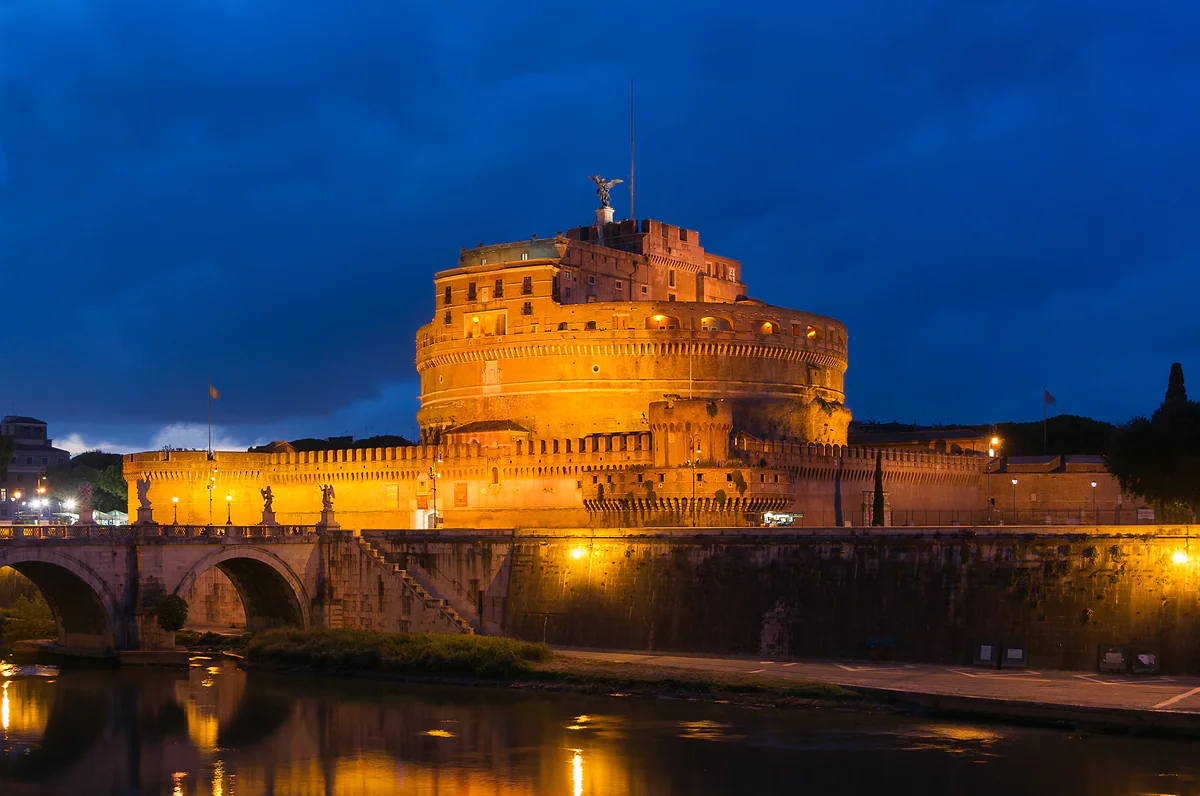
Hadrian's mausoleum, a short walk from the Vatican
Castel Sant'Angelo, from Hadrian's tomb to Tosca's terrace
Castel Sant'Angelo is the mausoleum Hadrian began in AD 135, later turned by the popes into a fortress, a refuge and a prison. In 2026 a ticket costs €18, it opens Tuesday to Sunday from 9:00 to 19:30 (last entry 18:30) and it's free on the first Sunday of every month. I'd save it for the afternoon of your Vatican day.
In 30 seconds
Full read: 7 min
- Castel Sant'Angelo is the tomb Hadrian began in AD 135, later turned into a papal fortress and prison, and a national museum since 1925.
- A standard ticket costs €18 from July 2026. Anyone under 18 goes free, and EU nationals between 18 and 25 pay €2.
- Hours are 9:00 to 19:30 every day but Monday, when it's closed, and nobody gets in after 18:30. The first Sunday of the month is free.
- My plan would be the Vatican Museums in the morning and the castle later, timed to reach the angel terrace as the sun goes down.
- The Passetto, the raised escape route of the 1527 papal flight, can be walked with a guide Friday to Sunday for €30, castle entry included.
I'd go in the afternoon, after the Vatican Museums and the basilica, and time it so I'm on the terrace as the sun goes down. And if your trip falls on a Friday, Saturday or Sunday, I'd flip the day round and do the guided Passetto in the morning, because it's the one extra on this side of the Tiber I think is really worth paying for.

Before you go
What I would keep in mind
-
01 Most beautiful
The angel's terrace late in the day
Rome's tourist board lists it among the finest views in the city, especially at sunset. With last entry at 18:30 and closing at 19:30, that's my favourite time to go up. If views from above are your thing, the other big climb nearby is St Peter's dome.
St Peter's Dome -
02 To save money
Free for under-18s, €2 for EU 18 to 25s
Under-18s go in free and EU citizens aged 18 to 25 pay €2. On top of that, the €18 ticket gets you into two of Rome's house museums that day and the next two. Add the free first Sunday and a family can see it for very little.
Is the Sistine Chapel free? -
03 Watch out
A ticket in someone else's name won't get you in
Tickets are issued in your name and staff check original ID at the door. If the names don't match, you don't go in and you don't get your money back. I'd only buy from museiitaliani.it, the Musei Italiani app or the official CoopCulture ticket office.
Vatican scams and tourist traps to avoid in 2026 -
04 Worth the splurge
The Passetto from the inside, €30 well spent
The daytime guided visit walks the whole of the popes' corridor, top level and covered passage, and includes castle entry. On Saturdays there's an evening version with the museum closed. It's the one extra in this part of Rome I'd book without a second thought.
Borgo Pio -
05 Getting there
Vatican to castle on foot
From St Peter's you walk down Via della Conciliazione and across Piazza Pia, pedestrianised since 23 December 2024. By metro, the stop the museum's ticket office recommends is Lepanto on line A.
How to get to Vatican City from Rome and the airports
My priorities
Unmissable
- The bronze angel terrace at sunset, with Rome and the dome of St Peter's in front of you
- The dromos and the spiral ramp that climbed to Hadrian's burial chamber
- Bring your original ID, because tickets are issued in your name and checked at the door
If you have time
- The guided Passetto di Borgo on a Friday, Saturday or Sunday morning
- The Farnese rooms, reopened on 20 June 2026 as a Renaissance papal apartment
- Using the same ticket at the Boncompagni Ludovisi and Andersen house museums over three days
- Crossing Ponte Sant'Angelo head-on, between the ten angels from Bernini's workshop
I would skip
- Going on a Monday, when it's shut, or turning up after 18:30, when entry has closed
- The free first Sunday if you have a choice, as there's no booking, a single queue and no Passetto
- Buying tickets anywhere but museiitaliani.it, the Musei Italiani app or CoopCulture, given the name rule
- Carrying large bags, since the castle has no cloakroom
What I would book
- Tours and ticketsGetYourGuide The Passetto with a guide, if the official office is full I'd try CoopCulture first, €30 with castle entry. If there's nothing left from Friday to Sunday, operators show up here. Make sure the ticket is in your own name.
- Places to stayBooking.com Staying by the castle and the Tiber A few minutes away, you can stay on the terrace until it shuts at 19:30 and stroll back to your hotel, which is exactly the evening I'd plan here.
My ranking, scored
What I'd see inside the castle, best first
My own scores out of 10, so opinion rather than fact. I weigh up what you can't see anywhere else in Rome, how well each spot explains the building's story and what you take away from it. Temporary exhibitions score lower because they close.
0 of 8 seen
-
The terraces and the bronze angel
It's the end of the route and the reason I'd climb up even if there were nothing else. At sunset, with Rome and the Vatican below you, it's easy to see why the popes shut themselves in here.
9.4 out of 10
-
The Passetto di Borgo, booked separately
The corridor Clement VII fled along in 1527 has been open end to end since 23 December 2024, guided or accompanied, on Friday to Sunday mornings and on Saturday evenings.
9.0 out of 10
-
The dromos and the spiral ramp
This is Hadrian's tomb as you'd have entered it. The brick ramp, once lined with marble, climbs gently towards the burial chamber and reminds you the castle started life as a mausoleum.
8.7 out of 10
-
The burial chamber
The ashes of Hadrian, Antoninus Pius, Marcus Aurelius, Commodus, Septimius Severus, Geta and Caracalla, among others, rested here. You can still see the clamps that held the marble slabs.
8.3 out of 10
-
The Sala di Apollo and the Farnese rooms
Perin del Vaga's grotesques borrow from Nero's Domus Aurea, and Paul III's apartment reopened on 20 June 2026, laid out to show how a Renaissance pope lived.
8.2 out of 10
-
The Cortile dell'Angelo
In this courtyard you get close to the marble angel with bronze wings that topped the castle before today's one. It's the best way to grasp the size of the figure you see up on the roof.
7.8 out of 10
-
The prisons
Cells such as the Sammalò, where prisoners were lowered in from above and could only crouch. Benvenuto Cellini, Cagliostro and Giordano Bruno all did time in the castle.
7.4 out of 10
-
The 2026 exhibitions
Historic weapons in the old Armoury until October, Cambellotti until 25 October and "Fuochi sul Tevere" until 22 November. Fine if they coincide with your trip, but I wouldn't go just for them.
6.8 out of 10
From the bridge it looks like a fortress, and it is one, but under the bastions there’s still an emperor’s tomb. That’s what I like most about the place. In a single visit you move through almost nineteen centuries of Rome without leaving the same walls. And because it’s a short walk from St Peter’s Square, nearly everyone visiting the Vatican has it on the doorstep, and plenty of them walk straight past.
An emperor’s tomb that became the popes’ bolthole
Hadrian, emperor from 117 to 138, commissioned his mausoleum from the architect Demetrianus, modelled on Augustus’s but bigger. According to Rome’s tourist board, work began in 135 and Antoninus Pius finished it in 139, a year after Hadrian died. It was a cube-shaped base of Luna marble topped by a round drum, all clad in marble and crowned with a bronze chariot carrying the emperor in triumph. That drum is what you see today as the lower part of the castle.
In 403 it was built into the Aurelian Walls as a bastion and stopped being a tomb. The name came in 590. Legend has it that Pope Gregory the Great, leading a procession against the plague, saw the Archangel Michael sheathe his sword above the building, and the epidemic ended. Hence the angel on top and the name it still carries.
After that it’s the popes’ story. In 1367 the keys were handed to Urban V to coax him back from Avignon, and from then on the castle served as refuge, archive, papal treasury, courtroom and jail. Alexander VI Borgia had Antonio da Sangallo the Elder turn it into a military stronghold, with four pentagonal bastions and the moat, and Paul III Farnese (1534 to 1549) enjoyed it at its height as a residence. From the 17th century it was little more than a political prison, in 1870 it passed to the Italian state as a barracks and military jail, and in 1925 it became a national museum. The gardens and moats around it date from the 1933 to 1934 restoration.
What is inside Castel Sant’Angelo?
The route makes most sense if you think of it as climbing through time. You go in through the dromos, the mausoleum’s original entrance, and up the spiral ramp that led to the burial chamber. Since 3 December 2024 accessibility works have been under way, and when the ground-floor circuit is closed you go straight into the dromos and on up the ramp to the Cortile dell’Angelo, the courtyard where the marble angel that topped the castle before today’s one now stands.
Higher up are the papal rooms. The Sala di Apollo has grotesques by Perin del Vaga inspired by the Domus Aurea, and the Farnese rooms, part of Paul III’s apartment, reopened on 20 June 2026, set out to recreate a Renaissance papal apartment. In 2026 there are also three exhibitions with closing dates. “Panopliæ”, on historic weapons, runs in the old Armoury until October, the Duilio Cambellotti show fills the rooms he decorated himself until 25 October, and “Fuochi sul Tevere” is in the Castellan’s Apartment until 22 November.
The prisons are the grimmest part. There were cells such as the Sammalò, where prisoners were lowered in from above and could only crouch, and separate cells for prisoners of rank. Beatrice Cenci, Benvenuto Cellini, Cagliostro and Giordano Bruno all passed through. And at the end comes the bit I’d pay for even if there were nothing else, the terrace. Rome’s tourist board counts it among the finest views in the city, especially at sunset, and the bronze angel above you has been there since 1753.
Is Castel Sant’Angelo free?
Only on certain days. Since 1 July 2026 a full-price ticket costs €18. EU citizens aged 18 to 25 pay €2 and under-18s go free, as at every Italian state museum. The same ticket also gets you into the Casa Museo Boncompagni Ludovisi and the Casa Museo Hendrik Christian Andersen that day and the next two, which almost nobody takes advantage of.
On the first Sunday of every month entry is free under the Domenica al museo scheme, and the next one falls on 4 October 2026. This is where a lot of people slip up. You can’t book that day, everyone joins a single queue at the ticket office, the route may change with the crowds and the Passetto is closed. If you’ve only got one Sunday in Rome and it lines up, go for it. If you can choose, I’d pay the €18 on a Tuesday morning.
One other date strikes me as better value than the free Sunday. From August to December 2026 the castle also opens on the first Monday afternoon of each month with a special €5 ticket, sold only at the ticket office. On Saturday 26 September 2026, for the European Heritage Days, it also opened in the evening for €1. If keeping costs down matters, there are more money-saving ideas in free and cheap things to do at the Vatican.
One practical warning before you buy. Tickets are in your name, sold on museiitaliani.it, the Musei Italiani app and at the CoopCulture office, and you’ll be asked for original ID at the door. If the name doesn’t match, you’re turned away with no refund. There’s no cloakroom either, so I’d travel light.
The Passetto, the popes’ back door
The Passetto di Borgo is the raised corridor linking the Vatican palaces with the castle, built on top of the wall Leo IV put up in the 9th century. It was joined to the castle in 1277 under Nicholas III Orsini, and Alexander VI added the covered passage. Rome’s tourist board says Alexander VI used it himself in 1494 to reach safety when Charles VIII of France marched into Rome. The famous escape is Clement VII’s in 1527, with the Swiss Guard covering his retreat during the Sack of Rome.
It reopened for visits on 23 December 2024 and you walk the full length, the open-air top level and the covered corridor below, from the Torre del Mascherino to the Bastione San Marco. The daytime visit runs on Friday to Sunday mornings and costs €30 including castle entry. The Saturday evening one combines the Passetto with the bastions, the ramp and the dromos after the museum has closed. If I could only pay for one extra in this part of Rome, it would be this. You’ll see it from the street anyway as you wander the Borgo district, but inside it’s a different thing altogether.
Bernini’s angels and the last act of Tosca
Hadrian also built the bridge, in 136, to reach the entrance to his tomb. It was called the Pons Aelius and it’s seen a lot. During the Jubilee of 1300 the crowds were so heavy that two lanes of foot traffic were set up, something Dante recorded. In the Holy Year of 1450 the parapets gave way as Nicholas V’s mule passed and dozens of people drowned. Between 1488 and 1534 the bodies of the executed were put on display here.
The ten angels holding the symbols of the Passion were commissioned by Clement IX between 1667 and 1669. Bernini designed them and his workshop carved them, because the two he sculpted himself ended up in the church of Sant’Andrea delle Fratte. The bridge has looked as it does now since the 1882 rebuild. It’s how I’d choose to arrive, walking straight across Ponte Sant’Angelo towards the castle from the far bank.
The castle is also the setting for the third act of Tosca, Puccini’s opera, which premiered on 14 January 1900 at Rome’s Teatro Costanzi. The whole story takes place on a single day, 14 June 1800. In the final act Cavaradossi awaits execution in the castle, he’s shot in the courtyard and Tosca throws herself from the terrace. If you love opera, standing on that terrace knowing all this changes the visit quite a bit.
Castle and Vatican on the same day, without rushing
This is where I think the visit really pays off. The castle is shut on Mondays and the Vatican Museums open Monday to Saturday from 8:00 to 20:00, so Tuesday to Saturday you can do both. I’d see the Museums first thing, St Peter’s Basilica next, then stroll down Via della Conciliazione and across Piazza Pia to the castle gate. With last entry at 18:30, there’s time for an unhurried lunch and to reach the top as the sun drops.
If you’d like the day laid out hour by hour, see my one-day Vatican itinerary. For a slower pace, staying in Prati or Borgo puts both visits, and the walk back to bed, within easy reach.
Getting there and what to know before you go in
The address is Lungotevere Castello, 50. By metro, the stop the museum’s ticket office recommends is Lepanto on line A. From Termini, bus 40 leaves from bay A of the new terminus, and the ticket office gives Ponte Vittorio Emanuele as the stop. From St Peter’s it’s a straight walk. Every other route is covered in how to get to the Vatican.
While the new visitor area is being built, tickets are sold from a temporary kiosk outside. Groups of 10 to 25 must book and use a radio guide. And if you’re travelling with a wheelchair user, bear in mind the museum only promises partial access to the outdoor areas. The Passetto, though, has step-free visits with two new lifts on the second and fourth Sunday of each month.
Castel Sant'Angelo ticket prices in 2026
| Ticket | Price | Conditions |
|---|---|---|
| Full price | €18 | From 1 July 2026, in your name, original ID checked at the door |
| EU citizens aged 18 to 25 | €2 | Up to and including your 25th birthday |
| Under-18s | Free | Under-12s must be accompanied |
| Disabled visitors and one companion | Free | Statutory free entry at state museums |
| First Sunday of every month | Free | Ticket office only, no booking, one single queue |
| First Monday of the month, 14:00 to 20:00 | €5 | 3 August to 7 December 2026, ticket office only, no groups |
| Saturday 26 September 2026, 19:30 to 23:30 | €1 | European Heritage Days, ticket office only |
Figures from the Italian Ministry of Culture and CoopCulture, the official ticket office, checked on 24 September 2026. The ticket also gets you into the Casa Museo Boncompagni Ludovisi and the Casa Museo Hendrik Christian Andersen that day and the following two.
Castle opening hours in 2026
| Day | Hours | Last entry |
|---|---|---|
| Tuesday to Sunday | 9:00 to 19:30 | 18:30 |
| Monday | Closed | Not applicable |
| First Monday of the month (August to December) | 14:00 to 20:00 | 19:00 |
| 1 January and 25 December | Closed | Not applicable |
At evening openings from 19:30 the route may change and groups aren't admitted. While the new visitor area is being built, the ticket office is in a temporary kiosk outside.
Passetto di Borgo visits in 2026
| Visit | When | Full price | Aged 18 to 25 |
|---|---|---|---|
| Guided daytime visit, with castle entry | Friday, Saturday and Sunday, 9:00 to 13:00 | €30 | €14 |
| Silent accompanied daytime visit (30 minutes) | Friday, Saturday and Sunday, 9:00 to 13:00 | €24 | €8 |
| Guided evening visit | Saturdays, 19:00 to 23:00 | €28 | €26 |
| Silent evening visit | Saturdays, 19:00 to 23:00 | €14 | €12 |
| Step-free visit (Passetto only) | Second and fourth Sunday, 10:45 and 12:15 | €14 | €12 |
Prices from CoopCulture, the official ticket office, as of 24 September 2026. Under-18s go free on daytime visits. The same page gives €18 + €10 in one paragraph and €18 + €12 in its table for the daytime visit; I've used the table. The Passetto is closed on the first Sunday of the month. Meet at the ticket office 15 minutes early.
- Standard ticket from 1 July 2026
- €18
- Year work began on Hadrian's mausoleum
- AD 135
- Year the castle became a national museum
- 1925
- Last entry, Tuesday to Sunday
- 18:30
- Guided daytime Passetto visit, castle entry included
- €30
Map
Everything within a short walk
Green for Rome, black for the Vatican. Every number opens its guide.
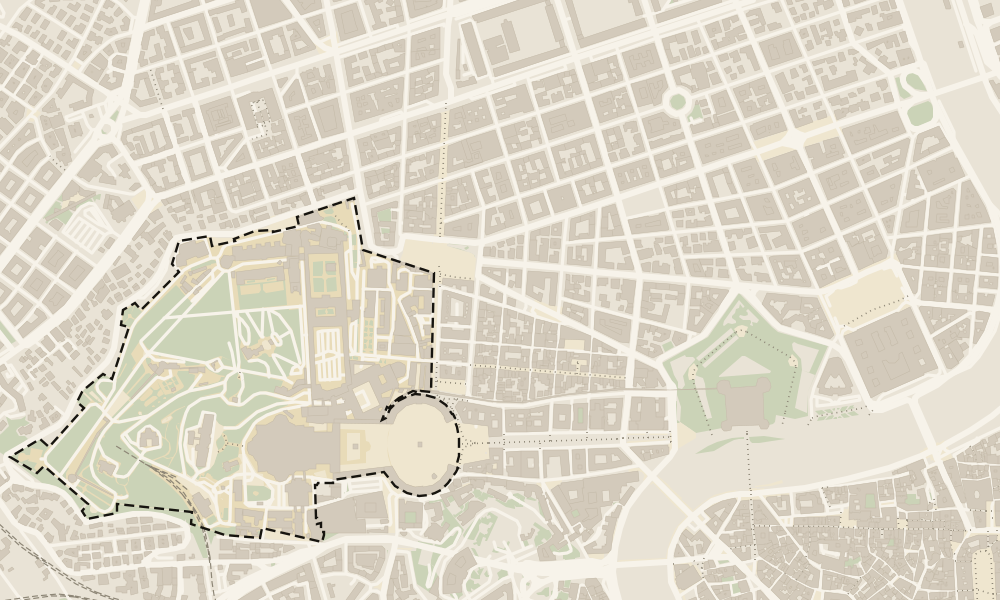 1Castel Sant'Angelo 2Borgo 3Sistine Chapel 4Prati 5Ponte Sant'Angelo 6Vatican Museums 7St Peter's Basilica 8St Peter's Square 9St Peter's Dome 10Vatican Necropolis 11Vatican Gardens 12Swiss Guard 13Seeing the Pope 14Apostolic Palace 15Papal audience 16Angelus 17Who painted it 18Where the Pope lives 19Facts 20Vatican Grottoes 21Pietà 22Baldachin 23Ceiling 24Chair of St Peter 25Last Judgement 26Raphael Rooms 27Architecture and architects 28Gallery of Maps 29Holy Door 30Bramante Staircase 31Facade and balcony 32Mass at St Peter's 33Pio Clementino Museum 34Vatican Pinacoteca 35Gallery of Tapestries 36Gallery of the Candelabra 37Egyptian and Etruscan Museums 38Obelisk 39Bernini's colonnade 40Chiaramonti and Braccio Nuovo 41Christmas 42Anima Mundi Museum 43Easter 44Carriage Pavilion 45Courtyard of the Pine Cone 46Train station 47Borgia Apartment 48Modern art collection 49Pharmacy, shop and petrol
 Map data © OpenStreetMap contributors (ODbL)
- 1Castel Sant'AngeloHadrian's mausoleum, a short walk from the Vatican
- 2BorgoRione XIV, between the colonnade and the Tiber
- 3Sistine ChapelInside the Vatican Museums
- 4PratiRione XXII, the last one Rome created
- 5Ponte Sant'AngeloTen marble angels, and two missing
- 6Vatican MuseumsSeven kilometres of galleries in Vatican City
- 7St Peter's BasilicaConsecrated in 1626, 400 years old this year
- 8St Peter's SquareFree, open to all, and technically another country
- 9St Peter's DomeMichelangelo's dome, 136.57 metres to the cross
- 10Vatican NecropolisThe Scavi tour, by request and with a guide
- 11Vatican Gardens22 hectares behind the museums
- 12Swiss GuardWho guards the Pope, and why they are Swiss
- 13Seeing the PopePope Leo XIV, Wednesdays and Sundays
- 14Apostolic PalaceThe Sistine Chapel is inside, though it doesn't feel like it
- 15Papal audiencePope Leo XIV in St Peter's Square
- 16AngelusSt Peter's Square, Sundays at noon
- 17Who painted itMichelangelo wasn't alone, and he wasn't first
- 18Where the Pope livesApostolic Palace, Santa Marta and Castel Gandolfo
- 19FactsFrom mould on the Flood to visitors' sweat
- 20Vatican GrottoesUnder the basilica, free and without booking
- 21PietàNew protective glass since November 2024
- 22BaldachinBack on view, restored, since October 2024
- 23CeilingMichelangelo, 1508-1512
- 24Chair of St PeterTen years' work and a dove twenty metres up
- 25Last JudgementCleaned between February and March 2026
- 26Raphael RoomsVatican Museums, just before the Sistine
- 27Architecture and architectsTwenty pontificates for one church
- 28Gallery of MapsNumber 8 on the official museum map
- 29Holy DoorClosed by Leo XIV on 6 January 2026
- 30Bramante StaircaseTwo spiral staircases, one name
- 31Facade and balcony116 metres of travertine most people walk past
- 32Mass at St Peter'sNine Masses every weekday, all free
- 33Pio Clementino MuseumClassical sculpture since 1506
- 34Vatican PinacotecaOpened on 27 October 1932
- 35Gallery of TapestriesNumber 7 on the map, between Candelabra and Maps
- 36Gallery of the CandelabraNumber 6 on the map, just before the Tapestries
- 37Egyptian and Etruscan MuseumsNumber 1 on the map, by the Cortile della Pigna
- 38Obelisk330 tonnes of granite without a single hieroglyph
- 39Bernini's colonnade284 columns in four rows that turn into one
- 40Chiaramonti and Braccio NuovoNumbers 2 and 3 on the map, first floor
- 41ChristmasThe 2026 nativity and tree are already announced
- 42Anima Mundi MuseumNumber 21 on the map, in the basement
- 43EasterThe 2026 timetable and what we know of 2027
- 44Carriage PavilionNumber 22 on the map, opened in 1973
- 45Courtyard of the Pine ConePoint CP on the map, open to the sky
- 46Train stationDesigned by Giuseppe Momo, opened in 1933
- 47Borgia ApartmentSix rooms painted in eighteen months
- 48Modern art collectionVan Gogh and Matisse on the way to the Sistine
- 49Pharmacy, shop and petrolOpen to anyone with a paper prescription
0 of 8 Italy guides
Your next stamp
Frequently asked questions
How much are Castel Sant'Angelo tickets?
A full-price ticket has cost €18 since 1 July 2026. EU citizens aged 18 to 25 pay €2 and under-18s go free. The guided daytime Passetto visit costs €30 with castle entry included.
Is Castel Sant'Angelo free on the first Sunday?
Yes, under Italy's Domenica al museo scheme, and the next one is 4 October 2026. You can't book that day, everyone joins one queue at the ticket office and the Passetto is closed. If I had the choice, I'd pay on another day and walk straight in.
What are Castel Sant'Angelo's opening hours?
Tuesday to Sunday from 9:00 to 19:30, with last entry at 18:30. It's closed on Mondays, 1 January and 25 December. From August to December 2026 it also opens on the first Monday of each month from 14:00 to 20:00 with a special €5 ticket.
How long does Castel Sant'Angelo take?
There's no official figure. As a guide, the museum's own free guided tours last an hour and a half, which I think is about right for the full route and the terrace. Add another hour if you're doing the Passetto.
Is Castel Sant'Angelo worth visiting?
I think so, and more than most people expect. It's Hadrian's tomb, a papal fortress and a prison in one building, the terrace view at sunset is one of the best in Rome, and it's a short walk from St Peter's, so it fits into your Vatican day.
Who is buried in Castel Sant'Angelo?
The burial chamber held the ashes of Hadrian and his wife Vibia Sabina, Antoninus Pius and Faustina the Elder, and the emperors Marcus Aurelius, Commodus, Septimius Severus, Geta and Caracalla. Today it's a museum and the chamber is part of the visit.
Can you walk from the Vatican to the castle through the Passetto?
You can visit the Passetto di Borgo, but not as a shortcut from the Vatican Museums. Daytime and evening visits start and finish at the castle; only the step-free visit begins and ends at the Torre del Mascherino, near St Peter's Square.
By
Tourism graduate with a master’s in Tourism Management and Planning from the University of Málaga, who has travelled across Europe. He writes every guide from official sources and his own judgement.
Published on . Updated on . Facts checked on .
Sources