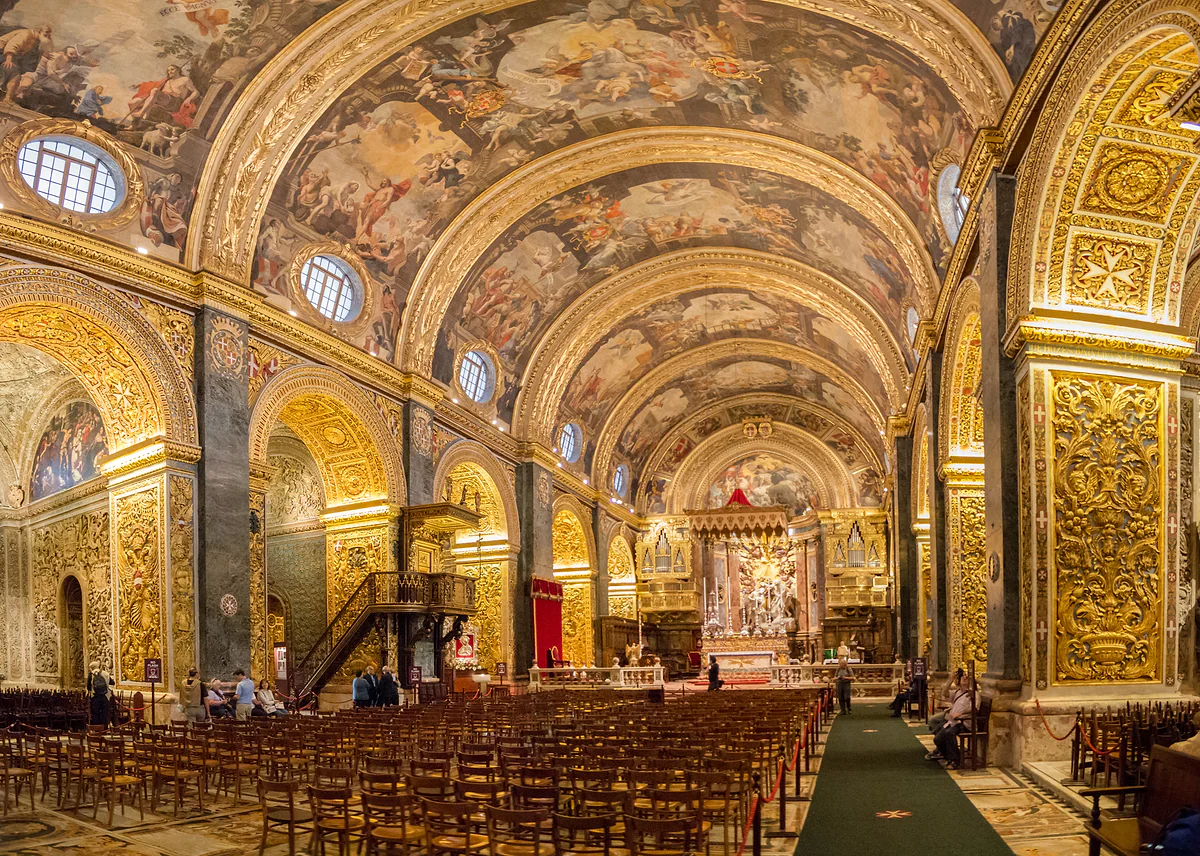
Finished in 1577, closed on Sundays
St John's Co-Cathedral, the Knights' church and its two Caravaggios
St John's Co-Cathedral is the conventual church of the Knights of St John in Valletta, completed in 1577 to a design by Girolamo Cassar. It opens Monday to Saturday from 09:00 to 16:45 (last entry 16:00) and adult tickets cost €15, audio guide included. Its Oratory holds the two paintings Caravaggio made in Malta.
In 30 seconds
Full read: 5 min
- St John's Co-Cathedral opens Monday to Saturday, 09:00 to 16:45, and closes on Sundays and public holidays.
- Adults pay €15, seniors and students €12, and under 12s go free with an adult.
- The ticket includes a 20-stop audio guide in eleven languages.
- Malta's two Caravaggios, St Jerome Writing and The Beheading of St John the Baptist, hang in the Oratory.
I'd walk in at 09:00 sharp and head straight for the Oratory before it fills up, leaving the nave for afterwards. The Beheading of St John the Baptist is far better with nobody standing in front of it.

Before you go
What I would keep in mind
-
01 Most beautiful
A five-metre Caravaggio in the room it was painted for
The Beheading of St John the Baptist measures 520 by 360 cm and hangs in the Oratory where it was made. For me it's the reason to pay, more than all the gilding in the nave.
the Knights of Malta -
02 My tip
No sightseeing on Sundays
The Co-Cathedral is closed to visitors on Sundays and public holidays, although Mass still goes ahead. If your Valletta day falls on a Sunday, rearrange it or go to Mass knowing it isn't a visit.
Valletta, Malta's capital -
03 To save money
Under 12s go free
Children under 12 get in free with an adult, and seniors and students pay €12 rather than €15. Heritage Malta's Multisite Pass isn't valid here, as a separate foundation runs the church.
Heritage Malta Multisite Pass -
04 Worth the splurge
Up the belfry for another €5
The foundation runs a belfry tour for €5 on top of admission, sold at the entrance. A small extra for seeing the church from above.
What I would book
My ranking, scored
What I'd look at inside St John's
My own scores out of 10, on how each piece lands in person and what it tells you about the Order. This isn't the audio guide's order, which runs to 20 stops.
0 of 6 seen
-
The Beheading of St John the Baptist
Oil, around 1608, 520 by 360 cm, in the Oratory. In that same room, that December, the Order threw the painter out in front of his own picture.
9.8 out of 10
-
St Jerome Writing
Malta's other Caravaggio, from around 1607, far smaller at 117 by 157 cm and much quieter. It also hangs in the Oratory.
9.0 out of 10
-
The nave and its Baroque makeover
Cassar built it plain, in keeping with the Order's mood after the siege. Grand Masters and knights then filled it with gifts until it became the treasure house you see now.
8.7 out of 10
-
The floor tombstones
The foundation limits how many people are inside at once to protect the tombstones and carvings. Look down as much as you look up.
8.3 out of 10
-
Meet Caravaggio
A ten-minute docudrama screened in the Caravaggio wing. Handy with children or if you arrive cold, skippable if you know the story.
7.2 out of 10
-
The façade and its two bell towers
Austere, with two bell towers topped by octagonal spires. Free from St John's Square, and the best way to feel the contrast with the gold inside.
7.0 out of 10
St John’s plays a trick on you. From the square it looks almost severe, a plain stone front with two bell towers, and inside it’s about as lavish as churches get in the Mediterranean. That contrast is what I enjoy most here, and it has a clear historical reason behind it.
A sober church the Knights covered in gold
The Order of St John completed it in 1577, a few years after the Great Siege, and dedicated it to St John the Baptist. It was designed by the Order’s military engineer and architect, Girolamo Cassar, and the foundation that runs it today puts the austere design down to the sombre mood of the Knights after the siege. It has a broad nave under a barrel vault, and the oratory and sacristy followed in 1604.
What you see now came later. Each Grand Master and many individual knights gave works of art, and a plain Mannerist church turned into a Baroque treasury. I like reading it as a two-hundred-year ledger of vanity and faith. If you want to know who these men were and how they ended up in Malta, it’s set out in the history of the Knights of Malta.
Where the Caravaggios hang, and why the room matters
Caravaggio reached Malta in July 1607 on one of the Order’s ships. On 14 July 1608 Grand Master Alof de Wignacourt made him a knight. During his stay he painted St Jerome Writing and The Beheading of St John the Baptist. Both are still here, in the Oratory.
It ended badly, and fast. In late August 1608 there was a fight in which several knights were wounded; Caravaggio was locked up in Fort St Angelo and escaped. On 1 December 1608, in the Oratory and in front of The Beheading, the Order expelled him “like a rotten and fetid limb”. Standing before that canvas knowing the verdict was delivered in the same room is what lifts this visit above a gallery stop, for me at least.
The Beheading measures 520 by 360 cm. St Jerome, from around 1607, is a much smaller 117 by 157 cm. He also painted a Sleeping Cupid and two portraits while in Malta; the one of Fra’ Antonio Martelli is now at the Palazzo Pitti in Florence and the one of Wignacourt with a page is in the Louvre.
The tombstone floor, Preti’s vault and the crypt
Plenty of people walk in staring at the ceiling and tread straight over what I’d call the building’s other great treasure. The entire floor of the church is covered in inlaid coloured-marble tombstones, from the early 17th to the late 18th century, commemorating knights of the Order, many from Europe’s great aristocratic families. The foundation bills it as the most beautiful floor in the world, and I can see why. Look out for the symbols. A skeleton with a sickle and an hourglass stands for passing time, an angel blowing a trumpet for the dead knight’s fame, and crowns mark out the noblest, each with its Latin epitaph.
The vault is the work of Mattia Preti, a Calabrian painter known as il Cavaliere Calabrese. He came to Malta in 1659, and Grand Master Raphael Cotoner accepted his offer to paint the entire vault with scenes from the life of St John the Baptist, the Order’s patron saint. It earned him the rank of Knight of Grace; he spent most of his life on the island and has been buried here since 1699. Several of the altar paintings are his too.
Then there’s the crypt. VisitMalta notes that it holds the tomb of Jean Parisot de la Valette, the Grand Master who founded the city, a quiet corner far removed from the bustle outside.
Hours, prices and the small print
It opens Monday to Saturday from 09:00 to 16:45, last entry 16:00, and is closed to visitors on Sundays and public holidays, when Mass carries on as normal. Adults pay €15, seniors and students €12, and under 12s get in free with an adult. The audio guide is included, runs to 20 stops and comes in eleven languages. The belfry tour is an extra €5.
One honest caveat. On 1 September 2026 the Co-Cathedral posted a notice about September opening hours that I couldn’t get hold of. The times I give are the ones it published at the end of August, so I’d double-check the day before.
The foundation staggers or caps visitor numbers to protect the tombstones and carvings, which can mean a short queue around midday. Wheelchairs can get in, with some areas off limits.
The visitor rules are worth reading before you leave the hotel. It’s a church, so dress accordingly, and the foundation asks you to bring a shawl to cover up. Stilettos and narrow heels aren’t allowed, since you’re walking on tombstones. You can take as many photos as you like without flash, but filming or recording sound is banned without written permission. There are no lockers, so bring a small bag, and big backpacks have to be carried in your hand or on your front. The foundation suggests setting aside about an hour and three quarters, and a ticket is valid for one entry within seven days of the date you pick.
In the Caravaggio wing there’s a ten-minute docudrama, Meet Caravaggio. With children, or if you haven’t read up on the painter, I’d watch it before stepping into the Oratory. If you know the story already, spend those minutes in front of the paintings instead.
Fitting it into your day
It sits in the middle of Valletta, Malta’s capital, a few steps off Republic Street. I’d make it the first stop at 09:00, then carry on to the Grandmaster’s Palace in Valletta, which opens at 10:00 in season and is five minutes’ walk away. That puts the Order’s two big sights back to back while you’re fresh.
If you want more Baroque painting afterwards, MUŻA, Malta’s national art museum, has work by Mattia Preti, Ribera and other masters who worked for the Order. If it’s the Knights rather than the art that grabs you, the Palace is the natural next step. Either way, keep the Co-Cathedral for the morning, because it closes to visitors earlier than the Heritage Malta museums around it.
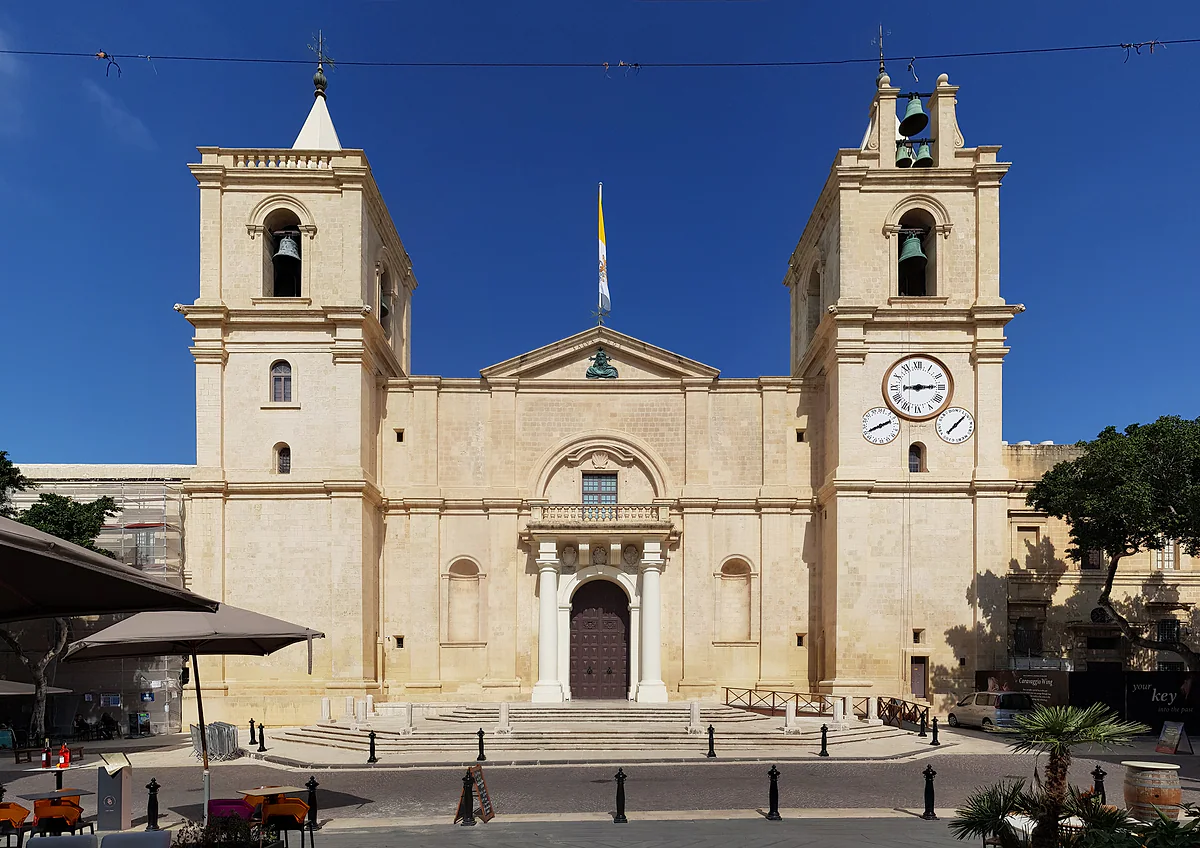
The plain façade of St John's Co-Cathedral in Valletta, with its two bell towers, the clock and the steps down to St John's Square.
Opening hours and tickets (2026)
| Item | Detail |
|---|---|
| Monday to Saturday | 09:00-16:45, last entry 16:00 |
| Sundays and public holidays | Closed to visitors |
| Adult | €15 |
| Seniors and students | €12 |
| Under 12 with an adult | Free |
| Belfry tour | €5 on top of admission |
From the official website, via archive.org copies of May and August 2026. On 1 September 2026 the Co-Cathedral posted a notice about September opening hours that I haven't been able to read, so check before you go.
Mass times
| Days | Times |
|---|---|
| Monday to Friday | 08:30 |
| Saturday | 08:30 and 17:45 |
| Sundays and feast days | 07:45, 09:30, 11:30 and 17:45 |
Test yourself
True or false?
0/4 Pick before you peek.
-
Caravaggio was made a Knight of the Order of Malta.
See the answer
True. Alof de Wignacourt admitted him as a Knight of Obedience on 14 July 1608. A few months later he was expelled after a brawl with other knights.
-
You can tour St John's on a Sunday morning.
See the answer
False. It's closed to visitors on Sundays and public holidays. Only Mass takes place on those days.
-
St Jerome Writing is larger than The Beheading of St John the Baptist.
See the answer
False. Far from it. St Jerome measures 117 by 157 cm; The Beheading is 520 by 360 cm.
-
Caravaggio escaped from prison in Malta.
See the answer
True. After the fight of late August 1608 he was held in Fort St Angelo and got away. The Order formally expelled him on 1 December 1608, in the Oratory.
- Year the Order's church was completed
- 1577
- Width of The Beheading of St John the Baptist
- 520 cm
- Adult ticket, audio guide included
- €15
- Stops on the audio guide
- 20
Map
Where St John's Co-Cathedral is
Gozo lies to the north-west, across the channel the ferry crosses from Ċirkewwa, with Comino between the two islands. Every number opens its guide.
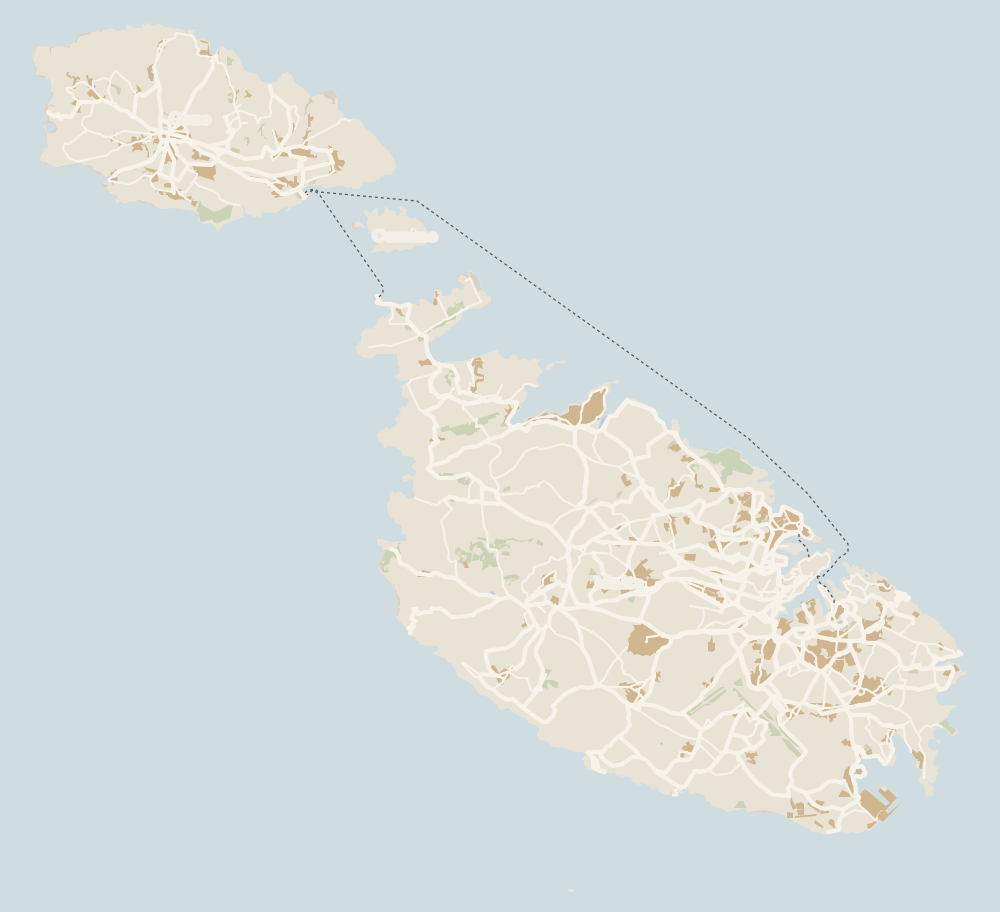 1Valletta 2St John's Co-Cathedral 3Grandmaster's Palace 4Fort St Elmo 5Barrakka Gardens 6Saluting Battery 7MUŻA 8National Museum of Archaeology 9Underground Valletta 10Lascaris War Rooms 11Casa Rocca Piccola 12Manoel Theatre 13City Gate and Parliament 14Valletta Waterfront
 Map data © OpenStreetMap contributors (ODbL)
- 1VallettaFounded 1566, on the UNESCO list since 1980
- 2St John's Co-CathedralFinished in 1577, closed on Sundays
- 3Grandmaster's PalaceHeritage Malta's most visited site
- 4Fort St ElmoFell on 23 June 1565
- 5Barrakka GardensGun salute at 12:00 and 16:00
- 6Saluting BatteryTwo firings a day, Monday to Saturday
- 7MUŻAOpened in late 2018
- 8National Museum of ArchaeologyNeolithic to Phoenician for €5
- 9Underground VallettaThree days a week, booking essential
- 10Lascaris War RoomsEisenhower's advance HQ in 1943
- 11Casa Rocca PiccolaGuided tours on the hour, 10:00 to 16:00
- 12Manoel TheatreOpened on 19 January 1732
- 13City Gate and ParliamentThe city's fifth gate, by Renzo Piano
- 14Valletta Waterfront19 Baroque warehouses from 1752
0 of 279 Malta guides
Your next stamp
- Mdina Cathedral
- Churches
- Things to do in Malta
- Gozo
- Most beautiful places
- Comino
- Prettiest villages
- UNESCO World Heritage Sites
- Where is Malta
- The Maltese islands
- Towns and villages
- Island of Malta
- Blue Lagoon
- Fort Rinella
- Fort St Angelo
- Gardjola Gardens
- Ħal Saflieni Hypogeum
- Is Malta a country?
- Popeye Village
- Tarxien Temples
- Things to do in Gozo
- Valletta
- Esplora
- Golden Bay
- Gozo day trip
- Inquisitor's Palace
- Population
- St Mary's Tower
- Grandmaster's Palace
- How big is Malta
- Maritime Museum
- Mellieħa Bay
- Fort St Elmo
- Language
- Malta at War Museum
- Paradise Bay
- Barrakka Gardens
- Red Tower
- Religion
- Malta government
- Saluting Battery
- MUŻA
- National Museum of Archaeology
- Underground Valletta
- Lascaris War Rooms
- Casa Rocca Piccola
- Malta in one day
- Three Cities
- Victoria
- Birgu
- Manoel Theatre
- Weekend in Malta
- Xagħra
- City Gate and Parliament
- Malta in three days
- Nadur
- Senglea
- Cospicua
- Malta in four days
- Qala
- Valletta Waterfront
- Għajnsielem
- Kalkara
- Malta in five days
- Malta in a week
- Paola
- Xewkija
- Sannat
- Tarxien
- Munxar
- Żabbar
- Fgura
- Fontana
- Kerċem
- Luqa
- Floriana
- Marsa
- Mellieħa
- The Citadel, Gozo
- Żebbuġ (Gozo)
- Ġgantija Temples
- Marsalforn
- Santa Luċija
- Ramla Bay
- San Lawrenz
- Xgħajra
- Xwejni salt pans
- Calypso's Cave
- Għarb
- Żejtun
- Għasri
- Gudja
- San Blas Bay
- Għaxaq
- Ħondoq Bay
- Marsaxlokk
- Kirkop
- Marsaxlokk Fish Market
- Mqabba
- St Peter's Pool
- Marsaskala
- Qrendi
- Żurrieq
- Beaches
- Comino ferry
- EU, Schengen and the euro
- Ħaġar Qim and Mnajdra
- Mdina
- Mġarr (Gozo)
- Blue Grotto
- Diving
- Entry requirements
- Xewkija Rotunda
- Birżebbuġa
- Money and payments
- Palazzo Falson
- Safi
- Shipwrecks
- Ta' Ċenċ Cliffs
- Għar Dalam
- Mdina Dungeons
- Mġarr ix-Xini
- Prices and budget
- Snorkelling
- Boat trips
- Malta on a budget
- Playmobil FunPark
- Rabat (Malta)
- Xlendi
- Dwejra
- Gozo beaches
- History
- Siġġiewi
- St Paul's Catacombs
- Tipping
- Azure Window
- Domvs Romana
- Għar Lapsi
- Great Siege of 1565
- Plugs
- Limestone Heritage Park
- Second World War
- St Paul's Grotto
- Ta' Pinu Basilica
- Time zone
- Buskett Gardens
- Knights of Malta
- Mobile and roaming
- Wied il-Għasri
- Dingli
- Maltese cross
- Dingli Cliffs
- Flag
- Żebbuġ
- Coat of arms
- Mtarfa
- Balzan
- National anthem
- Lija
- Malta facts
- Game of Thrones
- Iklin
- Attard
- Film locations
- Forts and fortifications
- San Anton Gardens
- Ta' Qali Crafts Village
- Victoria Lines
- Megalithic temples
- Catacombs
- Museums
- Where to eat
- Where to stay
- Hotels in Valletta
- Restaurants in Valletta
- Hotels in Sliema
- Maltese food
- Restaurants in Marsaxlokk
- Viewpoints
- Hotels in St Julian's
- Pastizzi
- Walking and hiking
- Hotels in Buġibba and Qawra
- Maltese rabbit stew
- Safety
- Hotels in Mellieħa
- Kinnie and Cisk
- Scams
- Gozo hotels
- Nightlife
- Tap water
- Boat parties
- Holiday packages
- Tourist tax
- All inclusive
- Gay Malta
- Sightseeing passes
- Apartments
- Malta with kids
- Public holidays
- How to get there
- Luxury
- Malta for couples
- Taxis and ride-hailing
- Weather
- Best time to visit
- Cycling
- English schools
- Flights
- Flights from Madrid
- Sea temperature
- Shopping and souvenirs
- Airport
- Free walking tours
- In winter
- Airport transfers
- Day trips and tours
- In summer
- Ferry from Sicily
- In January
- Cruise stop
- In February
- In March
- In April
- In May
- Getting around
- In June
- Buses
- July
- August
- Hop on hop off
- Gozo ferry
- September
- Gozo fast ferry
- October
- November
- Valletta ferries
- Car hire
- December
- Driving
- Events
- St Paul's Bay
- Village feasts
- Buġibba
- Christmas
- Easter
- Qawra
- Carnival
- Xemxija
- Fireworks festival
- Malta National Aquarium
- Isle of MTV
- St Paul's Islands
- Mosta
- Mosta Rotunda
- Naxxar
- Palazzo Parisio
- Għargħur
- Mġarr (Malta)
- Sliema
- Ta' Ħaġrat and Skorba Temples
- Għajn Tuffieħa Bay
- Tigné Point
- Ġnejna Bay
- St Julian's
- Paceville
- St George's Bay
- Gżira
- Msida
- Ta' Xbiex
- Pietà
- Pembroke
- Swieqi
- San Ġwann
- Birkirkara
- Ħamrun
- Santa Venera
- Qormi
Frequently asked questions
How much does it cost to visit St John's Co-Cathedral?
€15 for adults and €12 for seniors and students. Under 12s go free with an adult. The audio guide is included in the ticket.
Is St John's Co-Cathedral open on Sundays?
Not for sightseeing. It opens to visitors Monday to Saturday, 09:00 to 16:45, and closes on Sundays and public holidays, when only Mass takes place.
Where are the Caravaggios in Malta?
In the Oratory of St John's Co-Cathedral in Valletta. The two, St Jerome Writing and The Beheading of St John the Baptist, were both painted during his stay on the island in 1607 and 1608.
Do I need to book tickets in advance?
The official site sells at the door and doesn't mention compulsory booking. It does stagger or cap the number of visitors inside, so going at opening time means less waiting.
Is St John's Co-Cathedral wheelchair accessible?
Yes, wheelchair users and visitors with limited mobility can get in, though some areas are restricted.
Is there a dress code for St John's Co-Cathedral?
Yes. The foundation asks visitors to dress appropriately for a church and to bring a shawl to cover up, and it doesn't allow stilettos or narrow heels, to protect the marble tombstones on the floor.
Can you take photos inside St John's Co-Cathedral?
Yes, as many as you like, as long as you don't use flash. Filming and sound recording aren't allowed without the foundation's written permission, and it can restrict photography at particular times.
By
Tourism graduate with a master’s in Tourism Management and Planning from the University of Málaga, who has travelled across Europe. He writes every guide from official sources and his own judgement.
Published on . Facts checked on .
Sources
- St John's Co-Cathedral, visiting (archive.org copy)
- St John's Co-Cathedral, home page (copy of 27-08-2026)
- St John's Co-Cathedral, history
- St John's Co-Cathedral, Caravaggio
- St John's Co-Cathedral, Mattia Preti (archived 29-06-2026)
- St John's Co-Cathedral, tombstones and monuments (archived 29-06-2026)
- VisitMalta (MTA), St John's Co-Cathedral
- UNESCO, City of Valletta
Photos: Pedro J Pacheco (CC BY-SA 4.0); Matthew Axiak (CC BY-SA 4.0), via Wikimedia Commons.