Rabat, island of Malta
St Paul's Catacombs, the great cemetery beneath Rabat
St Paul's Catacombs in Rabat are, according to Heritage Malta, the earliest and largest archaeological evidence of Christianity in Malta, with a main complex of over 2,000 m² used until the 7th or 8th century. Tickets cost €6 with an audio guide, and until 31 October 2026 they open daily from 09:00 to 19:00.
In 30 seconds
Full read: 3 min
- St Paul's Catacombs are the largest archaeological record of early Christianity in Malta.
- The main complex covers over 2,000 m² and was in use until the 7th or 8th century.
- Tickets cost €6 with an audio guide; the Rabat Combo is €14.
- Until 31 Oct 2026 they open 09:00 to 19:00; in winter, 09:00 to 17:00.
I'd go round with the audio guide and take my time, because without it the passages and niches start to look alike. The one thing I'd make sure to understand is what the round tables cut into the rock were for, and the guide explains it.

Before you go
What I would keep in mind
-
01 To save money
Save €3 with the Rabat Combo
Heritage Malta's €14 adult combo covers the catacombs, the Domvs Romana and Mdina's Natural History Museum. Separately that's €17, and the combo lasts 30 days.
Domvs Romana -
02 Most beautiful
Tables for funeral feasts
The two large halls have circular tables carved out of the rock, like the triclinia in Roman houses. Heritage Malta believes they were used for meals in memory of the dead.
-
03 My tip
Watch your step
Heritage Malta rates access as partial, with some areas out of reach for anyone with limited mobility. I'd wear flat shoes, as the whole site is cut into the rock.
-
04 Getting there
Five minutes from the bus
The nearest stop is a five-minute walk away, according to Heritage Malta. From Valletta, any of the buses to Rabat will do.
Rabat
What I would book
If I could only do one thing in Rabat, it would be this. St Paul’s Catacombs are a maze of passages and tombs cut into the rock under the town, and they show something you won’t see anywhere else in Malta on this scale, how the people of the Roman town and the early Christian centuries buried their dead.
A cemetery used for more than a thousand years
Heritage Malta, which runs the site, explains that these tombs were part of a very large cemetery outside the walls of Melite, the Roman town that covered today’s Mdina and Rabat. The earliest burials go back to the 3rd or 4th century BC or earlier, in the Punic period, and they carried on under the Romans and Byzantines until the 7th or 8th century.
The area, known as Ħal Bajjada or Tad-Dlam, has more than thirty hypogea. The main complex, the St Paul’s cluster, is a network of connected passages and tombs covering over 2,000 square metres. Heritage Malta ranks it as Malta’s oldest and biggest archaeological trace of early Christianity, and it was the first Maltese site awarded the European Heritage Label.
Why are they named after St Paul?
It’s worth getting this right, because nearly everyone gets it wrong. The name comes from the idea that the catacombs were linked to the grotto where, according to tradition, St Paul lived. Heritage Malta calls that a myth. What recent research has shown is that the catacombs and the grotto were part of the same cemetery. So no, St Paul isn’t here, but the name has a certain logic. The grotto is close by and is visited through the Wignacourt Museum; it has its own page, St Paul’s Grotto.
What you’ll see
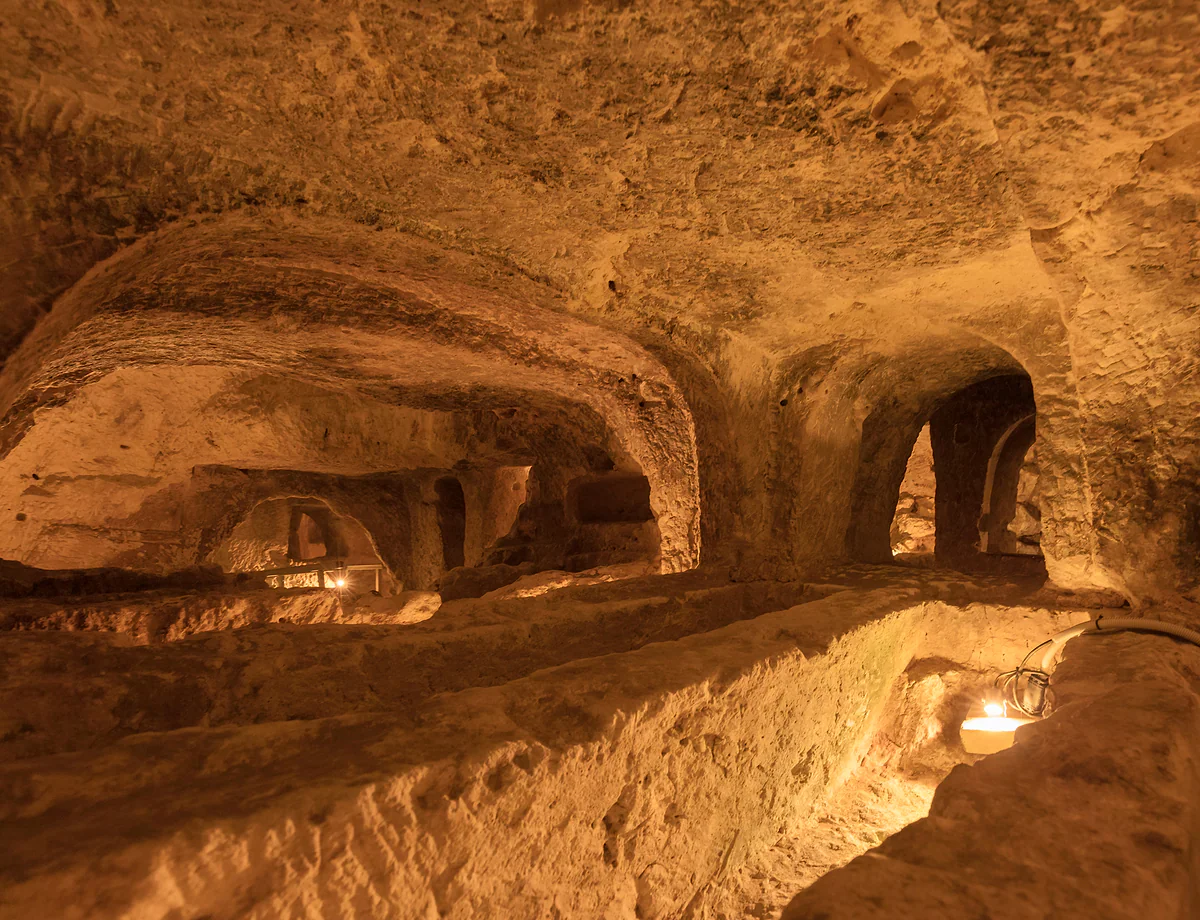
The entrance leads into two large halls with pillars carved to look like Doric columns, which were once covered in painted plaster, little of which survives. In them are two circular tables cut from the rock on a low platform, recalling the triclinium couches of Roman houses. Heritage Malta thinks they were used for commemorative meals during the annual festival of the dead. For me that’s the most interesting part of the visit, because it makes you think of these galleries as a place the living kept coming back to.
Around the 13th century, when Malta was re-Christianised, an open space in the catacombs was re-cut and used as a shrine, with wall paintings. In 1894 the archaeologist A. A. Caruana cleared and studied the site. Close by, St Augustine’s Catacombs can be seen by appointment, and the rest are rounded up in catacombs in Malta.
How to read the tombs
It helps to know what you’re looking at. The most striking are the baldacchino tombs, blocks of rock carved like a canopied bed and cut free all the way round. Window tombs open into the wall like a niche, and loculi are smaller recesses. The Wignacourt Museum, which has its own stretch of this cemetery, points out that in some window tombs you can still see the hollow carved to rest the dead person’s head.
Heritage Malta adds that at St Augustine’s Catacombs next door there’s a window tomb flanked by two decorated pillars with no equivalent in the St Paul’s cluster. All of this makes far more sense with the audio guide on, which is why I keep recommending it.
Tickets, hours and audio guide
An adult pays €6; youths, over-60s and students pay €4.50, and children aged 6 to 11 pay €3.50. Until the end of October 2026 you can go in any day between 09:00 and 19:00, and on the winter timetable, from November through February 2027, closing time moves to 17:00. Arrive at least thirty minutes before closing; it doesn’t open on 1 January, Good Friday or 24, 25 and 31 December.
The audio guide comes in adults’ and children’s versions, and Heritage Malta reckons on one to two hours. There’s a shop, lockers, baby-changing facilities and somewhere to sit. Access is partial, as some areas can’t be reached by visitors with limited mobility.
Getting the most out of it
I’d buy the €14 Rabat Combo if you’re also seeing the Domvs Romana and Mdina’s Natural History Museum, as it saves €3 and gives you 30 days to use it. I’d arrive at opening, before the heat and the groups, in flat shoes. Then I’d walk over to St Paul’s Grotto to round off the story that starts here, before heading up to Mdina.
Tickets (Heritage Malta, 2026)
| Ticket | Price |
|---|---|
| Adult (18+) | €6 |
| Youth 12-17, senior 60+ or student | €4.50 |
| Child 6-11 | €3.50 |
| Aged 1 to 5 | Free |
| Rabat Combo, adult | €14 |
Heritage Malta members and Heritage Malta Passport holders go free. The Rabat Combo adds the Domvs Romana and Mdina's Natural History Museum.
Opening hours
| Period | Hours |
|---|---|
| Until 31 Oct 2026 | 09:00-19:00, daily |
| 1 Nov 2026 to 28 Feb 2027 | 09:00-17:00, daily |
Last entry 30 minutes before closing. Closed on 1 January, Good Friday and 24, 25 and 31 December.
Test yourself
True or false?
0/4 Pick before you peek.
-
St Paul is buried in these catacombs.
See the answer
False. The name comes from the belief that they were connected to St Paul's Grotto. Heritage Malta calls that a myth, though both were part of the same large cemetery.
-
The catacombs were only used in Christian times.
See the answer
False. The cemetery was in use from at least the 3rd or 4th century BC, in the Punic period, and carried on under the Romans and Byzantines until the 7th or 8th century.
-
They were the first site in Malta to get the European Heritage Label.
See the answer
True. Heritage Malta says they received the EU recognition before any other site in the country.
-
They were excavated in 1894 by A. A. Caruana.
See the answer
True. Heritage Malta describes him as the pioneer of Christian-era archaeology in Malta.
- Area of the main complex
- 2,000 m²
- Hypogea in the area
- 30+
- Adult ticket
- €6
- Excavated by A. A. Caruana
- 1894
Map
Where St Paul's Catacombs is
Gozo lies to the north-west, across the channel the ferry crosses from Ċirkewwa, with Comino between the two islands. Every number opens its guide.
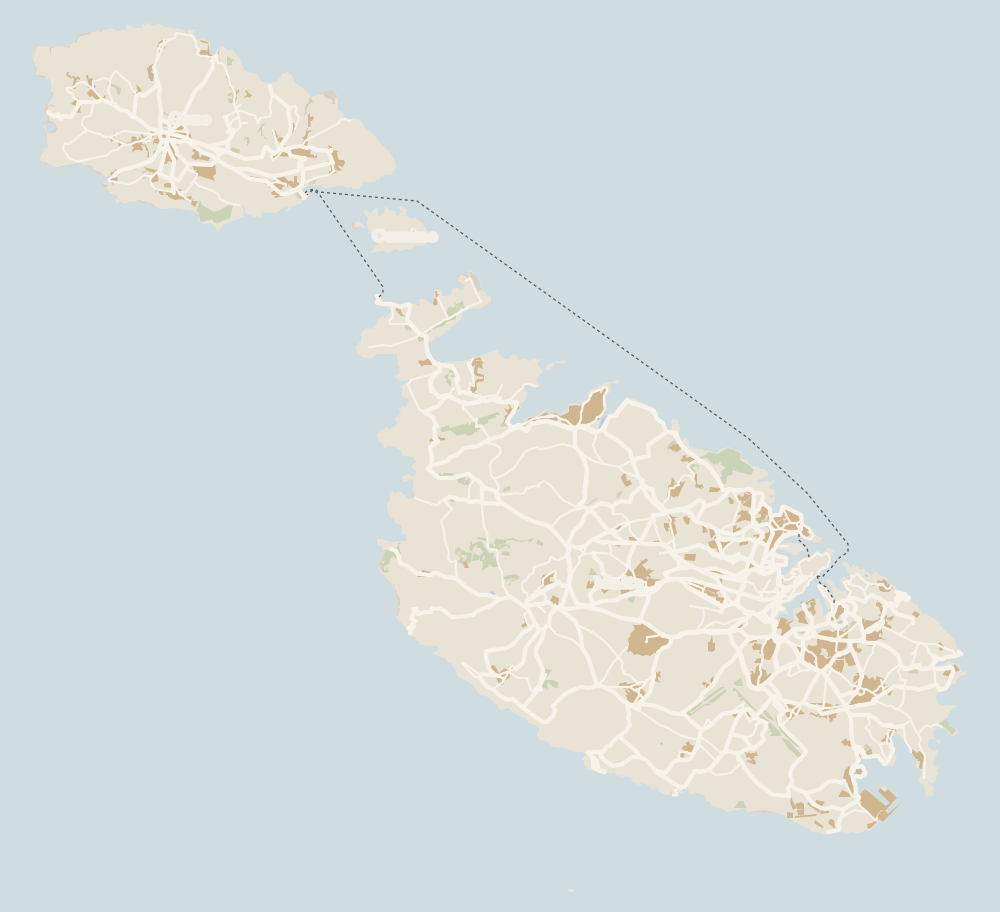 1Rabat (Malta) 2St Paul's Catacombs 3Domvs Romana 4St Paul's Grotto
 Map data © OpenStreetMap contributors (ODbL)
0 of 279 Malta guides
Your next stamp
- Catacombs
- Rabat (Malta)
- St Paul's Grotto
- Domvs Romana
- Mdina Cathedral
- Ħal Saflieni Hypogeum
- St Paul's Islands
- Mqabba
- Things to do in Malta
- Gozo
- Most beautiful places
- Comino
- Prettiest villages
- UNESCO World Heritage Sites
- Where is Malta
- The Maltese islands
- Towns and villages
- Island of Malta
- Blue Lagoon
- Fort Rinella
- Fort St Angelo
- Gardjola Gardens
- Is Malta a country?
- Popeye Village
- Tarxien Temples
- Things to do in Gozo
- Valletta
- Esplora
- Golden Bay
- Gozo day trip
- Inquisitor's Palace
- Population
- St John's Co-Cathedral
- St Mary's Tower
- Grandmaster's Palace
- How big is Malta
- Maritime Museum
- Mellieħa Bay
- Fort St Elmo
- Language
- Malta at War Museum
- Paradise Bay
- Barrakka Gardens
- Red Tower
- Religion
- Malta government
- Saluting Battery
- MUŻA
- National Museum of Archaeology
- Underground Valletta
- Lascaris War Rooms
- Casa Rocca Piccola
- Malta in one day
- Three Cities
- Victoria
- Birgu
- Manoel Theatre
- Weekend in Malta
- Xagħra
- City Gate and Parliament
- Malta in three days
- Nadur
- Senglea
- Cospicua
- Malta in four days
- Qala
- Valletta Waterfront
- Għajnsielem
- Kalkara
- Malta in five days
- Malta in a week
- Paola
- Xewkija
- Sannat
- Tarxien
- Munxar
- Żabbar
- Fgura
- Fontana
- Kerċem
- Luqa
- Floriana
- Marsa
- Mellieħa
- The Citadel, Gozo
- Żebbuġ (Gozo)
- Ġgantija Temples
- Marsalforn
- Santa Luċija
- Ramla Bay
- San Lawrenz
- Xgħajra
- Xwejni salt pans
- Calypso's Cave
- Għarb
- Żejtun
- Għasri
- Gudja
- San Blas Bay
- Għaxaq
- Ħondoq Bay
- Marsaxlokk
- Kirkop
- Marsaxlokk Fish Market
- St Peter's Pool
- Marsaskala
- Qrendi
- Żurrieq
- Beaches
- Comino ferry
- EU, Schengen and the euro
- Ħaġar Qim and Mnajdra
- Mdina
- Mġarr (Gozo)
- Blue Grotto
- Diving
- Entry requirements
- Xewkija Rotunda
- Birżebbuġa
- Money and payments
- Palazzo Falson
- Safi
- Shipwrecks
- Ta' Ċenċ Cliffs
- Għar Dalam
- Mdina Dungeons
- Mġarr ix-Xini
- Prices and budget
- Snorkelling
- Boat trips
- Malta on a budget
- Playmobil FunPark
- Xlendi
- Dwejra
- Gozo beaches
- History
- Siġġiewi
- Tipping
- Azure Window
- Għar Lapsi
- Great Siege of 1565
- Plugs
- Limestone Heritage Park
- Second World War
- Ta' Pinu Basilica
- Time zone
- Buskett Gardens
- Knights of Malta
- Mobile and roaming
- Wied il-Għasri
- Dingli
- Maltese cross
- Dingli Cliffs
- Flag
- Żebbuġ
- Coat of arms
- Mtarfa
- Balzan
- National anthem
- Lija
- Malta facts
- Game of Thrones
- Iklin
- Attard
- Film locations
- Forts and fortifications
- San Anton Gardens
- Ta' Qali Crafts Village
- Victoria Lines
- Megalithic temples
- Museums
- Where to eat
- Where to stay
- Churches
- Hotels in Valletta
- Restaurants in Valletta
- Hotels in Sliema
- Maltese food
- Restaurants in Marsaxlokk
- Viewpoints
- Hotels in St Julian's
- Pastizzi
- Walking and hiking
- Hotels in Buġibba and Qawra
- Maltese rabbit stew
- Safety
- Hotels in Mellieħa
- Kinnie and Cisk
- Scams
- Gozo hotels
- Nightlife
- Tap water
- Boat parties
- Holiday packages
- Tourist tax
- All inclusive
- Gay Malta
- Sightseeing passes
- Apartments
- Malta with kids
- Public holidays
- How to get there
- Luxury
- Malta for couples
- Taxis and ride-hailing
- Weather
- Best time to visit
- Cycling
- English schools
- Flights
- Flights from Madrid
- Sea temperature
- Shopping and souvenirs
- Airport
- Free walking tours
- In winter
- Airport transfers
- Day trips and tours
- In summer
- Ferry from Sicily
- In January
- Cruise stop
- In February
- In March
- In April
- In May
- Getting around
- In June
- Buses
- July
- August
- Hop on hop off
- Gozo ferry
- September
- Gozo fast ferry
- October
- November
- Valletta ferries
- Car hire
- December
- Driving
- Events
- St Paul's Bay
- Village feasts
- Buġibba
- Christmas
- Easter
- Qawra
- Carnival
- Xemxija
- Fireworks festival
- Malta National Aquarium
- Isle of MTV
- Mosta
- Mosta Rotunda
- Naxxar
- Palazzo Parisio
- Għargħur
- Mġarr (Malta)
- Sliema
- Ta' Ħaġrat and Skorba Temples
- Għajn Tuffieħa Bay
- Tigné Point
- Ġnejna Bay
- St Julian's
- Paceville
- St George's Bay
- Gżira
- Msida
- Ta' Xbiex
- Pietà
- Pembroke
- Swieqi
- San Ġwann
- Birkirkara
- Ħamrun
- Santa Venera
- Qormi
Frequently asked questions
How much does it cost to visit St Paul's Catacombs?
€6 for adults, €4.50 for 12 to 17-year-olds, over-60s and students, and €3.50 for children aged 6 to 11. Under-6s go free.
What are St Paul's Catacombs' opening hours?
Until 31 October 2026, 09:00 to 19:00 daily. From 1 November to 28 February 2027, 09:00 to 17:00. Last entry is half an hour before closing.
Is there an audio guide?
Yes. Heritage Malta has an audio guide in Maltese, English and Spanish, with separate versions for adults and children.
How long does a visit take?
Heritage Malta reckons between one and two hours. I'd allow an hour and a half if you listen to the whole audio guide.
Where are St Paul's Catacombs?
On Triq Hal-Bajjada in Rabat, on the edge of Mdina. The nearest bus stop is a five-minute walk away.
Are there other catacombs in Rabat?
Yes. A few metres away are St Augustine's Catacombs, open by appointment only, and Abbatija tad-Dejr, currently closed. The area has more than thirty hypogea in all.
By
Tourism graduate with a master’s in Tourism Management and Planning from the University of Málaga, who has travelled across Europe. He writes every guide from official sources and his own judgement.
Published on . Facts checked on .
Sources
Photos: Diego Delso (CC BY-SA 4.0), via Wikimedia Commons.