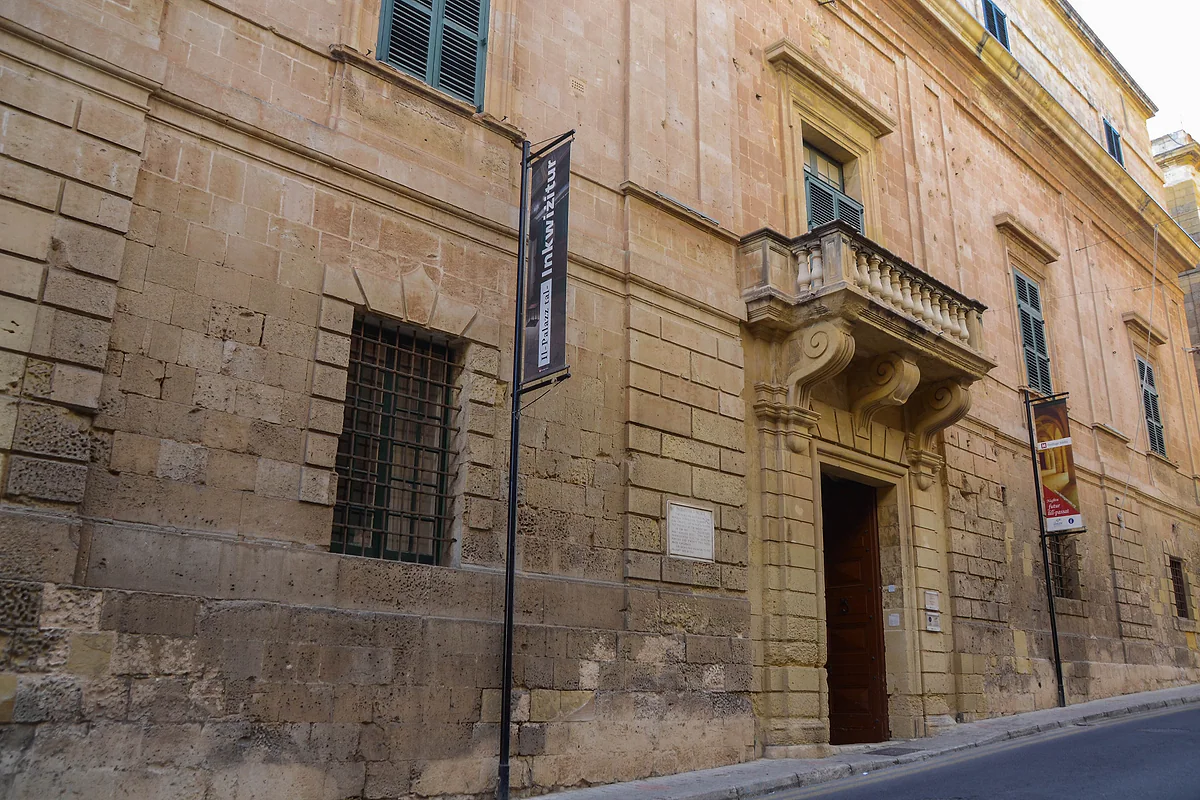
224 years of the Holy Office in Birgu
The Inquisitor's Palace, home, courtroom and prison of Malta's Inquisition
The Inquisitor's Palace, on Main Gate Street in Birgu, was the Order's civil court from 1543 and seat of the Roman Inquisition from 1574 until the French abolished it in 1798. It is now Malta's national museum of ethnography. Tickets cost €6, and it opens Tuesday to Sunday, 09:00 to 17:00.
In 30 seconds
Full read: 3 min
- The Inquisitor's Palace is on Main Gate Street in Birgu.
- It was a civil court from 1543 and seat of the Roman Inquisition from 1574 to 1798.
- It's now the national museum of ethnography, with tickets at €6.
- Open Tuesday to Sunday, 09:00 to 17:00; closed on Mondays.
Most of us arrive with a picture of the Inquisition borrowed from Spain, and this palace politely takes it apart. I'd read Heritage Malta's two answers on torture before going in, then head for the courtroom.

Before you go
What I would keep in mind
-
01 My tip
Shut on Mondays
Open Tuesday to Sunday, 09:00 to 17:00. From 4 January 2027 it also closes on Wednesdays, through to 28 February.
-
02 To save money
€6, or free with the pass
One of Heritage Malta's cheapest sites, and covered by the Multisite Pass. If you already have the pass for Fort St Angelo, this one costs nothing extra.
Heritage Malta Multisite Pass -
03 Getting there
Three minutes from the bus
Heritage Malta puts the nearest bus stop 3 minutes' walk away. From Valletta, route 2 runs to Birgu.
Malta buses -
04 Most beautiful
Three palaces in one
A period kitchen downstairs, state rooms and private quarters on the piano nobile, and the Holy Office with its courtroom, torture chamber and cells. Each floor tells a different life.
What I would book
My ranking, scored
The rooms I'd make for
My own order, scored out of 10, by how much each part explains the inquisitor's power and life in Malta between 1574 and 1798.
0 of 5 seen
-
The tribunal chamber
The heart of the Holy Office, where the inquisitor sat as supreme judge of the Inquisition in Malta.
9.1 out of 10
-
The prison and the punishment cell
The austere prison complex that Heritage Malta describes as part of the same building as the refined residence.
8.7 out of 10
-
The grand staircase and piano nobile
The diplomatic side of the inquisitor, who was also the Pope's apostolic delegate in Malta.
8.2 out of 10
-
The historic kitchen
On the ground floor. The domestic side that tends to be forgotten when people talk about the Inquisition.
7.8 out of 10
-
The textiles wing
The National Textiles Collection shares the building. One for anyone with a specific interest in fabrics.
7.0 out of 10
Say “Inquisition” and most people picture Spain, racks and bonfires. That’s exactly why I rate this palace so highly. The Inquisition that ran here for 224 years was a different institution, and the museum goes out of its way to explain the difference with figures rather than drama.
A palace that began as a civil court
The building went up around the 1530s, just as the Knights were settling in Birgu. In 1543 Grand Master Juan de Homedes installed the Magna Curia Castellania Melitensis here, the Order’s civil court, which stayed until 1572, when it moved to the newly built Valletta.
Two years later, in 1574, Pietro Dusina arrived as Malta’s first inquisitor and apostolic delegate of Pope Gregory XIII. Grand Master Jean de la Cassière offered him this building, and the name has stuck ever since. From then on each inquisitor wore two hats, supreme judge of the Holy Office and representative of the Vatican’s interests on the island. Heritage Malta describes the palace as one of the three centres of power in early modern Malta. For the Knights’ side of that story, see the Knights of Malta.
The French abolished the Inquisition as soon as they arrived in 1798. The building went on to serve the French and the British, and for a while after the Second World War it passed to the Dominicans.
What do you see inside the Inquisitor’s Palace?
The visit falls into three parts, and I like taking them in order. On the ground floor is the domestic area with the historic kitchen. Upstairs is the piano nobile, with official halls and private quarters over two floors, where the inquisitor was a polished diplomat. Then come the rooms of the Holy Office itself, with the tribunal chamber, the torture chamber and the prison complex.
Heritage Malta sums up the contrast well. The palace was designed to inspire awe towards a powerful churchman in a sophisticated residence, and at the same time reverence and repentance through a courtroom with an austere prison attached. Today it works as both a historic house museum and the national museum of ethnography, looking at the Inquisition’s effect on Maltese society and the role of religion in daily life. It also houses the National Textiles Collection.
Not the Spanish Inquisition
This is the bit that grabs me. In its FAQs, Heritage Malta explains that the Spanish Inquisition, set up in 1478, was under the direct control of the Spanish crown, used harsh torture and made wide use of the death penalty. The Roman Inquisition, set up in 1542, was highly centralised, focused mainly on countering Protestant ideas and was much more lenient.
On torture, the museum gives a number. The Roman Inquisition in Malta used it in less than 1% of cases, never as a punishment and only as a last resort, usually after guidance from Rome. The old, weak, disabled, sick and pregnant women were spared. I’m not asking you to take that on trust, just to walk into the tribunal chamber with the figure in mind.
Then there are two legends. The pit of knives, the bir tas-skieken, has no documentary or archaeological evidence behind it; the museum thinks it was a tale to stop children wandering in unaccompanied. As for ghosts, the official answer is that it’s a highly subjective question, which made me smile.
Tickets, hours and fitting it in
Adults pay €6, concessions €4.50 and 6 to 11-year-olds €3, with the Multisite Pass also valid. It opens Tuesday to Sunday, 09:00 to 17:00, until 3 January 2027; from 4 January to 28 February it also closes on Wednesdays. Heritage Malta flags uneven floors, low lighting and low doorways, so anyone with limited mobility will find it hard going.
One more thing. Heritage Malta backs the visit with a busy programme of events and educational sessions, and its 2026 calendar lists workshops and talks here, some of them in Maltese. If one lines up with your trip it can add a lot, so I’d glance at the calendar before fixing the day.
I’d give it an hour and a half and slot it in after Fort St Angelo in Birgu, which opens earlier and needs more time. With both done, the Malta at War Museum in Birgu rounds off the day, or you can carry on round the rest of Birgu (Vittoriosa).
Inquisitor's Palace tickets
| Ticket | Price |
|---|---|
| Adults (18+) | €6 |
| Youths 12-17, over-60s and students | €4.50 |
| Children 6-11 | €3 |
| Children 1-5 | Free |
| Heritage Malta Multisite Pass | Included |
Prices from the Heritage Malta site page, 28-09-2026.
Opening hours (2026-2027)
| Period | Hours |
|---|---|
| 1 March 2026 to 3 January 2027 | 09:00-17:00, Tuesday to Sunday |
| 4 January to 28 February 2027 | 09:00-17:00, Tuesday, Thursday, Friday, Saturday and Sunday |
Closed on 1 January, Good Friday and 24, 25 and 31 December. Last admission 30 minutes before closing.
Test yourself
True or false?
0/4 Pick before you peek.
-
The building was put up for the Inquisition.
See the answer
False. It dates from around the 1530s and first housed the Castellania civil court. The inquisitor was given it in 1574.
-
The French abolished the Inquisition in Malta.
See the answer
True. They scrapped it on arrival in 1798, after 224 years.
-
Malta's inquisitor was purely a religious judge.
See the answer
False. He was also apostolic delegate, representing the Vatican's interests in Malta.
-
Heritage Malta has found the legendary pit of knives.
See the answer
False. There's no documentary or archaeological evidence it ever existed; it's most likely a myth.
- First inquisitor, Pietro Dusina, arrives
- 1574
- Years of the Roman Inquisition in Malta
- 224
- Of cases involving torture, per Heritage Malta
- <1%
- Adult ticket
- €6
Map
Where Inquisitor's Palace is
Gozo lies to the north-west, across the channel the ferry crosses from Ċirkewwa, with Comino between the two islands. Every number opens its guide.
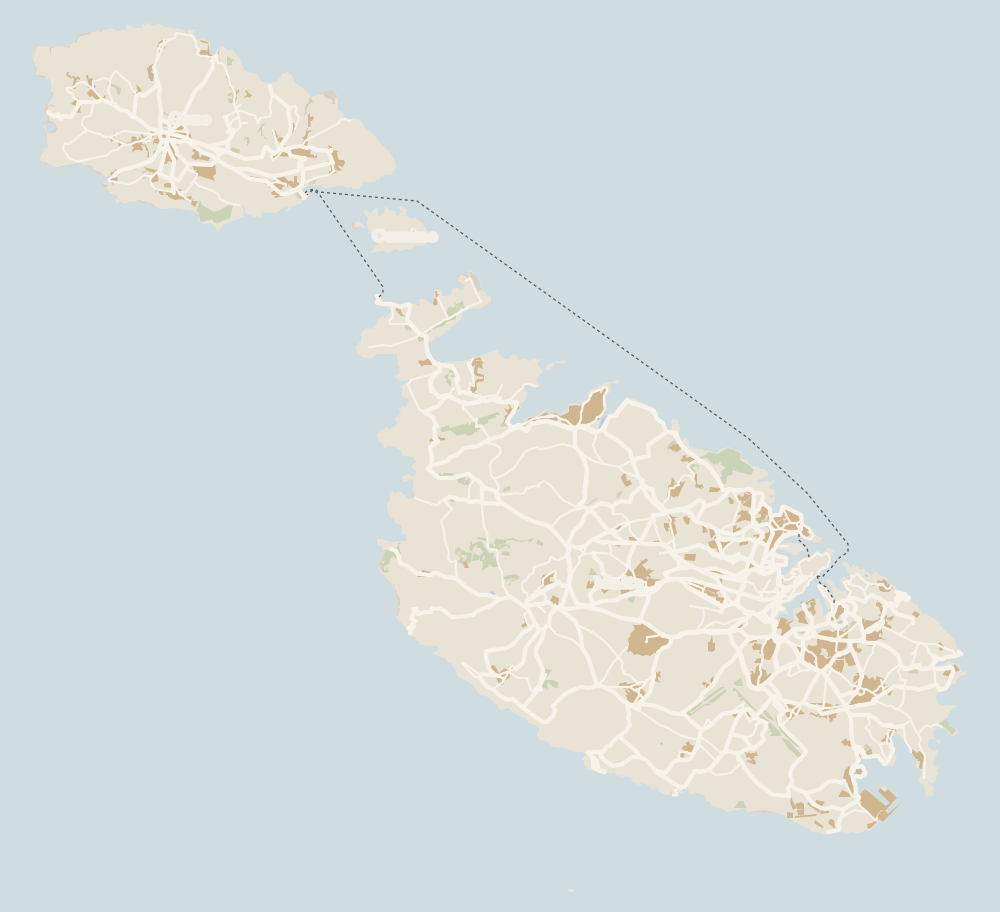 1Fort St Angelo 2Inquisitor's Palace 3Maritime Museum 4Malta at War Museum 5Birgu
 Map data © OpenStreetMap contributors (ODbL)
0 of 279 Malta guides
Your next stamp
- Birgu
- Malta at War Museum
- Fort St Angelo
- Grandmaster's Palace
- Mdina Cathedral
- Domvs Romana
- History
- Things to do in Malta
- Gozo
- Most beautiful places
- Comino
- Prettiest villages
- UNESCO World Heritage Sites
- Where is Malta
- The Maltese islands
- Towns and villages
- Island of Malta
- Blue Lagoon
- Fort Rinella
- Gardjola Gardens
- Ħal Saflieni Hypogeum
- Is Malta a country?
- Popeye Village
- Tarxien Temples
- Things to do in Gozo
- Valletta
- Esplora
- Golden Bay
- Gozo day trip
- Population
- St John's Co-Cathedral
- St Mary's Tower
- How big is Malta
- Maritime Museum
- Mellieħa Bay
- Fort St Elmo
- Language
- Paradise Bay
- Barrakka Gardens
- Red Tower
- Religion
- Malta government
- Saluting Battery
- MUŻA
- National Museum of Archaeology
- Underground Valletta
- Lascaris War Rooms
- Casa Rocca Piccola
- Malta in one day
- Three Cities
- Victoria
- Manoel Theatre
- Weekend in Malta
- Xagħra
- City Gate and Parliament
- Malta in three days
- Nadur
- Senglea
- Cospicua
- Malta in four days
- Qala
- Valletta Waterfront
- Għajnsielem
- Kalkara
- Malta in five days
- Malta in a week
- Paola
- Xewkija
- Sannat
- Tarxien
- Munxar
- Żabbar
- Fgura
- Fontana
- Kerċem
- Luqa
- Floriana
- Marsa
- Mellieħa
- The Citadel, Gozo
- Żebbuġ (Gozo)
- Ġgantija Temples
- Marsalforn
- Santa Luċija
- Ramla Bay
- San Lawrenz
- Xgħajra
- Xwejni salt pans
- Calypso's Cave
- Għarb
- Żejtun
- Għasri
- Gudja
- San Blas Bay
- Għaxaq
- Ħondoq Bay
- Marsaxlokk
- Kirkop
- Marsaxlokk Fish Market
- Mqabba
- St Peter's Pool
- Marsaskala
- Qrendi
- Żurrieq
- Beaches
- Comino ferry
- EU, Schengen and the euro
- Ħaġar Qim and Mnajdra
- Mdina
- Mġarr (Gozo)
- Blue Grotto
- Diving
- Entry requirements
- Xewkija Rotunda
- Birżebbuġa
- Money and payments
- Palazzo Falson
- Safi
- Shipwrecks
- Ta' Ċenċ Cliffs
- Għar Dalam
- Mdina Dungeons
- Mġarr ix-Xini
- Prices and budget
- Snorkelling
- Boat trips
- Malta on a budget
- Playmobil FunPark
- Rabat (Malta)
- Xlendi
- Dwejra
- Gozo beaches
- Siġġiewi
- St Paul's Catacombs
- Tipping
- Azure Window
- Għar Lapsi
- Great Siege of 1565
- Plugs
- Limestone Heritage Park
- Second World War
- St Paul's Grotto
- Ta' Pinu Basilica
- Time zone
- Buskett Gardens
- Knights of Malta
- Mobile and roaming
- Wied il-Għasri
- Dingli
- Maltese cross
- Dingli Cliffs
- Flag
- Żebbuġ
- Coat of arms
- Mtarfa
- Balzan
- National anthem
- Lija
- Malta facts
- Game of Thrones
- Iklin
- Attard
- Film locations
- Forts and fortifications
- San Anton Gardens
- Ta' Qali Crafts Village
- Victoria Lines
- Megalithic temples
- Catacombs
- Museums
- Where to eat
- Where to stay
- Churches
- Hotels in Valletta
- Restaurants in Valletta
- Hotels in Sliema
- Maltese food
- Restaurants in Marsaxlokk
- Viewpoints
- Hotels in St Julian's
- Pastizzi
- Walking and hiking
- Hotels in Buġibba and Qawra
- Maltese rabbit stew
- Safety
- Hotels in Mellieħa
- Kinnie and Cisk
- Scams
- Gozo hotels
- Nightlife
- Tap water
- Boat parties
- Holiday packages
- Tourist tax
- All inclusive
- Gay Malta
- Sightseeing passes
- Apartments
- Malta with kids
- Public holidays
- How to get there
- Luxury
- Malta for couples
- Taxis and ride-hailing
- Weather
- Best time to visit
- Cycling
- English schools
- Flights
- Flights from Madrid
- Sea temperature
- Shopping and souvenirs
- Airport
- Free walking tours
- In winter
- Airport transfers
- Day trips and tours
- In summer
- Ferry from Sicily
- In January
- Cruise stop
- In February
- In March
- In April
- In May
- Getting around
- In June
- Buses
- July
- August
- Hop on hop off
- Gozo ferry
- September
- Gozo fast ferry
- October
- November
- Valletta ferries
- Car hire
- December
- Driving
- Events
- St Paul's Bay
- Village feasts
- Buġibba
- Christmas
- Easter
- Qawra
- Carnival
- Xemxija
- Fireworks festival
- Malta National Aquarium
- Isle of MTV
- St Paul's Islands
- Mosta
- Mosta Rotunda
- Naxxar
- Palazzo Parisio
- Għargħur
- Mġarr (Malta)
- Sliema
- Ta' Ħaġrat and Skorba Temples
- Għajn Tuffieħa Bay
- Tigné Point
- Ġnejna Bay
- St Julian's
- Paceville
- St George's Bay
- Gżira
- Msida
- Ta' Xbiex
- Pietà
- Pembroke
- Swieqi
- San Ġwann
- Birkirkara
- Ħamrun
- Santa Venera
- Qormi
Frequently asked questions
How much is the Inquisitor's Palace in Malta?
€6 for adults, €4.50 for youths, over-60s and students, and €3 for children aged 6 to 11. Under-6s go free, and the Multisite Pass covers it.
What are the Inquisitor's Palace opening hours?
Tuesday to Sunday, 09:00 to 17:00, until 3 January 2027. From 4 January to 28 February 2027 it's also closed on Wednesdays.
Did the Inquisition use torture in Malta?
Heritage Malta says the Roman Inquisition in Malta used torture in less than 1% of cases, never as a punishment and only as a last resort. The old, sick, disabled and pregnant women were spared.
Was it the Spanish Inquisition in Malta?
No. The Spanish Inquisition, founded in 1478, answered to the Spanish crown. The Roman Inquisition that operated in Malta dates from 1542, was run from Rome and, according to Heritage Malta, was much more lenient.
Is the pit of knives real?
Heritage Malta says there's no documentary or archaeological evidence for the bir tas-skieken, and reckons it's probably a myth meant to keep children from wandering in alone.
Is the Inquisitor's Palace wheelchair accessible?
Only partly. Heritage Malta warns of uneven flooring, low lighting and low doorways, and some areas can't be reached with reduced mobility.
By
Tourism graduate with a master’s in Tourism Management and Planning from the University of Málaga, who has travelled across Europe. He writes every guide from official sources and his own judgement.
Published on . Facts checked on .
Sources
Photos: Mandyy88 (CC BY-SA 4.0), via Wikimedia Commons.