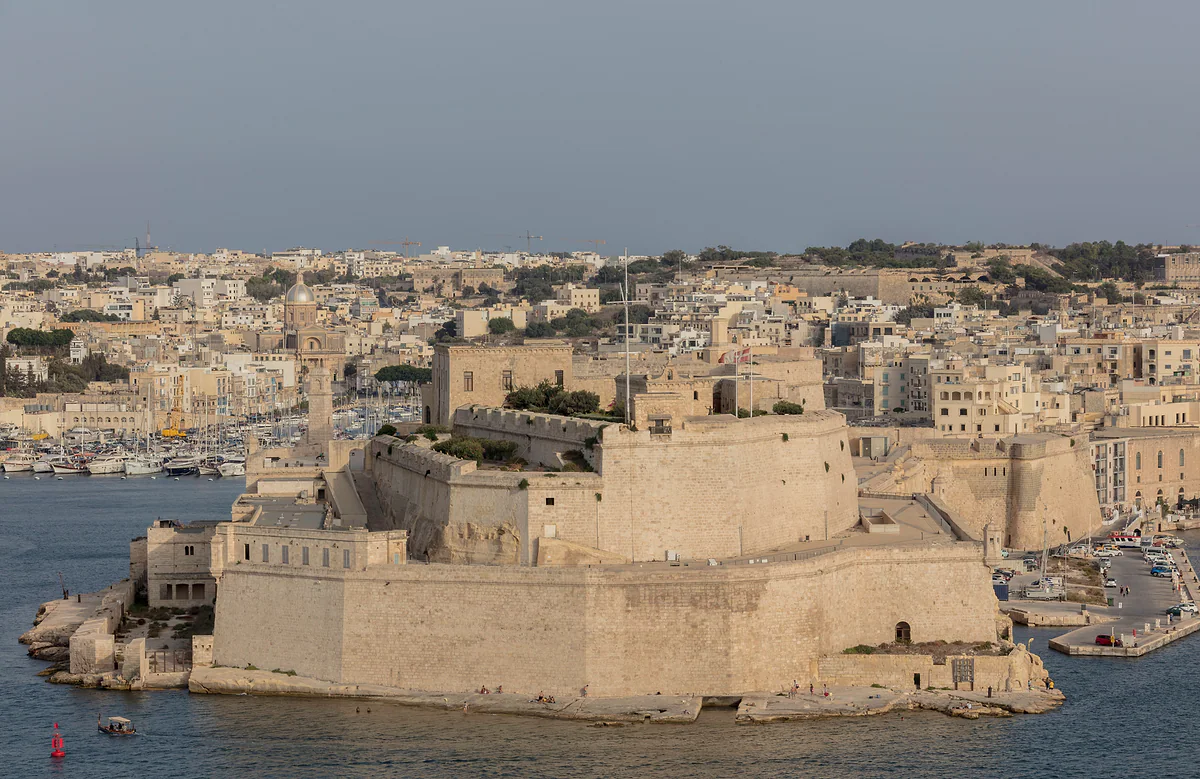
At the tip of Birgu since the 13th century
Fort St Angelo, the harbour castle that shaped Malta's fate
Fort St Angelo stands at the tip of Birgu, in the Three Cities, facing Valletta. It was already a sea castle by 1274, became the Order of St John's headquarters in 1530 and served the Royal Navy until 1979. Adult tickets cost €10, and it's open daily from 09:00 to 19:00 until 31 October 2026.
In 30 seconds
Full read: 3 min
- Fort St Angelo stands at the tip of Birgu, facing Valletta.
- It was a sea castle by 1274, the Knights' headquarters from 1530 and a Royal Navy base until 1979.
- Tickets are €10 and it's open daily 09:00 to 19:00 until 31 October 2026.
- The upper fort, with the Magistral Palace and St Anne's chapel, is open thanks to an agreement with the Order of Malta.
I'd head straight for the upper fort, the part opened up through the agreement with the Order of Malta, and leave the interpretation rooms for afterwards. Up there it takes a minute to see why whoever held this fort held the harbour.

Before you go
What I would keep in mind
-
01 Most beautiful
The upper fort and the Magistral Palace
Thanks to an agreement with the Sovereign Military Order of Malta, the upper part of the fort is open, with the Magistral Palace, the Keep and the Chapel of St Anne. It's reached by steps only.
-
02 Getting there
Come by ferry from Valletta
Heritage Malta notes that as well as bus and taxi, there's a ferry and water taxis from Valletta, weather permitting. The nearest bus stop is a 10-minute walk.
Sliema to Valletta ferry -
03 To save money
Covered by the Multisite Pass
St Angelo is a Heritage Malta site, so it's included in the €60 pass valid for 30 days. Add the Inquisitor's Palace and the Tarxien Temples and it starts to add up.
Heritage Malta Multisite Pass -
04 My tip
Take the audio guide
Audio guides come in Maltese, English, German, Italian, Spanish, French and Chinese. I'd take one, because the fort's story has a lot of layers.
What I would book
My ranking, scored
What I wouldn't miss at Fort St Angelo
My own scores out of 10, for how much each part impresses and how well it explains 700 years of the fort, from Sicilian castle to Royal Navy base.
0 of 4 seen
-
The Grand Harbour views
From the top you have Valletta straight ahead, Senglea alongside and the harbour mouth. The whole point of the fort, explained without a word.
9.4 out of 10
-
The Order's upper fort
The Magistral Palace, the Keep and the Chapel of St Anne, open thanks to the agreement with the Sovereign Military Order of Malta.
9.0 out of 10
-
The gun platforms
Heritage Malta highlights the artillery on show. Grunenbergh's platforms of 1689 were built to take some fifty guns.
8.3 out of 10
-
The interpretation centre and dioramas
It tells the fort's role in Malta's history through displays and immersive media. Useful, but I'd save it until last.
7.6 out of 10
Heritage Malta opens its page on St Angelo with a line it doesn’t use lightly, that no other fortress has been so bound up with Malta’s destiny. Having read the history, I agree. This is the spot from which the Grand Harbour was controlled for seven centuries, by Sicilians, Knights and the British in turn, and you feel it as soon as you climb up.
From sea castle to the Knights’ headquarters
By 1274 there was already a two-enclosure stronghold here, the Castrum Maris or sea castle, run for its Sicilian overlords by a castellan. It stood, and stands, on a small hill at the end of the Birgu peninsula, commanding the harbour. The MTA calls it perhaps the oldest fortification on the islands.
When the Order of St John arrived in 1530 it renamed the place Fort St Angelo and made it its headquarters. The Knights remodelled it heavily with artillery platforms that brought the bastioned system of defence to Malta, and the fort played a major part in the Great Siege of 1565. For the story of the siege itself, see the Great Siege of Malta.
In 1689 the military engineer Carlos Grunenbergh turned it into a more formidable coastal work, with four gun platforms able to hold around fifty pieces of artillery. To my mind, that’s the moment it stops being a medieval castle and turns into a gun battery facing out to sea.
What happened to St Angelo under the British?
In 1906 the Royal Navy’s Mediterranean Fleet moved its command hub into the fort, which was commissioned as a shore base, first as HMS Egmont in 1912 and from 1933 as HMS St Angelo. In the Second World War it took 69 direct hits and stayed in service. The last detachment of foreign forces marched out in March 1979, fifteen years after independence. That war makes more sense alongside Malta in the Second World War.
The visit, from the bottom up
Today the fort combines an interpretation centre using traditional and immersive displays, several dioramas and artillery pieces. The part I’d call essential is the upper fort. Thanks to an agreement with the Sovereign Military Order of Malta, today’s Order of Malta, it’s open to visitors, with the Keep, the Magistral Palace and St Anne’s chapel all on the route. Be warned that it’s reached by steps only.
Heritage Malta recommends two hours and I wouldn’t cut that. There are audio guides in seven languages, a shop with souvenirs and light snacks, and toilets dotted around the site. For wheelchair users there are electric vehicles covering Heritage Malta’s areas, except in bad weather.
St Angelo or St Elmo?
It’s the question I see most from people short on time, since both are the Order’s forts, both cost €10 and they stare at each other across the Grand Harbour. I don’t see them as either-or. Fort St Elmo in Valletta is above all a museum, the National War Museum, with seven sections and pieces such as the George Cross. St Angelo is above all a place, the castle the harbour was run from, with more centuries behind it and fewer display cases.
If I could only pick one, it would depend on who’s asking. For anyone drawn to objects and the Second World War, St Elmo. For anyone who wants to understand the Order and the lie of the harbour, St Angelo. With time for both, I’d do St Elmo on a Valletta day and St Angelo on a Three Cities day, rather than two forts back to back, which I think blurs them together and does neither of them justice.
Tickets, hours and getting there
Adults pay €10; youths aged 12 to 17, students and over-60s pay €6; children aged 6 to 11 pay €4, and under-6s get in free. It’s also on the Heritage Malta Multisite Pass. Summer hours, 09:00 to 19:00 every day, run until 31 October 2026; over the winter, to 28 February 2027, it shuts at 17:00.
From Valletta, I’d take the ferry to Cospicua and walk on along the Birgu waterfront. By bus, route 2 goes to Birgu, and Heritage Malta reckons 10 minutes on foot from the nearest stop. Once you’re done, the Inquisitor’s Palace in Birgu and the rest of Birgu (Vittoriosa) are close by.
Fort St Angelo tickets
| Ticket | Price |
|---|---|
| Adults (18+) | €10 |
| Youths 12-17, over-60s and students | €6 |
| Children 6-11 | €4 |
| Children 1-5 | Free |
| Heritage Malta Multisite Pass | Included |
Prices from the Heritage Malta site page, 28-09-2026.
Opening hours (2026-2027)
| Period | Hours |
|---|---|
| 1 March to 31 October 2026 | 09:00-19:00, daily |
| 1 November 2026 to 28 February 2027 | 09:00-17:00, daily |
Closed on 1 January, Good Friday and 24, 25 and 31 December. Last admission 30 minutes before closing.
Test yourself
True or false?
0/4 Pick before you peek.
-
The Knights built Fort St Angelo from scratch in 1530.
See the answer
False. It already existed in 1274 as the Castrum Maris, the sea castle. The Order renamed and remodelled it from 1530.
-
The fort took 69 direct hits in the Second World War.
See the answer
True. That's Heritage Malta's figure, and it stayed in service as a British naval base regardless.
-
For a time the fort was known as HMS St Angelo.
See the answer
True. The Royal Navy commissioned it as a shore base, first as HMS Egmont in 1912 and as HMS St Angelo from 1933.
-
British forces left the fort at independence in 1964.
See the answer
False. The last detachment of foreign forces marched out in March 1979.
- First record as a sea castle
- 1274
- Direct hits in the Second World War
- 69
- Last foreign forces march out
- 1979
- Adult ticket
- €10
Map
Where Fort St Angelo is
Gozo lies to the north-west, across the channel the ferry crosses from Ċirkewwa, with Comino between the two islands. Every number opens its guide.
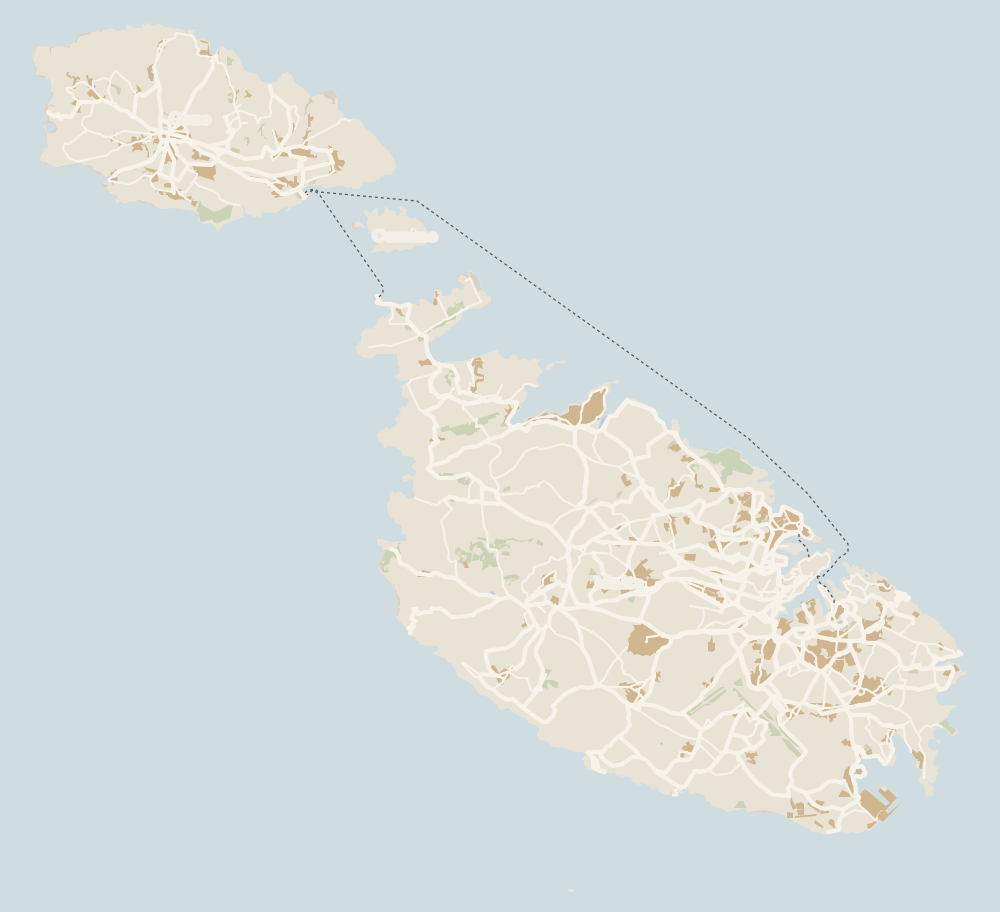 1Fort St Angelo 2Inquisitor's Palace 3Maritime Museum 4Malta at War Museum 5Birgu
 Map data © OpenStreetMap contributors (ODbL)
0 of 279 Malta guides
Your next stamp
- Birgu
- Forts and fortifications
- Three Cities
- Malta at War Museum
- Fort St Elmo
- Great Siege of 1565
- History
- Things to do in Malta
- Gozo
- Most beautiful places
- Comino
- Prettiest villages
- UNESCO World Heritage Sites
- Where is Malta
- The Maltese islands
- Towns and villages
- Island of Malta
- Blue Lagoon
- Fort Rinella
- Gardjola Gardens
- Ħal Saflieni Hypogeum
- Is Malta a country?
- Popeye Village
- Tarxien Temples
- Things to do in Gozo
- Valletta
- Esplora
- Golden Bay
- Gozo day trip
- Inquisitor's Palace
- Population
- St John's Co-Cathedral
- St Mary's Tower
- Grandmaster's Palace
- How big is Malta
- Maritime Museum
- Mellieħa Bay
- Language
- Paradise Bay
- Barrakka Gardens
- Red Tower
- Religion
- Malta government
- Saluting Battery
- MUŻA
- National Museum of Archaeology
- Underground Valletta
- Lascaris War Rooms
- Casa Rocca Piccola
- Malta in one day
- Victoria
- Manoel Theatre
- Weekend in Malta
- Xagħra
- City Gate and Parliament
- Malta in three days
- Nadur
- Senglea
- Cospicua
- Malta in four days
- Qala
- Valletta Waterfront
- Għajnsielem
- Kalkara
- Malta in five days
- Malta in a week
- Paola
- Xewkija
- Sannat
- Tarxien
- Munxar
- Żabbar
- Fgura
- Fontana
- Kerċem
- Luqa
- Floriana
- Marsa
- Mellieħa
- The Citadel, Gozo
- Żebbuġ (Gozo)
- Ġgantija Temples
- Marsalforn
- Santa Luċija
- Ramla Bay
- San Lawrenz
- Xgħajra
- Xwejni salt pans
- Calypso's Cave
- Għarb
- Żejtun
- Għasri
- Gudja
- San Blas Bay
- Għaxaq
- Ħondoq Bay
- Marsaxlokk
- Kirkop
- Marsaxlokk Fish Market
- Mqabba
- St Peter's Pool
- Marsaskala
- Qrendi
- Żurrieq
- Beaches
- Comino ferry
- EU, Schengen and the euro
- Ħaġar Qim and Mnajdra
- Mdina
- Mġarr (Gozo)
- Blue Grotto
- Diving
- Entry requirements
- Mdina Cathedral
- Xewkija Rotunda
- Birżebbuġa
- Money and payments
- Palazzo Falson
- Safi
- Shipwrecks
- Ta' Ċenċ Cliffs
- Għar Dalam
- Mdina Dungeons
- Mġarr ix-Xini
- Prices and budget
- Snorkelling
- Boat trips
- Malta on a budget
- Playmobil FunPark
- Rabat (Malta)
- Xlendi
- Dwejra
- Gozo beaches
- Siġġiewi
- St Paul's Catacombs
- Tipping
- Azure Window
- Domvs Romana
- Għar Lapsi
- Plugs
- Limestone Heritage Park
- Second World War
- St Paul's Grotto
- Ta' Pinu Basilica
- Time zone
- Buskett Gardens
- Knights of Malta
- Mobile and roaming
- Wied il-Għasri
- Dingli
- Maltese cross
- Dingli Cliffs
- Flag
- Żebbuġ
- Coat of arms
- Mtarfa
- Balzan
- National anthem
- Lija
- Malta facts
- Game of Thrones
- Iklin
- Attard
- Film locations
- San Anton Gardens
- Ta' Qali Crafts Village
- Victoria Lines
- Megalithic temples
- Catacombs
- Museums
- Where to eat
- Where to stay
- Churches
- Hotels in Valletta
- Restaurants in Valletta
- Hotels in Sliema
- Maltese food
- Restaurants in Marsaxlokk
- Viewpoints
- Hotels in St Julian's
- Pastizzi
- Walking and hiking
- Hotels in Buġibba and Qawra
- Maltese rabbit stew
- Safety
- Hotels in Mellieħa
- Kinnie and Cisk
- Scams
- Gozo hotels
- Nightlife
- Tap water
- Boat parties
- Holiday packages
- Tourist tax
- All inclusive
- Gay Malta
- Sightseeing passes
- Apartments
- Malta with kids
- Public holidays
- How to get there
- Luxury
- Malta for couples
- Taxis and ride-hailing
- Weather
- Best time to visit
- Cycling
- English schools
- Flights
- Flights from Madrid
- Sea temperature
- Shopping and souvenirs
- Airport
- Free walking tours
- In winter
- Airport transfers
- Day trips and tours
- In summer
- Ferry from Sicily
- In January
- Cruise stop
- In February
- In March
- In April
- In May
- Getting around
- In June
- Buses
- July
- August
- Hop on hop off
- Gozo ferry
- September
- Gozo fast ferry
- October
- November
- Valletta ferries
- Car hire
- December
- Driving
- Events
- St Paul's Bay
- Village feasts
- Buġibba
- Christmas
- Easter
- Qawra
- Carnival
- Xemxija
- Fireworks festival
- Malta National Aquarium
- Isle of MTV
- St Paul's Islands
- Mosta
- Mosta Rotunda
- Naxxar
- Palazzo Parisio
- Għargħur
- Mġarr (Malta)
- Sliema
- Ta' Ħaġrat and Skorba Temples
- Għajn Tuffieħa Bay
- Tigné Point
- Ġnejna Bay
- St Julian's
- Paceville
- St George's Bay
- Gżira
- Msida
- Ta' Xbiex
- Pietà
- Pembroke
- Swieqi
- San Ġwann
- Birkirkara
- Ħamrun
- Santa Venera
- Qormi
Frequently asked questions
How much does it cost to visit Fort St Angelo?
€10 for adults, €6 for 12 to 17-year-olds, over-60s and students, and €4 for children aged 6 to 11. Under-6s go free, and the Multisite Pass covers it.
What are Fort St Angelo's opening hours?
Until 31 October 2026, daily from 09:00 to 19:00. From 1 November to 28 February 2027, 09:00 to 17:00. Last entry is half an hour before closing.
How long do you need at Fort St Angelo?
Heritage Malta recommends about two hours. I wouldn't do it in less if you want the upper fort and the gun platforms without rushing.
How do you get to Fort St Angelo from Valletta?
Take the Valletta to Cospicua ferry and walk on, or bus 2 to Birgu; the nearest stop is 10 minutes on foot. Heritage Malta also mentions water taxis.
Can you go up to the upper part of the fort?
Yes. Under an agreement with the Sovereign Military Order of Malta, the upper fort with the Magistral Palace, the Keep and the Chapel of St Anne is open. Access is by steps only.
Is Fort St Angelo wheelchair accessible?
Partly. Heritage Malta has electric vehicles to take wheelchair users round its sites, except in bad weather, but the upper fort can only be reached by steps.
By
Tourism graduate with a master’s in Tourism Management and Planning from the University of Málaga, who has travelled across Europe. He writes every guide from official sources and his own judgement.
Published on . Facts checked on .
Sources
Photos: Diego Delso (CC BY-SA 4.0), via Wikimedia Commons.