A 100-ton gun that never fired in anger
Fort Rinella, the battery built around one giant gun
Fort Rinella is a British battery in Kalkara, built between 1878 and 1886 for a single Armstrong 100-ton gun that is still in place. It's run by the Fondazzjoni Wirt Artna. Tickets cost €14 and include a guided tour and a film; it opens Monday to Saturday, 09:30 to 17:30, and bus 3 from Valletta stops at the gate.
In 30 seconds
Full read: 3 min
- Fort Rinella is a British battery in Kalkara, built 1878-1886.
- It was designed for a single Armstrong 100-ton gun, which is still there.
- Tickets are €14, including a guided tour and a film.
- Open Monday to Saturday, 09:30 to 17:30, last admission 16:00.
I'd get there early, no later than 14:00, since last admission is 16:00 and the guided tour and film both take time. And I'd let the staff tell the gun's story on site, because that's what brings the place to life.

Before you go
What I would keep in mind
-
01 Worth the splurge
The gun that never fired in anger
The Armstrong 100-ton gun arrived from Woolwich in 1882 and was ready in January 1884. In 1906 it was declared obsolete without ever having fired at an enemy.
-
02 Getting there
Bus 3 stops at the gate
Wirt Artna says bus 3 from Valletta terminus stops right outside the main gate and runs every half hour, Monday to Saturday.
Malta buses -
03 To save money
Covered by Wirt Artna's Heritage Pass
Fort Rinella is in the foundation's Heritage Pass, €50 per person for a week, alongside the Malta at War Museum, the Saluting Battery and the Lascaris War Rooms.
Heritage Malta Multisite Pass -
04 My tip
Bring a card and go early
Wirt Artna's ticket desks are cashless, and the fort's website sets last admission at 16:00, an hour and a half before closing. The foundation suggests at least two hours.
What I would book
My ranking, scored
The best of Fort Rinella, by my reckoning
My own scores out of 10, for what makes this visit different from any other fort in Malta.
0 of 4 seen
-
The Armstrong 100-ton gun
Mounted en barbette on a wrought-iron sliding carriage, it fired over the parapet without exposing the crew. The fort's whole reason for being.
9.3 out of 10
-
The hydraulic machinery
The gun was far too big to work by hand, so a hydraulic system traversed and loaded it. That makes Rinella the first battery with a gun worked by mechanical means.
8.6 out of 10
-
The guided tour and film
Both included in the ticket, telling the story of the fort and its gun. The film runs roughly on the hour.
8.0 out of 10
-
The ditch and caponiers
An irregular pentagon ringed by a deep ditch, swept by three caponiers and a counterscarp gallery.
7.5 out of 10
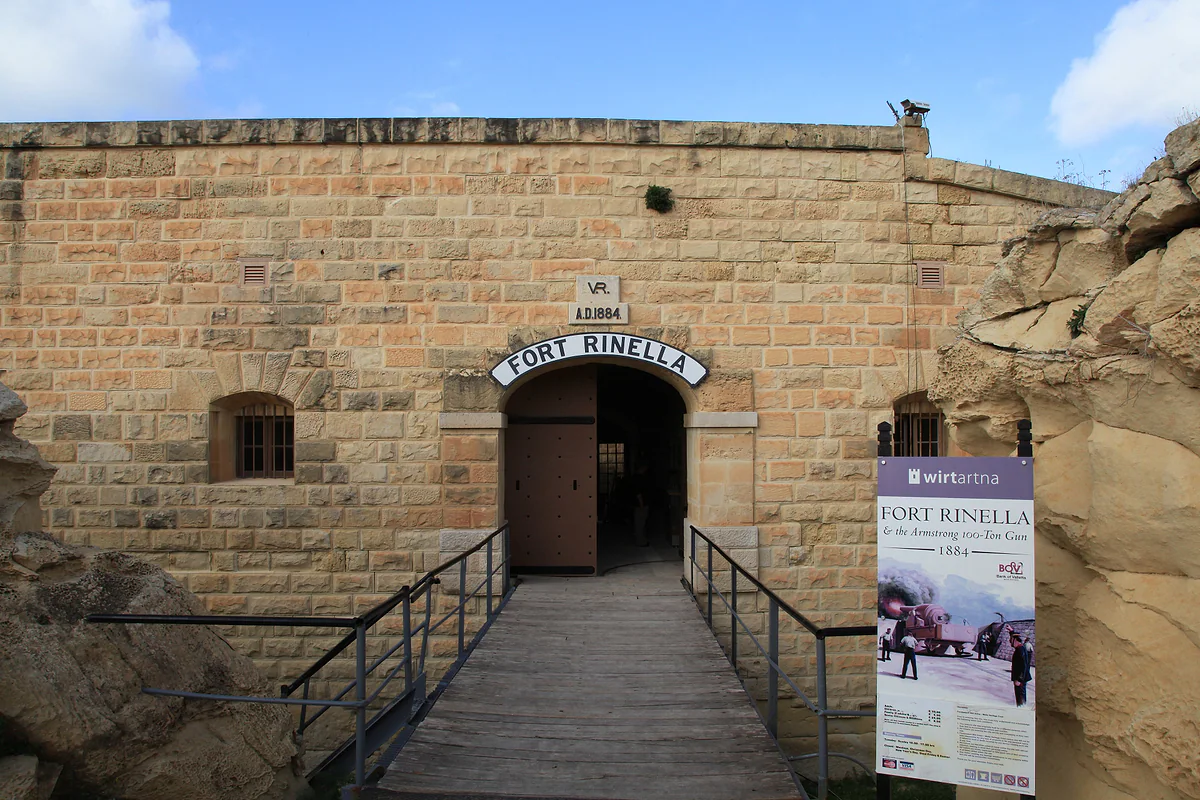
Some forts are built to defend a city, others to defend a gun. Fort Rinella belongs in the second group. The whole structure, ditch, caponiers and underground galleries included, exists to house and protect a single 100-ton piece of artillery, and it’s still there.
Why Britain shipped a 100-ton gun to Malta
The story starts in Italy. In 1873 the Italian navy launched two battleships, the Duilio and the Dandolo, protected by 22 inches of steel armour and each carrying four Armstrong 100-ton guns. According to the Fondazzjoni Wirt Artna, they outclassed anything any other navy had. For Britain, watching the Mediterranean closely since the Suez Canal opened in 1869 because it was the route to India, that was a threat.
A military commission visited Malta and Gibraltar and recommended two 100-ton guns for each. In Malta two sites were picked at the mouth of the Grand Harbour, and two identical batteries went up, one at Sliema and one at Rinella. Between 1878 and 1886 all four of the series were built, two here and two in Gibraltar. For the harbour’s defences as a whole, see Malta’s forts and fortifications.
The gun’s journey and the first mechanical battery
The gun now at Rinella arrived from Woolwich on 10 September 1882. Some months later it was ferried from the dockyard to Rinella Bay and then hauled by hand to the fort. It took about 100 men of the 1st Brigade Scottish R.A. Division three months. In January 1884 it was finally in position.
It was mounted en barbette on a wrought-iron sliding carriage, so it fired over the parapet without exposing the gunners. Too big to work by hand, it was traversed and loaded by an ingenious hydraulic system, which is why Wirt Artna calls Rinella the first battery to have a gun worked by mechanical means. For me that detail is worth the visit more than the sheer size.
The fort is an irregular pentagon inside a deep ditch, covered by three caponiers and a counterscarp gallery. Underground were the magazine and two loading chambers; at ground level, the accommodation and the machinery rooms.
Did it ever fire?
Never at an enemy. In 1906, after only twenty years’ service, Britain’s 100-ton guns were declared obsolete. Rinella was stripped of its machinery and abandoned. Until the mid-1930s it served as a position-finding station for nearby Fort Ricasoli, then passed to the Admiralty and, in 1965, to the Government of Malta. Since 1991 Wirt Artna volunteers have been restoring it, with the aim of turning it into a living museum.
The website’s slogan, see the world’s largest cannon, is the fort’s own claim. I’ll stick to what can be checked, an Armstrong 100-ton gun on its original emplacement, which is quite enough.
Is it worth it next to the Knights’ forts?
It’s a fair question, as Malta is hardly short of forts. My answer is that Rinella doesn’t compete with them, because it tells a different era. Fort St Angelo in Birgu and St Elmo are the story of the Knights and their sieges; Rinella is the 19th-century naval arms race, with Italy, Suez and the route to India in the background. If you’ve only seen the Order’s forts, this one shows you British Malta from the inside, and for a British visitor there’s a particular interest in seeing how far the Royal Navy went to hold on to this harbour.
It’s also a guided visit with re-enactments rather than a wander through empty rooms, which makes it an easy sell to teenagers. I’d put it in a day given over to Kalkara, next to the Three Cities, with Esplora for the younger ones.
Tickets, hours and getting there
Adults (16 and over) pay €14, seniors and students €12, children from 5 to 15 €7, and a family ticket is €28. Included in that are a guided tour, a film about the fort and its gun shown roughly on the hour, and the historical re-enactments. It’s open from 09:30 until 17:30 every day except Sunday, with last admission at 16:00, and the foundation suggests at least two hours. The desk takes cards only.
Bus 3 from Valletta terminus stops outside the main gate, every half hour Monday to Saturday. With children, Esplora, Malta’s science centre, is close by and fits into the same morning. And if you’re doing more of the foundation’s sites, such as the Malta at War Museum in Birgu, work out whether its Heritage Pass pays.
Fort Rinella tickets
| Ticket | Price |
|---|---|
| Adult (16+) | €14 |
| Senior or student | €12 |
| Child (5-15) | €7 |
| Family (2 adults and 3 under-16s) | €28 |
| Wirt Artna Heritage Pass | €50 individual, €95 family |
Prices from the fort's website, 28-09-2026. Tickets include a guided tour, film and re-enactments.
Opening hours
| Days | Hours |
|---|---|
| Monday to Saturday | 09:30-17:30 (last admission 16:00) |
| Sunday | Closed |
Also closed on 31 December, 1 January, Good Friday, Easter, and 24 and 25 December.
Test yourself
True or false?
0/4 Pick before you peek.
-
The Fort Rinella gun fired on the Italian fleet.
See the answer
False. It never fired in anger. It was declared obsolete in 1906, after twenty years in service.
-
It took around 100 men three months to haul the gun to the fort.
See the answer
True. According to Wirt Artna, men of the 1st Brigade Scottish R.A. Division dragged it there by hand in a three-month operation.
-
Malta had two batteries built for 100-ton guns.
See the answer
True. One at Sliema and one at Rinella. The other two in the series were in Gibraltar.
-
Fort Rinella opens on Sundays.
See the answer
False. It opens Monday to Saturday, 09:30 to 17:30, and is closed on Sundays.
- Weight of the Armstrong gun
- 100 t
- Year the gun was ready for use
- 1884
- Year it was declared obsolete
- 1906
- Adult ticket
- €14
Map
Where Fort Rinella is
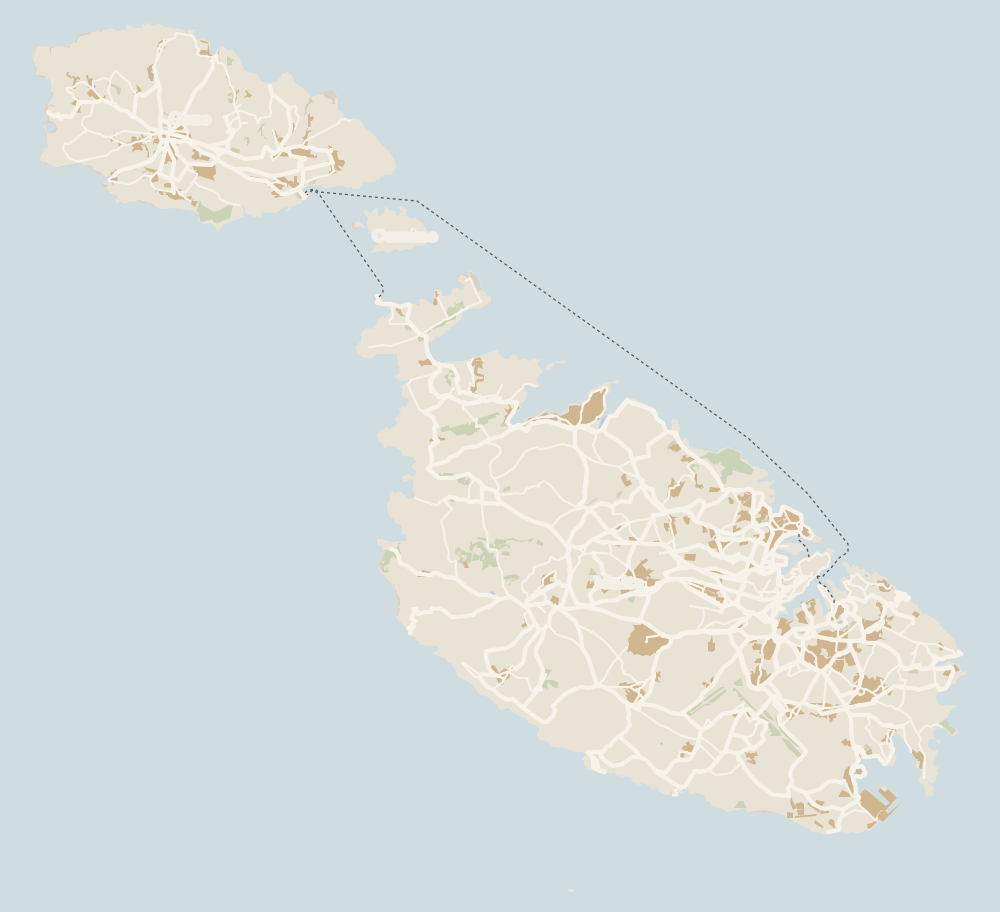
Gozo lies to the north-west, across the channel the ferry crosses from Ċirkewwa, with Comino between the two islands. Every number opens its guide.
0 of 279 Malta guides
Your next stamp
- Kalkara
- Forts and fortifications
- Fort St Elmo
- Saluting Battery
- Fort St Angelo
- Mosta
- Mosta Rotunda
- Second World War
- Things to do in Malta
- Gozo
- Most beautiful places
- Comino
- Prettiest villages
- UNESCO World Heritage Sites
- Where is Malta
- The Maltese islands
- Towns and villages
- Island of Malta
- Blue Lagoon
- Gardjola Gardens
- Ħal Saflieni Hypogeum
- Is Malta a country?
- Popeye Village
- Tarxien Temples
- Things to do in Gozo
- Valletta
- Esplora
- Golden Bay
- Gozo day trip
- Inquisitor's Palace
- Population
- St John's Co-Cathedral
- St Mary's Tower
- Grandmaster's Palace
- How big is Malta
- Maritime Museum
- Mellieħa Bay
- Language
- Malta at War Museum
- Paradise Bay
- Barrakka Gardens
- Red Tower
- Religion
- Malta government
- MUŻA
- National Museum of Archaeology
- Underground Valletta
- Lascaris War Rooms
- Casa Rocca Piccola
- Malta in one day
- Three Cities
- Victoria
- Birgu
- Manoel Theatre
- Weekend in Malta
- Xagħra
- City Gate and Parliament
- Malta in three days
- Nadur
- Senglea
- Cospicua
- Malta in four days
- Qala
- Valletta Waterfront
- Għajnsielem
- Malta in five days
- Malta in a week
- Paola
- Xewkija
- Sannat
- Tarxien
- Munxar
- Żabbar
- Fgura
- Fontana
- Kerċem
- Luqa
- Floriana
- Marsa
- Mellieħa
- The Citadel, Gozo
- Żebbuġ (Gozo)
- Ġgantija Temples
- Marsalforn
- Santa Luċija
- Ramla Bay
- San Lawrenz
- Xgħajra
- Xwejni salt pans
- Calypso's Cave
- Għarb
- Żejtun
- Għasri
- Gudja
- San Blas Bay
- Għaxaq
- Ħondoq Bay
- Marsaxlokk
- Kirkop
- Marsaxlokk Fish Market
- Mqabba
- St Peter's Pool
- Marsaskala
- Qrendi
- Żurrieq
- Beaches
- Comino ferry
- EU, Schengen and the euro
- Ħaġar Qim and Mnajdra
- Mdina
- Mġarr (Gozo)
- Blue Grotto
- Diving
- Entry requirements
- Mdina Cathedral
- Xewkija Rotunda
- Birżebbuġa
- Money and payments
- Palazzo Falson
- Safi
- Shipwrecks
- Ta' Ċenċ Cliffs
- Għar Dalam
- Mdina Dungeons
- Mġarr ix-Xini
- Prices and budget
- Snorkelling
- Boat trips
- Malta on a budget
- Playmobil FunPark
- Rabat (Malta)
- Xlendi
- Dwejra
- Gozo beaches
- History
- Siġġiewi
- St Paul's Catacombs
- Tipping
- Azure Window
- Domvs Romana
- Għar Lapsi
- Great Siege of 1565
- Plugs
- Limestone Heritage Park
- St Paul's Grotto
- Ta' Pinu Basilica
- Time zone
- Buskett Gardens
- Knights of Malta
- Mobile and roaming
- Wied il-Għasri
- Dingli
- Maltese cross
- Dingli Cliffs
- Flag
- Żebbuġ
- Coat of arms
- Mtarfa
- Balzan
- National anthem
- Lija
- Malta facts
- Game of Thrones
- Iklin
- Attard
- Film locations
- San Anton Gardens
- Ta' Qali Crafts Village
- Victoria Lines
- Megalithic temples
- Catacombs
- Museums
- Where to eat
- Where to stay
- Churches
- Hotels in Valletta
- Restaurants in Valletta
- Hotels in Sliema
- Maltese food
- Restaurants in Marsaxlokk
- Viewpoints
- Hotels in St Julian's
- Pastizzi
- Walking and hiking
- Hotels in Buġibba and Qawra
- Maltese rabbit stew
- Safety
- Hotels in Mellieħa
- Kinnie and Cisk
- Scams
- Gozo hotels
- Nightlife
- Tap water
- Boat parties
- Holiday packages
- Tourist tax
- All inclusive
- Gay Malta
- Sightseeing passes
- Apartments
- Malta with kids
- Public holidays
- How to get there
- Luxury
- Malta for couples
- Taxis and ride-hailing
- Weather
- Best time to visit
- Cycling
- English schools
- Flights
- Flights from Madrid
- Sea temperature
- Shopping and souvenirs
- Airport
- Free walking tours
- In winter
- Airport transfers
- Day trips and tours
- In summer
- Ferry from Sicily
- In January
- Cruise stop
- In February
- In March
- In April
- In May
- Getting around
- In June
- Buses
- July
- August
- Hop on hop off
- Gozo ferry
- September
- Gozo fast ferry
- October
- November
- Valletta ferries
- Car hire
- December
- Driving
- Events
- St Paul's Bay
- Village feasts
- Buġibba
- Christmas
- Easter
- Qawra
- Carnival
- Xemxija
- Fireworks festival
- Malta National Aquarium
- Isle of MTV
- St Paul's Islands
- Naxxar
- Palazzo Parisio
- Għargħur
- Mġarr (Malta)
- Sliema
- Ta' Ħaġrat and Skorba Temples
- Għajn Tuffieħa Bay
- Tigné Point
- Ġnejna Bay
- St Julian's
- Paceville
- St George's Bay
- Gżira
- Msida
- Ta' Xbiex
- Pietà
- Pembroke
- Swieqi
- San Ġwann
- Birkirkara
- Ħamrun
- Santa Venera
- Qormi
Frequently asked questions
How much are Fort Rinella tickets?
€14 for adults aged 16 and over, €12 for seniors and students, €7 for children aged 5 to 15 and €28 for a family of two adults and three children. A guided tour, film and re-enactments are included.
What are Fort Rinella's opening hours?
Monday to Saturday, 09:30 to 17:30, with last admission at 16:00 according to its website. It's closed on Sundays.
Is it really the world's largest cannon?
That's the fort's own slogan. What you can check is that it's an Armstrong 100-ton gun still on its original emplacement, which is impressive enough.
How do I get to Fort Rinella?
Bus 3 from Valletta terminus stops right outside the main gate. By car, follow signs for Cottonera and then Kalkara.
How long should I allow at Fort Rinella?
The foundation recommends at least two hours. Your ticket is valid all day, with re-entry allowed on the same day.
Did the Fort Rinella gun ever fire?
Never in anger. Wirt Artna says Britain's 100-ton guns were declared obsolete in 1906, after just twenty years in service, without firing a shot at an enemy.
By
Tourism graduate with a master’s in Tourism Management and Planning from the University of Málaga, who has travelled across Europe. He writes every guide from official sources and his own judgement.
Published on . Facts checked on .
Sources
Photos: Frank Vincentz (CC BY-SA 3.0), via Wikimedia Commons.