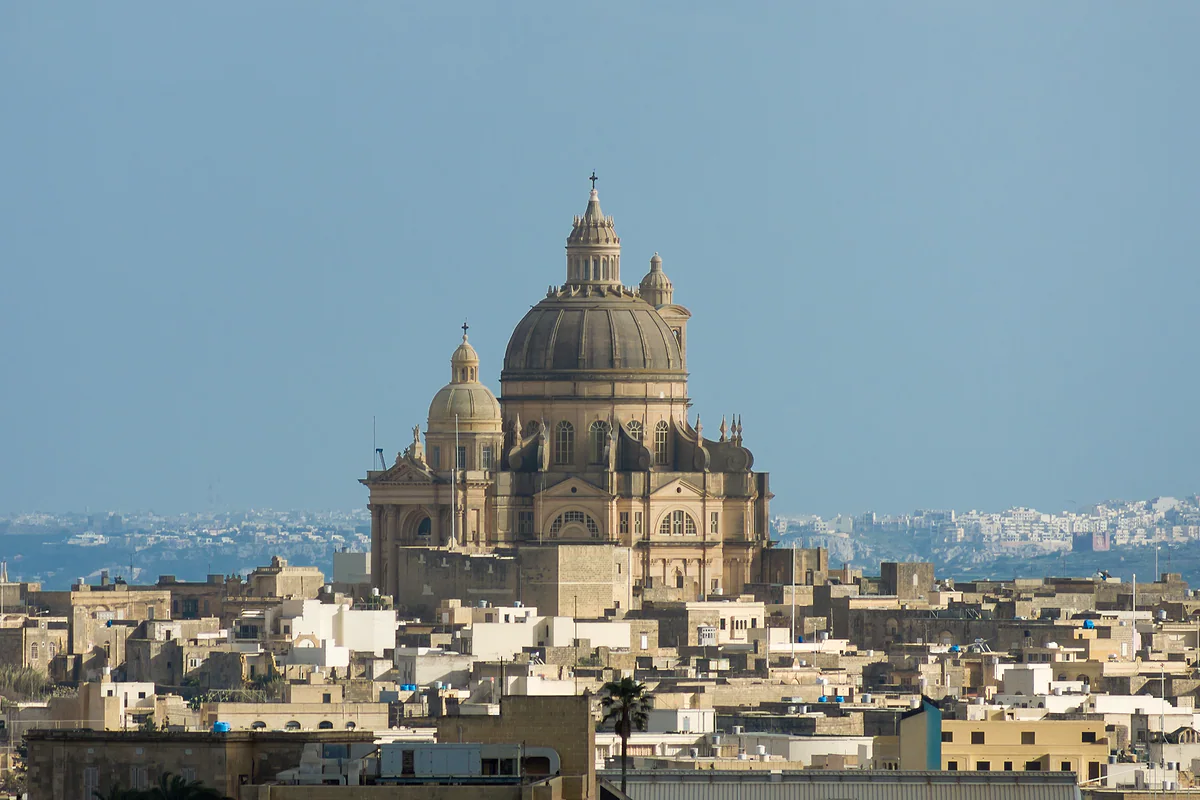
A church on Gozo
The Xewkija Rotunda, a church built around another church
The Xewkija Rotunda is the parish church of St John the Baptist and the largest church on Gozo. Its dome stands 75 metres high and weighs around 45,000 tonnes, according to the Ministry for Gozo. Villagers built it around the old church, finished the structure in 1970 and saw it consecrated on 17 June 1978.
In 30 seconds
Full read: 4 min
- The Xewkija Rotunda is the church of St John the Baptist, the largest on Gozo.
- Its dome is 75 metres high and weighs around 45,000 tonnes, according to the Ministry for Gozo.
- Villagers built it around the old church between 1951-52 and 1970, and it was consecrated in 1978.
- Inside are a Sculpture Museum holding the old church and a lift up towards the dome.
I'd go into the Sculpture Museum first and the nave second. Seeing the old church taken apart and numbered changes how you look at the dome, because you realise a village of stonemasons made it, not a grand state project.

Before you go
What I would keep in mind
-
01 Most beautiful
The old church, inside the new one
Before it came down, every stone of the old church was numbered and later rebuilt as the Sculpture Museum. For me it's the best part of the visit.
-
02 My tip
Take the lift up
A lift runs up from the Sculpture Museum, with views across Gozo and, on a clear day, as far as Malta. The Ministry doesn't publish a price or opening times.
-
03 My tip
Take the dome league tables with a pinch of salt
Xewkija and Mosta both claim 'third largest dome' titles that don't square with each other. I'd stick to the measurements each parish gives and leave the podium alone.
Mosta Rotunda -
04 Getting there
On the village square
The Rotunda is the centre of Xewkija, between Mġarr harbour and Victoria. Bus route 323 runs through the village.
Xewkija
The story behind the Xewkija Rotunda moves me more than the dome itself. No grand master or government paid for it. Around 3,000 villagers, most of them fishermen, farmers and builders, funded it and put it up themselves, and they did it without pulling down the church they already had.
A church built around a church
After the Second World War, Archpriest Ġużepp Grech won approval to replace the old parish church, consecrated in 1755, because Xewkija was growing by around a hundred people a year and had simply run out of room. The architect, Joseph D’Amato, took his cue from Santa Maria della Salute in Venice. The catch was that the old church had to keep holding services while the new one went up around it, so the masons were quite literally building one church inside another.
One Ministry for Gozo page dates the first stone to 1951, while another describes the ceremony on 4 May 1952, with the bishop escorted into the village on horseback. What’s certain is that work began in the early 1950s and took 18 years.
How a village paid for it and built it
This is the part that gets me. The village raised £18,000 plus another £2,000 in gold jewellery, much of it given by women, and the archpriest made house calls every week to collect. Farmers and fishermen handed over part of what they produced, and Gozitans who had emigrated sent money home.
On 16 July 1964 the concrete ring that carries the dome was cast in a single day. It took 1,300 sacks of cement, 2,600 of sand and 5,200 of crushed stone, hauled up by pulley from five in the morning. The men took the day off work, and the women cooked on site and helped lift the sacks.
D’Amato died before the job was done, and the dome was finished by master mason Ġużepp Vella, chief mason for 14 years. The Ministry describes him as a genius at geometry who couldn’t read or write. The structure was completed on 31 May 1970, when Vella himself set the cross on top of the lantern.
The measurements, and why I skip the league tables
The dome stands 75 metres high with a circumference of 85 metres, and its weight is put at about 45,000 tonnes. For the width, one Ministry page says 27 metres and another 28. Eight stone-clad concrete columns hold it up. Inside, local stone does most of the talking, with a polished Carrara marble floor, fine sculpture, stained glass and recent paintings of the saint’s life by Paul Camilleri Cauchi.
The parish bills it as the third largest unsupported dome, in the world on one page and in Europe on another, and the Mosta Rotunda makes similar claims of its own. Those claims contradict each other, so I don’t repeat any of them. For comparison, Mosta publishes an internal diameter of 39.6 metres on its website.
What to see inside the Rotunda
The bit I wouldn’t miss is the Sculpture Museum. Every stone of the old church was numbered before it came down, then reassembled beside the new building, so you can get close to the lace-like carving Gozitan masons did in Maltese limestone. From the museum a lift runs up towards the dome, with views over the whole island and, on a clear day, across to Malta.
Neither the Ministry nor the parish publishes opening hours or a price for the museum or the lift on the pages I’ve read. As with any working parish church, services come first, so I’d go on a weekday morning and leave some slack in the plan.
The 1978 consecration and the feast
The Rotunda was consecrated on 17 June 1978, the parish’s 300th anniversary, when twelve marble crosses were blessed and fixed to the walls. The feast of St John the Baptist falls on the Sunday nearest 24 June, and that’s when the church looks its best, with the whole village dressed up. If you’re touring the south of the island, pair it with the cove at Mġarr ix-Xini, down the valley, and the rest of the things to do in Gozo.
Where it fits in a day on Gozo
The Rotunda sits on the road from the ferry, so it makes an easy first or last stop. I’d come off the boat at Mġarr, spend the first hour of the day here, when the church is quietest, and carry on to Victoria. On a longer stay it works just as well at the end of an afternoon walking the valley, when the evening light falls on the dome.
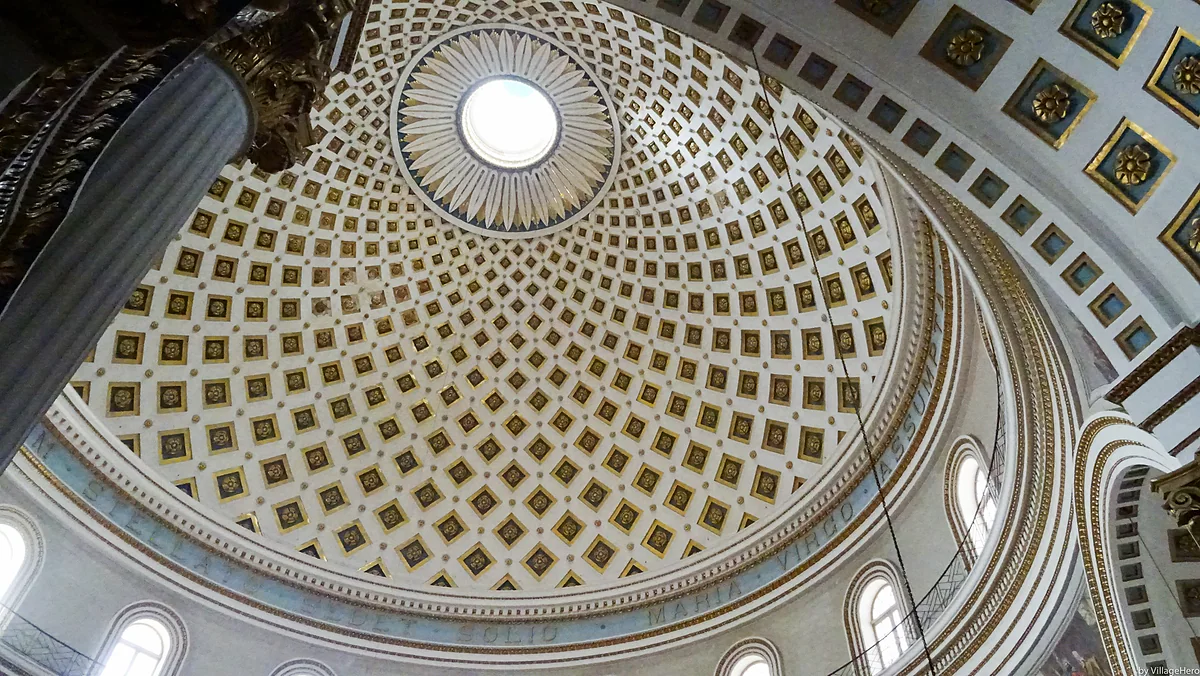
Inside the dome of the Rotunda of Mosta, its diamond-shaped coffers rising in rings towards the oculus of light at the centre.
The Rotunda in numbers (Ministry for Gozo)
| Measure | Figure |
|---|---|
| Dome height | 75 metres |
| Dome width | 27 or 28 metres, depending on the page |
| Circumference | 85 metres |
| Estimated weight | About 45,000 tonnes |
| Columns | Eight, stone-clad concrete |
| Structure finished | 31 May 1970 |
| Consecrated | 17 June 1978 |
The Ministry's two pages give 27 and 28 metres for the width. I don't publish dome rankings because the Xewkija and Mosta parishes make contradictory claims.
Before you go
| Topic | What's known |
|---|---|
| Opening hours | Not published by the Ministry or the parish on the pages I read |
| Museum and lift price | Not published |
| Accessibility | Accessible for disabled visitors, according to the Ministry |
| Feast | St John the Baptist, Sunday nearest 24 June |
Test yourself
True or false?
0/3 Pick before you peek.
-
Xewkija's old church was knocked down before work on the Rotunda began.
See the answer
False. It stayed in use throughout. The new church rose around it, and only at the end was the old one dismantled and rebuilt as a museum.
-
The master mason who placed the cross on the lantern couldn't read or write.
See the answer
True. The Ministry for Gozo says Ġużepp Vella, chief mason for 14 years, was a genius at geometry despite being unable to read or write.
-
The Rotunda was consecrated on the parish's 300th anniversary.
See the answer
True. Xewkija has been a parish since 1678, and the consecration took place on 17 June 1978, three hundred years later.
- Height of the dome
- 75 m
- Estimated weight of the dome
- 45,000 t
- Length of the build
- 18 years
- Year of consecration
- 1978
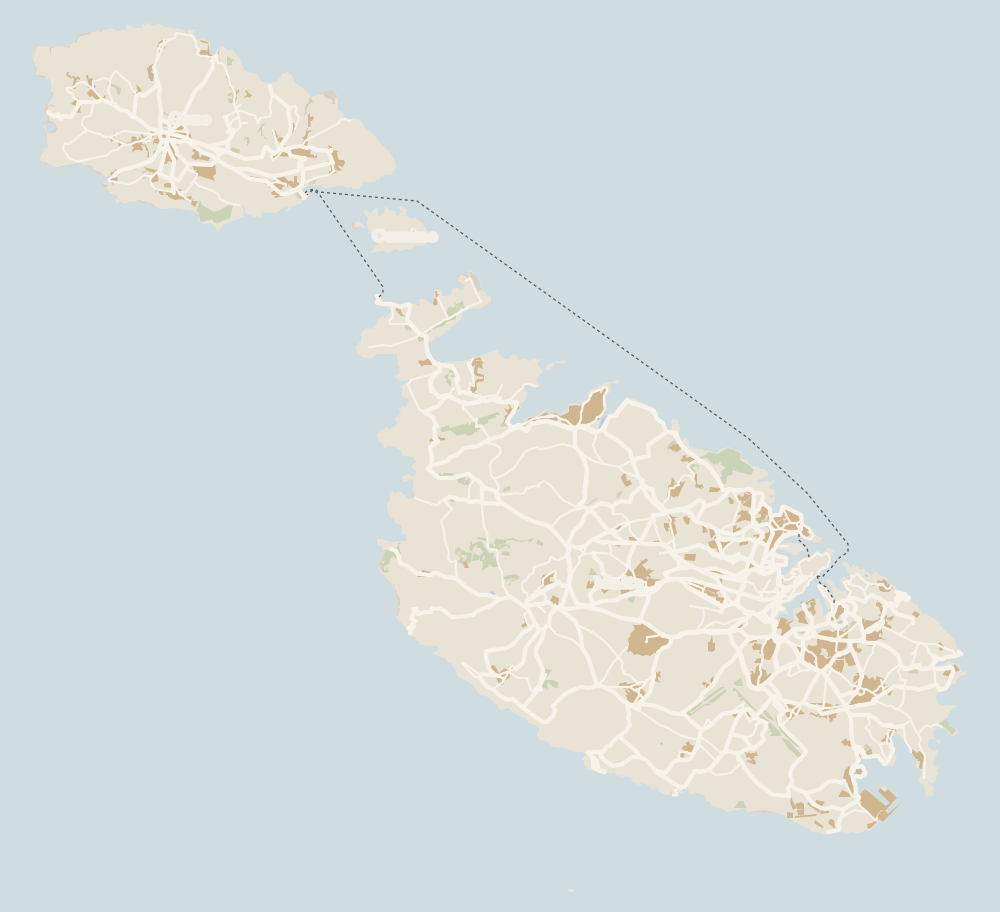
Map
Where Xewkija Rotunda is
Gozo lies to the north-west, across the channel the ferry crosses from Ċirkewwa, with Comino between the two islands. Every number opens its guide.
0 of 279 Malta guides
Your next stamp
- Xewkija
- Churches
- Mosta Rotunda
- Żebbuġ (Gozo)
- Prettiest villages
- Fontana
- Viewpoints
- Għasri
- Things to do in Malta
- Gozo
- Most beautiful places
- Comino
- UNESCO World Heritage Sites
- Where is Malta
- The Maltese islands
- Towns and villages
- Island of Malta
- Blue Lagoon
- Fort Rinella
- Fort St Angelo
- Gardjola Gardens
- Ħal Saflieni Hypogeum
- Is Malta a country?
- Popeye Village
- Tarxien Temples
- Things to do in Gozo
- Valletta
- Esplora
- Golden Bay
- Gozo day trip
- Inquisitor's Palace
- Population
- St John's Co-Cathedral
- St Mary's Tower
- Grandmaster's Palace
- How big is Malta
- Maritime Museum
- Mellieħa Bay
- Fort St Elmo
- Language
- Malta at War Museum
- Paradise Bay
- Barrakka Gardens
- Red Tower
- Religion
- Malta government
- Saluting Battery
- MUŻA
- National Museum of Archaeology
- Underground Valletta
- Lascaris War Rooms
- Casa Rocca Piccola
- Malta in one day
- Three Cities
- Victoria
- Birgu
- Manoel Theatre
- Weekend in Malta
- Xagħra
- City Gate and Parliament
- Malta in three days
- Nadur
- Senglea
- Cospicua
- Malta in four days
- Qala
- Valletta Waterfront
- Għajnsielem
- Kalkara
- Malta in five days
- Malta in a week
- Paola
- Sannat
- Tarxien
- Munxar
- Żabbar
- Fgura
- Kerċem
- Luqa
- Floriana
- Marsa
- Mellieħa
- The Citadel, Gozo
- Ġgantija Temples
- Marsalforn
- Santa Luċija
- Ramla Bay
- San Lawrenz
- Xgħajra
- Xwejni salt pans
- Calypso's Cave
- Għarb
- Żejtun
- Gudja
- San Blas Bay
- Għaxaq
- Ħondoq Bay
- Marsaxlokk
- Kirkop
- Marsaxlokk Fish Market
- Mqabba
- St Peter's Pool
- Marsaskala
- Qrendi
- Żurrieq
- Beaches
- Comino ferry
- EU, Schengen and the euro
- Ħaġar Qim and Mnajdra
- Mdina
- Mġarr (Gozo)
- Blue Grotto
- Diving
- Entry requirements
- Mdina Cathedral
- Birżebbuġa
- Money and payments
- Palazzo Falson
- Safi
- Shipwrecks
- Ta' Ċenċ Cliffs
- Għar Dalam
- Mdina Dungeons
- Mġarr ix-Xini
- Prices and budget
- Snorkelling
- Boat trips
- Malta on a budget
- Playmobil FunPark
- Rabat (Malta)
- Xlendi
- Dwejra
- Gozo beaches
- History
- Siġġiewi
- St Paul's Catacombs
- Tipping
- Azure Window
- Domvs Romana
- Għar Lapsi
- Great Siege of 1565
- Plugs
- Limestone Heritage Park
- Second World War
- St Paul's Grotto
- Ta' Pinu Basilica
- Time zone
- Buskett Gardens
- Knights of Malta
- Mobile and roaming
- Wied il-Għasri
- Dingli
- Maltese cross
- Dingli Cliffs
- Flag
- Żebbuġ
- Coat of arms
- Mtarfa
- Balzan
- National anthem
- Lija
- Malta facts
- Game of Thrones
- Iklin
- Attard
- Film locations
- Forts and fortifications
- San Anton Gardens
- Ta' Qali Crafts Village
- Victoria Lines
- Megalithic temples
- Catacombs
- Museums
- Where to eat
- Where to stay
- Hotels in Valletta
- Restaurants in Valletta
- Hotels in Sliema
- Maltese food
- Restaurants in Marsaxlokk
- Hotels in St Julian's
- Pastizzi
- Walking and hiking
- Hotels in Buġibba and Qawra
- Maltese rabbit stew
- Safety
- Hotels in Mellieħa
- Kinnie and Cisk
- Scams
- Gozo hotels
- Nightlife
- Tap water
- Boat parties
- Holiday packages
- Tourist tax
- All inclusive
- Gay Malta
- Sightseeing passes
- Apartments
- Malta with kids
- Public holidays
- How to get there
- Luxury
- Malta for couples
- Taxis and ride-hailing
- Weather
- Best time to visit
- Cycling
- English schools
- Flights
- Flights from Madrid
- Sea temperature
- Shopping and souvenirs
- Airport
- Free walking tours
- In winter
- Airport transfers
- Day trips and tours
- In summer
- Ferry from Sicily
- In January
- Cruise stop
- In February
- In March
- In April
- In May
- Getting around
- In June
- Buses
- July
- August
- Hop on hop off
- Gozo ferry
- September
- Gozo fast ferry
- October
- November
- Valletta ferries
- Car hire
- December
- Driving
- Events
- St Paul's Bay
- Village feasts
- Buġibba
- Christmas
- Easter
- Qawra
- Carnival
- Xemxija
- Fireworks festival
- Malta National Aquarium
- Isle of MTV
- St Paul's Islands
- Mosta
- Naxxar
- Palazzo Parisio
- Għargħur
- Mġarr (Malta)
- Sliema
- Ta' Ħaġrat and Skorba Temples
- Għajn Tuffieħa Bay
- Tigné Point
- Ġnejna Bay
- St Julian's
- Paceville
- St George's Bay
- Gżira
- Msida
- Ta' Xbiex
- Pietà
- Pembroke
- Swieqi
- San Ġwann
- Birkirkara
- Ħamrun
- Santa Venera
- Qormi
Frequently asked questions
What is the Xewkija Rotunda?
It's the parish church of St John the Baptist in Xewkija, Gozo, a huge circular building with a dome, hence the name. It's the largest church on the island.
How big is the dome of the Xewkija Rotunda?
The Ministry for Gozo gives 75 metres high, 85 metres round, 27 or 28 metres wide depending on the page, and an estimated weight of about 45,000 tonnes.
Is it the third largest dome in the world?
The parish says so, and Mosta makes its own claim, and the two don't add up. I wouldn't take any ranking as fact and would go by the measurements instead.
Can you go up the dome?
Yes. A lift runs up from the Sculpture Museum, with views over Gozo and, on a clear day, Malta. No price is published.
Who designed the Xewkija Rotunda?
The architect Joseph D'Amato, inspired by Santa Maria della Salute in Venice. He died halfway through, and the master mason Ġużepp Vella saw the dome through to the end.
When is the Rotunda's feast day?
St John the Baptist is celebrated on the Sunday nearest 24 June. In 2026 that was 21 June.
By
Tourism graduate with a master’s in Tourism Management and Planning from the University of Málaga, who has travelled across Europe. He writes every guide from official sources and his own judgement.
Published on . Facts checked on .
Sources
Photos: CEphoto, Uwe Aranas (CC BY-SA 3.0); VillageHero from Ulm, Germany (CC BY-SA 2.0), via Wikimedia Commons.