World Heritage in Peja
The Patriarchate of Peć, four churches at the mouth of the Rugova Canyon
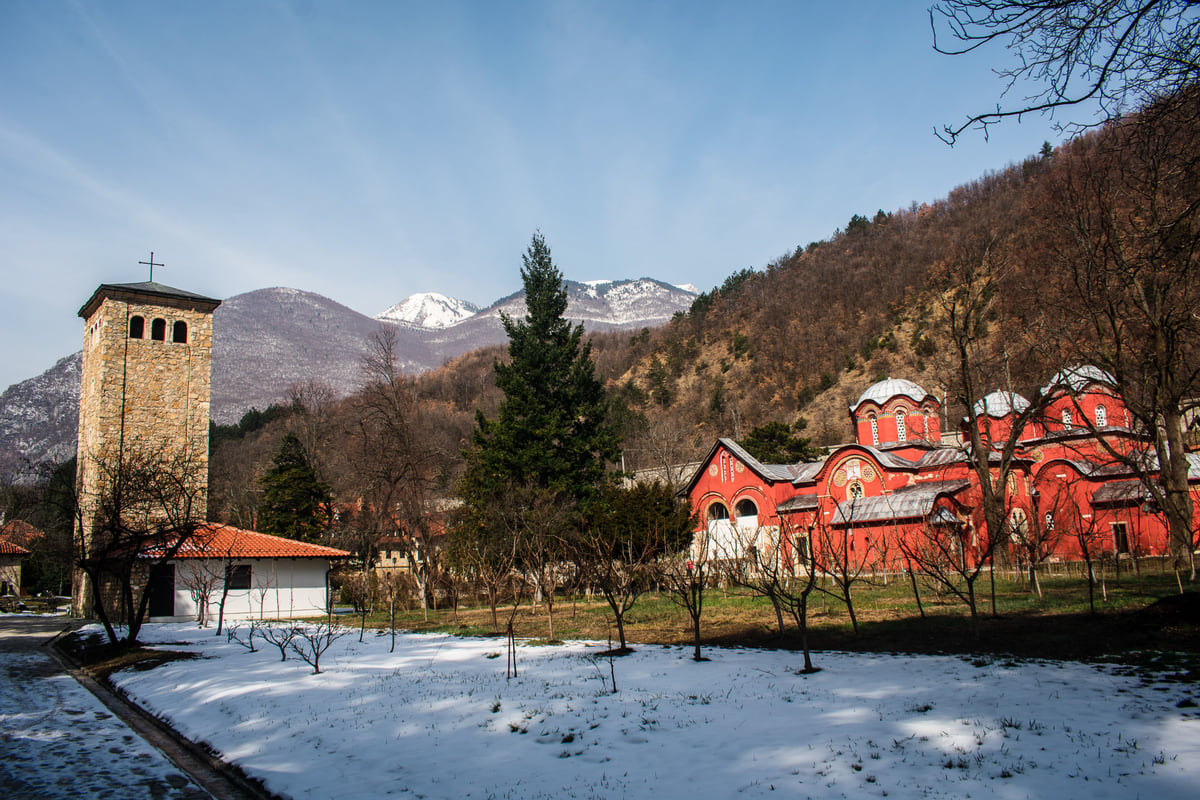
The Patriarchate of Peć (Patrikana e Pejës in Kosovo law) is an Orthodox monastery on the western edge of Peja. UNESCO added it in 2006 to the Medieval Monuments in Kosovo and describes it as four domed churches with wall paintings, the frescoes of the Church of the Holy Apostles dating from the 13th century. It has been on the In Danger list since 2006.
In 30 seconds
Full read: 3 min
- The Patriarchate of Peć is an Orthodox monastery of four churches on the edge of Peja.
- It joined the UNESCO property Medieval Monuments in Kosovo in 2006.
- The whole property has been on the List of World Heritage in Danger since 2006.
- Kosovo's Law 03/L-039 protects it as a Special Zone.
I would always pair it with the first stretch of the Rugova Canyon, which starts right behind it. Go early, unhurried and away from tour groups; it is a working monastery and is best taken in quietly.

Before you go
What I would keep in mind
-
01 Most beautiful
Thirteenth-century frescoes
UNESCO singles out the wall paintings of the Church of the Holy Apostles, from the 13th century, within the group of four domed churches.
Peja -
02 Getting there
Right at the mouth of the canyon
The monastery sits on the west side of Peja, where the road begins to squeeze into the Rugova Canyon. Do both on the same outing.
Rugova Canyon -
03 My tip
One of four components
Kosovo's UNESCO site has four parts. The nearest to the Patriarchate is Visoki Dečani, also in the west, in Deçan municipality.
Visoki Dečani Monastery
What I would book
Some monuments you visit; others make more sense once you see where they stand. The Patriarchate of Peć is one of the latter. It sits on the western edge of Peja, exactly where the town gives out and the road starts to squeeze into the Rugova Canyon, and that position between farmland and mountain wall explains much of its pull.
Four churches, one cluster of domes
In UNESCO’s description the Patriarchate is four domed, painted churches, and the oldest frescoes, in the Church of the Holy Apostles, go back to the 13th century. On OpenStreetMap the four appear under their Serbian names, the Holy Apostles, St Demetrius, the Virgin Hodegetria and St Nicholas. From outside you see a tight cluster of reddish buildings with the mountains behind; inside, the paintwork is the point.
I won’t walk you through the iconography wall by wall, because I have no official source that details it and I would rather not repeat unsigned material. What I can say is that UNESCO places the ensemble within the Byzantine-Romanesque church culture of the medieval Balkans, which ran from the 13th century until the 17th, the same thread that ties the whole property together.
One of the four Medieval Monuments
The Patriarchate is component 724-002bis of the serial property Medieval Monuments in Kosovo. In 2004 the listing covered only Visoki Dečani monastery, and extended in 2006 with the Patriarchate, the Church of the Virgin of Ljeviš in Prizren and Gračanica monastery. All four have been on the List of World Heritage in Danger since 2006. The full picture is in Kosovo’s UNESCO sites.
One point on neutrality that I think is fair to make. UNESCO lists the property under the State Party «Serbia» and adds that its maps and names imply no view on the legal status of any territory. Kosovo protects it under its own law. For a visitor the practical upshot is simply that you see it from Peja, like any other sight in the west.
To sleep close to everything, search places to stay in Peja on Expedia and filter by area before price.
What the Special Zones law says
Passed in 2008, Law 03/L-039 sets up protected areas around Orthodox monasteries and churches and a handful of non-religious sites. The Patriarchate appears in article 7.1 b, among the zones with an annexed map. UNESCO, for its part, gives the component 1.5335 hectares and a buffer zone of 99.8054, close to a hundred, reaching up to the first slopes.
None of this changes much for your visit, except that it helps to treat the grounds as a protected place rather than one more viewpoint on the way to Rugova. The FCDO’s advice for Kosovo does note that terrorist attacks cannot be ruled out and may target religious sites, churches included. That is a general warning for the whole territory, not about this monastery, and I mention it only because the FCDO gives it.
What to expect when you go
Honestly, I haven’t found opening hours, an entry fee or visiting rules for the Patriarchate anywhere official, and the government’s tourism portal is offline for rebuilding. So I follow the rule for any working monastery, which is to go in the morning, unhurried, modestly dressed and quietly, and to ask before taking a camera into the churches. If a service is on, wait outside, and keep voices down in the courtyard as well as in the churches.
From central Peja it is a few minutes by car or taxi. I’d link it with the first kilometres of the Rugova Canyon, which starts just behind, and leave the afternoon for the bazaar and the Bajrakli Mosque in Peja.
If you are short on time, see the best tours in Patriarchate of Peć and pick one that fits your day.
Worth it if you have already seen Dečani?
Yes, for a simple reason. Dečani is one large stone church in a valley; the Patriarchate is a huddle of churches at the foot of the mountain, at another scale and in another light. Both are in the west, in neighbouring municipalities, so if you are covering that side of Kosovo it makes sense to see them on the same trip. Short of time for both? Let your taste decide, painting spread over a cluster of chapels or the stonework of a single large church. I cover the second in Visoki Dečani Monastery.
To sleep close to everything, search places to stay in Peja on Booking.com and filter by area before price.
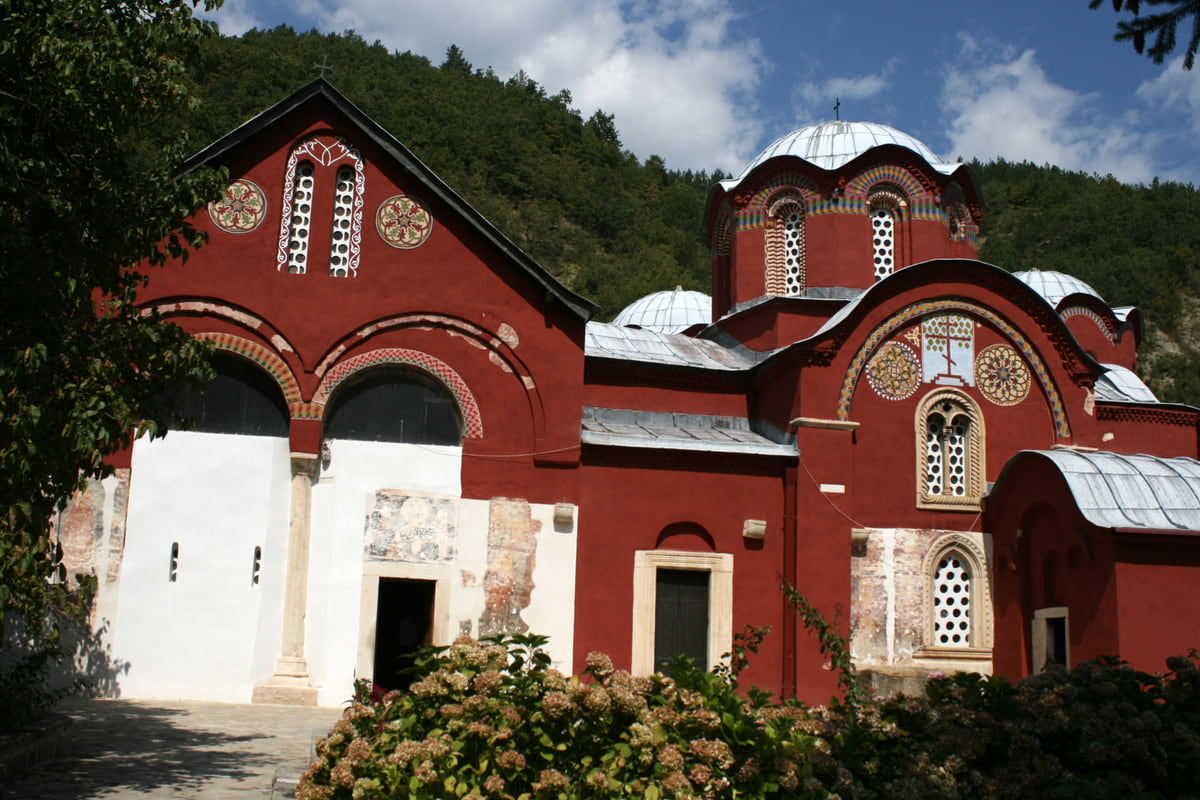
The red facades and domes of the church complex of the Patriarchate of Peć, among trees under a cloudy sky
The Patriarchate within the UNESCO site
| Item | Detail |
|---|---|
| Property | Medieval Monuments in Kosovo |
| Component | 724-002bis, Patriarchate of Peć Monastery |
| UNESCO coordinates | N42 39 0 E20 15 0 |
| Area | 1.5335 ha |
| Buffer zone | 99.8054 ha |
| Inscription | 2004 for the property, 2006 for the extension with the Patriarchate |
| In Danger list | Since 2006 |
UNESCO World Heritage Centre, property 724 and its component map. UNESCO lists the property under the State Party «Serbia» and notes that its maps imply no opinion on the legal status of any territory.
The churches of the complex on OpenStreetMap
| Name on OpenStreetMap | Dedication |
|---|---|
| Crkva sv. Apostola | Holy Apostles |
| Crkva sv. Dimitrija | St Demetrius |
| Crkva Bogorodice Odigitrije | Virgin Hodegetria |
| Crkva sv. Nikole | St Nicholas |
© OpenStreetMap contributors, ODbL. UNESCO speaks of four domed churches; the names are taken from OpenStreetMap.
Test yourself
True or false?
0/3 Pick before you peek.
-
The Patriarchate of Peć was the first site in Kosovo inscribed by UNESCO.
See the answer
False. The first was Visoki Dečani, in 2004. The Patriarchate joined in 2006, when the property was extended with its three other components.
-
The frescoes of the Church of the Holy Apostles date from the 13th century.
See the answer
True. That is what the property description on the UNESCO World Heritage Centre website says.
-
The Patriarchate has a buffer zone of almost 100 hectares.
See the answer
True. UNESCO gives 1.5335 ha for the component and 99.8054 ha for its buffer zone.
- Domed churches
- 4
- Frescoes of the Holy Apostles
- 13th c.
- Added to the UNESCO property
- 2006
- Buffer zone
- 99.8 ha
Map
Where Patriarchate of Peć is
The Bjeshkët e Nemuna mountains close off the west and the Sharr the south; in the middle lies the Pristina plain. Every number opens its guide.
 1Rugova Canyon 2Patriarchate of Peć 3Radavc Cave 4Bajrakli Mosque 5Peja 6Peja bazaar
 Map data © OpenStreetMap contributors (ODbL)
0 of 208 Kosovo guides
Your next stamp
- Peja
- UNESCO sites
- Peja region
- Places to visit
- Gračanica Monastery
- Kosovo monasteries
- Istog
- Gjakova Grand Bazaar
- Gjeravica
- Pristina region
- Visoki Dečani Monastery
- Bjeshkët e Nemuna National Park
- Hadum Mosque
- Mitrovica Region
- Things to do
- Most beautiful places
- Sheh Danjolli tekke
- Prettiest villages
- Tailors' Bridge
- Rugova Canyon
- Gjakova
- Map
- Where is Kosovo
- Regions
- Municipalities
- Cities
- Mitrovica
- Pristina
- Prizren
- Rugova via ferrata
- Fushë Kosovë
- Population
- Vushtrri
- Podujeva
- Radavc Cave
- Size
- Bajrakli Mosque
- Devič Monastery
- Gazimestan
- Ibar Bridge
- Is it a country?
- One day in Pristina
- Prizren region
- Ulpiana
- Vushtrri Stone Bridge
- Gadime Cave
- Klina
- Name
- Vushtrri Fortress
- Deçan
- Flag
- Isa Boletini Complex
- Novo Brdo Fortress
- History
- Junik
- Lake Batllava
- Zvečan Fortress
- Banjska Monastery
- Ferizaj region
- Languages
- Rahovec
- Ferizaj
- Religion
- Sokolica Monastery
- Currency
- Lake Gazivoda
- Štrpce
- Brezovica
- EU membership
- Entry requirements
- Skiing in Kosovo
- Kaçanik
- Serbian border
- Gračanica
- Guesthouses in Rugova
- Hotels in Peja
- Kaçanik fortress
- Newborn monument
- North Mitrovica
- One day in Prizren
- Peja bazaar
- Public holidays
- Velika Hoča
- Facts
- Gjakova region
- Hani i Elezit
- Hotels in Gjakova
- National Library
- Obiliq
- Zočište Monastery
- Drenas
- Mother Teresa Cathedral
- Shtime
- Skënderaj
- Lipjan
- Mother Teresa Boulevard
- Zvečan
- Kosovo Museum
- Leposavić
- Novo Brdo
- Emin Gjiku Ethnological Museum
- Janjevo
- Zubin Potok
- Imperial Mosque
- Pristina Clock Tower
- Pristina Old Bazaar
- Great Hammam of Pristina
- Bogë
- Germia Park
- Getting there
- Lake Radoniq
- Prizren Fortress
- Bear Sanctuary Prishtina
- Drelaj
- Flights
- Sinan Pasha Mosque
- Hotels in Pristina
- Pristina airport
- Prizren stone bridge
- Buses
- Grand Hotel Pristina
- Our Lady of Ljeviš
- Prizren hammam
- Swiss Diamond Hotel
- Tirana to Pristina
- League of Prizren
- Restaurants in Pristina
- Skopje to Pristina
- Belgrade to Pristina
- Prizren Archaeological Museum
- Balkans itinerary
- St George's Cathedral
- Church of the Holy Saviour
- Getting around
- Holy Archangels Monastery
- Trains
- Car hire
- Day trips
- Marash
- Driving
- Sharr National Park
- Taxis
- Distances
- Prevalla
- Dragash
- Road trip
- Brod
- Prices and budget
- On a budget
- Restelica
- Free things to do
- Mirusha waterfalls
- Malisheva
- Safety
- Mamusha
- Scams
- Healthcare
- National parks in Kosovo
- Nightlife
- Suhareka
- Mobile and roaming
- Mountains in Kosovo
- Mushtisht
- Hiking in Kosovo
- Korisha
- Packing list
- DokuFest
- Peaks of the Balkans
- With kids
- Holidays
- Hotels in Prizren
- Kosovo lakes
- 3 days
- Caves and waterfalls
- Restaurants in Prizren
- 5 days
- One week
- Gjilan region
- Kosovo food
- Sunny Hill Festival
- Gjilan
- Rahovec wine
- Atik Mosque, Gjilan
- Kosovo beer
- Draganac Monastery
- Where to eat in Kosovo
- Kamenica
- Where to stay in Kosovo
- Kllokot
- Weather in Kosovo
- Best time to visit Kosovo
- Partesh
- Kosovo in winter
- Ranillug
- Kosovo in spring
- Viti
- Kosovo in summer
- Letnica
- Binač Monastery
- Kosovo in autumn
- Events in Kosovo
- Independence Day
- Mosques in Kosovo
- Kullas in Kosovo
- Castles in Kosovo
- Museums in Kosovo
- Bazaars in Kosovo
Frequently asked questions
What is the Peja Patriarchate?
An Orthodox monastery on the edge of Peja made up of four domed churches with wall paintings, as UNESCO describes it. It is one of the four components of the World Heritage property Medieval Monuments in Kosovo.
Why is it on the List of World Heritage in Danger?
UNESCO placed the whole Medieval Monuments in Kosovo property on the In Danger list in 2006, and it remains there. I could not read its detailed conservation reports from an official page, so I won't summarise them.
Where exactly is the Patriarchate of Peć?
On the western side of Peja, at the entrance to the Rugova Canyon. UNESCO gives the component's coordinates as N42 39 0 E20 15 0.
Can you visit the Patriarchate of Peć?
It is a working monastery. No official source I could read publishes opening hours or an entry fee, so I'd go in the morning, dressed modestly, and follow whatever you are asked at the gate.
How is it protected under Kosovo law?
Law 03/L-039 on Special Protective Zones, passed in 2008, lists it in article 7.1 b as «Patrikana e Pejës, Pejë», one of the zones with an annexed map.
By
Tourism graduate with a master’s in Tourism Management and Planning from the University of Málaga, who has travelled across Europe. He writes every guide from official sources and his own judgement.
Published on . Facts checked on .
Sources
Some links in this guide are affiliate links: if you book through them, the site earns a commission at no extra cost to you. Affiliate disclosure
Photos: Tom.whitehead337 (CC BY-SA 4.0); Quinn Dombrowski (CC BY-SA 2.0), via Wikimedia Commons.