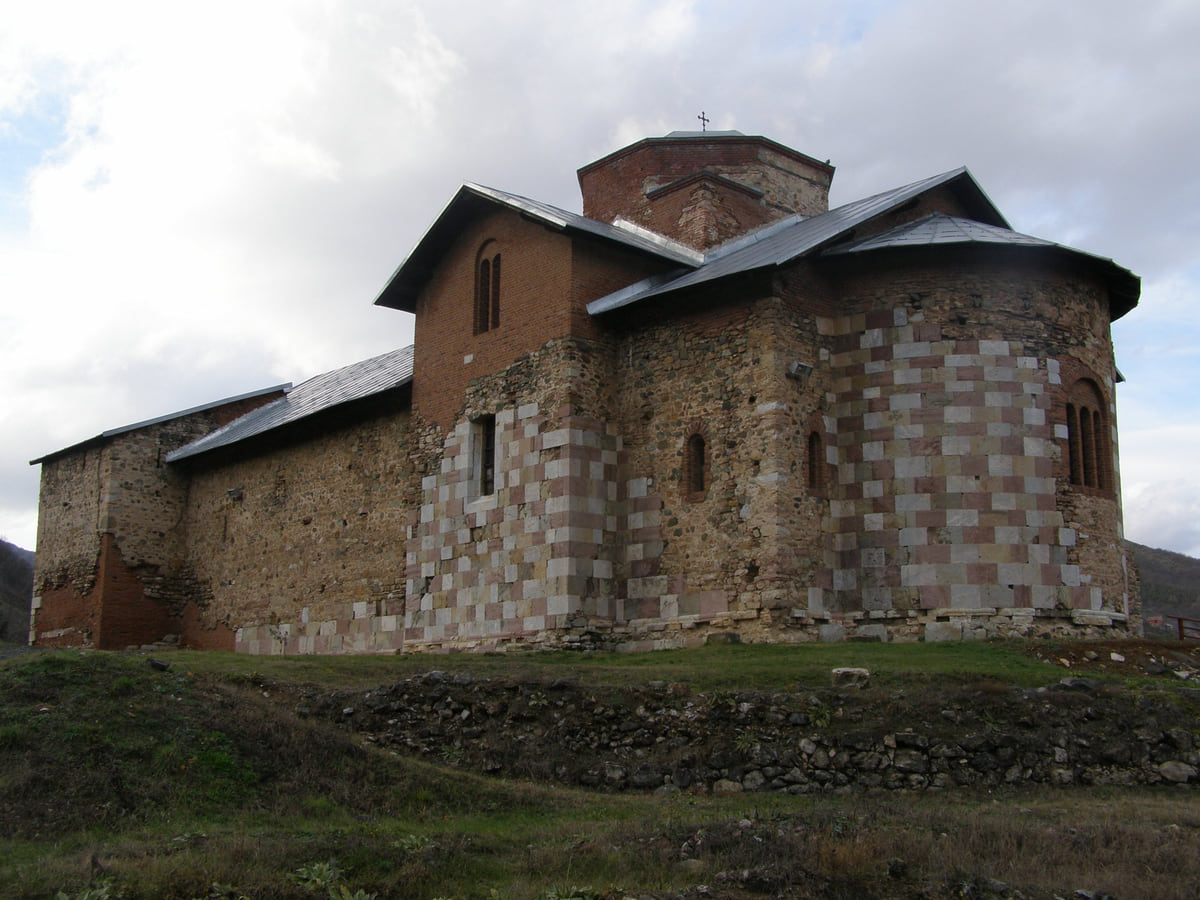
Special Protective Zone, 14th century
Banjska monastery, seven centuries in northern Kosovo
Banjska monastery (Manastiri i Banjskës in the law, Manastir Banjska in Serbian) lies in Zvečan municipality, about 12 km from Mitrovica. The Eparchy of Raška-Prizren presents it as King Milutin's foundation, built in 1313, with its church dedicated to St Stephen. Monastic life returned in 2004, and a 2008 law protects it as a Special Zone.
In 30 seconds
Full read: 3 min
- Banjska monastery is, according to the Eparchy, King Milutin's foundation of 1313-1317, dedicated to St Stephen and built as his mausoleum.
- Monastic life returned on 15 August 2004, and its feast is celebrated every 15 August.
- It's a Special Protective Zone with no published visiting hours.
If you only see one monastery in the north, I'd make it Banjska, for its royal foundation and because the story of the marble Virgin now kept at Sokolica begins here. I'd go by day, dressed modestly, having read the FCDO advice.

Before you go
What I would keep in mind
-
01 Most beautiful
The marble Virgin that left from here
The Ministry of Culture says a marble sculpture of the Virgin and Child, from 1312-1316, was taken from Banjska to Sokolica to keep it safe.
Sokolica monastery -
02 My tip
15 August is the big day
The church is dedicated to St Stephen and the monastery's feast falls on 15 August, with a liturgy and procession, according to the Eparchy. Expect crowds.
-
03 Getting there
Zvečan, about 8 km away
The town of Zvečan, with its medieval fortress and the Isa Boletini complex, is about 8 km away as the crow flies.
Zvečan -
04 Getting there
Leposavić, further north
About 15 km away in a straight line lies Leposavić, home to Sočanica monastery and the Roman town of Municipium DD.
Leposavić
Of the northern monasteries, Banjska has the fullest history set down by its own diocese. The Eparchy of Raška-Prizren calls it the golden monastery, presents it as a king’s foundation and writes about it every 15 August. What follows comes from there, from the Special Zones law and from Kosovo’s Ministry of Culture, and I attribute each piece to its source.
A church built for a king
According to the Eparchy, King Milutin built the church between 1313 and 1317 as his mausoleum, and in 2013 the monastery marked 700 years since it went up. Its first abbot was Danilo II, previously abbot of Hilandar on Mount Athos. The same source sums up its history as seven centuries of destruction, looting, fire, abandonment and a spell as a mosque, each followed by rebuilding. The church is dedicated to St Stephen, protomartyr and archdeacon, and the monastery’s feast falls on 15 August, the day his relics were translated.
Milutin was buried here, but he didn’t stay. After 1389 his remains went to Trepča, in 1460 to the monastery of Gorna Banja, and since 1867 they have rested in St Nedelya church in Sofia, where a yearly ceremony with the relics is attended by the Serbian embassy. On 15 August 2004, after 520 years of abandonment, monastic life returned, with a liturgy led by Patriarch Pavle.
What you see, and what ended up in Belgrade
The Tabula Imperii Byzantini, the Austrian Academy of Sciences’ database, describes a single-nave church with a dome, modelled on Studenica, with two bell towers at the west end and Romanesque carving probably by the same craftsmen who worked at Hilandar. Little of the painting survives, mostly under the dome. Several pieces from here are now in Belgrade, among them a gold ring with the double-headed eagle found in a tomb in the church, at the National Museum, and Milutin’s embroidered burial shroud, at the Museum of the Serbian Orthodox Church. I find that scattering part of the story, because it explains why the building impresses more from outside than in.
To sleep close to everything, search places to stay in Pristina on Expedia and filter by area before price.
The Virgin that went to Sokolica
One piece that isn’t at Banjska still tells its story. In its record for Sokolica monastery, the Ministry of Culture explains that Sokolica holds an early 14th-century marble Virgin and Child that was carried over from Banjska for safekeeping. Visit both and that’s the thread that links them.
Where it is
It stands in Zvečan municipality beside the village of Banjskë, which had two residents at the 2024 census. OpenStreetMap places it about 8 km from Zvečan town, 12 km from Mitrovica and 46 km from Pristina in a straight line. It isn’t in the Ministry of Culture database; its protection comes from the 2008 Law 03/L-039, which lists it among the Special Zones with a map of its own. Among the aims set by that law is, word for word, preserving the monastic way of life of the clergy and the visual setting.
If you are short on time, see the best tours in Banjska Monastery and pick one that fits your day.
Visiting
Opening times, tickets and visiting rules aren’t published anywhere official that I’ve looked. It’s a lived-in monastery, which tells you how to behave, by day, modestly dressed and asking before you take photos. On 15 August there’s a liturgy and procession, so expect a crowd. The entrance gate you’ll see is new. The old one was destroyed on 24 September 2023, the day of the armed attack on Kosovo Police in Banjska that the EU condemned, and the monks of Hilandar made the current one in 2024, according to the Eparchy.
The FCDO says things in the north have improved since 2024 but remain politically sensitive, with incidents and protests possible at short notice, and it names Zvečan among the municipalities at risk of protests, so I’d check its page on the morning of the trip. Remember too that your UK GHIC won’t be accepted in Kosovo, so travel insurance matters on rural day trips like this. From here the north carries on to Leposavić, while to the south, in the Drenica area, there’s the convent of Devič. Both monasteries are reached by road only, so plan this as a car day. Zvečan fortress fits into the same outing.
To sleep close to everything, search places to stay in Pristina on Booking.com and filter by area before price.
Banjska monastery in its sources
| Detail | Value | Source |
|---|---|---|
| Founder | King Milutin | Eparchy of Raška-Prizren |
| Built | 1313-1317 (700th anniversary in 2013) | Eparchy of Raška-Prizren |
| Dedication | St Stephen, protomartyr and archdeacon | Eparchy of Raška-Prizren and OpenStreetMap |
| Monastery feast | 15 August, translation of St Stephen's relics | Eparchy of Raška-Prizren |
| Monastic life | Restored on 15 August 2004 | Eparchy of Raška-Prizren |
| First abbot | Danilo II, 1313 to 1317 | Eparchy of Raška-Prizren |
| Plan | Single nave with a dome, modelled on Studenica, two bell towers on the narthex | Austrian Academy of Sciences (TIB) |
| Sculpture | Romanesque, probably by the craftsmen who worked at Hilandar | Austrian Academy of Sciences (TIB) |
| King Milutin | Buried here; his relics have been in St Nedelya, Sofia, since 1867 | Eparchy of Raška-Prizren |
| Entrance gate | New, made by the Hilandar monks and fitted in 2024 | Eparchy of Raška-Prizren |
| Protection | Special Protective Zone | Law 03/L-039, art. 7.1 k |
Checked on 11 and 12 October 2026. None of the sources read publishes opening hours or visiting rules.
Test yourself
True or false?
0/3 Pick before you peek.
-
Banjska monastery celebrated its 700th anniversary in 2013.
See the answer
True. The Eparchy of Raška-Prizren held a jubilee that year marking 700 years since its construction in 1313.
-
Sokolica's marble Virgin originally came from Banjska.
See the answer
True. The Ministry of Culture says the sculpture, from 1312-1316, was moved from Banjska monastery to Sokolica for safekeeping.
-
Banjska is in Leposavić municipality.
See the answer
False. It's in Zvečan. Law 03/L-039 lists it as Banjska monastery, Zveçan.
Map
Where Banjska Monastery is
The Bjeshkët e Nemuna mountains close off the west and the Sharr the south; in the middle lies the Pristina plain. Every number opens its guide.
 1Isa Boletini Complex 2Zvečan Fortress 3Banjska Monastery 4Sokolica Monastery 5Zvečan
 Map data © OpenStreetMap contributors (ODbL)
0 of 208 Kosovo guides
Your next stamp
- Zvečan
- Devič Monastery
- Binač Monastery
- Sokolica Monastery
- Visoki Dečani Monastery
- Zočište Monastery
- Zvečan Fortress
- Gjakova Grand Bazaar
- Gjeravica
- Places to visit
- Pristina region
- Bjeshkët e Nemuna National Park
- Hadum Mosque
- Mitrovica Region
- Things to do
- Most beautiful places
- Sheh Danjolli tekke
- Prettiest villages
- Tailors' Bridge
- Rugova Canyon
- UNESCO sites
- Gjakova
- Map
- Where is Kosovo
- Regions
- Municipalities
- Cities
- Gračanica Monastery
- Mitrovica
- Patriarchate of Peć
- Pristina
- Prizren
- Rugova via ferrata
- Fushë Kosovë
- Population
- Vushtrri
- Podujeva
- Radavc Cave
- Size
- Bajrakli Mosque
- Gazimestan
- Ibar Bridge
- Is it a country?
- Istog
- One day in Pristina
- Peja
- Prizren region
- Ulpiana
- Vushtrri Stone Bridge
- Gadime Cave
- Klina
- Name
- Vushtrri Fortress
- Deçan
- Flag
- Isa Boletini Complex
- Novo Brdo Fortress
- History
- Junik
- Lake Batllava
- Ferizaj region
- Languages
- Rahovec
- Ferizaj
- Religion
- Currency
- Lake Gazivoda
- Štrpce
- Brezovica
- EU membership
- Entry requirements
- Skiing in Kosovo
- Kaçanik
- Serbian border
- Gračanica
- Guesthouses in Rugova
- Hotels in Peja
- Kaçanik fortress
- Newborn monument
- North Mitrovica
- One day in Prizren
- Peja bazaar
- Peja region
- Public holidays
- Velika Hoča
- Facts
- Gjakova region
- Hani i Elezit
- Hotels in Gjakova
- National Library
- Obiliq
- Drenas
- Mother Teresa Cathedral
- Shtime
- Skënderaj
- Lipjan
- Mother Teresa Boulevard
- Kosovo Museum
- Leposavić
- Novo Brdo
- Emin Gjiku Ethnological Museum
- Janjevo
- Zubin Potok
- Imperial Mosque
- Pristina Clock Tower
- Pristina Old Bazaar
- Great Hammam of Pristina
- Bogë
- Germia Park
- Getting there
- Lake Radoniq
- Prizren Fortress
- Bear Sanctuary Prishtina
- Drelaj
- Flights
- Sinan Pasha Mosque
- Hotels in Pristina
- Pristina airport
- Prizren stone bridge
- Buses
- Grand Hotel Pristina
- Our Lady of Ljeviš
- Prizren hammam
- Swiss Diamond Hotel
- Tirana to Pristina
- League of Prizren
- Restaurants in Pristina
- Skopje to Pristina
- Belgrade to Pristina
- Prizren Archaeological Museum
- Balkans itinerary
- St George's Cathedral
- Church of the Holy Saviour
- Getting around
- Holy Archangels Monastery
- Trains
- Car hire
- Day trips
- Marash
- Driving
- Sharr National Park
- Taxis
- Distances
- Prevalla
- Dragash
- Road trip
- Brod
- Prices and budget
- On a budget
- Restelica
- Free things to do
- Mirusha waterfalls
- Malisheva
- Safety
- Mamusha
- Scams
- Healthcare
- National parks in Kosovo
- Nightlife
- Suhareka
- Mobile and roaming
- Mountains in Kosovo
- Mushtisht
- Hiking in Kosovo
- Korisha
- Packing list
- DokuFest
- Peaks of the Balkans
- With kids
- Holidays
- Hotels in Prizren
- Kosovo lakes
- 3 days
- Caves and waterfalls
- Restaurants in Prizren
- 5 days
- One week
- Gjilan region
- Kosovo food
- Sunny Hill Festival
- Gjilan
- Rahovec wine
- Atik Mosque, Gjilan
- Kosovo beer
- Draganac Monastery
- Where to eat in Kosovo
- Kamenica
- Where to stay in Kosovo
- Kllokot
- Weather in Kosovo
- Best time to visit Kosovo
- Partesh
- Kosovo in winter
- Ranillug
- Kosovo in spring
- Viti
- Kosovo in summer
- Letnica
- Kosovo in autumn
- Events in Kosovo
- Independence Day
- Kosovo monasteries
- Mosques in Kosovo
- Kullas in Kosovo
- Castles in Kosovo
- Museums in Kosovo
- Bazaars in Kosovo
Frequently asked questions
Where is Banjska monastery in Kosovo?
In Zvečan municipality, northern Kosovo, beside the village of Banjskë. OpenStreetMap places it at 42.9717, 20.7824, about 12 km from Mitrovica and 46 km from Pristina as the crow flies.
Who founded Banjska monastery?
King Milutin, according to the Eparchy of Raška-Prizren, which calls it his foundation and marked 700 years since its construction, in 1313, with a jubilee in 2013.
Who is Banjska monastery dedicated to?
St Stephen, protomartyr and archdeacon. The monastery's feast is held on 15 August, the day of the translation of his relics, according to the Eparchy.
Can you visit Banjska monastery?
No official source I've read publishes opening hours or visiting rules. It has been a working monastery since 2004, so I'd go by day, dressed modestly, and ask before taking photos.
How is Banjska protected?
It's a Special Protective Zone under the 2008 Law 03/L-039, listed in article 7.1 k with a boundary map. One of the law's stated aims is to preserve the monastic way of life.
Where is King Milutin buried?
He was buried at Banjska, which he built as his mausoleum, but his remains were moved several times and have rested in St Nedelya church in Sofia since 1867, according to the Eparchy of Raška-Prizren.
By
Tourism graduate with a master’s in Tourism Management and Planning from the University of Málaga, who has travelled across Europe. He writes every guide from official sources and his own judgement.
Published on . Updated on . Facts checked on .
Sources
- Eparchy of Raška-Prizren, Banjska's 700th anniversary
- Eparchy of Raška-Prizren, Banjska feast day 2025
- Kosovo Ministry of Culture, Sokolica monastery
- Law 03/L-039 on Special Protective Zones
- GOV.UK, Foreign travel advice: Kosovo
- Eparchy of Raška-Prizren, Banjska's new gate (2024)
- European External Action Service, statement of 24 September 2023
Some links in this guide are affiliate links: if you book through them, the site earns a commission at no extra cost to you. Affiliate disclosure
Photos: Vanjagenije (CC BY-SA 3.0), via Wikimedia Commons.