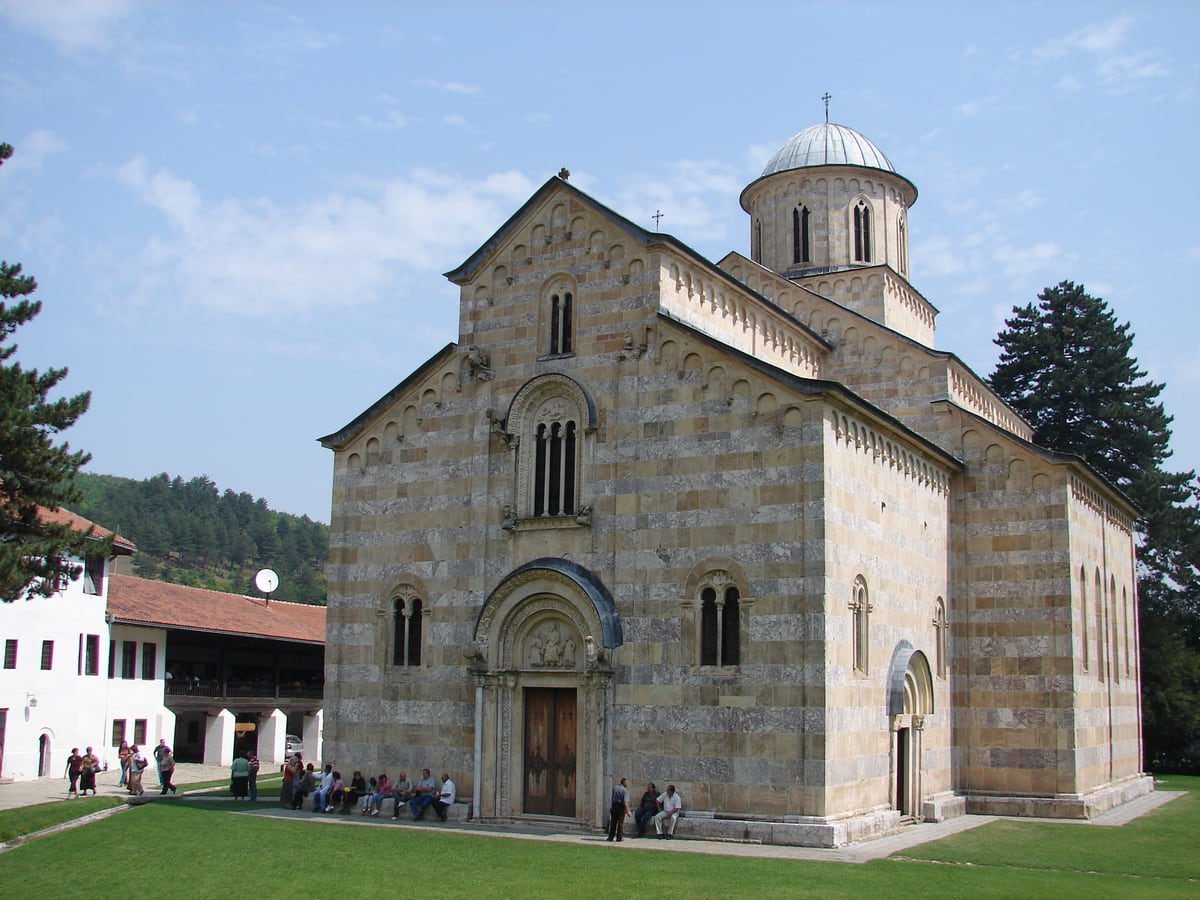
UNESCO World Heritage since 2004
Visoki Dečani, the great medieval monastery of western Kosovo
Visoki Dečani Monastery (Manastiri i Deçanit in Albanian) stands in Deçan municipality, western Kosovo. UNESCO inscribed it in 2004 as the first component of the Medieval Monuments in Kosovo; it was built in the mid-14th century for the Serbian king Stefan Dečanski and is his mausoleum. It has been on the List of World Heritage in Danger since 2006.
In 30 seconds
Full read: 3 min
- Visoki Dečani is a 14th-century monastery in Deçan, western Kosovo.
- It was the first component of the Medieval Monuments in Kosovo to be inscribed, in 2004.
- It has been on the danger list since 2006.
- No official source publishes visiting hours or a price.
This is a working monastery, not a museum. I would go in the morning, with shoulders and legs covered, unhurried and ready to follow whatever rules you are given at the gate. What you see inside is worth any formality.

Before you go
What I would keep in mind
-
01 Most beautiful
More than a thousand painted figures
UNESCO's description mentions well-preserved Byzantine painting covering almost the whole church interior, with more than a thousand depictions of saints.
UNESCO sites in Kosovo -
02 Most beautiful
A treasury of icons
The same description cites around 60 icons from the 14th to 17th centuries, and the government tourism portal also highlights manuscripts, old books and precious metalwork.
Kosovo monasteries -
03 My tip
Two UNESCO sites in a day
With the Patriarchate of Peć close by, the west lets you see two of Kosovo's four UNESCO monuments on the same day.
Patriarchate of Peć -
04 Getting there
Stay in Peja or Gjakova
There is no official accommodation data for Deçan. Peja and Gjakova hold the west's beds and are close by.
Deçan
What I would book
If I had to pick one place in Kosovo for someone travelling for medieval art, it would be this. Visoki Dečani is a large monastery in a valley at the foot of the mountains, with a church UNESCO itself calls the largest of the medieval churches in the Balkans and an interior painted almost from top to bottom.
What it is and who built it
Known in Albanian as Manastiri i Deçanit, Visoki Dečani stands in Deçan municipality, western Kosovo. According to UNESCO, it dates from the mid-14th century and was commissioned by the Serbian king Stefan Dečanski, who is buried in its church. The government of Kosovo’s tourism portal, in its 2021 archive copy, presents it as a cultural heritage monument and adds that it stands beside the Bistrica river, below the slopes of Bjeshkët e Nemuna.
In 2004 it became the first inscribed part of the «Medieval Monuments in Kosovo». Two years on, in 2006, the Patriarchate of Peć, Gračanica and the Ljeviš church in Prizren joined it, and the whole property went on UNESCO’s danger list at the same time. It hasn’t come off since. UNESCO files the property under «Serbia» as State Party, with a disclaimer that its maps and names carry no position on any territory’s status; I keep to what it says about the buildings.
What you will see
UNESCO’s description in its Russian version is the most detailed. It speaks of the last major phase of Byzantine-Romanesque architecture in the area, of very well-preserved Byzantine painting covering almost the entire church interior with more than a thousand figures of saints, of abundant Romanesque sculpture and of a treasury of around 60 icons from the 14th to the 17th century. The text common to every language version describes the four sites together as the peak of Byzantine-Romanesque church building, with a distinctive way of painting walls that spread across the Balkans from the 1200s onwards.
The government tourism portal agrees on the essentials and singles out the icon collection, manuscripts, old books and precious metalwork in the treasury. What would hold me longest is the painting, the reason I would plan the day around this visit. Seeing a complete cycle of medieval frescoes in place, with almost nothing missing, is not something you get often.
Once your dates are set, check which hotels are still free in Peja before prices climb.
A Special Protective Zone with monastic life
Kosovo’s Special Protective Zones law covers the monastery, and its zone is identical to the «Special Zone» that existed before. The law says these zones aim to ensure the peaceful functioning of the protected sites and preserve monastic life, bans new industry, mining, dams or transit roads inside them, and makes shops, hotels, bars, gatherings and shows subject to the Serbian Orthodox Church’s consent.
For you, that boils down to something simple. You are visiting a monastery with a community living in it, not a tourist attraction, and the visit follows their rules.
What is a visit like?
Let me be frank. No official source I could open gives opening hours, a price or visiting rules; the monastery’s own website returned an access error when I checked and the government tourism portal is being rebuilt. So I will not give you times.
Here is what I would do. Arrive early in the morning, with plenty of time in hand. Carry your passport, as you should anywhere in Kosovo. Cover shoulders and legs, keep your voice down in the church and ask before using a camera. The FCDO notes that terrorism cannot be ruled out in Kosovo and that religious sites may be targets; it does not say this about this monastery in particular, but it is one more reason to follow any security instructions without argument. And since your GHIC is not valid in Kosovo, check that your travel insurance covers medical care before the trip.
Once your dates are set, check which hotels are still free in Peja before prices climb.
Fitting it in
The most practical plan is to stay in Peja or Gjakova and drive over in the morning. From Peja, the Patriarchate is on the edge of town, so in one day you see two of the territory’s four UNESCO monuments. All four, with their context, are on UNESCO sites in Kosovo, and the other protected Orthodox monasteries on Kosovo’s Orthodox monasteries.
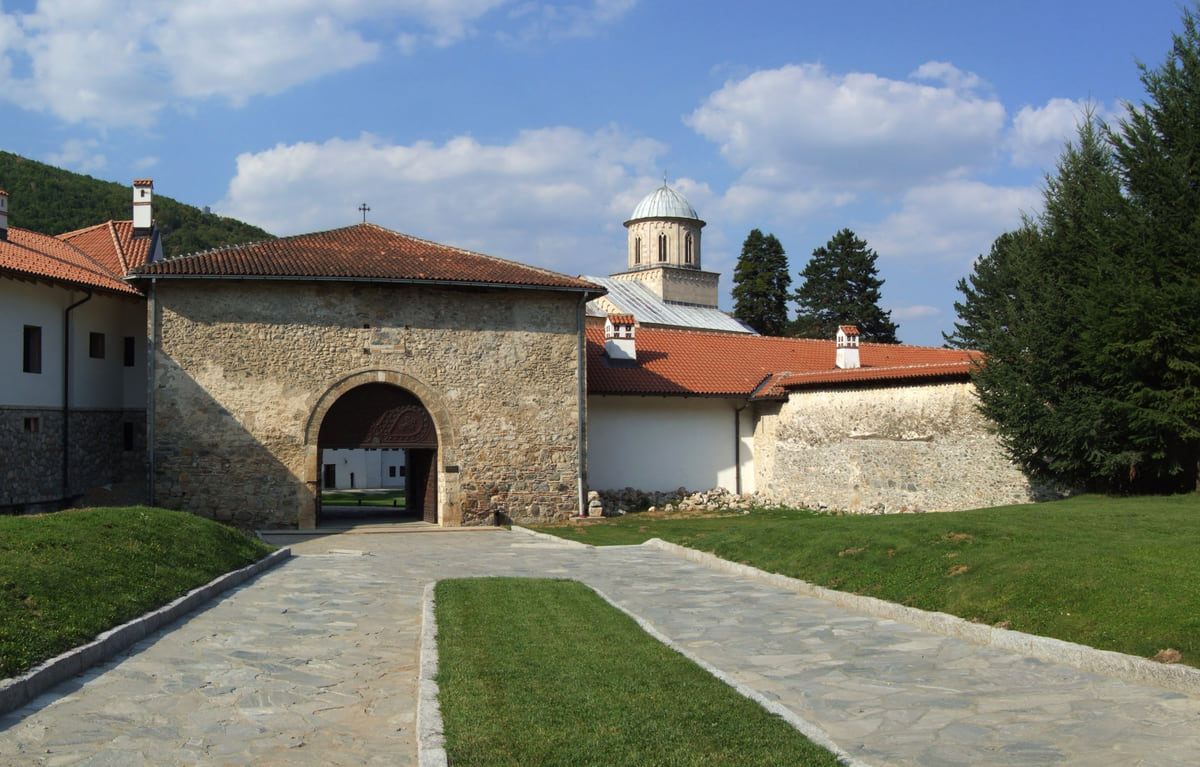
The main gate of Visoki Dečani Monastery, a stone archway with a tiled roof and the bell tower behind
Visoki Dečani at UNESCO
| Item | Detail |
|---|---|
| Property | Medieval Monuments in Kosovo (724) |
| Component | 724-001, Dečani Monastery |
| Inscription | 2004; property extended in 2006 |
| Criteria | (ii), (iii) and (iv) |
| Area | 1.8011 ha |
| Buffer zone | 111.644 ha |
| List of World Heritage in Danger | Since 2006 |
Source: UNESCO World Heritage Centre. UNESCO lists the property under the State Party «Serbia» and states that its maps and names imply no opinion on the legal status of any territory.
What Law 03/L-039 says about its Special Protective Zone
| Point | Content |
|---|---|
| Aim | Ensure the peaceful functioning of the site and preserve monastic life |
| Prohibited | New industry, mining, dams, power stations, transit roads and anything that causes deforestation or pollution |
| Needs prior agreement | Commercial buildings, hotels, bars, public gatherings and entertainment |
| Zone | Identical to the Special Zone created before the law |
Source: Law 03/L-039 on Special Protective Zones, arts 3, 5, 6 and 7.1 a), Official Gazette of Kosovo.
Test yourself
True or false?
0/4 Pick before you peek.
-
Visoki Dečani was the first monument in Kosovo inscribed by UNESCO.
See the answer
True. It was inscribed in 2004; in 2006 UNESCO extended the property with the Patriarchate of Peć, Our Lady of Ljeviš and Gračanica.
-
The monastery was built in the 17th century.
See the answer
False. UNESCO dates it to the mid-14th century. The icons in its treasury range from the 14th to the 17th century.
-
The monastery church is also a royal mausoleum.
See the answer
True. UNESCO says it was built for the Serbian king Stefan Dečanski and is his mausoleum.
-
The Special Protective Zones law allows a new factory beside the monastery if the council agrees.
See the answer
False. Article 5 of Law 03/L-039 bans any new industrial development inside the zone.
- UNESCO inscription
- 2004
- On the danger list
- 2006
- Painted figures of saints (UNESCO)
- 1,000
- Icons, 14th-17th century (UNESCO)
- 60
Map
Where Visoki Dečani Monastery is
The Bjeshkët e Nemuna mountains close off the west and the Sharr the south; in the middle lies the Pristina plain. Every number opens its guide.

0 of 208 Kosovo guides
Your next stamp
- UNESCO sites
- Deçan
- Kosovo monasteries
- Gjakova region
- Gračanica Monastery
- Places to visit
- Patriarchate of Peć
- Banjska Monastery
- Gjakova Grand Bazaar
- Gjeravica
- Pristina region
- Bjeshkët e Nemuna National Park
- Hadum Mosque
- Mitrovica Region
- Things to do
- Most beautiful places
- Sheh Danjolli tekke
- Prettiest villages
- Tailors' Bridge
- Rugova Canyon
- Gjakova
- Map
- Where is Kosovo
- Regions
- Municipalities
- Cities
- Mitrovica
- Pristina
- Prizren
- Rugova via ferrata
- Fushë Kosovë
- Population
- Vushtrri
- Podujeva
- Radavc Cave
- Size
- Bajrakli Mosque
- Devič Monastery
- Gazimestan
- Ibar Bridge
- Is it a country?
- Istog
- One day in Pristina
- Peja
- Prizren region
- Ulpiana
- Vushtrri Stone Bridge
- Gadime Cave
- Klina
- Name
- Vushtrri Fortress
- Flag
- Isa Boletini Complex
- Novo Brdo Fortress
- History
- Junik
- Lake Batllava
- Zvečan Fortress
- Ferizaj region
- Languages
- Rahovec
- Ferizaj
- Religion
- Sokolica Monastery
- Currency
- Lake Gazivoda
- Štrpce
- Brezovica
- EU membership
- Entry requirements
- Skiing in Kosovo
- Kaçanik
- Serbian border
- Gračanica
- Guesthouses in Rugova
- Hotels in Peja
- Kaçanik fortress
- Newborn monument
- North Mitrovica
- One day in Prizren
- Peja bazaar
- Peja region
- Public holidays
- Velika Hoča
- Facts
- Hani i Elezit
- Hotels in Gjakova
- National Library
- Obiliq
- Zočište Monastery
- Drenas
- Mother Teresa Cathedral
- Shtime
- Skënderaj
- Lipjan
- Mother Teresa Boulevard
- Zvečan
- Kosovo Museum
- Leposavić
- Novo Brdo
- Emin Gjiku Ethnological Museum
- Janjevo
- Zubin Potok
- Imperial Mosque
- Pristina Clock Tower
- Pristina Old Bazaar
- Great Hammam of Pristina
- Bogë
- Germia Park
- Getting there
- Lake Radoniq
- Prizren Fortress
- Bear Sanctuary Prishtina
- Drelaj
- Flights
- Sinan Pasha Mosque
- Hotels in Pristina
- Pristina airport
- Prizren stone bridge
- Buses
- Grand Hotel Pristina
- Our Lady of Ljeviš
- Prizren hammam
- Swiss Diamond Hotel
- Tirana to Pristina
- League of Prizren
- Restaurants in Pristina
- Skopje to Pristina
- Belgrade to Pristina
- Prizren Archaeological Museum
- Balkans itinerary
- St George's Cathedral
- Church of the Holy Saviour
- Getting around
- Holy Archangels Monastery
- Trains
- Car hire
- Day trips
- Marash
- Driving
- Sharr National Park
- Taxis
- Distances
- Prevalla
- Dragash
- Road trip
- Brod
- Prices and budget
- On a budget
- Restelica
- Free things to do
- Mirusha waterfalls
- Malisheva
- Safety
- Mamusha
- Scams
- Healthcare
- National parks in Kosovo
- Nightlife
- Suhareka
- Mobile and roaming
- Mountains in Kosovo
- Mushtisht
- Hiking in Kosovo
- Korisha
- Packing list
- DokuFest
- Peaks of the Balkans
- With kids
- Holidays
- Hotels in Prizren
- Kosovo lakes
- 3 days
- Caves and waterfalls
- Restaurants in Prizren
- 5 days
- One week
- Gjilan region
- Kosovo food
- Sunny Hill Festival
- Gjilan
- Rahovec wine
- Atik Mosque, Gjilan
- Kosovo beer
- Draganac Monastery
- Where to eat in Kosovo
- Kamenica
- Where to stay in Kosovo
- Kllokot
- Weather in Kosovo
- Best time to visit Kosovo
- Partesh
- Kosovo in winter
- Ranillug
- Kosovo in spring
- Viti
- Kosovo in summer
- Letnica
- Binač Monastery
- Kosovo in autumn
- Events in Kosovo
- Independence Day
- Mosques in Kosovo
- Kullas in Kosovo
- Castles in Kosovo
- Museums in Kosovo
- Bazaars in Kosovo
Frequently asked questions
Where is Decani Monastery?
In Deçan municipality, western Kosovo, at the foot of the Bjeshkët e Nemuna mountains. On OpenStreetMap it is less than 2 km in a straight line from Deçan town.
Who built Visoki Dečani Monastery?
UNESCO dates it to the mid-14th century, raised for the Serbian king Stefan Dečanski, whose tomb it holds.
Why is it on the World Heritage in Danger list?
UNESCO put the Medieval Monuments in Kosovo on the danger list in 2006, the year the property was extended. I could not read its conservation reports, so I go no further than that fact.
Can you visit Visoki Decani Monastery?
It has a resident community, and the monastery's own website did not load when I checked. No official source gives hours or a price, so allow time, carry your passport and follow whatever you are told at the entrance.
What are the Decani monastery frescoes like?
UNESCO describes well-preserved Byzantine painting covering almost the entire church interior, with more than a thousand depictions of saints, plus Romanesque sculpture and a treasury of about 60 icons.
What should I wear to Visoki Dečani?
I found no official dress rule. My advice is the same as for any Orthodox monastery, shoulders and legs covered, quiet voices and asking before taking photos.
By
Tourism graduate with a master’s in Tourism Management and Planning from the University of Málaga, who has travelled across Europe. He writes every guide from official sources and his own judgement.
Published on . Facts checked on .
Sources
Some links in this guide are affiliate links: if you book through them, the site earns a commission at no extra cost to you. Affiliate disclosure
Photos: a.dombrowski (CC BY-SA 2.0); Pudelek (Marcin Szala) (CC BY-SA 3.0), via Wikimedia Commons.