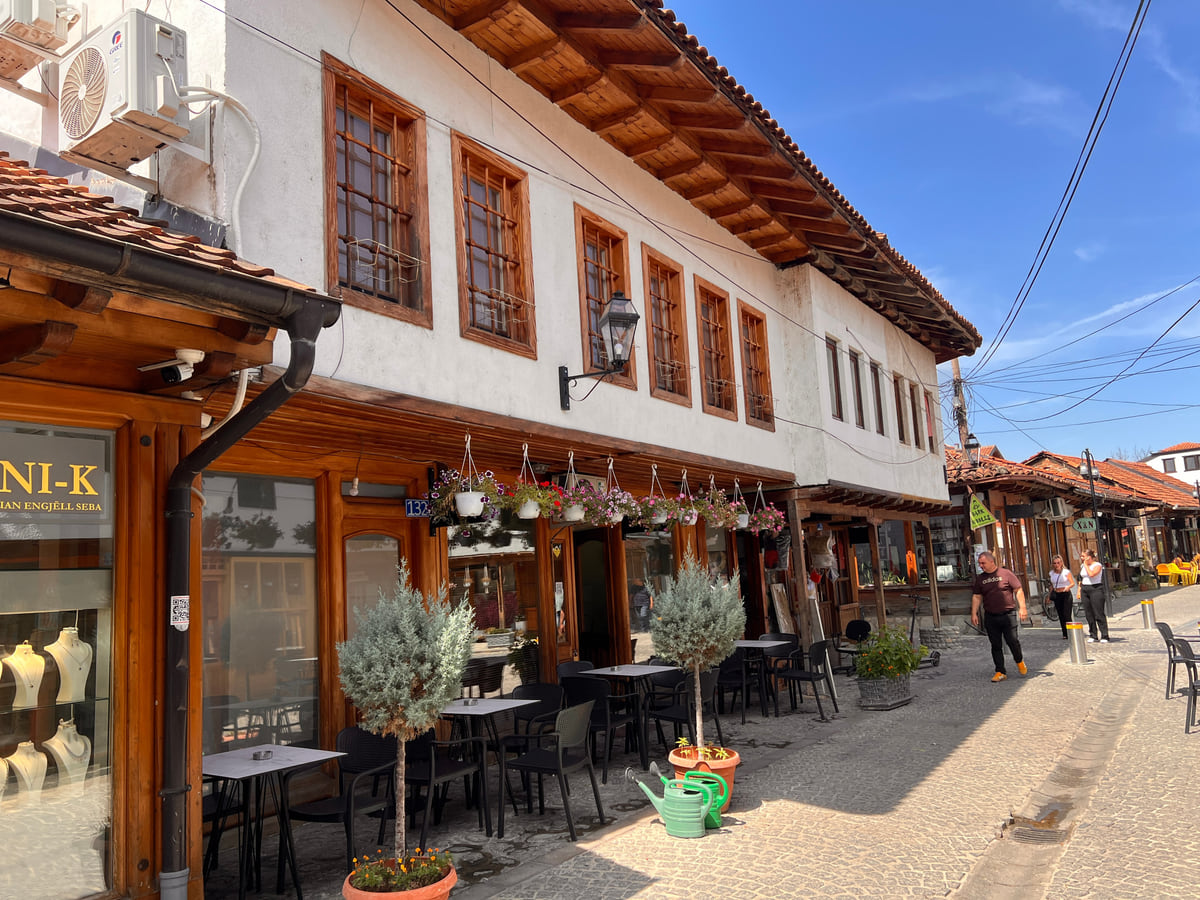
Çarshia, the Ottoman market quarter
Kosovo's bazaars, from the one still standing to the ones that were lost
Kosovo's best-preserved bazaar is Gjakova's Çarshia e Madhe, from the 16th century, which the heritage register credits with 525 significant buildings and has protected since 1955. In Pristina and Prizren much of the old bazaars was demolished in the 20th century, and in Peja the Bajrakli Mosque marks the heart of the former market.
In 30 seconds
Full read: 2 min
- Gjakova's great bazaar dates from the 16th century and its record counts 525 significant buildings.
- It has had permanent protection since 1955.
- Pristina's bazaar was demolished in the 1960s; Prizren's Arasta went the same way.
- In Peja, the Bajrakli Mosque marks the heart of the old market.
If you only see one bazaar, make it Gjakova's, and give it time, because it's the only one that keeps its whole street pattern. I'd treat Pristina and Prizren as walks through what's left, looking out for the mosques and clock towers that made it through.

Before you go
What I would keep in mind
-
01 Most beautiful
Gjakova, a bazaar of 525 buildings
The official record for the Çarshia e Madhe counts 525 significant buildings in stone, timber, mud brick, old tiles and lead, and says it's known as the largest bazaar in south-eastern Europe.
Gjakova Grand Bazaar -
02 My tip
An inn for a hundred guests
The 17th-century Haraqia Han, beside the Hadum Mosque, was an inn with a yard for pack animals; a traveller in 1838 mentions one in Gjakova with room for up to 100 guests.
Hadum Mosque -
03 Getting there
Pristina, 300 shops in 1662
The record for Pristina's old bazaar quotes a 1662 account of a covered trading area, bazaar, hammam, 11 hans and around 300 shops. Nearly all of it was pulled down in the 1960s.
Pristina's old bazaar -
04 My tip
Prizren's lost Arasta
The Arasta, Prizren's row of shops, was demolished in the 20th century along with its mosque. The minaret of 1526-1538 survives, with a Star of David carved into it.
Prizren
Bazaars were the beating heart of Kosovo’s Ottoman towns, and today they tell two very different stories. One, Gjakova’s, is still standing more or less whole. The others were largely lost in the 20th century, and you walk them looking for what survived. Here’s which is which, going by the Ministry of Culture heritage database (DTK).
Gjakova, the one to see
Gjakova’s grand bazaar, the Çarshia e Madhe, dates from the 16th century and has had permanent protection since 19 February 1955. Its official record counts 525 significant buildings, explains that it brought together the town’s crafts, trade and administration, and says it’s known as the largest bazaar in south-eastern Europe. It’s built from local materials, stone, timber, mud brick, old tiles and lead.
At its centre, where the two main streets meet, stands the Hadum Mosque of 1585. Beside it, the 17th-century Haraqia Han was an inn for traders arriving with their animals, and the DTK notes that the traveller Ami Boué mentioned it in 1835 and that in 1838 another traveller described a great Gjakova inn with room for up to 100 guests. The clock tower, from the early 19th century, burned in 1912 and was rebuilt near its foundations by the Ministry of Culture for the centenary. For me it’s the best town walk in Kosovo.
Pristina, what’s left of the old bazaar
In Pristina, the DTK protects the Pristina old bazaar complex, with buildings from the 14th to 19th centuries. Its record quotes a 1662 account of a town that already had a covered trading area, the bazaar, a hammam, 11 hans and around 300 shops. The bazaar itself was demolished in the 1960s to build a new administrative district, and what remains are three mosques, the hammams, the clock tower and a few houses. Go knowing that, so you’re not hunting for a market that no longer exists.
If you are staying the night, see the best hotel deals in Gjakova for your dates: the well-placed rooms go fast.
Prizren and Peja, bazaars in pieces
In Prizren, the DTK has no record for the bazaar as a whole. The Arasta, the shopping street that gave its name to a mosque of 1526-1538, was knocked down in the 20th century for flats and a bank, leaving only the minaret. The record for the Kukli Bey Mosque tells us that the Saraçhane quarter was home to the leatherworkers and the grain market, and at the foot of the fortress, on the left bank of the Lumbardhi, the Marash quarter keeps a plane tree more than 450 years old.
Peja has no bazaar record either, but the Bajrakli Mosque’s record places it at the centre of the former bazaar, on the site of the old open market, and Jashar Pasha’s kulla stands in its wider area. I cover it in Peja bazaar.
Walking them
No official source publishes shop or market hours, but these are open streets you can wander at any time. I’d give Gjakova a whole unhurried morning, coming in by the clock tower and leaving by the Hadum Mosque. Kosovo uses the euro, so change your pounds beforehand and keep a little cash in case a small shop doesn’t take cards.
So you do not lose the morning at the ticket office, browse tickets and tours in Gjakova on GetYourGuide.
If you are staying the night, see the best hotel deals in Gjakova for your dates: the well-placed rooms go fast.
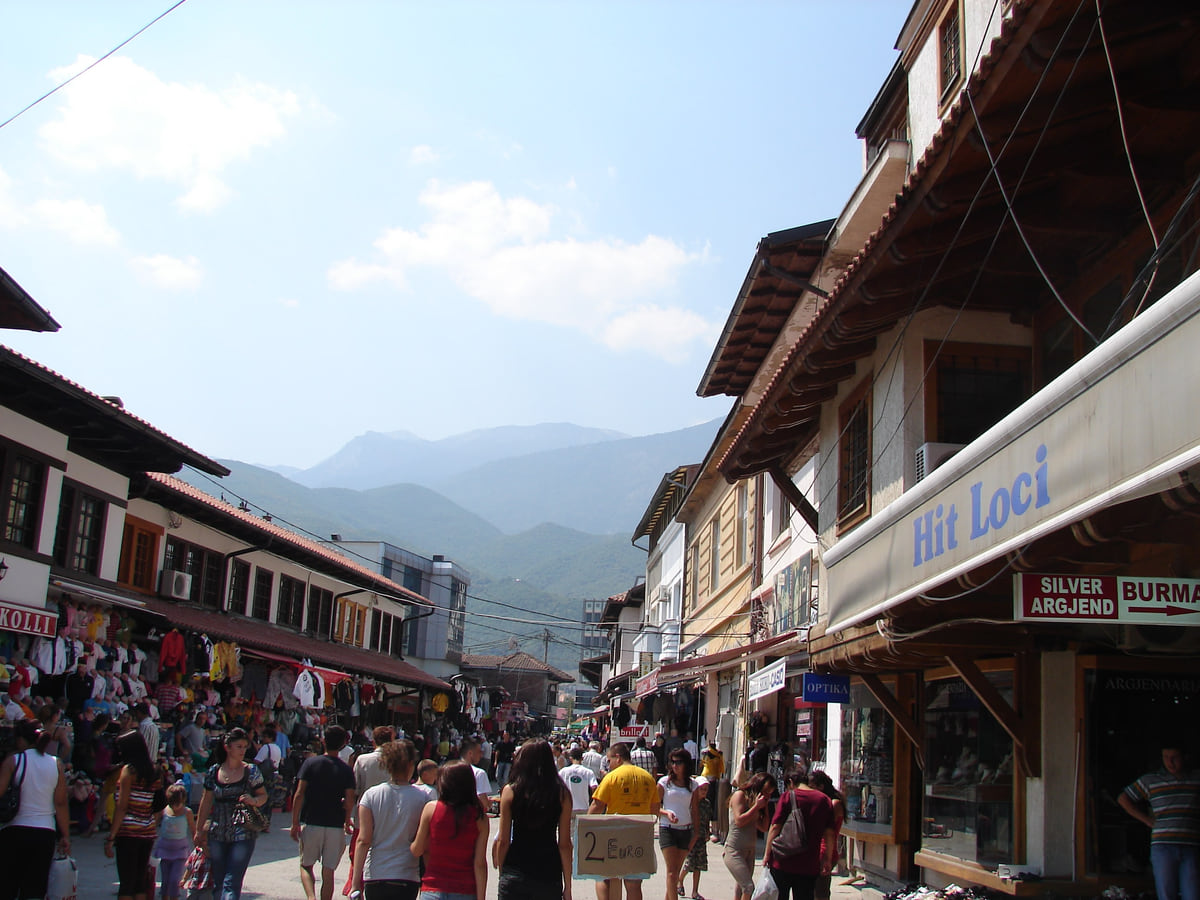
The bazaar street in Peja lined with wooden shopfronts on both sides, people strolling and mountains beyond
Bazaars in the heritage register
| Bazaar or complex | Town | What the DTK says |
|---|---|---|
| Çarshia e Madhe | Gjakova | 16th century, 525 buildings, permanent protection since 1955 |
| Çarshia e Jupave | Gjakova | 18th century; rebuilt kulla now a hotel and shops |
| Haraqia Han | Gjakova | 17th century, inn beside the Hadum Mosque |
| Old bazaar | Pristina | Buildings from the 14th to 19th centuries; bazaar demolished in the 1960s |
| Arasta minaret | Prizren | Mosque of 1526-1538; only the minaret remains |
Source: Kosovo Ministry of Culture heritage database (DTK). Peja has no record for its bazaar as a whole. Shop and market hours: no official information as of 11 October 2026.
Test yourself
True or false?
0/3 Pick before you peek.
-
Gjakova's great bazaar has had permanent protection since 1955.
See the answer
True. Its DTK record gives 19 February 1955 as the date of protection.
-
Pristina's old bazaar survives intact.
See the answer
False. According to the DTK it was demolished in the 1960s for a new administrative district; mosques, hammams, the clock tower and some houses remain.
-
Gjakova's clock tower is the original 19th-century one.
See the answer
False. Its record says it burned in 1912 and that the Ministry of Culture rebuilt it near the old foundations for the centenary.
0 of 208 Kosovo guides
Your next stamp
- Pristina Old Bazaar
- Free things to do
- Gjakova
- Mosques in Kosovo
- Gjakova Grand Bazaar
- Where to eat in Kosovo
- Where to stay in Kosovo
- Cities
- Gjeravica
- Places to visit
- Pristina region
- Visoki Dečani Monastery
- Bjeshkët e Nemuna National Park
- Hadum Mosque
- Mitrovica Region
- Things to do
- Most beautiful places
- Sheh Danjolli tekke
- Prettiest villages
- Tailors' Bridge
- Rugova Canyon
- UNESCO sites
- Map
- Where is Kosovo
- Regions
- Municipalities
- Gračanica Monastery
- Mitrovica
- Patriarchate of Peć
- Pristina
- Prizren
- Rugova via ferrata
- Fushë Kosovë
- Population
- Vushtrri
- Podujeva
- Radavc Cave
- Size
- Bajrakli Mosque
- Devič Monastery
- Gazimestan
- Ibar Bridge
- Is it a country?
- Istog
- One day in Pristina
- Peja
- Prizren region
- Ulpiana
- Vushtrri Stone Bridge
- Gadime Cave
- Klina
- Name
- Vushtrri Fortress
- Deçan
- Flag
- Isa Boletini Complex
- Novo Brdo Fortress
- History
- Junik
- Lake Batllava
- Zvečan Fortress
- Banjska Monastery
- Ferizaj region
- Languages
- Rahovec
- Ferizaj
- Religion
- Sokolica Monastery
- Currency
- Lake Gazivoda
- Štrpce
- Brezovica
- EU membership
- Entry requirements
- Skiing in Kosovo
- Kaçanik
- Serbian border
- Gračanica
- Guesthouses in Rugova
- Hotels in Peja
- Kaçanik fortress
- Newborn monument
- North Mitrovica
- One day in Prizren
- Peja bazaar
- Peja region
- Public holidays
- Velika Hoča
- Facts
- Gjakova region
- Hani i Elezit
- Hotels in Gjakova
- National Library
- Obiliq
- Zočište Monastery
- Drenas
- Mother Teresa Cathedral
- Shtime
- Skënderaj
- Lipjan
- Mother Teresa Boulevard
- Zvečan
- Kosovo Museum
- Leposavić
- Novo Brdo
- Emin Gjiku Ethnological Museum
- Janjevo
- Zubin Potok
- Imperial Mosque
- Pristina Clock Tower
- Great Hammam of Pristina
- Bogë
- Germia Park
- Getting there
- Lake Radoniq
- Prizren Fortress
- Bear Sanctuary Prishtina
- Drelaj
- Flights
- Sinan Pasha Mosque
- Hotels in Pristina
- Pristina airport
- Prizren stone bridge
- Buses
- Grand Hotel Pristina
- Our Lady of Ljeviš
- Prizren hammam
- Swiss Diamond Hotel
- Tirana to Pristina
- League of Prizren
- Restaurants in Pristina
- Skopje to Pristina
- Belgrade to Pristina
- Prizren Archaeological Museum
- Balkans itinerary
- St George's Cathedral
- Church of the Holy Saviour
- Getting around
- Holy Archangels Monastery
- Trains
- Car hire
- Day trips
- Marash
- Driving
- Sharr National Park
- Taxis
- Distances
- Prevalla
- Dragash
- Road trip
- Brod
- Prices and budget
- On a budget
- Restelica
- Mirusha waterfalls
- Malisheva
- Safety
- Mamusha
- Scams
- Healthcare
- National parks in Kosovo
- Nightlife
- Suhareka
- Mobile and roaming
- Mountains in Kosovo
- Mushtisht
- Hiking in Kosovo
- Korisha
- Packing list
- DokuFest
- Peaks of the Balkans
- With kids
- Holidays
- Hotels in Prizren
- Kosovo lakes
- 3 days
- Caves and waterfalls
- Restaurants in Prizren
- 5 days
- One week
- Gjilan region
- Kosovo food
- Sunny Hill Festival
- Gjilan
- Rahovec wine
- Atik Mosque, Gjilan
- Kosovo beer
- Draganac Monastery
- Kamenica
- Kllokot
- Weather in Kosovo
- Best time to visit Kosovo
- Partesh
- Kosovo in winter
- Ranillug
- Kosovo in spring
- Viti
- Kosovo in summer
- Letnica
- Binač Monastery
- Kosovo in autumn
- Events in Kosovo
- Independence Day
- Kosovo monasteries
- Kullas in Kosovo
- Castles in Kosovo
- Museums in Kosovo
Frequently asked questions
What is the biggest bazaar in Kosovo?
Gjakova's Çarshia e Madhe. Its official record counts 525 significant buildings and says it's known as the largest bazaar in south-eastern Europe.
Where is the old bazaar in Gjakova?
In the town centre, around the Hadum Mosque, which stands where its two main streets cross according to the DTK.
Is there a bazaar in Pristina?
The old bazaar quarter survives with its mosques, hammams and clock tower, but the bazaar itself was demolished in the 1960s to make way for a new administrative district, according to the DTK.
Is there a bazaar in Prizren?
The DTK has no record for Prizren's bazaar as a whole. The Arasta, its shopping street, was knocked down in the 20th century, and the Ottoman centre is now a walk between mosques, the hammam and the Marash quarter.
Is Peja's bazaar worth seeing?
It's a pleasant walk rather than a protected ensemble. The DTK places the Bajrakli Mosque at the heart of the old bazaar, where the open-air market used to be.
By
Tourism graduate with a master’s in Tourism Management and Planning from the University of Málaga, who has travelled across Europe. He writes every guide from official sources and his own judgement.
Published on . Facts checked on .
Sources
Some links in this guide are affiliate links: if you book through them, the site earns a commission at no extra cost to you. Affiliate disclosure
Photos: Bdx (CC0); a.dombrowski (CC BY-SA 2.0), via Wikimedia Commons.