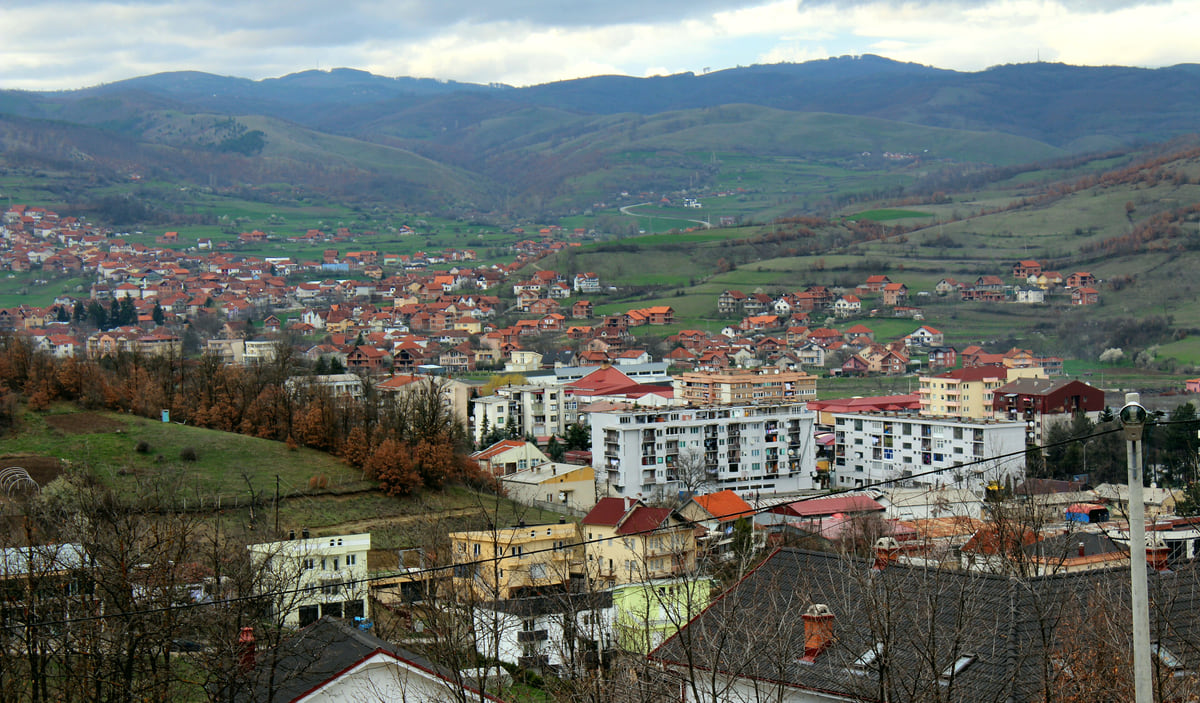
Kamenicë (Kamenica), Gjilan region
Kamenica, the municipality of 58 villages
Kamenica (Kamenicë in Albanian) is a hilly municipality north-east of Gjilan, with 22,868 people in 2024 spread over 58 settlements, more than anywhere else in the region. The heritage register lists eight sites, including Sheikh Zenel's tekke at Topanicë, from 1754, and three medieval churches at Vaganesh, Hajnoc and Moçar.
In 30 seconds
Full read: 2 min
- Kamenica has 22,868 people in 58 settlements, the most villages of any municipality in the region.
- It has lost over a third of its population since 2011, according to ASK.
- Sheikh Zenel's tekke at Topanicë dates from 1754 and served the Halveti order.
- Vaganesh, Hajnoc and Moçar keep churches from the 13th and 14th centuries.
Kamenica is for people who've done Kosovo's big names and want small, scattered heritage. I'd pick two things, the Topanicë tekke and one of the medieval churches, rather than trying to tick everything off in a day.

Before you go
What I would keep in mind
-
01 Most beautiful
A Halveti tekke from 1754
Sheikh Zenel's tekke at Topanicë served the Halveti order. Its record describes a porch on five carved wooden posts and a tomb with seven graves.
mosques in Kosovo -
02 My tip
A monastery signposted as a prison
The record for the 14th-century monastery at Hajnoc notes a roadside sign calling it Tamnica, Serbian for prison.
Kosovo monasteries -
03 Getting there
Draganac, to the west in Gjilan
Draganac Monastery, with its Special Protective Zone, lies in neighbouring Gjilan municipality, about 10 km from Kamenica town as the crow flies.
Draganac Monastery
Let me be straight with you about Kamenica. No one building here is worth the drive by itself. What it has is a scatter of small things across hills and villages, and one of them, the tekke at Topanicë, is among the most curious sights in eastern Kosovo.
Hills and villages
Kamenica (Kamenicë in Albanian) lies north-east of Gjilan, in the region OpenStreetMap assigns to that town. The 2024 census found 22,868 people, more than a third fewer than the 36,085 of 2011, spread across 58 settlements, the highest number in the Gjilan region. The town had 5,206 residents, followed by Koretin, Rogaçicë, Berivojcë and Topanicë.
The photo on this page shows the setting, blocks of flats on the valley floor, red-roofed houses climbing the slopes and wooded hills all round. By mother tongue the census counts 20,558 Albanian, 1,891 Serbian and 378 Romani speakers. Further east is neighbouring Ranillug, a far smaller municipality.
The Topanicë tekke
The one place I’d make a point of seeing is Sheikh Zenel Abedini’s tekke at Topanicë. The Ministry of Culture heritage register (DTK) dates it to 1754 and explains that it hosted ceremonies of the Halveti dervish order. It’s a single-storey building of stone, mud brick and timber, with a half-open porch on five carved wooden posts, two of them with capitals. Inside are two rooms, one where the dervishes met and one for the ceremony itself, which still has its mihrab.
Beside it is the tomb, with seven graves, Zenel’s among them. The DTK says the tekke was restored in 2012 and that in November 2021 its own team couldn’t get inside because the caretaker wouldn’t allow it, so I can’t promise access. I bring tekkes and mosques together in mosques in Kosovo.
Also at Topanicë, the DTK records a site on a rocky hill called Gradec, at 480 m, with remains covering about 6 hectares. Digs in 2017 traced it from the Eneolithic through to Late Antiquity and the early Middle Ages.
If you are staying the night, see the best hotel deals in Gjilan for your dates: the well-placed rooms go fast.
Three medieval churches
The register lists three late medieval churches in Kamenica. At Hajnoc, on the road from Kamenica to Strezoc, a 14th-century monastery stands on older foundations, with fragments of frescoes from that time; a roadside sign, its record notes, calls it Tamnica, or prison. At Moçar, to the north-east, is another 14th-century monastery on a cross plan, with three apses and herringbone brickwork, which the DTK links to the Morava school. And at Vaganesh, about 20 km north-west and over 750 m up, a 13th to 14th-century church of the Virgin survives in a village where ASK counted only 4 residents in 2024. For the rest of the Orthodox heritage, see Kosovo monasteries.
Getting there
None of these sites has published opening times, admission or visiting rules, and I couldn’t find official buses between the villages. By car from Gjilan, the town is about 16 km away in a straight line according to OpenStreetMap, driving on the right. Country roads here can be rough by the FCDO’s account, and it’s best not to drive them at night, so I’d tour the villages in daylight.
So you do not lose the morning at the ticket office, browse tickets and tours in Gjilan on GetYourGuide.
If you are staying the night, see the best hotel deals in Gjilan for your dates: the well-placed rooms go fast.
Kamenica's largest settlements
| Settlement | 2024 | 2011 |
|---|---|---|
| Kamenicë | 5,206 | 7,331 |
| Koretin | 2,266 | 3,476 |
| Rogaçicë | 1,904 | 2,668 |
| Berivojcë | 1,459 | 1,553 |
| Topanicë | 1,286 | 2,061 |
| Hodonoc | 1,258 | 2,446 |
Source: ASK, 2024 census by settlement.
Kamenica on the Ministry of Culture heritage register
| Site | Settlement | Period |
|---|---|---|
| Sheikh Zenel Abedini's tekke | Topanicë | 1754 |
| Gradec hill fort | Topanicë | Eneolithic to early Middle Ages |
| Church of the Virgin | Vaganesh | 13th-14th century |
| Monastery | Hajnoc | 14th century |
| Moçar Monastery | Moçar | 14th century |
| Mosque | Meshinë | Ottoman, 19th century |
Source: DTK. Two 19th-century houses at Krilevë and Leshtar are also listed. Visits: no official information.
Test yourself
True or false?
0/3 Pick before you peek.
-
Kamenica has more settlements than any other municipality in the Gjilan region.
See the answer
True. It has 58, ahead of Gjilan (49) and Viti (39), according to ASK.
-
The Topanicë tekke dates from the 16th century.
See the answer
False. Its record dates it to 1754, the middle of the 18th century.
-
Vaganesh is a large village today.
See the answer
False. ASK counted just 4 residents there in 2024, although the heritage register keeps a medieval church in the village.

0 of 208 Kosovo guides
Your next stamp
- UNESCO sites
- Dragash
- Skënderaj
- Kaçanik
- Restelica
- Suhareka
- Letnica
- Gjakova Grand Bazaar
- Gjeravica
- Places to visit
- Pristina region
- Visoki Dečani Monastery
- Bjeshkët e Nemuna National Park
- Hadum Mosque
- Mitrovica Region
- Things to do
- Most beautiful places
- Sheh Danjolli tekke
- Prettiest villages
- Tailors' Bridge
- Rugova Canyon
- Gjakova
- Map
- Where is Kosovo
- Regions
- Municipalities
- Cities
- Gračanica Monastery
- Mitrovica
- Patriarchate of Peć
- Pristina
- Prizren
- Rugova via ferrata
- Fushë Kosovë
- Population
- Vushtrri
- Podujeva
- Radavc Cave
- Size
- Bajrakli Mosque
- Devič Monastery
- Gazimestan
- Ibar Bridge
- Is it a country?
- Istog
- One day in Pristina
- Peja
- Prizren region
- Ulpiana
- Vushtrri Stone Bridge
- Gadime Cave
- Klina
- Name
- Vushtrri Fortress
- Deçan
- Flag
- Isa Boletini Complex
- Novo Brdo Fortress
- History
- Junik
- Lake Batllava
- Zvečan Fortress
- Banjska Monastery
- Ferizaj region
- Languages
- Rahovec
- Ferizaj
- Religion
- Sokolica Monastery
- Currency
- Lake Gazivoda
- Štrpce
- Brezovica
- EU membership
- Entry requirements
- Skiing in Kosovo
- Serbian border
- Gračanica
- Guesthouses in Rugova
- Hotels in Peja
- Kaçanik fortress
- Newborn monument
- North Mitrovica
- One day in Prizren
- Peja bazaar
- Peja region
- Public holidays
- Velika Hoča
- Facts
- Gjakova region
- Hani i Elezit
- Hotels in Gjakova
- National Library
- Obiliq
- Zočište Monastery
- Drenas
- Mother Teresa Cathedral
- Shtime
- Lipjan
- Mother Teresa Boulevard
- Zvečan
- Kosovo Museum
- Leposavić
- Novo Brdo
- Emin Gjiku Ethnological Museum
- Janjevo
- Zubin Potok
- Imperial Mosque
- Pristina Clock Tower
- Pristina Old Bazaar
- Great Hammam of Pristina
- Bogë
- Germia Park
- Getting there
- Lake Radoniq
- Prizren Fortress
- Bear Sanctuary Prishtina
- Drelaj
- Flights
- Sinan Pasha Mosque
- Hotels in Pristina
- Pristina airport
- Prizren stone bridge
- Buses
- Grand Hotel Pristina
- Our Lady of Ljeviš
- Prizren hammam
- Swiss Diamond Hotel
- Tirana to Pristina
- League of Prizren
- Restaurants in Pristina
- Skopje to Pristina
- Belgrade to Pristina
- Prizren Archaeological Museum
- Balkans itinerary
- St George's Cathedral
- Church of the Holy Saviour
- Getting around
- Holy Archangels Monastery
- Trains
- Car hire
- Day trips
- Marash
- Driving
- Sharr National Park
- Taxis
- Distances
- Prevalla
- Road trip
- Brod
- Prices and budget
- On a budget
- Free things to do
- Mirusha waterfalls
- Malisheva
- Safety
- Mamusha
- Scams
- Healthcare
- National parks in Kosovo
- Nightlife
- Mobile and roaming
- Mountains in Kosovo
- Mushtisht
- Hiking in Kosovo
- Korisha
- Packing list
- DokuFest
- Peaks of the Balkans
- With kids
- Holidays
- Hotels in Prizren
- Kosovo lakes
- 3 days
- Caves and waterfalls
- Restaurants in Prizren
- 5 days
- One week
- Gjilan region
- Kosovo food
- Sunny Hill Festival
- Gjilan
- Rahovec wine
- Atik Mosque, Gjilan
- Kosovo beer
- Draganac Monastery
- Where to eat in Kosovo
- Where to stay in Kosovo
- Kllokot
- Weather in Kosovo
- Best time to visit Kosovo
- Partesh
- Kosovo in winter
- Ranillug
- Kosovo in spring
- Viti
- Kosovo in summer
- Binač Monastery
- Kosovo in autumn
- Events in Kosovo
- Independence Day
- Kosovo monasteries
- Mosques in Kosovo
- Kullas in Kosovo
- Castles in Kosovo
- Museums in Kosovo
- Bazaars in Kosovo
Frequently asked questions
Where is Kamenica in Kosovo?
In the east, in the Gjilan region. OpenStreetMap puts the town about 16 km north-east of Gjilan as the crow flies.
What is there to see in Kamenica?
Sheikh Zenel's tekke at Topanicë, from 1754, and the medieval churches at Vaganesh, Hajnoc and Moçar. The register also lists a prehistoric hill fort at Topanicë.
What is the population of Kamenica?
22,868 in ASK's 2024 census, down from 36,085 in 2011. The town itself had 5,206.
Are Kamenica and Kamenicë the same place?
Yes. Kamenicë is the Albanian form and Kamenica the Serbian, the one most used in English. The heritage register sometimes calls it Dardana.
What languages are spoken in Kamenica?
In the 2024 census, 20,558 residents gave Albanian as their mother tongue, 1,891 Serbian and 378 Romani, according to ASK.
By
Tourism graduate with a master’s in Tourism Management and Planning from the University of Málaga, who has travelled across Europe. He writes every guide from official sources and his own judgement.
Published on . Facts checked on .
Sources
Some links in this guide are affiliate links: if you book through them, the site earns a commission at no extra cost to you. Affiliate disclosure
Photos: Toksave (CC BY-SA 3.0), via Wikimedia Commons.