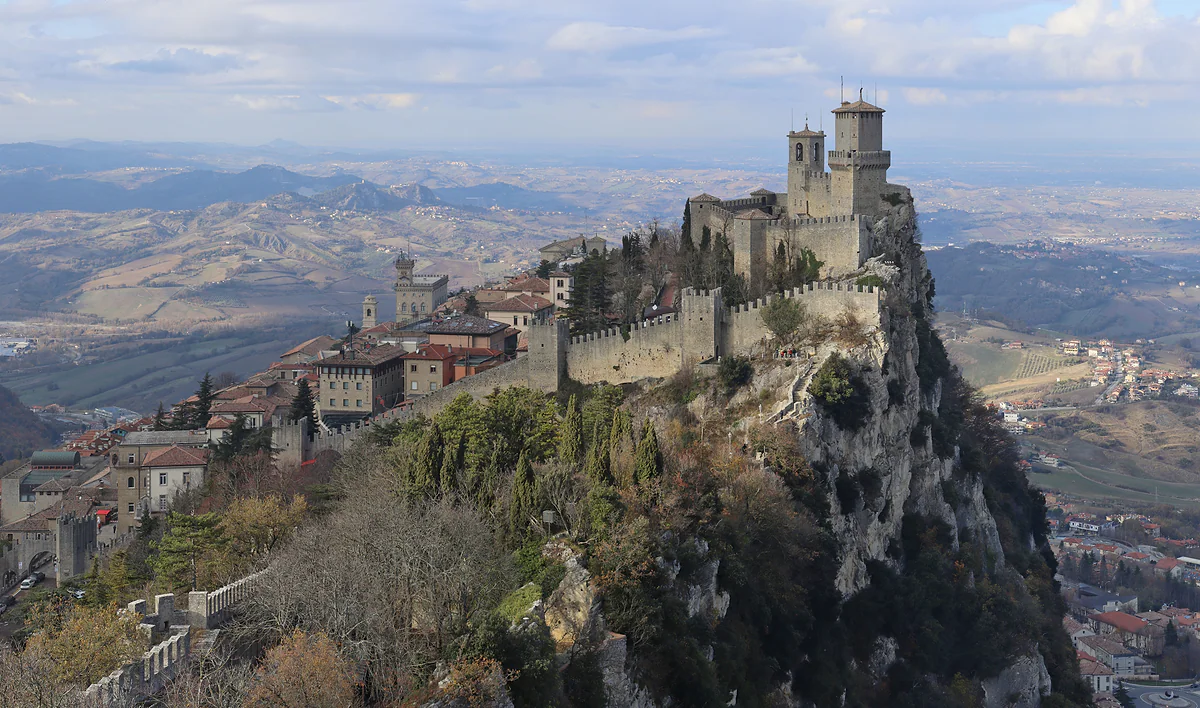
34,167 residents across 61.19 km²
San Marino's nine castelli, and which are worth the detour
San Marino is divided into nine castelli, its municipalities. Serravalle is the largest, with 11,243 residents on 30 June 2026 and 10.53 km², and Montegiardino the smallest, with 986 people and 3.31 km². The capital, City of San Marino, only ranks third by population. Each has its own council, the Giunta, led by a Capitano di Castello.
In 30 seconds
Full read: 4 min
- San Marino has nine castelli, which work as municipalities, each with its own Giunta and Capitano di Castello.
- Serravalle is the largest, with 11,243 residents and 10.53 km²; Montegiardino the smallest, with 986 people and 3.31 km².
- The capital, City of San Marino, has 4,158 residents and ranks third by population.
- To visit, I'd pick Borgo Maggiore and, with a car, Montegiardino and Faetano.
On a day trip I wouldn't leave the capital and Borgo Maggiore. With a night and a car, I'd drive down to Montegiardino and Faetano, which are the opposite of the souvenir-lined centre and show you the country where people actually live.

Before you go
What I would keep in mind
-
01 Most beautiful
Montegiardino, the castello that never changed
The government calls it the smallest and most intact of the nine, with very narrow lanes, a wall with its old tower and a gate that looks like a drawbridge. For me it's the best half hour outside Mount Titano.
walking trails in San Marino -
02 Getting there
Bus 47 links five castelli
AASS line 47 runs from the City to Borgo Maggiore, Domagnano, Serravalle and Dogana. AASS made public buses free from 2 March to 30 September 2026; from 1 October, check the fare before you ride.
getting around San Marino -
03 My tip
This Serravalle isn't the designer outlet
Most searches for a Serravalle outlet mean Serravalle Scrivia, in Piedmont. San Marino's Serravalle is its most populated castello, and its own outlet sits in Falciano.
Serravalle, the most populated castello -
04 To save money
Sleeping lower down costs less
The lower castelli have cheaper rooms and easier parking than the old town, which is a limited traffic zone. Borgo Maggiore also has the cable car up to the City.
where to stay in San Marino
What I would book
My ranking, scored
The castelli I'd visit, with scores
My own scores out of 10. They weigh what each castello offers someone who has come to see San Marino, not how pleasant it is to live in. The capital sits apart because it is the visit itself.
0 of 8 seen
-
Borgo Maggiore
The old Mercatale, with Piazza Grande, the 1896 clock tower and the cable car to the capital. It's the one nearly everyone ends up in without planning to.
8.9 out of 10
-
Montegiardino
The smallest and best kept, with walls, a tower and the Malatesta fortress turned into homes after 1463. No souvenir shops.
8.4 out of 10
-
Faetano
Perched on a gypsum spur above the Marano, with a beech tree on its crest and the river park for a walk. It handed itself over to San Marino in 1463.
7.6 out of 10
-
Fiorentino
The land of three castles. At Pennarossa you can still see the foundations, the keep and a cistern cut into the rock, and in 1913 the first flight over San Marino took off here.
7.3 out of 10
-
Chiesanuova
114 hectares of woodland and the Molarini watermill by the Fosso Canepa, one of the few with its walls intact. For anyone after countryside.
7.0 out of 10
-
Acquaviva
Tradition says the saint entered the territory here and baptised in the spring below Montecerreto, where La Pineta park now stands.
6.6 out of 10
-
Serravalle
The most populated, with a medieval tower, but mostly industry, stadiums and shopping centres. I see it as a practical stop.
6.2 out of 10
-
Domagnano
Olive groves, vines and a carnival with floats. Little is left of the Lombard fort on Montelupo beside the small Torraccia church.
5.8 out of 10
San Marino has no counties or boroughs in the usual sense. It has nine castelli, which is what the Sammarinese call their municipalities, and the word is no affectation. Almost every one grew up around a castle, and several still keep the tower or its ruins. It’s the clearest way I know of showing that the country doesn’t end on the ridge of Mount Titano, even if most day-trippers never come down from it.
Nine municipalities in 61 square kilometres
Together the nine add up to 34,167 residents on 30 June 2026 and 61.19 km², the sum of the figures the government gives for each. Every castello has its Giunta di Castello, chaired by a Capitano di Castello, which looks after local matters, a little like a parish council with more clout. The table above lists all nine from most to least populated.
What surprises people is that the capital doesn’t win on numbers. The City of San Marino, with its towers, Palazzo Pubblico and museums, has 4,158 residents. Serravalle has nearly three times as many and Borgo Maggiore almost three thousand more. The real country lives below, in the valleys, while the city on top is mostly institutions, shops and visitors.
Why five arrived at once in 1463
The castelli explain the map of San Marino. In 1463 San Marino joined Pope Pius II’s league against Sigismondo Pandolfo Malatesta, lord of Rimini, and was rewarded with Serravalle, Domagnano, Fiorentino and Montegiardino. That same year Faetano asked to join, and its own government page says it surrendered of its own accord to the Sammarinese troops. The borders have stayed put ever since.
Chiesanuova is the exception I like to mention. Its people asked to join on 10 February 1320, when the place was still called Busignano, and it only took its current name in the 16th century. The coats of arms of the last castles to join sit on the front of the Palazzo Pubblico, a detail almost nobody notices while crossing the square.
The ones I’d see beyond Titano
Borgo Maggiore is the obvious one, because the cable car drops straight into it and because it was the Mercatale, the market town. Given an afternoon and a car, though, I’d head for Montegiardino. The government describes it as the smallest and most intact of the nine, a maze of tight lanes with its wall, the old tower and a gate reminiscent of a drawbridge. It belonged to the Counts of Carpegna and then to the Malatesta, who strengthened the fort, and once it passed to San Marino the stronghold was turned into houses.
Faetano would be my second stop. It sits on a gypsum spur high above the Marano stream, carries a beech tree on its crest because that’s where its name comes from, and has a riverside park with a path for walks out of the village, plus Lake Faetano, a small fishing lake by the border. Neighbouring Fiorentino boasts three castles, and at Pennarossa you can still make out the foundations, the keep, the wall walks and a cistern cut into the rock. It also remembers the aviator Gianni Widmer, who made the first flight over San Marino in 1913.
Chiesanuova and Acquaviva are for anyone after countryside. The first has 114 hectares of woodland and the Molarini watermill beside the Fosso Canepa, one of the few with its walls still standing. The second keeps the tradition that the saint entered here and baptised converts in the spring below Montecerreto, where La Pineta park now stands. I’ve gathered the walks through these valleys in walking trails in San Marino.
Serravalle, Dogana and the San Marino that works
Serravalle is the largest by both measures, and Dogana and Falciano sit inside it. It has a medieval tower and an old pedigree, turning up as «serra vallum» in a charter of 962, but today it’s mostly industrial estates, stadiums and shopping centres. Dogana is the way in from Rimini along the dual carriageway, and it’s where you notice there’s no border with checks.
Domagnano, between Borgo and Serravalle, is farmland, with 70% of its land given over to olives, vines and wheat according to its page, and a carnival of floats the locals take very seriously. I wouldn’t put it on a first visit, but you pass through it on the Rimini bus.
Getting between castelli
Without a car, AASS line 47 connects the City with Borgo Maggiore, Domagnano, Serravalle and Dogana, and the SMUVI on-demand service reaches the rest from the existing stops, booked by app or phone. All internal buses were free from March to 30 September 2026, so check the fare from October before you set off. Lines and times are in getting around San Marino. By car the distances are short, and the hard part is parking at the top, not at the bottom.
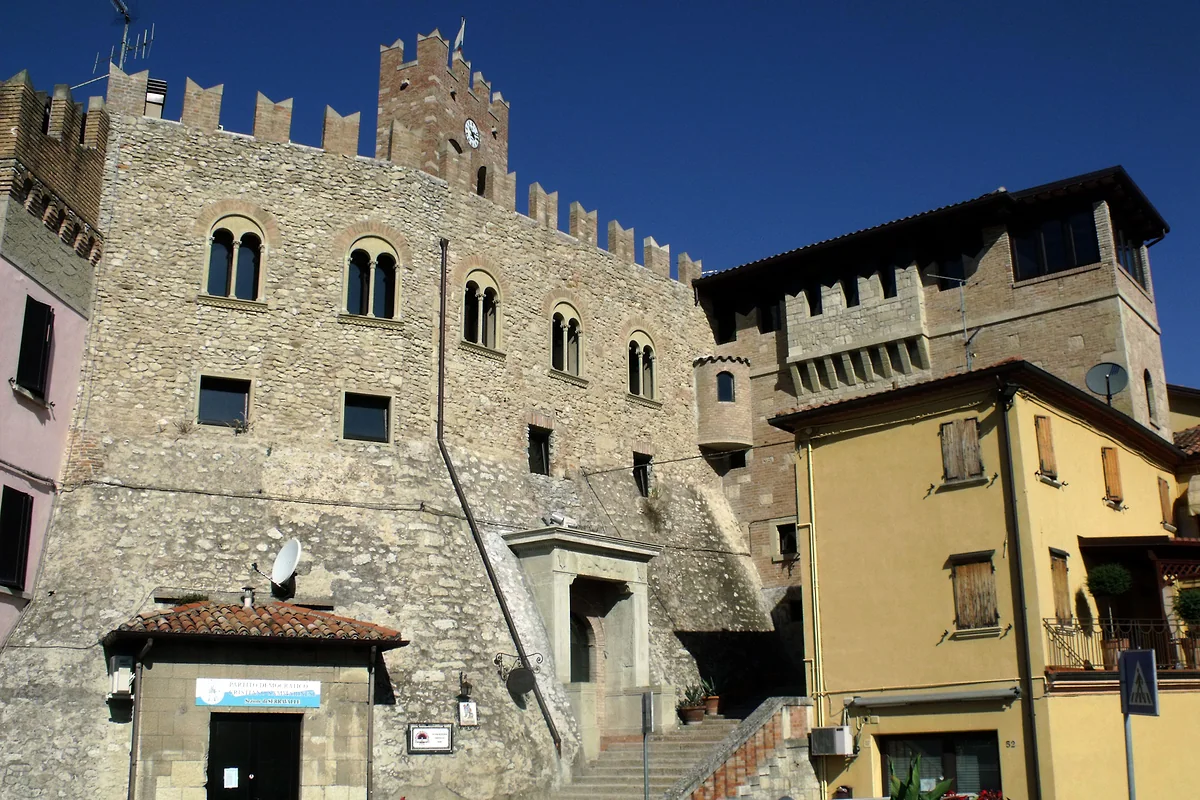
Serravalle castle, with its stone walls, battlements and tower, under a deep blue sky.
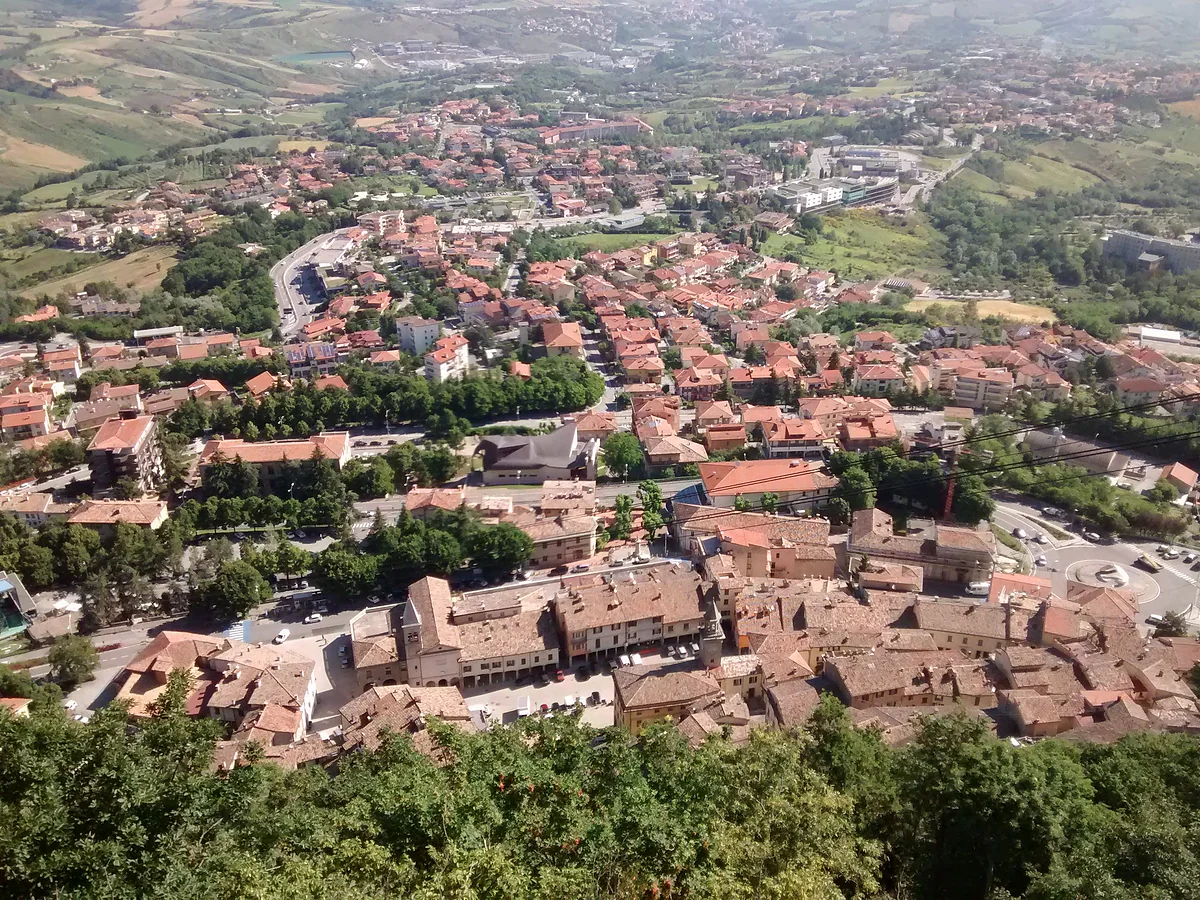
Borgo Maggiore seen from the top of Monte Titano, with its red roofs, the market square and the hills beyond.
Population and area of the nine castelli
| Castello | Residents on 30 June 2026 | Area |
|---|---|---|
| Serravalle | 11,243 | 10.53 km² |
| Borgo Maggiore | 7,019 | 9.01 km² |
| City of San Marino | 4,158 | 7.09 km² |
| Domagnano | 3,623 | 6.62 km² |
| Fiorentino | 2,593 | 6.56 km² |
| Acquaviva | 2,154 | 4.86 km² |
| Faetano | 1,204 | 7.75 km² |
| Chiesanuova | 1,187 | 5.46 km² |
| Montegiardino | 986 | 3.31 km² |
| Total | 34,167 | 61.19 km² |
Population from the Statistics Bulletin for the second quarter of 2026 (statistica.sm). Area from each castello's page on gov.sm; the total is the sum. The gov.sm pages still show 2024 population figures.
Test yourself
True or false?
0/4 Pick before you peek.
-
The capital, City of San Marino, is the castello with the most residents.
See the answer
False. It's third. Serravalle has 11,243 residents and Borgo Maggiore 7,019, against the capital's 4,158, on 30 June 2026.
-
Dogana, the gateway from Rimini, isn't one of the nine castelli.
See the answer
True. Dogana belongs to the castello of Serravalle, as does Falciano. Italian Wikipedia calls it the country's most populated settlement, but it isn't a municipality in its own right.
-
Montegiardino is the castello with the smallest area.
See the answer
True. It covers 3.31 km², according to its government page. It's also the least populated, with 986 residents.
-
Chiesanuova joined San Marino in the war of 1463.
See the answer
False. It joined earlier, on 10 February 1320, at the request of the people of what was then called Busignano, according to the castello's page.
- Castelli the country is split into
- 9
- Residents of Serravalle, the largest
- 11,243
- Residents of Montegiardino, the smallest
- 986
- Year five of the nine joined
- 1463
Map
Where The 9 castelli is
Every number opens its guide. The towers sit on the ridge, the city beside them and Borgo Maggiore below, linked by the cable car.
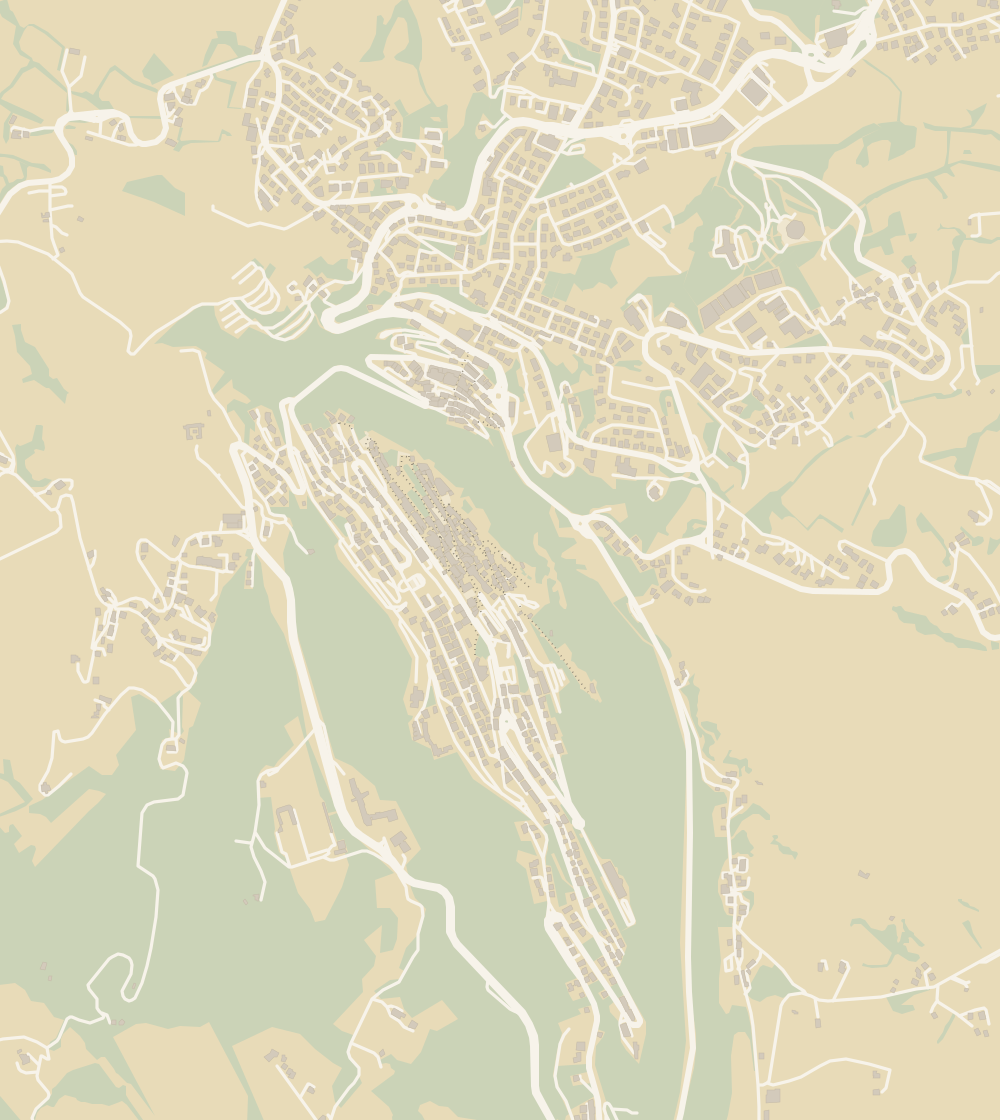 1The Three Towers 2Guaita Tower 3Cesta Tower and Arms Museum 4City of San Marino 5Montale Tower 6Borgo Maggiore 7Witches' Passage 8Palazzo Pubblico 9Changing of the guard 10Basilica of Saint Marinus 11Mount Titano 12Museums 13State Museum 14San Francesco Art Gallery 15Torture Museum 16Cable car (funivia) 17Quirky museums 18Stamp and Coin Museum 19National Gallery 20Valdragone 21San Giovanni sotto le Penne 22Medieval Days 23Christmas 24Hotel Titano 25Grand Hotel San Marino 26Hotel Rosa 27Hotel Crocenzi 28Hotel La Rocca 29Porta San Francesco 30Cava dei Balestrieri 31Map 32Teatro Titano 33Church of San Quirino 34Trenino Bianco Azzurro 35Consolazione Sanctuary 36University 37Prison 38Piazza della Libertà
 Map data © OpenStreetMap contributors (ODbL)
- 1The Three TowersTwo open inside, the third only from outside
- 2Guaita TowerAn 11th-century fortress that was a jail until 1970
- 3Cesta Tower and Arms MuseumThe top of Mount Titano, at 755 metres
- 4City of San MarinoWorld Heritage since 2008
- 5Montale TowerNo ticket, no hours, no pass
- 6Borgo MaggioreA cable car to the capital every 15 minutes
- 7Witches' PassageAbout 200 metres of battlements, no ticket
- 8Palazzo PubblicoClosed for restoration in 2026
- 9Changing of the guardNo timetable in any reliable source
- 10Basilica of Saint MarinusNeoclassical, begun in 1826, free to enter
- 11Mount Titano755 metres at the top of the Cesta
- 12MuseumsOne €11 ticket, seven venues
- 13State MuseumOpen to the public since 1899
- 14San Francesco Art GalleryIn the Franciscan cloister since 1966
- 15Torture MuseumMore than 100 original instruments
- 16Cable car (funivia)Closed from 21 to 23 October 2026
- 17Quirky museumsThree private museums with their own websites
- 18Stamp and Coin MuseumStamps since 1877, on the €11 pass
- 19National GalleryOpened on 7 July 2018
- 20ValdragoneA curazia of Borgo Maggiore
- 21San Giovanni sotto le PenneA curazia of Borgo Maggiore, below the towers
- 22Medieval DaysJuly, the old town and free entry
- 23Christmas28 November to 6 January, with a caveat
- 24Hotel TitanoOpen since 30 September 1894
- 25Grand Hotel San MarinoA hot tub on the third-floor terrace
- 26Hotel RosaFamily-run and open all year since 1965
- 27Hotel Crocenzi1 km from the cable car, 3 km from the old town
- 28Hotel La RoccaNot the Rocca, but on the road up to it
- 29Porta San FrancescoA guard post since 1361
- 30Cava dei BalestrieriThe crossbowmen's range since 1965
- 31MapNine castelli in 61 km²
- 32Teatro Titano2026-27 season from 22 October
- 33Church of San QuirinoOn the 5-cent coin
- 34Trenino Bianco AzzurroRimini to the City, 1932 to 1944
- 35Consolazione SanctuaryConsecrated on 11 June 1967
- 36UniversityCreated by law on 31 October 1985
- 37PrisonEmpty on the day the European inspectors arrived
- 38Piazza della LibertàIt used to be called the Pianello
0 of 108 San Marino guides
Your next stamp
- Serravalle
- Montegiardino
- City of San Marino
- Chiesanuova
- Walking trails
- Domagnano
- Acquaviva
- Things to do
- One day
- Two days
- The Three Towers
- Guaita Tower
- Cesta Tower and Arms Museum
- Montale Tower
- Borgo Maggiore
- Witches' Passage
- Palazzo Pubblico
- Changing of the guard
- Dogana
- Basilica of Saint Marinus
- Mount Titano
- Faetano
- Fiorentino
- Museums
- State Museum
- San Francesco Art Gallery
- Torture Museum
- Cable car (funivia)
- Quirky museums
- Viewpoints
- Murata
- Stamp and Coin Museum
- Cailungo
- National Gallery
- Valdragone
- Best time to visit
- Getting there
- Ventoso
- Rimini to San Marino
- San Giovanni sotto le Penne
- Weather
- Getting around
- In winter
- With kids
- In summer
- Parking
- Passport stamp
- Rainy day
- Nightlife
- Phone and roaming
- Casino
- Gualdicciolo
- Money
- Coins and stamps
- Torraccia
- Falciano
- Shopping and tax-free
- Rovereta
- Lake Faetano
- Events
- Beaches
- Medieval Days
- Christmas
- MotoGP
- Where to stay
- Hotel Titano
- Where to eat
- Food
- Grand Hotel San Marino
- Luxury hotels
- Free and cheap
- Hotel iDesign
- Day trips
- Hotel Rosa
- Safety and rules
- Hotel Crocenzi
- Language
- Entry requirements
- Hotel La Rocca
- Healthcare and emergencies
- Plugs and voltage
- Is it a country?
- Opening hours
- Porta San Francesco
- Tap water
- Cava dei Balestrieri
- Map
- Post office
- Cost of a trip
- Flag
- Teatro Titano
- Accessibility
- Church of San Quirino
- History
- Captains Regent
- Trenino Bianco Azzurro
- With a dog
- Consolazione Sanctuary
- Facts
- University
- Weddings
- Wine
- Prison
- Camping
- Piazza della Libertà
- Is it worth visiting?
- Constitution
Frequently asked questions
How many castelli are there in San Marino?
Nine. City of San Marino, Serravalle, Borgo Maggiore, Domagnano, Fiorentino, Acquaviva, Faetano, Chiesanuova and Montegiardino. Each is run by a Giunta di Castello chaired by a Capitano di Castello.
What is a castello in San Marino?
It's the country's administrative division, the nearest thing to a municipality or parish council. The name comes from the castles that guarded each patch of land, and several still have a tower or ruins, such as Serravalle, Montegiardino and Fiorentino.
What is the largest castello in San Marino?
Serravalle, both by population and by area, with 11,243 residents on 30 June 2026 and 10.53 km². It includes Dogana, the gateway from Rimini, and Falciano, home of the outlet.
Is the City of San Marino a castello?
Yes. City of San Marino is the castello along the ridge of Mount Titano, with the three towers and the Palazzo Pubblico. With 4,158 residents it's only the third most populated, behind Serravalle and Borgo Maggiore.
Which castelli joined San Marino in 1463?
After the war against Sigismondo Malatesta, Pope Pius II handed Serravalle, Domagnano, Fiorentino and Montegiardino to San Marino, and Faetano asked to join the same year. The borders haven't moved since, according to the history in Italian Wikipedia.
Can you visit the castelli without a car?
Partly. Line 47 links the City with Borgo Maggiore, Domagnano, Serravalle and Dogana, and the SMUVI on-demand service reaches the rest from the existing bus stops. It was free from 2 March to 30 September 2026.
By
Tourism graduate with a master’s in Tourism Management and Planning from the University of Málaga, who has travelled across Europe. He writes every guide from official sources and his own judgement.
Published on . Updated on . Facts checked on .
Sources
Photos: Terragio67 (CC BY-SA 4.0); LigaDue (CC BY 3.0); Mx. Granger (CC0), via Wikimedia Commons.