Consecrated on 11 June 1967
Michelucci's Consolazione, Borgo Maggiore's modern church
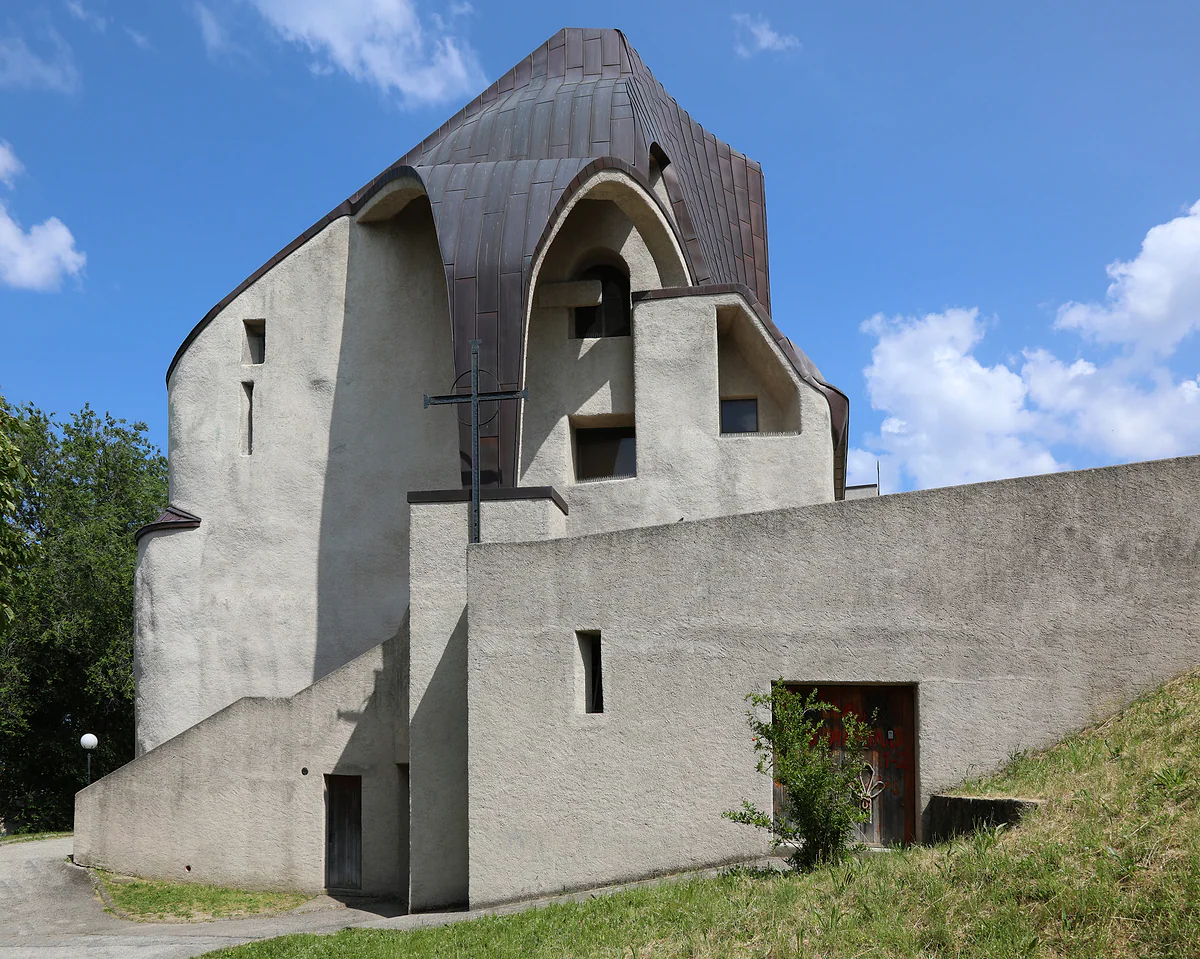
The sanctuary of the Madonna della Consolazione is in Borgo Maggiore, at the foot of Mount Titano, and was designed by the Italian architect Giovanni Michelucci. Work began in February 1964 and it was consecrated on 11 June 1967. It has an irregular trapezoid plan, a main hall below street level and a copper roof resting on parabolic arches.
In 30 seconds
Full read: 2 min
- The Madonna della Consolazione sanctuary is in Borgo Maggiore and was designed by Giovanni Michelucci.
- Work began in February 1964 and it was consecrated on 11 June 1967.
- Its main hall sits about four metres below the street, under a copper roof on parabolic arches.
- You reach it by cable car from the city, €4 single.
For me it's the best reason, besides the market, to go down to Borgo Maggiore. After all that mock-medieval stone up in the city, a 20th-century building of this calibre changes the impression you take home, and it fits into an hour with the cable car.

Before you go
What I would keep in mind
-
01 Most beautiful
A church designed like a landscape
According to Wikipedia, critics link it with Michelucci's well-known church on the Autostrada del Sole. It isn't a stand-alone block; it opens to its surroundings with shapes that recall a cave or a tent.
-
02 Getting there
Take the cable car down
The cable car links the city and Borgo Maggiore every quarter of an hour from 07:45. A single costs €4 and a return €7.
San Marino cable car -
03 My tip
Go in high, come out low
Two routes leave the narthex, one straight into the church at gallery level and one down a covered stairway to the main hall, about four metres below the street.
Up in the city, plenty of the medieval look is really a 20th-century reconstruction. Down in Borgo Maggiore there’s a 20th-century building that makes no secret of it, and for me it ranks among the country’s best sights. I mean the Madonna della Consolazione sanctuary, designed by the Tuscan architect Giovanni Michelucci.
A commission that changed hands
The San Marino government lists it among the sights of Borgo Maggiore, and Wikipedia explains how it came about. The commission first went to Gino Zani, the local engineer who reshaped the look of the city, who drew up a design in the area’s traditional style. Michelucci had already been in touch with the government about something else, converting a care home, which never got off the drawing board. When the first commission lapsed, the Tuscan architect was called in and presented his design to the confraternity in 1961. Work began in February 1964 and the sanctuary was consecrated on 11 June 1967. It belongs to the Madonna della Consolazione confraternity and today also serves as a parish church, run by Borgo’s parish priest.
What it’s like inside
The plan is an irregular trapezoid, with routes wrapping round the main hall, which sits about four metres below street level. You enter through a narthex, and from there two paths split. One leads straight into the church at gallery level; the other follows the forecourt down a covered stairway to the hall. The roof is two slopes resting on parabolic arches. It was lead to begin with and is copper today.
According to the critics Wikipedia cites, the building revisits ideas Michelucci had already tried in his famous church on the Autostrada del Sole. It doesn’t stand apart; it opens to its setting, with volumes that recall a natural space, a cave or a tent, and different paths leading to different places. The idea was a place for community, almost a small town. I’d take it slowly, going up and down both routes, because that’s where the point of it lies.
A roof that caused trouble
Water leaks through the roof appeared early and meant repairs every ten years or so. In the end, between 2012 and spring 2013, the copper covering was replaced completely, following the archive drawings of the original building site. In 2016 Pope Francis granted a Jubilee Year for the 50th anniversary of the consecration, opening on 19 November 2016 and closing on 26 November 2017.
Fitting it in
I haven’t found any published visiting hours. As it’s still a parish church, the sensible thing is to go between services and keep your voice down. The easy way down is the cable car, every quarter of an hour from 07:45, €4 single or €7 return, and while you’re there you can see the Piazza Grande and its clock tower. On Thursday mornings there’s a market too. For the full contrast, head back up to the Basilica of Saint Marinus, neoclassical and 19th-century, and compare two very different ideas of a church.
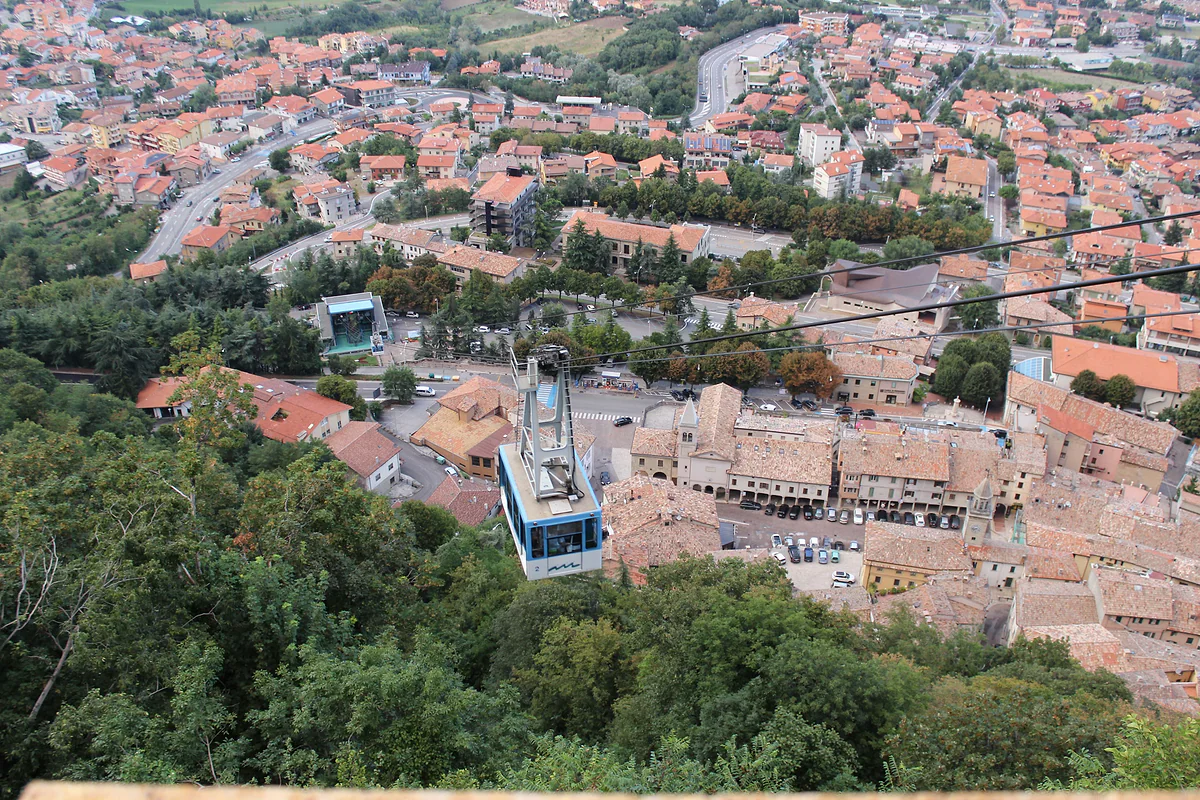
A cable car cabin descends over the woods towards Borgo Maggiore, with the town's red roofs and the valley station below.
The sanctuary in dates
| Date | What happened |
|---|---|
| 1961 | Michelucci presents the design to the confraternity |
| February 1964 | Work begins |
| 11 June 1967 | Consecration |
| 2012-2013 | The copper roof is replaced entirely |
| 19 Nov 2016 to 26 Nov 2017 | Jubilee Year for the 50th anniversary |
Secondary source, Italian Wikipedia. The Government of San Marino lists it among Borgo Maggiore's sights. No visiting hours are published; it's a working parish church.
Test yourself
True or false?
0/3 Pick before you peek.
-
The Borgo Maggiore sanctuary is a restored medieval church.
See the answer
False. It's 20th-century. Giovanni Michelucci designed it, work began in February 1964 and it was consecrated on 11 June 1967.
-
The commission first went to Gino Zani.
See the answer
True. According to Wikipedia, the Sammarinese engineer drew up a traditional-style design first; when that commission lapsed, Michelucci was brought in.
-
The sanctuary still has its original roof.
See the answer
False. It was lead and is now copper. Because of leaks it was replaced entirely between 2012 and spring 2013, according to Wikipedia.
- Year of consecration
- 1967
- Below the street, the main hall
- 4 m
- Copper roof replacement completed
- 2013
Map
Where Consolazione Sanctuary is
Every number opens its guide. The towers sit on the ridge, the city beside them and Borgo Maggiore below, linked by the cable car.
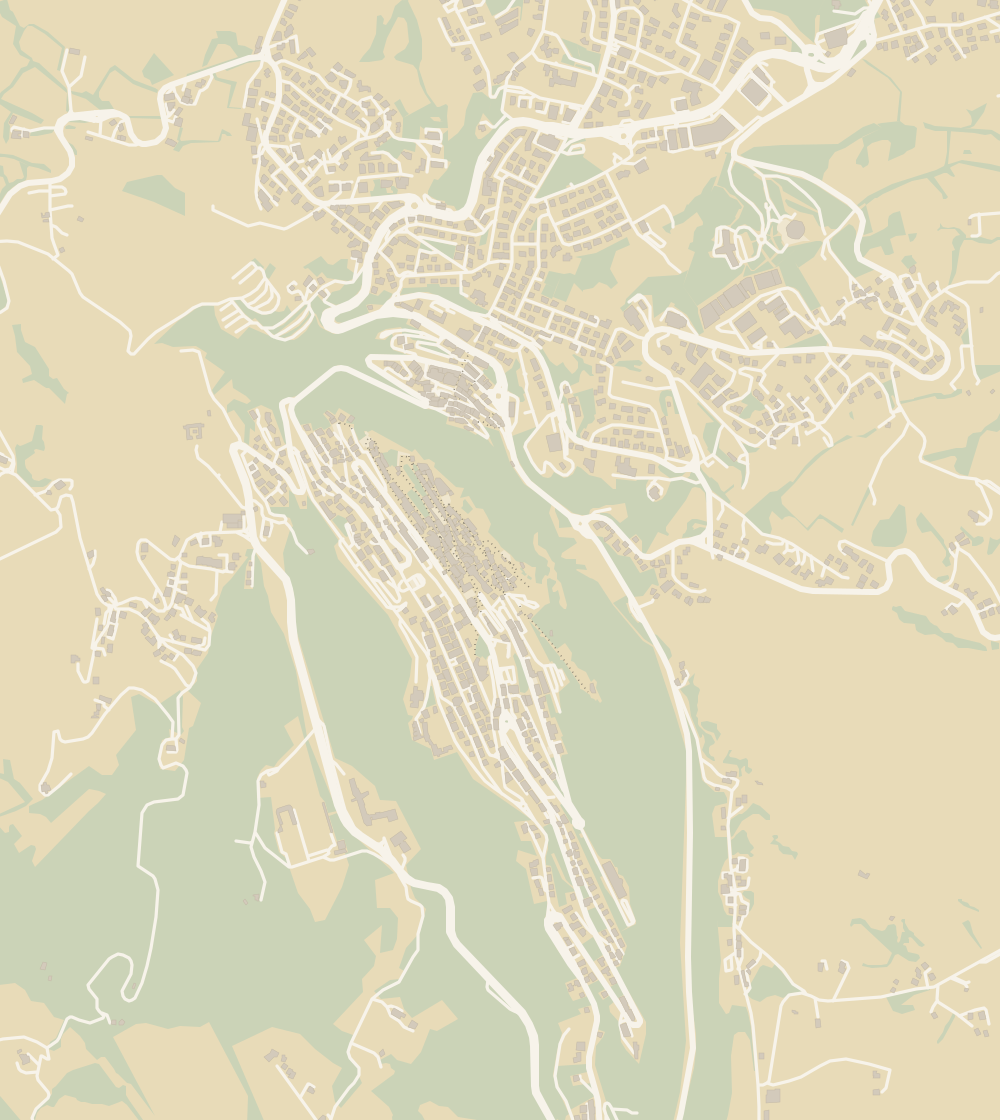 1The Three Towers 2Guaita Tower 3Cesta Tower and Arms Museum 4City of San Marino 5Montale Tower 6Borgo Maggiore 7Witches' Passage 8Palazzo Pubblico 9Changing of the guard 10Basilica of Saint Marinus 11Mount Titano 12Museums 13State Museum 14San Francesco Art Gallery 15Torture Museum 16Cable car (funivia) 17Quirky museums 18Stamp and Coin Museum 19National Gallery 20Valdragone 21San Giovanni sotto le Penne 22Medieval Days 23Christmas 24Hotel Titano 25Grand Hotel San Marino 26Hotel Rosa 27Hotel Crocenzi 28Hotel La Rocca 29Porta San Francesco 30Cava dei Balestrieri 31Map 32Teatro Titano 33Church of San Quirino 34Trenino Bianco Azzurro 35Consolazione Sanctuary 36University 37Prison 38Piazza della Libertà
 Map data © OpenStreetMap contributors (ODbL)
- 1The Three TowersTwo open inside, the third only from outside
- 2Guaita TowerAn 11th-century fortress that was a jail until 1970
- 3Cesta Tower and Arms MuseumThe top of Mount Titano, at 755 metres
- 4City of San MarinoWorld Heritage since 2008
- 5Montale TowerNo ticket, no hours, no pass
- 6Borgo MaggioreA cable car to the capital every 15 minutes
- 7Witches' PassageAbout 200 metres of battlements, no ticket
- 8Palazzo PubblicoClosed for restoration in 2026
- 9Changing of the guardNo timetable in any reliable source
- 10Basilica of Saint MarinusNeoclassical, begun in 1826, free to enter
- 11Mount Titano755 metres at the top of the Cesta
- 12MuseumsOne €11 ticket, seven venues
- 13State MuseumOpen to the public since 1899
- 14San Francesco Art GalleryIn the Franciscan cloister since 1966
- 15Torture MuseumMore than 100 original instruments
- 16Cable car (funivia)Closed from 21 to 23 October 2026
- 17Quirky museumsThree private museums with their own websites
- 18Stamp and Coin MuseumStamps since 1877, on the €11 pass
- 19National GalleryOpened on 7 July 2018
- 20ValdragoneA curazia of Borgo Maggiore
- 21San Giovanni sotto le PenneA curazia of Borgo Maggiore, below the towers
- 22Medieval DaysJuly, the old town and free entry
- 23Christmas28 November to 6 January, with a caveat
- 24Hotel TitanoOpen since 30 September 1894
- 25Grand Hotel San MarinoA hot tub on the third-floor terrace
- 26Hotel RosaFamily-run and open all year since 1965
- 27Hotel Crocenzi1 km from the cable car, 3 km from the old town
- 28Hotel La RoccaNot the Rocca, but on the road up to it
- 29Porta San FrancescoA guard post since 1361
- 30Cava dei BalestrieriThe crossbowmen's range since 1965
- 31MapNine castelli in 61 km²
- 32Teatro Titano2026-27 season from 22 October
- 33Church of San QuirinoOn the 5-cent coin
- 34Trenino Bianco AzzurroRimini to the City, 1932 to 1944
- 35Consolazione SanctuaryConsecrated on 11 June 1967
- 36UniversityCreated by law on 31 October 1985
- 37PrisonEmpty on the day the European inspectors arrived
- 38Piazza della LibertàIt used to be called the Pianello
0 of 108 San Marino guides
Your next stamp
- Borgo Maggiore
- Valdragone
- Things to do
- One day
- Two days
- The Three Towers
- Guaita Tower
- Cesta Tower and Arms Museum
- The 9 castelli
- City of San Marino
- Montale Tower
- Witches' Passage
- Palazzo Pubblico
- Serravalle
- Changing of the guard
- Dogana
- Acquaviva
- Basilica of Saint Marinus
- Mount Titano
- Chiesanuova
- Domagnano
- Faetano
- Fiorentino
- Montegiardino
- Museums
- State Museum
- San Francesco Art Gallery
- Torture Museum
- Cable car (funivia)
- Quirky museums
- Viewpoints
- Murata
- Stamp and Coin Museum
- Walking trails
- Cailungo
- National Gallery
- Best time to visit
- Getting there
- Ventoso
- Rimini to San Marino
- San Giovanni sotto le Penne
- Weather
- Getting around
- In winter
- With kids
- In summer
- Parking
- Passport stamp
- Rainy day
- Nightlife
- Phone and roaming
- Casino
- Gualdicciolo
- Money
- Coins and stamps
- Torraccia
- Falciano
- Shopping and tax-free
- Rovereta
- Lake Faetano
- Events
- Beaches
- Medieval Days
- Christmas
- MotoGP
- Where to stay
- Hotel Titano
- Where to eat
- Food
- Grand Hotel San Marino
- Luxury hotels
- Free and cheap
- Hotel iDesign
- Day trips
- Hotel Rosa
- Safety and rules
- Hotel Crocenzi
- Language
- Entry requirements
- Hotel La Rocca
- Healthcare and emergencies
- Plugs and voltage
- Is it a country?
- Opening hours
- Porta San Francesco
- Tap water
- Cava dei Balestrieri
- Map
- Post office
- Cost of a trip
- Flag
- Teatro Titano
- Accessibility
- Church of San Quirino
- History
- Captains Regent
- Trenino Bianco Azzurro
- With a dog
- Facts
- University
- Weddings
- Wine
- Prison
- Camping
- Piazza della Libertà
- Is it worth visiting?
- Constitution
Frequently asked questions
Where is the Consolazione sanctuary?
In Borgo Maggiore, the castello at the foot of Mount Titano where the cable car from the City of San Marino arrives. It belongs to the Madonna della Consolazione confraternity and also serves as a parish church.
Who designed the Consolazione sanctuary?
The Italian architect Giovanni Michelucci, known for the church on the Autostrada del Sole. According to Wikipedia the commission first went to the Sammarinese engineer Gino Zani before passing to Michelucci, who presented his design in 1961.
When was the sanctuary built?
Work began in February 1964 and it was consecrated on 11 June 1967. Between 2012 and spring 2013 the copper roof was replaced entirely.
Is there an entry fee?
No fee is published. It's a working church, so visit outside services and respectfully.
How do I get there from the City of San Marino?
The easiest way is the cable car, which runs down to Borgo Maggiore every quarter of an hour from 07:45, €4 single or €7 return. Several AASS bus lines also pass through Borgo.
By
Tourism graduate with a master’s in Tourism Management and Planning from the University of Málaga, who has travelled across Europe. He writes every guide from official sources and his own judgement.
Published on . Facts checked on .
Sources
Photos: Francesco Bini (CC BY-SA 4.0); Tulumnes (CC BY-SA 4.0), via Wikimedia Commons.