World Heritage since 2008
City of San Marino, the capital on top of Mount Titano
The City of San Marino is the country's capital and one of its nine castelli, with 4,158 residents on 30 June 2026. Its historic centre and Mount Titano have been a UNESCO World Heritage Site since 2008, covering 55 hectares with the three towers, the walls, the basilica and the Palazzo Pubblico, closed for restoration for much of 2026.
In 30 seconds
Full read: 4 min
- The City of San Marino is the capital and one of nine castelli, with 4,158 residents on 30 June 2026.
- Its historic centre and Mount Titano have been World Heritage since 2008, across 55 hectares.
- The Palazzo Pubblico is closed for restoration in 2026; the square and the façade are still there to see.
- The State Museums share one €11 pass and from 27 September open from 09:00 to 16:50.
I'd go up early, leave the car or bus below and walk the city from the outside in, from Porta San Francesco to the towers. In 2026 I wouldn't count on getting into the Palazzo Pubblico, and I'd only buy the €11 pass if I'm going to use at least two of its sites.

Before you go
What I would keep in mind
-
01 My tip
The Palazzo Pubblico is shut for works
The State Museums ticket office lists it as closed for restoration from 2 April to 31 October 2026. The façade and the square look just the same.
Palazzo Pubblico in San Marino -
02 To save money
One pass for all the State Museums
€11 gets you into the First and Second Towers, the State Museum, the San Francesco art gallery, the National Gallery and the Stamp and Coin Museum. In the last hour before closing it's €5 at the desk.
museums in San Marino -
03 Getting there
The Rimini bus drops you at the top
Bonelli's shuttle leaves Rimini station and ends at the Ex Stazione Park 2 Bus stop, in the city itself, after 55 minutes. A single costs €7.
Rimini to San Marino bus -
04 Money
Roaming isn't what you're used to
San Marino sits outside the EU's roam-like-at-home rules, and since Brexit UK networks set their own charges for Europe anyway. Check how your plan treats San Marino before you go up.
using your phone in San Marino
My priorities
Unmissable
If you have time
I would skip
- Driving into the centre, which is a limited traffic zone
- Assuming summer museum hours; from 27 September they close at 16:50
What I would book
- Places to stayBooking.com Sleep inside the walls The city changes once the day visitors leave, and the last bus back to Rimini goes at 19:00 on the autumn timetable.
- Data eSIMHolafly An eSIM so roaming isn't a worry San Marino is outside the EU's roaming rules and UK networks price Europe their own way. An eSIM takes the guesswork out.
When someone tells you they’ve been to San Marino, they’ve almost always been here. The City of San Marino is the capital, the castello that runs along the ridge of Mount Titano, and it packs the towers, the Palazzo Pubblico, the basilica and the State Museums into a handful of streets. What I want to explain is how to see it well, because the city at eleven, when the coaches arrive, and the city at eight in the morning are two very different places.
What UNESCO protects, and why
The site’s official name is San Marino Historic Centre and Mount Titano, and it was listed in 2008. It covers 55 hectares, with a 167-hectare buffer zone, and UNESCO recognises it as evidence of a free republic that has carried on since the Middle Ages. The listing takes in the towers, walls, gates and bastions, the 19th-century neoclassical basilica, convents from the 14th and 16th centuries, the Palazzo Pubblico and the 18th-century Teatro Titano.
There’s a nuance I find refreshingly honest, and few guides mention it. Much of what looks medieval was rebuilt in the early 20th century by Gino Zani with a strongly medieval taste, and UNESCO itself treats that restoration as part of the site’s story. It isn’t a stage set; it’s a city that restored itself according to the idea it had of its own past. UNESCO also points out that being up on the mountain spared it the changes of the industrial age.
The city from gate to gate
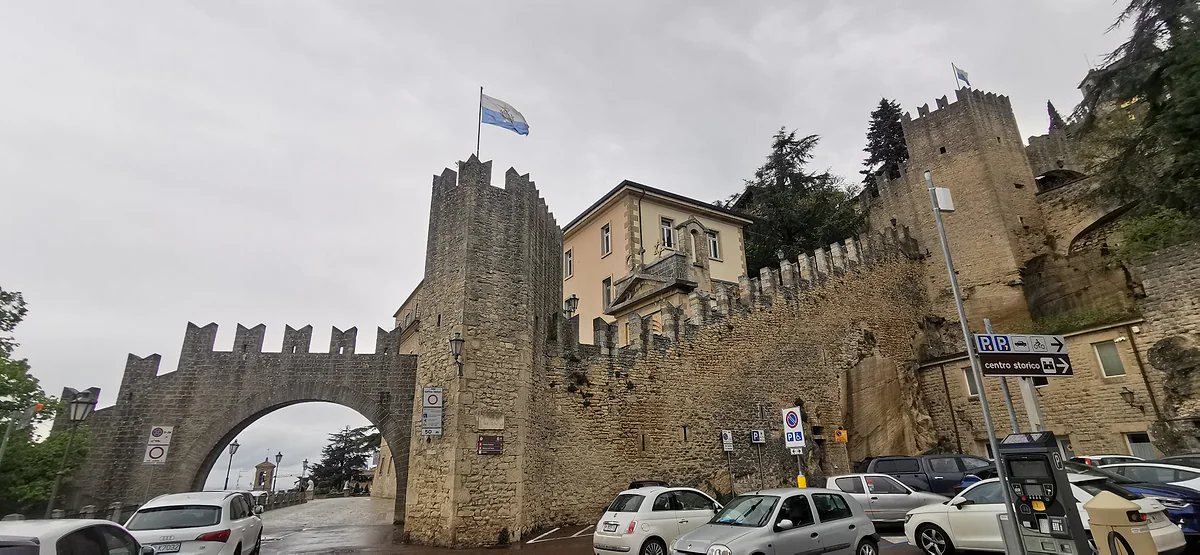
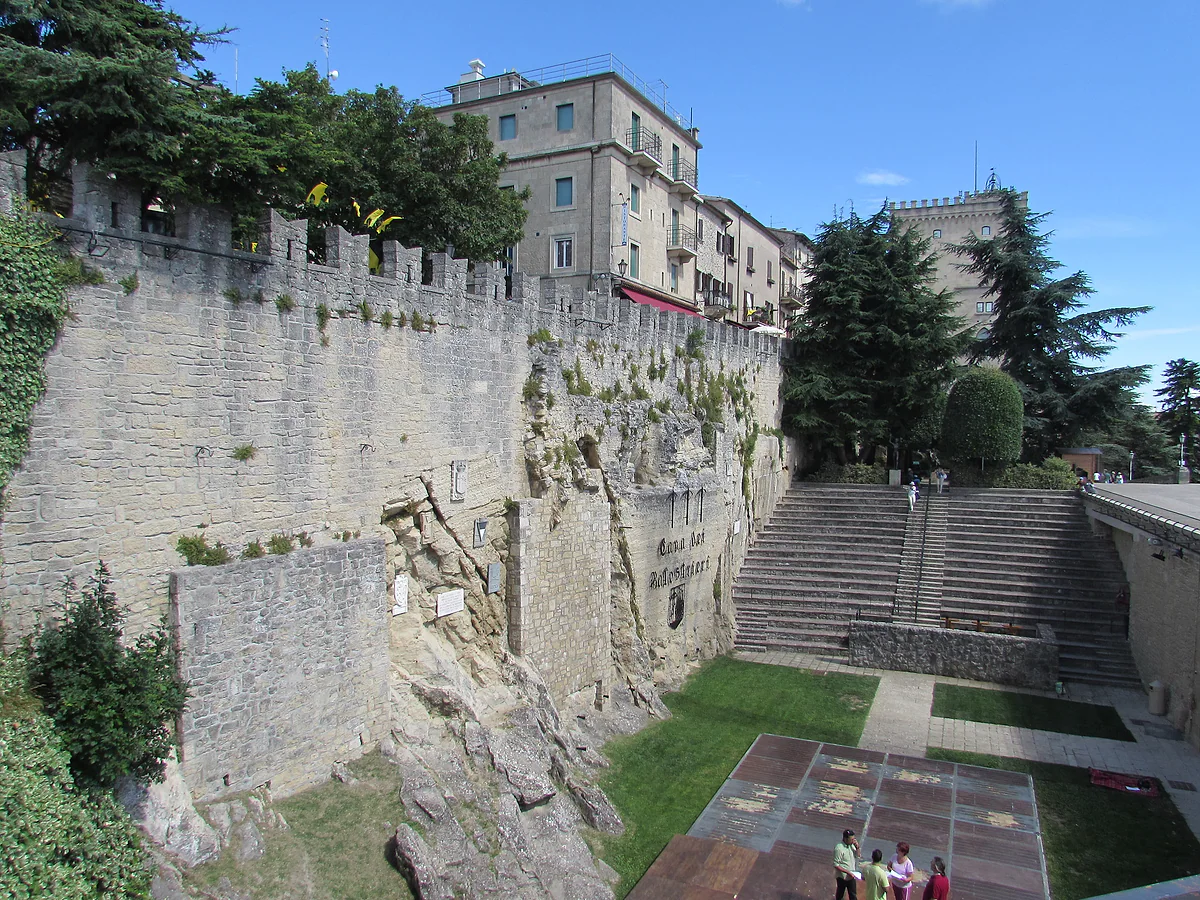
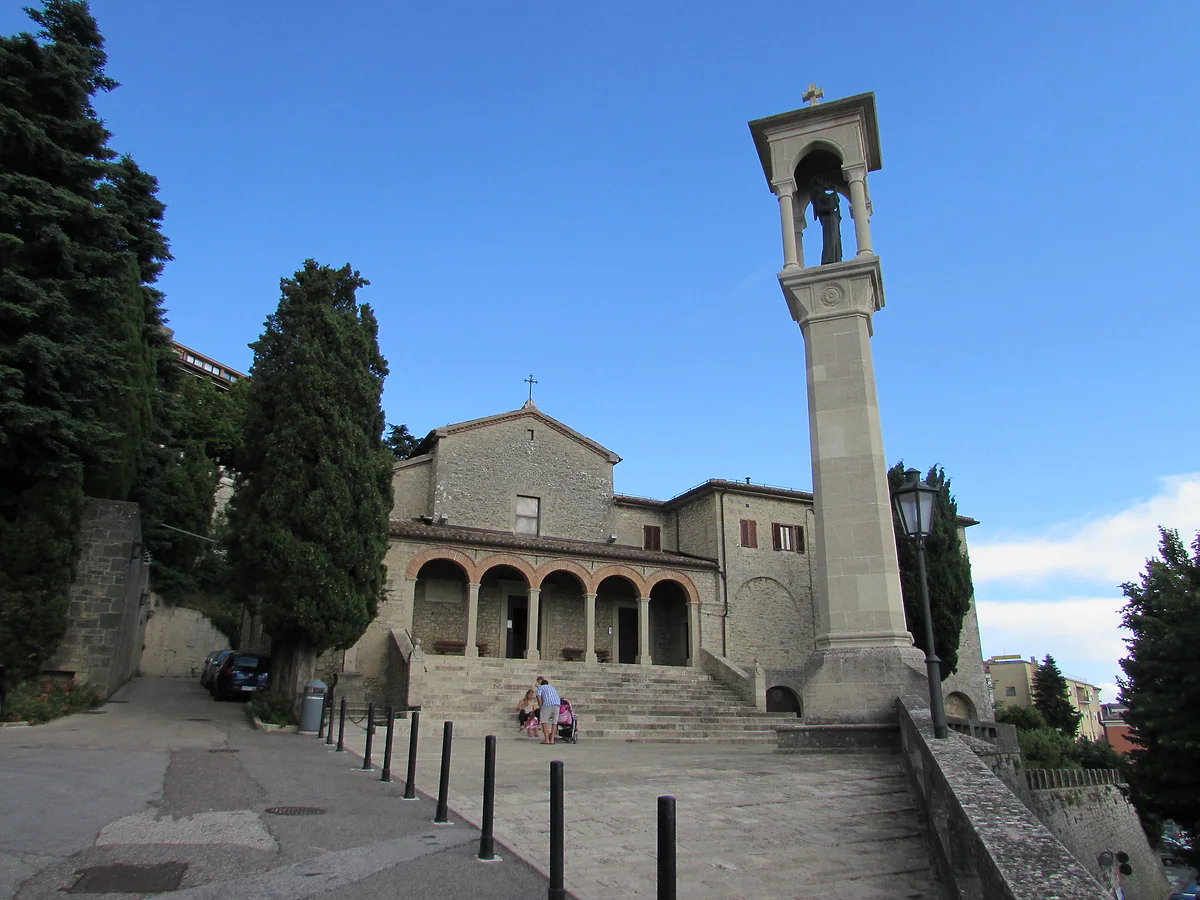
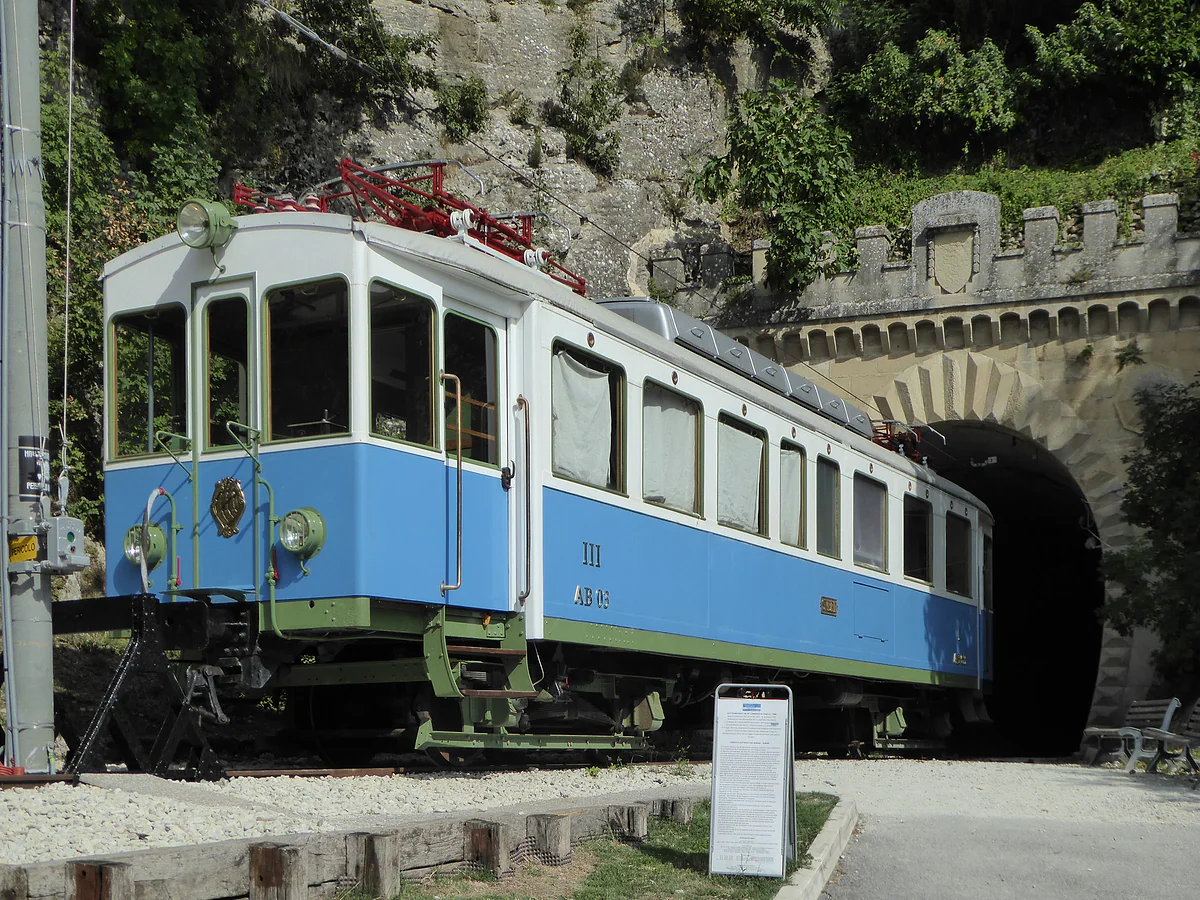
I like to walk it from the outside in. You enter through Porta San Francesco, also known as Porta del Paese, which secondary sources list as one of the four gates in the walls along with the Fratta, the Rupe and the Murata. A few steps away is the San Francesco art gallery, in the old Franciscan convent, and from there the streets climb towards Piazza della Libertà. Just outside the gate is the church of San Quirino, where Garibaldi’s story ends, and inside the old town is the Cava dei Balestrieri, the crossbowmen’s range. The old station square, where the Rimini bus stops, is also the end of the heritage stretch of the Trenino Bianco Azzurro.
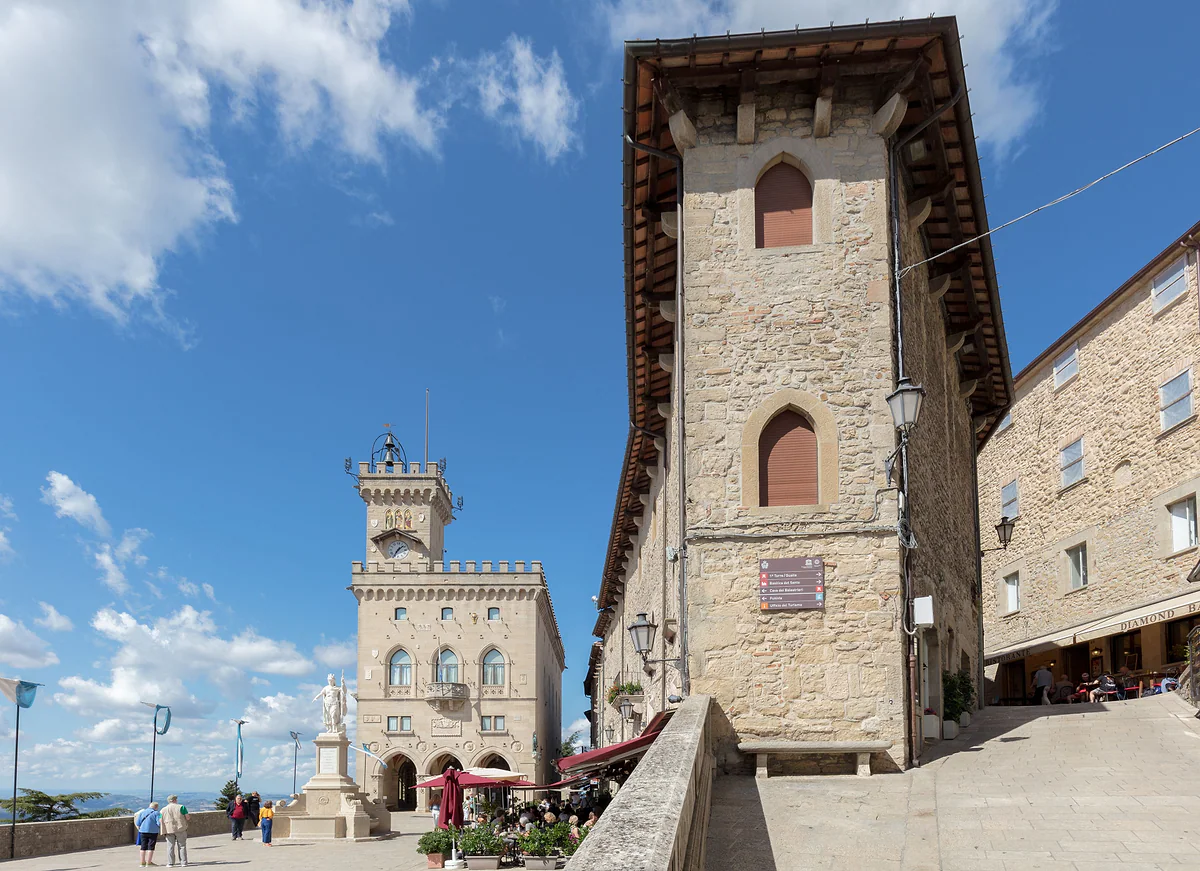
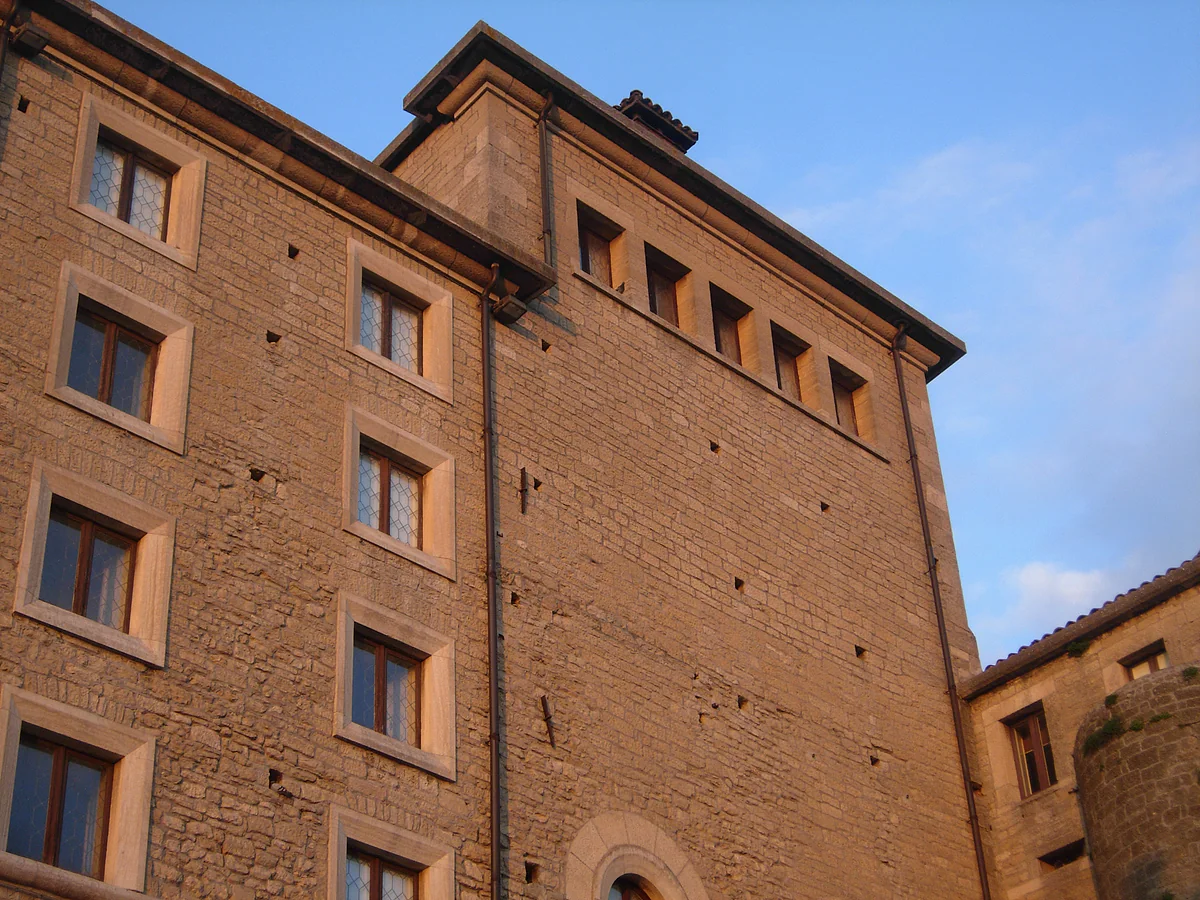
The square is the political heart. The Palazzo Pubblico, designed by Francesco Azzurri and finished in 1894 after a decade of work, is the seat of the Captains Regent and parliament, with the Statue of Liberty in front. Restoration keeps it shut in 2026, and the museums’ ticket office gives 2 April to 31 October. Until it reopens, I’d plan on seeing it from outside only.
Higher up are the Basilica of Saint Marinus, where part of the saint’s remains lie under the high altar, and the path to the towers. The Guaita and the Cesta are included in the museum pass. The walk between them, along the edge of the cliff, is for me the best thing in the city, and I cover it fully in the Three Towers of San Marino.
A capital that has shrunk
The government’s own page on this castello says something I didn’t expect from an official website. It admits a clear slowdown in the old town, with shops closing because of fewer visitors, fewer residents and competition from newer shopping hubs further down. Even so, the city still leads the country in retail, with 423 businesses. And the castello doesn’t stop at the walls, since its most developed residential area lies outside them, down the slope in Murata.
I read that as practical advice. The main streets are lined with shops aimed at people passing through, and the city with a life of its own shows up in the corners, in the State Museum, the State Library and the State Archive, which sit a few metres apart, and in the University of San Marino, whose main site is a former convent of Poor Clares. The castello also spreads beyond the walls to the west, with Murata as its residential area and the Montecchio park.
Timing your visit and moving around
The centre is a limited traffic zone, so the car stays in the numbered car parks. Bonelli’s bus from Rimini takes 55 minutes, costs €7 and terminates at the Ex Stazione Park 2 Bus stop. Coming from Borgo Maggiore, the cable car runs every quarter of an hour. Timetables are in getting around San Marino. If you’re sleeping inside, Hotel Rosa has its own parking by the Guaita, Hotel Titano sits right in the pedestrian zone and Hotel La Rocca, on Salita alla Rocca, sends guests to car parks P6 and P7.
On timing, I’d go up early. From 27 September 2026 the State Museums move to their short winter day, opening at 09:00 and shutting at 16:50 (the desk stops selling at 16:30), and the afternoons get shorter. That very day, the 27th, is one of the free-entry days for World Tourism Day. The normal pass is €11, and in the last opening hour it drops to €5 at the desk, a good option if you only want to climb one tower at the end of the day. And if you want the order I’d put all this in, with a score for each sight, it’s in things to do in San Marino.
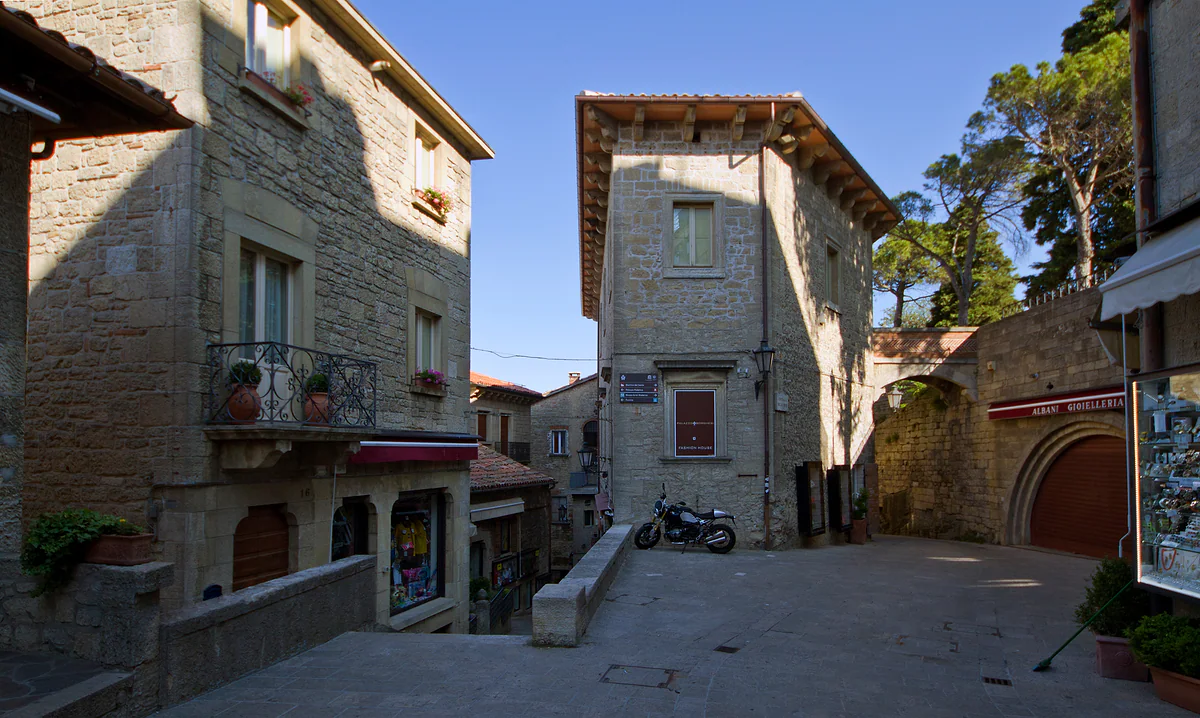
A corner of the old town with stone houses, balconies with flowers and a tower with a wooden eave under a blue sky.
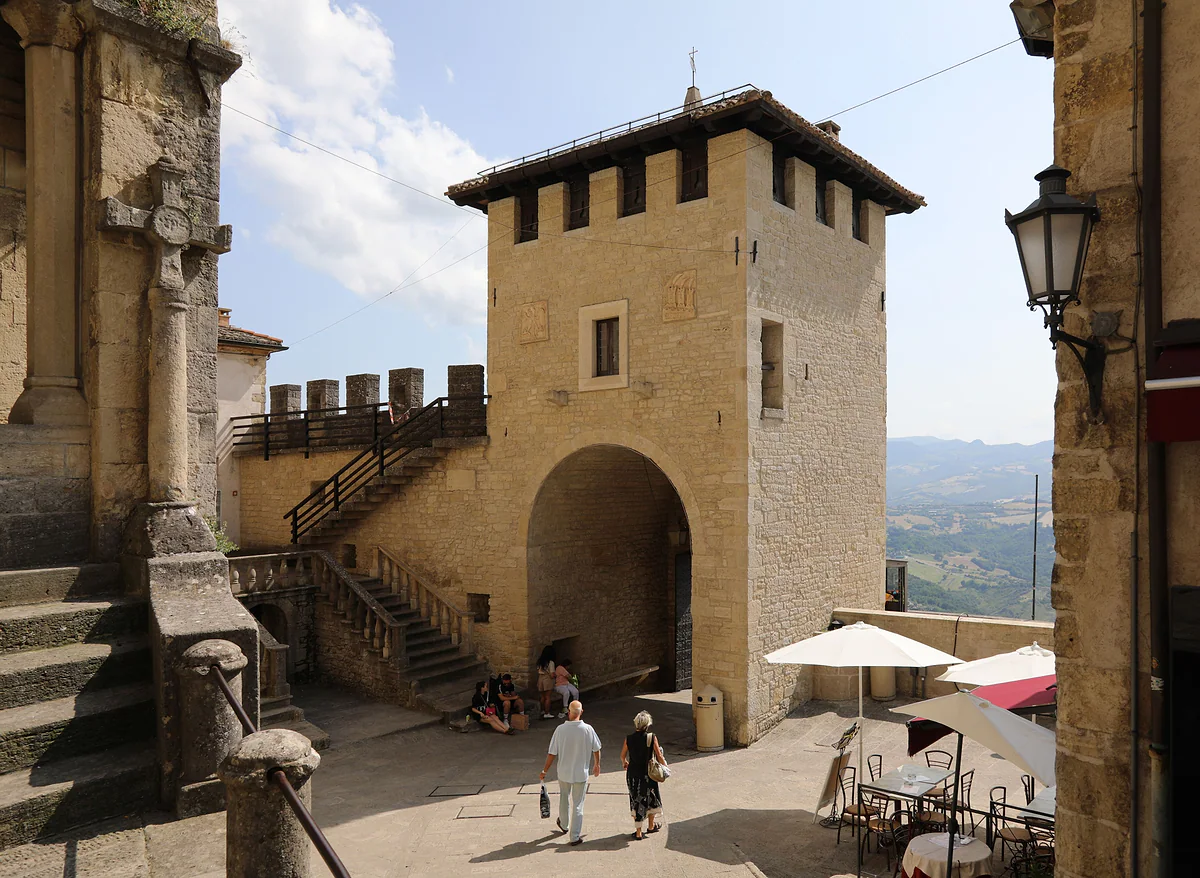
Porta San Francesco seen from inside the town, with its battlemented tower, the entrance arch and the stone staircase up to the wall.
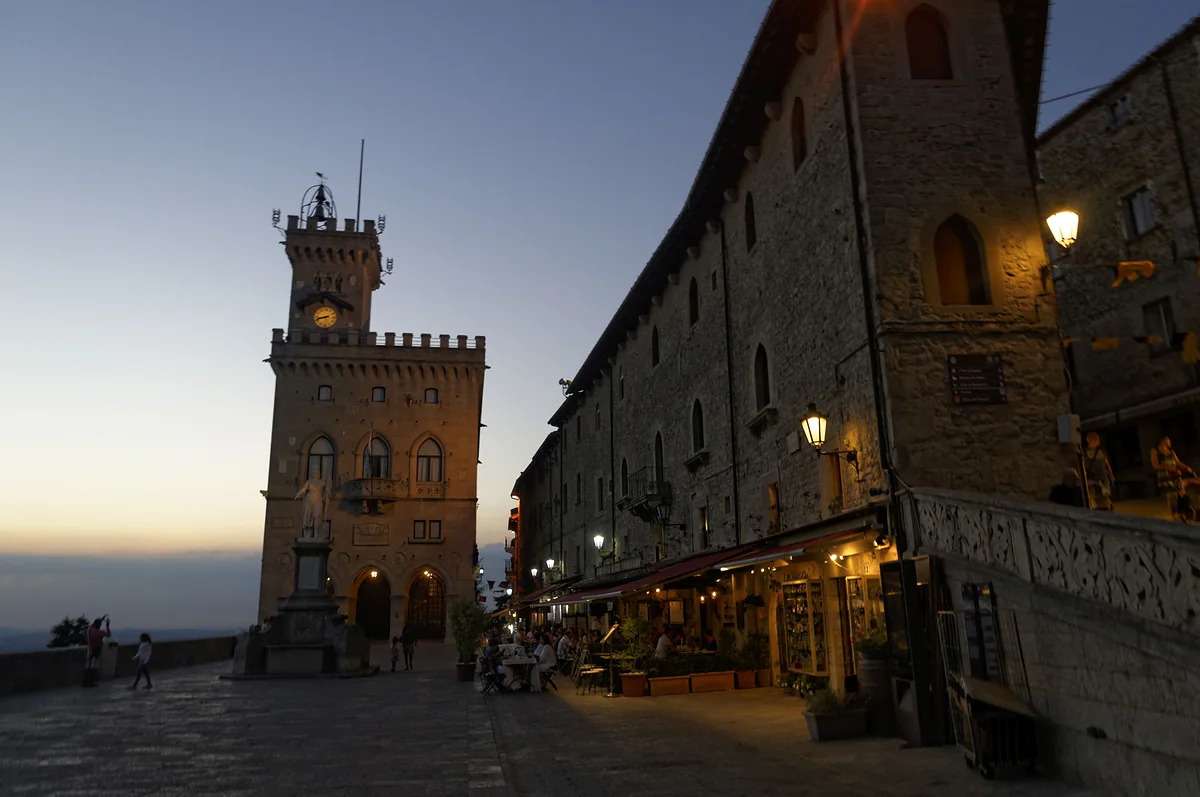
Piazza della Libertà at dusk, with the Palazzo Pubblico outlined against the sky and the terraces already lit.
State Museums opening hours in 2026
| Season | Open | Last entry |
|---|---|---|
| 2 January to 28 March and 27 September to 31 December | 09:00-16:50 | 16:30 |
| 29 March to 27 June | 10:00-17:50 | 17:30 |
| 28 June to 5 September | 08:30-19:45 | 19:15 |
| 6 to 26 September | 10:00-17:50 | 17:30 |
Closed on 1 January, the afternoon of 2 November and 25 December. The museums warn that hours may change without notice. The Palazzo Pubblico is part of the pass but closed for restoration in 2026.
How to get up to the city
| Option | Where it leaves you | Price |
|---|---|---|
| Rimini bus (Bonelli) | Ex Stazione Park 2 Bus, after stopping at Murata | €7 single |
| Cable car from Borgo Maggiore | Top station by the centre | €4 single, €7 return |
| Car | Car parks P1 to P10 and the P9 lifts | €1.50 an hour (unofficial source) |
| AASS bus or SMUVI | Stops at P9 or P2 | Free 2 March to 30 September 2026; check the fare after |
Parking prices come from a private website quoting the parking office; no official tariff could be read.
Test yourself
True or false?
0/4 Pick before you peek.
-
The City of San Marino is the country's most populated castello.
See the answer
False. It has 4,158 residents, behind Serravalle with 11,243 and Borgo Maggiore with 7,019, on 30 June 2026.
-
In 2008 UNESCO listed the whole territory of San Marino.
See the answer
False. The site covers 55 hectares with the historic centre and Mount Titano, plus a 167-hectare buffer zone. The whole country measures 61.19 km².
-
UNESCO counts the early 20th-century medieval-style restoration as part of the site's history.
See the answer
True. UNESCO's listing says Gino Zani's restoration work in the early 20th century is part of the history of the property.
-
Entry to the State Museums is free on 27 September.
See the answer
True. It's World Tourism Day, one of the free days for everyone listed by the official ticket office, along with 5 February, 7 July and 3 September.
- Residents of the castello, 30 June 2026
- 4,158
- Year of UNESCO listing
- 2008
- Area of the World Heritage Site
- 55 ha
- Pass for all the State Museums
- €11
Map
Where City of San Marino is
Every number opens its guide. The towers sit on the ridge, the city beside them and Borgo Maggiore below, linked by the cable car.
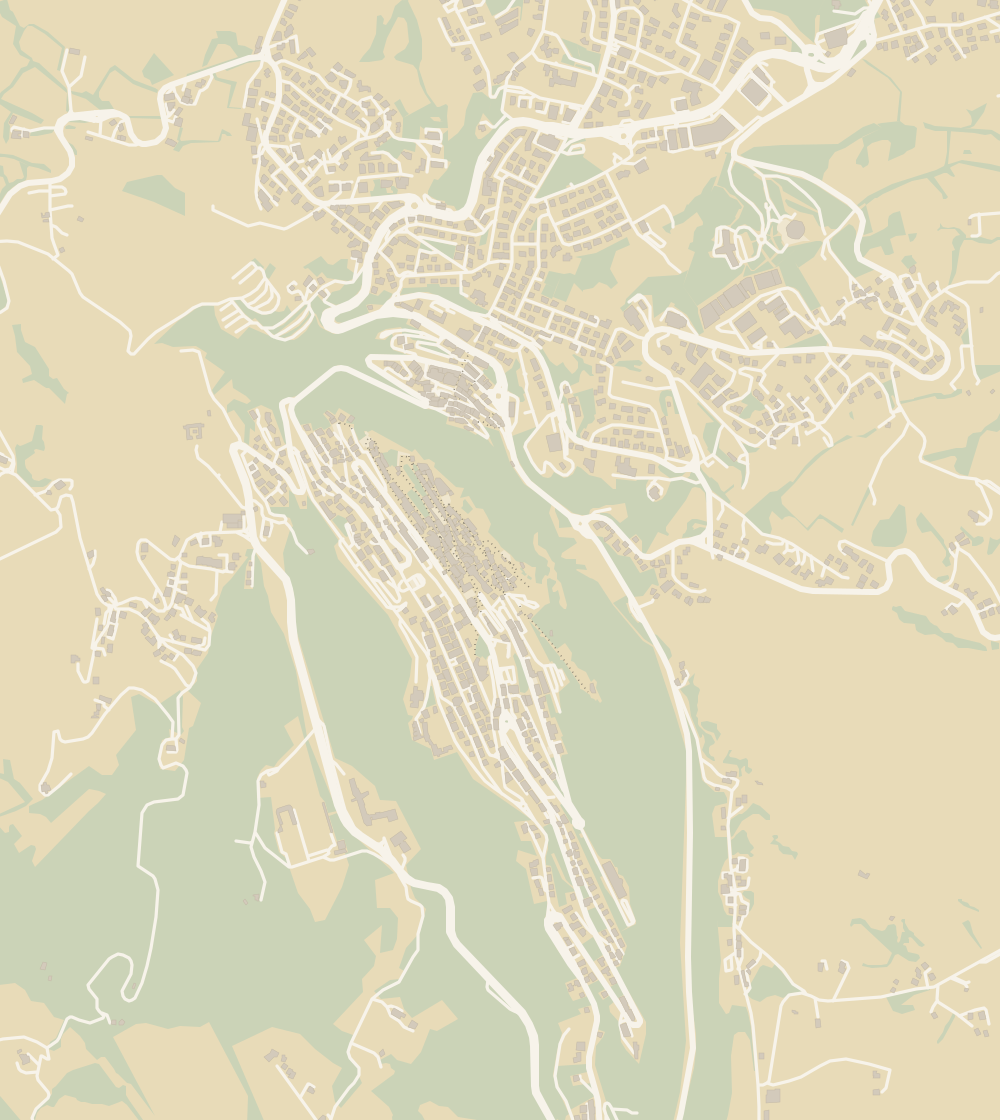 1The Three Towers 2Guaita Tower 3Cesta Tower and Arms Museum 4City of San Marino 5Montale Tower 6Borgo Maggiore 7Witches' Passage 8Palazzo Pubblico 9Changing of the guard 10Basilica of Saint Marinus 11Mount Titano 12Museums 13State Museum 14San Francesco Art Gallery 15Torture Museum 16Cable car (funivia) 17Quirky museums 18Stamp and Coin Museum 19National Gallery 20Valdragone 21San Giovanni sotto le Penne 22Medieval Days 23Christmas 24Hotel Titano 25Grand Hotel San Marino 26Hotel Rosa 27Hotel Crocenzi 28Hotel La Rocca 29Porta San Francesco 30Cava dei Balestrieri 31Map 32Teatro Titano 33Church of San Quirino 34Trenino Bianco Azzurro 35Consolazione Sanctuary 36University 37Prison 38Piazza della Libertà
 Map data © OpenStreetMap contributors (ODbL)
- 1The Three TowersTwo open inside, the third only from outside
- 2Guaita TowerAn 11th-century fortress that was a jail until 1970
- 3Cesta Tower and Arms MuseumThe top of Mount Titano, at 755 metres
- 4City of San MarinoWorld Heritage since 2008
- 5Montale TowerNo ticket, no hours, no pass
- 6Borgo MaggioreA cable car to the capital every 15 minutes
- 7Witches' PassageAbout 200 metres of battlements, no ticket
- 8Palazzo PubblicoClosed for restoration in 2026
- 9Changing of the guardNo timetable in any reliable source
- 10Basilica of Saint MarinusNeoclassical, begun in 1826, free to enter
- 11Mount Titano755 metres at the top of the Cesta
- 12MuseumsOne €11 ticket, seven venues
- 13State MuseumOpen to the public since 1899
- 14San Francesco Art GalleryIn the Franciscan cloister since 1966
- 15Torture MuseumMore than 100 original instruments
- 16Cable car (funivia)Closed from 21 to 23 October 2026
- 17Quirky museumsThree private museums with their own websites
- 18Stamp and Coin MuseumStamps since 1877, on the €11 pass
- 19National GalleryOpened on 7 July 2018
- 20ValdragoneA curazia of Borgo Maggiore
- 21San Giovanni sotto le PenneA curazia of Borgo Maggiore, below the towers
- 22Medieval DaysJuly, the old town and free entry
- 23Christmas28 November to 6 January, with a caveat
- 24Hotel TitanoOpen since 30 September 1894
- 25Grand Hotel San MarinoA hot tub on the third-floor terrace
- 26Hotel RosaFamily-run and open all year since 1965
- 27Hotel Crocenzi1 km from the cable car, 3 km from the old town
- 28Hotel La RoccaNot the Rocca, but on the road up to it
- 29Porta San FrancescoA guard post since 1361
- 30Cava dei BalestrieriThe crossbowmen's range since 1965
- 31MapNine castelli in 61 km²
- 32Teatro Titano2026-27 season from 22 October
- 33Church of San QuirinoOn the 5-cent coin
- 34Trenino Bianco AzzurroRimini to the City, 1932 to 1944
- 35Consolazione SanctuaryConsecrated on 11 June 1967
- 36UniversityCreated by law on 31 October 1985
- 37PrisonEmpty on the day the European inspectors arrived
- 38Piazza della LibertàIt used to be called the Pianello
What to see
What to see in City of San Marino
0 of 108 San Marino guides
Your next stamp
- Is it a country?
- Things to do
- State Museum
- The Three Towers
- Map
- Mount Titano
- Getting around
- One day
- Two days
- Guaita Tower
- Cesta Tower and Arms Museum
- The 9 castelli
- Montale Tower
- Borgo Maggiore
- Witches' Passage
- Palazzo Pubblico
- Serravalle
- Changing of the guard
- Dogana
- Acquaviva
- Basilica of Saint Marinus
- Chiesanuova
- Domagnano
- Faetano
- Fiorentino
- Montegiardino
- Museums
- San Francesco Art Gallery
- Torture Museum
- Cable car (funivia)
- Quirky museums
- Viewpoints
- Murata
- Stamp and Coin Museum
- Walking trails
- Cailungo
- National Gallery
- Valdragone
- Best time to visit
- Getting there
- Ventoso
- Rimini to San Marino
- San Giovanni sotto le Penne
- Weather
- In winter
- With kids
- In summer
- Parking
- Passport stamp
- Rainy day
- Nightlife
- Phone and roaming
- Casino
- Gualdicciolo
- Money
- Coins and stamps
- Torraccia
- Falciano
- Shopping and tax-free
- Rovereta
- Lake Faetano
- Events
- Beaches
- Medieval Days
- Christmas
- MotoGP
- Where to stay
- Hotel Titano
- Where to eat
- Food
- Grand Hotel San Marino
- Luxury hotels
- Free and cheap
- Hotel iDesign
- Day trips
- Hotel Rosa
- Safety and rules
- Hotel Crocenzi
- Language
- Entry requirements
- Hotel La Rocca
- Healthcare and emergencies
- Plugs and voltage
- Opening hours
- Porta San Francesco
- Tap water
- Cava dei Balestrieri
- Post office
- Cost of a trip
- Flag
- Teatro Titano
- Accessibility
- Church of San Quirino
- History
- Captains Regent
- Trenino Bianco Azzurro
- With a dog
- Consolazione Sanctuary
- Facts
- University
- Weddings
- Wine
- Prison
- Camping
- Piazza della Libertà
- Is it worth visiting?
- Constitution
Frequently asked questions
What is the capital city of San Marino?
The City of San Marino, also called San Marino Città, on the ridge of Mount Titano. It holds the Palazzo Pubblico, seat of the Captains Regent and of parliament, the three towers and the main State Museums.
Is the City of San Marino the same as San Marino?
Not quite. San Marino is the country, 61.19 km² split into nine castelli; the City of San Marino is the castello that works as its capital. Most visitors only see the City and Borgo Maggiore below it.
How many people live in the City of San Marino?
The castello of the City of San Marino had 4,158 residents on 30 June 2026, according to the official statistics bulletin. It's the country's third largest by population, behind Serravalle and Borgo Maggiore.
Which part of San Marino is a UNESCO site?
The site called San Marino Historic Centre and Mount Titano, listed in 2008. It covers 55 hectares with a 167-hectare buffer zone and includes towers, walls, gates and bastions, the basilica, 14th and 16th-century convents, the Palazzo Pubblico and the Teatro Titano.
Can you drive into the old town of San Marino?
Not unless you're authorised. It's a limited traffic zone, and hotels issue a temporary permit to drop off luggage. The usual way is to leave the car in the numbered car parks and walk up or use the P9 lifts.
Is the Palazzo Pubblico open in 2026?
No. The State Museums ticket office lists it as closed for restoration from 2 April to 31 October 2026. I'd check it has reopened before going.
By
Tourism graduate with a master’s in Tourism Management and Planning from the University of Málaga, who has travelled across Europe. He writes every guide from official sources and his own judgement.
Published on . Updated on . Facts checked on .
Sources
Photos: Diego Delso (CC BY-SA 4.0); trolvag (CC BY-SA 3.0); Francesco Bini (CC BY-SA 4.0); © Ra Boe / Wikipedia (CC BY-SA 3.0 de), via Wikimedia Commons.