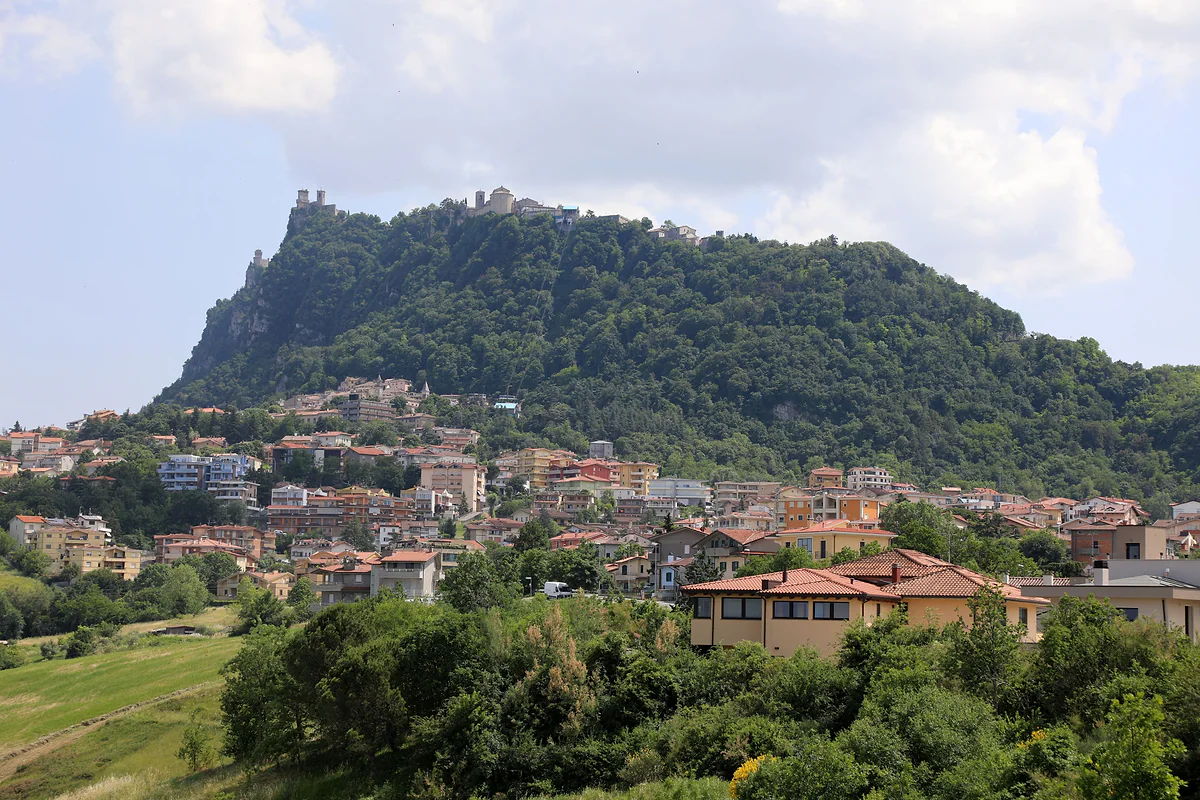
A curazia of Borgo Maggiore, below the towers
San Giovanni sotto le Penne, where San Marino's story begins
San Giovanni sotto le Penne, or San Gianni, is a 170-hectare curazia of Borgo Maggiore at the foot of the City's towers. According to Wikipedia, it yielded the oldest object ever found in San Marino, a stone axe-hammer from 5000-4000 BC, and at Maiano the State Museums excavated Roman brick kilns. Today it's farmland, woods and olive groves.
In 30 seconds
Full read: 3 min
- San Giovanni sotto le Penne is a curazia of Borgo Maggiore below Mount Titano's towers.
- According to Wikipedia, San Marino's oldest find turned up here, a stone axe-hammer from 5000-4000 BC.
- At Maiano, Roman brick kilns were excavated, and the area is now a protected nature zone.
- It has the parish church of John the Baptist, a crossbow training ground and an experimental olive grove.
- It's countryside and woodland for walking, not a village of monuments.
San Giovanni is for anyone who wants rural San Marino with Mount Titano looming overhead. I'd come for a walk in the Maiano woods and to look up at the towers, which is when the name makes sense, and I'd take it slowly, because nothing here is laid on for tourists.

Before you go
What I would keep in mind
-
01 Most beautiful
Maiano, woodland and a spring with a wash-house
According to Wikipedia, Maiano is a protected natural area and wildlife haven, with the Fonte di Maiano spring feeding one of the country's two surviving old public wash-houses and an original farmhouse.
walking trails in San Marino -
02 My tip
The Roman bricks are in the State Museum
The State Museum itself names Maiano among the places where bricks, tiles and pottery were made in Roman times. Room II on the ground floor is where that period is told.
San Marino State Museum -
03 Most beautiful
The crossbowmen train here
Wikipedia places a training ground for San Marino's crossbowmen in San Giovanni. Their public displays, though, happen up the hill at the Cava dei Balestrieri.
the Cava dei Balestrieri -
04 Getting there
Circular lines 3D and 3S, summer included
They leave car park P2 in the City, pass through Borgo Maggiore and San Giovanni and carry on via Fiorentino, Montegiardino and Faetano, on weekdays. They're among the lines that keep running in summer.
getting around San Marino
Look up from San Giovanni sotto le Penne and Mount Titano’s towers are right above you. That’s where the name comes from, pairing John the Baptist with the Penne, the capital’s forts. It’s a rural village with no grand square, and yet it’s the one in Borgo Maggiore that intrigues me most, because this is where San Marino’s story starts, thousands of years before Marinus the stonemason.
The oldest object in the country
According to Wikipedia, a stone axe-hammer turned up in San Giovanni that radiocarbon dating places between 5000 and 4000 BC, making it the oldest archaeological find in the Republic. The State Museum website doesn’t mention the piece, so whether it’s on display I simply don’t know, but it does confirm the essentials, that the territory has been lived in since the Stone Age and had small Villanovan and Roman settlements. I find it a good corrective to the idea that San Marino begins in AD 301.
Maiano, Roman kilns in the woods
Within the village lies Maiano, which Wikipedia describes as a nature and archaeology area and the southern edge of the buffer zone around the UNESCO site. It was inhabited from Roman times. A rescue dig took place in 1998, and in August 2012 the State Museums uncovered a kiln works covering more than 8,000 square metres, where bricks, tiles, amphorae, jugs and cups were made between the 1st and 3rd centuries. It had everything the trade needed, clay, water and firewood.
What I like best is the detail of the stamps. Some tiles bore the mark of the Seia family, Sextus Seius and Lucius Seius, whose products also turn up in Rimini, and misfired tiles reused in the kiln itself suggest Maiano was one of their production centres. The State Museum, in its room on the Roman period, lists Maiano among the places where bricks and pottery were made. If you want to see that side of it, that’s where to go. My suggestion, if archaeology is your thing, is to do it in that order, the museum room up in the City first and the Maiano woods afterwards, so the landscape has a story attached when you walk through it. The other way round, you’re mostly looking at trees and fields.
A protected area for walking
These days Maiano is mostly about nature. Wikipedia describes it as a protected natural area and wildlife repopulation zone, with hunting banned. It has a spring, the Fonte di Maiano, feeding one of the two old public wash-houses still standing in the country, one of the last original Sammarinese farmhouses, Casa Ugolini, and a handful of fountains and wayside shrines protected by law. The Maiano woods are among the nature walks picked out by the state tourist office.
With no official route map to go on, I’d treat it as an easy, unambitious stroll and pair the area with the better-marked routes I cover in San Marino’s walking trails.
The church, the crossbowmen and the olive grove
The parish church is San Giovanni Battista, at Strada di San Gianno 10, with its feast day on 24 June. Wikipedia lists it as one of the territory’s oldest churches. At the same address live Franciscan missionary sisters who work with residents of Il Colore del Grano, a centre for people with disabilities and one of the social services the government lists in Borgo Maggiore.
The rest of the village is country life with the odd surprise. According to Wikipedia there’s a training ground for San Marino’s crossbowmen, whose public displays you can watch up at the Cava dei Balestrieri. There’s also the refuge of the Sammarinese Animal Protection Association, a riding stable and, since 2014, the country’s first experimental olive grove, run by the Sammarinese Olive Growers’ Cooperative. None of it is set up for visitors, so I wouldn’t give you opening times.
Getting there
From car park P2 in the City, the circular AASS lines 3D and 3S run through Borgo Maggiore and stop at San Giovanni before continuing via Fiorentino, Montegiardino and Faetano. They run on weekdays, summer included, and cost nothing during the free-travel trial that ended on 30 September 2026. By car it’s a short detour from Borgo Maggiore, and I’d slot it into a loop of the southern castelli, with Valdragone or Fiorentino the same morning.
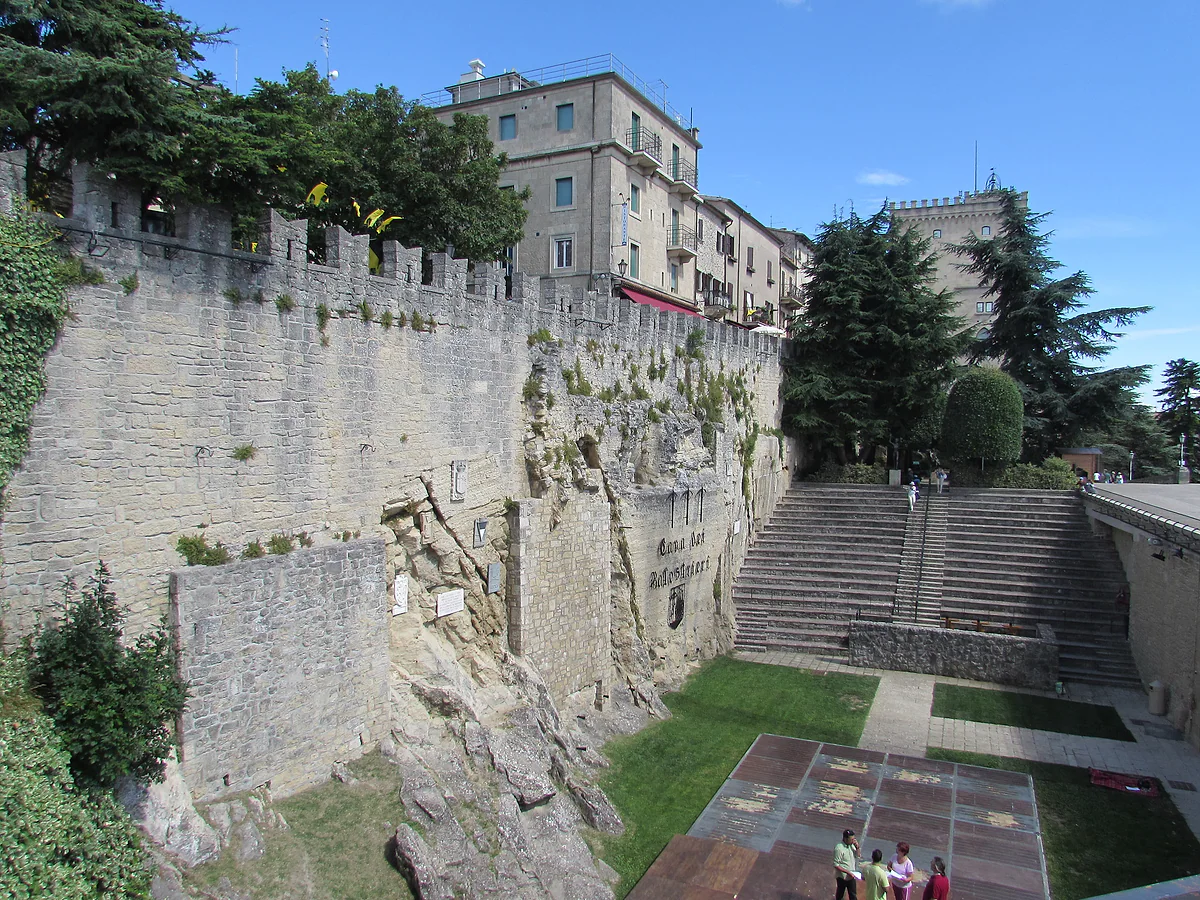
The Cava dei Balestrieri, a sunken space between the battlemented wall and the rock, with lawn, steps and old-town buildings above.
San Giovanni sotto le Penne through time
| Period | What's there | Source |
|---|---|---|
| 5000-4000 BC | Stone axe-hammer, the oldest find in the country | Wikipedia |
| 1st-3rd century AD | Roman brick and pottery kilns at Maiano | State Museum and Wikipedia |
| 1998 and 2012 | Rescue dig and State Museums excavation at Maiano | Wikipedia |
| 2014 | The country's first experimental olive grove, at Maiano | Wikipedia |
| 24 June | Feast of John the Baptist, the parish patron | Diocese of San Marino-Montefeltro |
The State Museum's website mentions Maiano but not the axe-hammer, so I can't confirm it's on display.
Test yourself
True or false?
0/4 Pick before you peek.
-
The Penne in the name are a range of Apennine peaks.
See the answer
False. According to Wikipedia, the Penne are the City's forts, the towers of Mount Titano right above the village.
-
Bricks and pottery were made at Maiano in Roman times.
See the answer
True. The State Museum names Maiano among the places where bricks, tiles and pottery were produced in Roman San Marino.
-
You can hunt at Maiano with a permit.
See the answer
False. According to Wikipedia, Maiano is a wildlife repopulation area and hunting is banned throughout.
-
San Marino's first experimental olive grove is at Maiano.
See the answer
True. According to Wikipedia, the Sammarinese Olive Growers' Cooperative has run it there since 2014.
- Area of the curazia, per Wikipedia
- 170 ha
- Earliest date for the axe-hammer
- 5000 BC
- Area surveyed in the 2012 dig
- 8,000 m²
- First experimental olive grove
- 2014
Map
Where San Giovanni sotto le Penne is
Every number opens its guide. The towers sit on the ridge, the city beside them and Borgo Maggiore below, linked by the cable car.
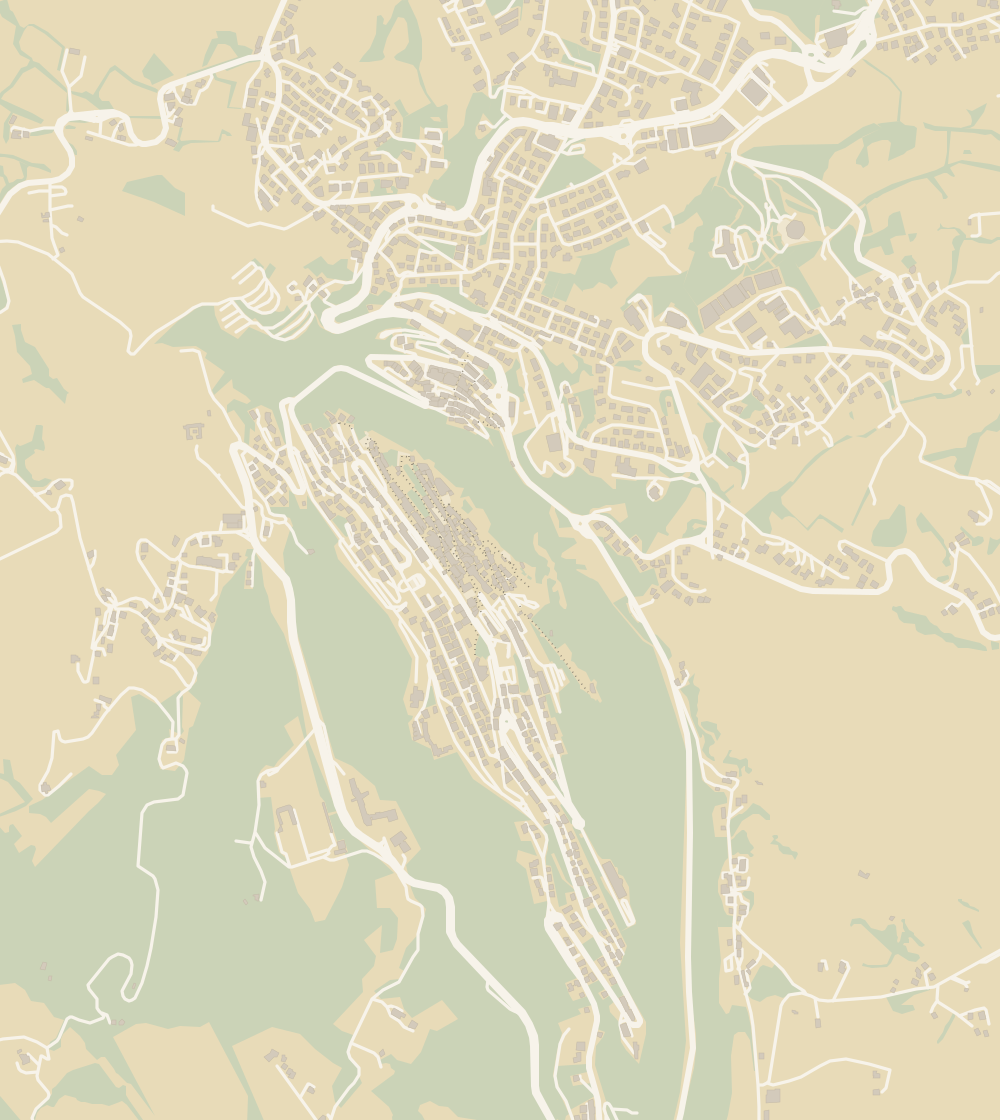 1The Three Towers 2Guaita Tower 3Cesta Tower and Arms Museum 4City of San Marino 5Montale Tower 6Borgo Maggiore 7Witches' Passage 8Palazzo Pubblico 9Changing of the guard 10Basilica of Saint Marinus 11Mount Titano 12Museums 13State Museum 14San Francesco Art Gallery 15Torture Museum 16Cable car (funivia) 17Quirky museums 18Stamp and Coin Museum 19National Gallery 20Valdragone 21San Giovanni sotto le Penne 22Medieval Days 23Christmas 24Hotel Titano 25Grand Hotel San Marino 26Hotel Rosa 27Hotel Crocenzi 28Hotel La Rocca 29Porta San Francesco 30Cava dei Balestrieri 31Map 32Teatro Titano 33Church of San Quirino 34Trenino Bianco Azzurro 35Consolazione Sanctuary 36University 37Prison 38Piazza della Libertà
 Map data © OpenStreetMap contributors (ODbL)
- 1The Three TowersTwo open inside, the third only from outside
- 2Guaita TowerAn 11th-century fortress that was a jail until 1970
- 3Cesta Tower and Arms MuseumThe top of Mount Titano, at 755 metres
- 4City of San MarinoWorld Heritage since 2008
- 5Montale TowerNo ticket, no hours, no pass
- 6Borgo MaggioreA cable car to the capital every 15 minutes
- 7Witches' PassageAbout 200 metres of battlements, no ticket
- 8Palazzo PubblicoClosed for restoration in 2026
- 9Changing of the guardNo timetable in any reliable source
- 10Basilica of Saint MarinusNeoclassical, begun in 1826, free to enter
- 11Mount Titano755 metres at the top of the Cesta
- 12MuseumsOne €11 ticket, seven venues
- 13State MuseumOpen to the public since 1899
- 14San Francesco Art GalleryIn the Franciscan cloister since 1966
- 15Torture MuseumMore than 100 original instruments
- 16Cable car (funivia)Closed from 21 to 23 October 2026
- 17Quirky museumsThree private museums with their own websites
- 18Stamp and Coin MuseumStamps since 1877, on the €11 pass
- 19National GalleryOpened on 7 July 2018
- 20ValdragoneA curazia of Borgo Maggiore
- 21San Giovanni sotto le PenneA curazia of Borgo Maggiore, below the towers
- 22Medieval DaysJuly, the old town and free entry
- 23Christmas28 November to 6 January, with a caveat
- 24Hotel TitanoOpen since 30 September 1894
- 25Grand Hotel San MarinoA hot tub on the third-floor terrace
- 26Hotel RosaFamily-run and open all year since 1965
- 27Hotel Crocenzi1 km from the cable car, 3 km from the old town
- 28Hotel La RoccaNot the Rocca, but on the road up to it
- 29Porta San FrancescoA guard post since 1361
- 30Cava dei BalestrieriThe crossbowmen's range since 1965
- 31MapNine castelli in 61 km²
- 32Teatro Titano2026-27 season from 22 October
- 33Church of San QuirinoOn the 5-cent coin
- 34Trenino Bianco AzzurroRimini to the City, 1932 to 1944
- 35Consolazione SanctuaryConsecrated on 11 June 1967
- 36UniversityCreated by law on 31 October 1985
- 37PrisonEmpty on the day the European inspectors arrived
- 38Piazza della LibertàIt used to be called the Pianello
0 of 108 San Marino guides
Your next stamp
- Cesta Tower and Arms Museum
- Domagnano
- History
- Trenino Bianco Azzurro
- Cava dei Balestrieri
- Valdragone
- Things to do
- One day
- Two days
- The Three Towers
- Guaita Tower
- The 9 castelli
- City of San Marino
- Montale Tower
- Borgo Maggiore
- Witches' Passage
- Palazzo Pubblico
- Serravalle
- Changing of the guard
- Dogana
- Acquaviva
- Basilica of Saint Marinus
- Mount Titano
- Chiesanuova
- Faetano
- Fiorentino
- Montegiardino
- Museums
- State Museum
- San Francesco Art Gallery
- Torture Museum
- Cable car (funivia)
- Quirky museums
- Viewpoints
- Murata
- Stamp and Coin Museum
- Walking trails
- Cailungo
- National Gallery
- Best time to visit
- Getting there
- Ventoso
- Rimini to San Marino
- Weather
- Getting around
- In winter
- With kids
- In summer
- Parking
- Passport stamp
- Rainy day
- Nightlife
- Phone and roaming
- Casino
- Gualdicciolo
- Money
- Coins and stamps
- Torraccia
- Falciano
- Shopping and tax-free
- Rovereta
- Lake Faetano
- Events
- Beaches
- Medieval Days
- Christmas
- MotoGP
- Where to stay
- Hotel Titano
- Where to eat
- Food
- Grand Hotel San Marino
- Luxury hotels
- Free and cheap
- Hotel iDesign
- Day trips
- Hotel Rosa
- Safety and rules
- Hotel Crocenzi
- Language
- Entry requirements
- Hotel La Rocca
- Healthcare and emergencies
- Plugs and voltage
- Is it a country?
- Opening hours
- Porta San Francesco
- Tap water
- Map
- Post office
- Cost of a trip
- Flag
- Teatro Titano
- Accessibility
- Church of San Quirino
- Captains Regent
- With a dog
- Consolazione Sanctuary
- Facts
- University
- Weddings
- Wine
- Prison
- Camping
- Piazza della Libertà
- Is it worth visiting?
- Constitution
Frequently asked questions
What does San Giovanni sotto le Penne mean?
Saint John below the Penne. According to Wikipedia, the name joins the patron saint, John the Baptist, with the Penne, the City's forts, meaning the towers you see overhead. It's also known as San Gianni.
Where is San Giovanni sotto le Penne?
It's a curazia of Borgo Maggiore at the foot of Mount Titano, below the towers, on the way to Fiorentino. According to Wikipedia it covers 170 hectares and includes the Maiano nature and archaeology area.
What is the Maiano archaeological site?
An area where, according to Wikipedia, the State Museums excavated Roman kilns for bricks, tiles and pottery from the 1st to 3rd centuries in 2012, over more than 8,000 m². The State Museum names Maiano as a Roman production site.
What is the oldest find in San Marino?
According to Wikipedia, a stone axe-hammer found in San Giovanni sotto le Penne and radiocarbon-dated to between 5000 and 4000 BC. The State Museum confirms the territory has been inhabited since the Stone Age.
Where is the church of San Giovanni Battista?
At Strada di San Gianno 10. It's the village's parish church, with its feast on 24 June, and Wikipedia counts it among the oldest churches in San Marino.
How do I get there by bus?
On the circular AASS lines 3D and 3S, which leave car park P2 in the City and stop at San Giovanni, on weekdays and in summer too. They were free from 2 March to 30 September 2026.
By
Tourism graduate with a master’s in Tourism Management and Planning from the University of Málaga, who has travelled across Europe. He writes every guide from official sources and his own judgement.
Published on . Updated on . Facts checked on .
Sources
Photos: Francesco Bini (CC BY-SA 4.0); Cezar Suceveanu (CC BY-SA 4.0), via Wikimedia Commons.