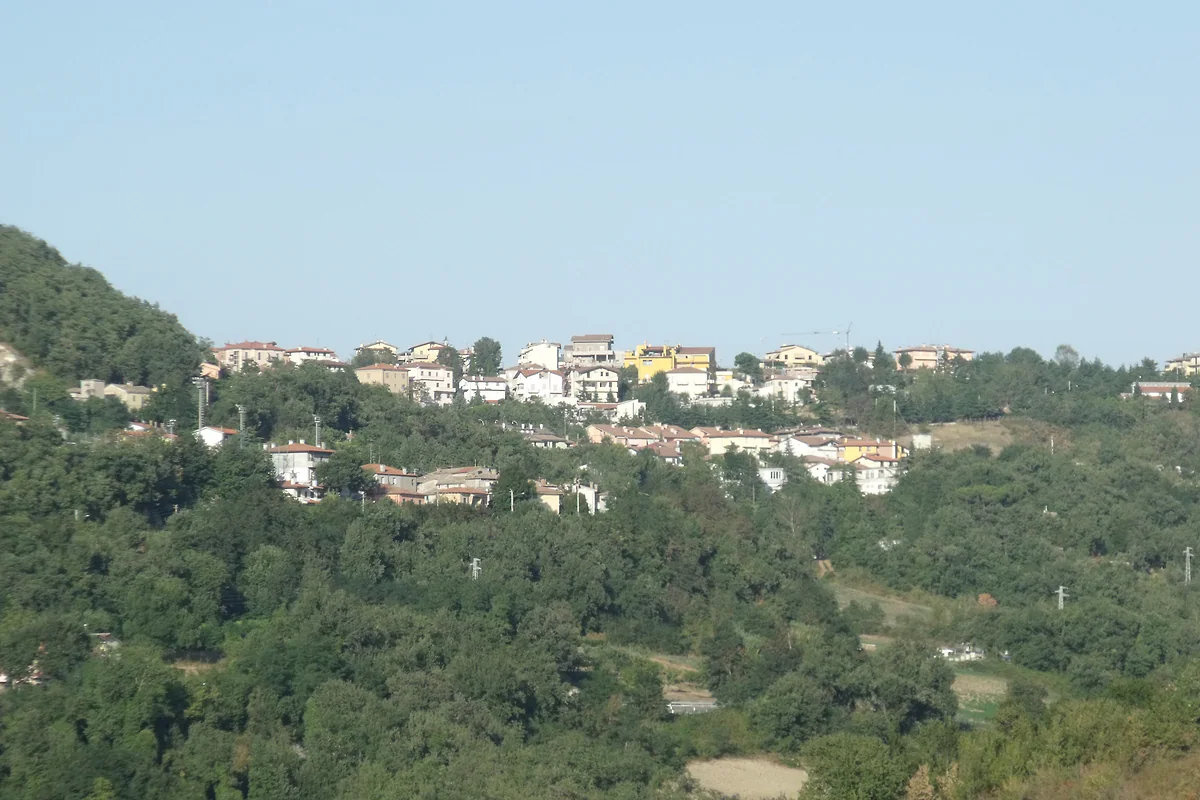
The Focheraccia bonfire, every 18 March
Fiorentino, three castles, an aviator and a bonfire
Fiorentino is the southern San Marino castello that calls itself the land of three castles. It has 2,593 residents on 30 June 2026 and 6.56 km². At Pennarossa you can see foundations, the keep and a cistern cut into the rock, and in 1913 the aviator Gianni Widmer landed here after the first flight over the country.
In 30 seconds
Full read: 3 min
- Fiorentino is a southern San Marino castello with 2,593 residents and 6.56 km².
- It calls itself the land of three castles; Pennarossa still has its keep and a rock-cut cistern.
- In 1913 Gianni Widmer landed here after the first flight over San Marino.
- Its best-known festival is the Focheraccia bonfire on 18 March.
Of the lower castelli, Fiorentino is the one I'd pick for proper ruins. I'd head up to Pennarossa, cleared in the 1960s and still with its keep, and if I could make the dates work I'd come on 18 March for the bonfire.

Before you go
What I would keep in mind
-
01 Most beautiful
The ruins of Pennarossa
Cleared and made safe from the early 1960s, they show the foundations, the keep, the wall walks and a cistern carved into the rock. Nothing is left of the third castle, Torricella.
-
02 Worth the splurge
Come on 18 March, Focheraccia night
It's the fire festival in honour of St Joseph, and the council itself says it's better known than the patron's feast. The castello festival, for St Bartholomew, is on the last Sunday of July.
events in San Marino -
03 My tip
The Wednesday market
Every Wednesday morning, 07:00 to 13:00, there's a fruit, veg and fish market beside the Due Archi restaurant. The council suggests parking behind it and arriving via the San Giovanni turn.
Fiorentino bills itself as the land of three castles, and it’s one of the few lower castelli where genuine medieval stonework is still visible. It also has two stories I’m very fond of, one about an aviator who landed here in 1913 and one about a bonfire that every 18 March outshines the patron saint’s own feast.
Three castles, two half standing
The castello council names them one by one. The ruins of Castellaccio and Pennarossa can still be seen. Pennarossa was cleared and made safe from the early 1960s and now shows its foundations and keep, plus the wall walks and a cistern hewn from the rock. Of the third, Torricella, there’s no trace. If I could choose only one spot in Fiorentino, I’d walk up to Pennarossa.
Wikipedia fills in the history. Fiorentino is first recorded in 1069, among properties given to St Peter Damian, and from the 13th to the 15th century it belonged to the Counts of Carpegna, so much so that one branch of the family took its name. It passed to the Malatesta in 1440, and in 1463 Federico da Montefeltro and the Sammarinese took it, a gain Pope Pius II confirmed in a bull of 27 June that year. The defences were then dismantled. What came next is in the history of San Marino.
The aviator of Monte Carlo
In 1913 the Trieste-born aviator Gianni Widmer made the first flight over San Marino. According to the council, his 50-horsepower Blériot climbed to 1,600 metres and landed on the plateau after eleven minutes. Wikipedia gives the date as 16 April and places the landing on the plateau of Monte Carlo, at 508 metres. A memorial stone by the sculptor Carlo Reffi, with an inscription by Pietro Franciosi, marks the spot, and the same encyclopaedia says it was only the second monument in the world raised to an aviator. It’s one of my favourite small facts about the country.
Garibaldi and the Vascone
In the garden of a farmhouse not far from the centre you can still find the Vascone. The council says Garibaldi and his men would have stopped here on the night of 30 July 1849 to drink and rest on their march towards Venice. It tells it in the conditional, and so shall I. Up in the capital, the same episode ends at the church of San Quirino, where he disbanded his legion the next day.
There’s older archaeology too. Tombs from the Roman Republican period were found in 1910, and the State Museum keeps a vase and several fragments from that find.
The Focheraccia and the market
The castello festival falls on the last Sunday of July, for St Bartholomew, patron of the village’s modern church. But the council says plainly that the fire festival, the Focheraccia on 18 March in honour of St Joseph, is even better known. In 2024, per the official calendar, the castello festival ran from 26 to 28 July. Since the 2026 list isn’t out, I’d check dates with the council. Everything else in the year is in San Marino’s events.
If you’re here on a Wednesday, there’s a fruit, veg and fish market in the morning, 07:00 to 13:00, next to the Due Archi restaurant. The council suggests using the car park behind the restaurant and arriving via the turn for San Giovanni sotto le Penne.
Getting there
Two AASS services reach it from the capital. Line 1 starts at car park P9, crosses Murata and stops here on the way to Chiesanuova, while the circular lines 3D and 3S from P2 link it with Faetano and Montegiardino. All run on weekdays; other times, book the SMUVI. By car it’s the nearest castello to the capital on the southern side, and it’s all in getting around San Marino.
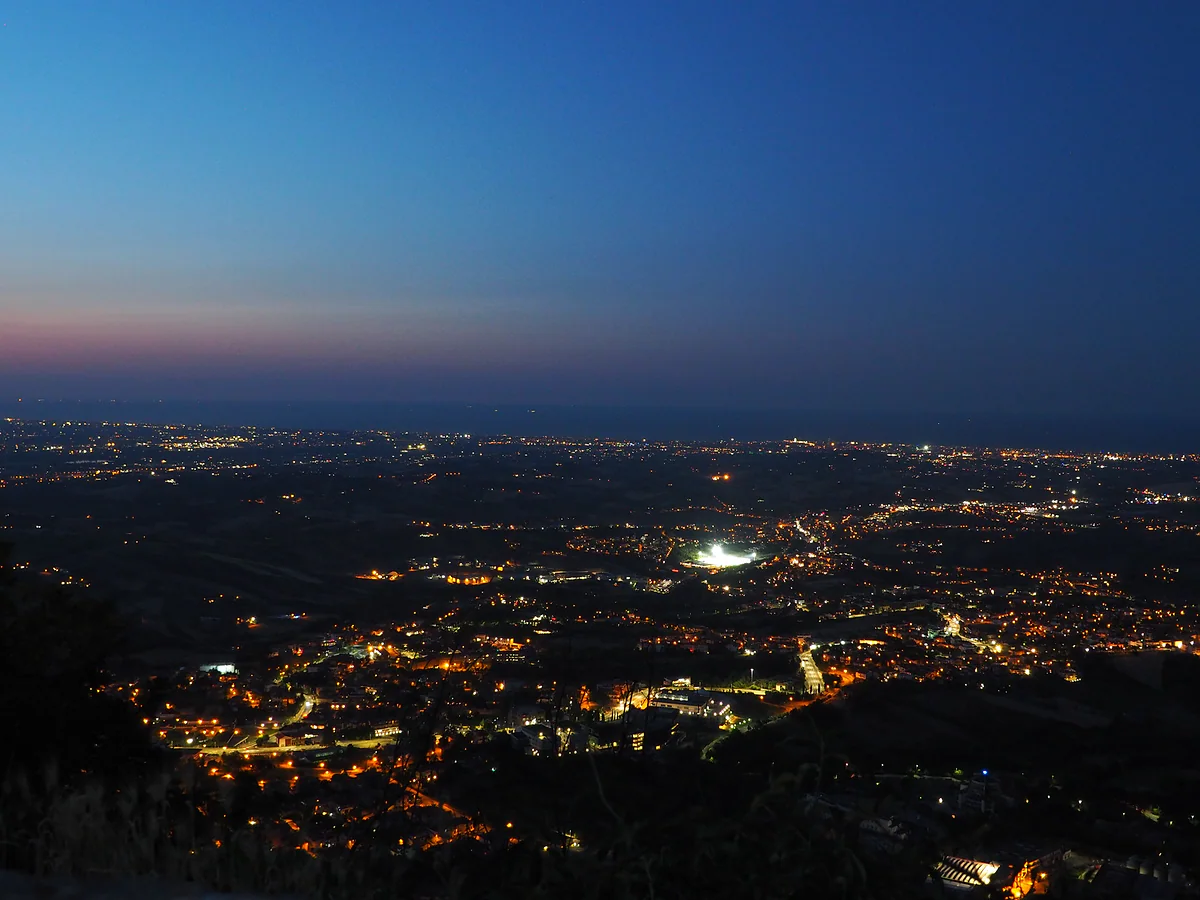
The lights of the plain and the Rimini coast seen at night from Monte Titano, with the last glow on the horizon.
Fiorentino at a glance
| Fact | Figure | Source |
|---|---|---|
| Residents on 30 June 2026 | 2,593 | Statistics Bulletin |
| Area | 6.56 km² | Government of San Marino |
| Castles | Pennarossa, Castellaccio and Torricella | Government of San Marino |
| Gianni Widmer's flight | 1913, 1,600 m in eleven minutes | Government of San Marino |
| Garibaldi's stop (the Vascone) | Night of 30 July 1849 | Government of San Marino |
| First recorded | 1069 | Wikipedia |
In 2024 the castello festival ran from 26 to 28 July per the official calendar; no 2026 calendar has been published.
Test yourself
True or false?
0/3 Pick before you peek.
-
Fiorentino is named after Florence.
See the answer
False. According to Wikipedia it comes from the Latin «florente», because of how wild the land was. It has no link with the Tuscan city.
-
The first flight over San Marino ended in Fiorentino.
See the answer
True. In 1913 Gianni Widmer took off from Monte Carlo in a 50-horsepower Blériot, climbed to 1,600 metres and landed on the plateau after eleven minutes. A memorial marks it.
-
Ruins survive of all three of Fiorentino's castles.
See the answer
False. There are ruins of Castellaccio and Pennarossa, but no trace remains of Torricella castle, according to the castello council.
- Residents on 30 June 2026
- 2,593
- Castles, two with visible ruins
- 3
- First flight over San Marino
- 1913
- Focheraccia night
- 18 March
Map
Where Fiorentino is
Every number opens its guide. The towers sit on the ridge, the city beside them and Borgo Maggiore below, linked by the cable car.
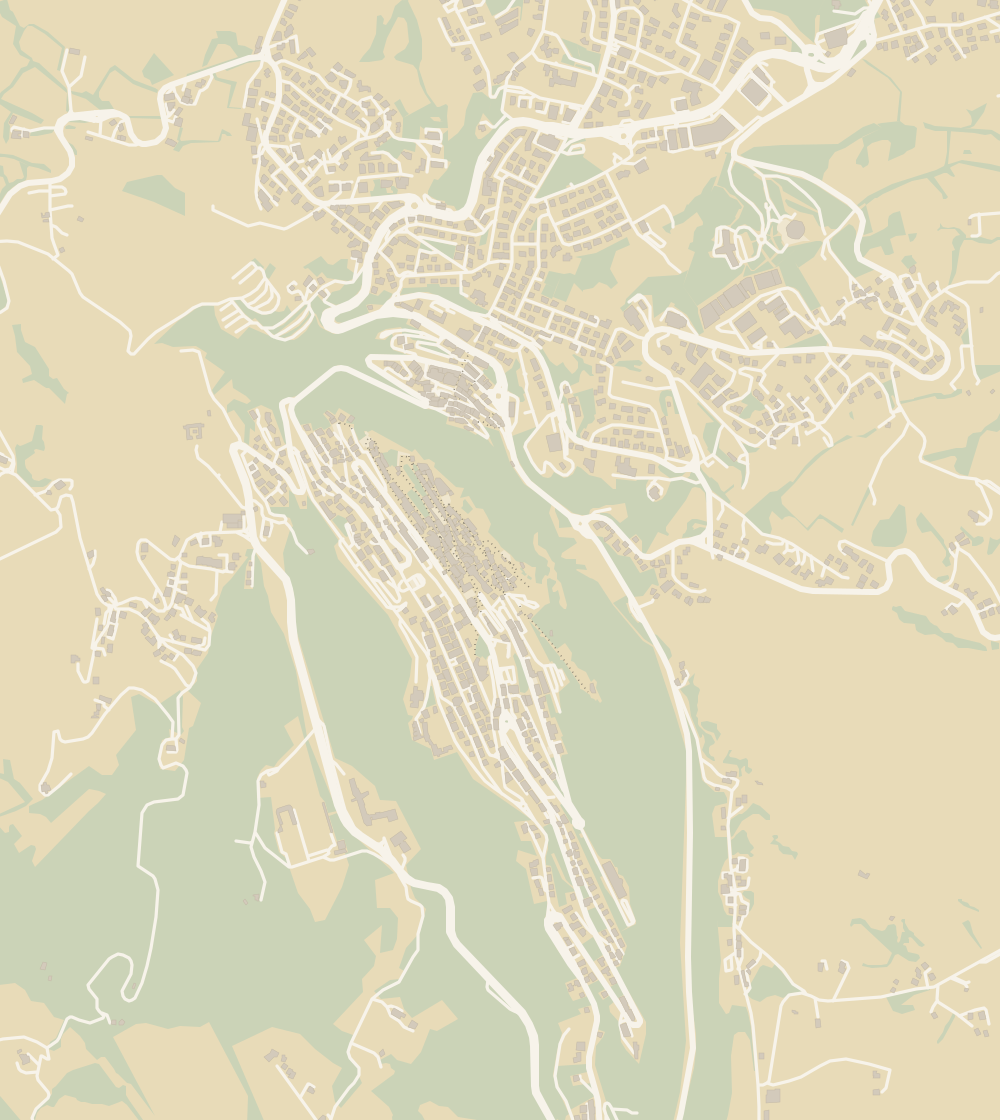 1The Three Towers 2Guaita Tower 3Cesta Tower and Arms Museum 4City of San Marino 5Montale Tower 6Borgo Maggiore 7Witches' Passage 8Palazzo Pubblico 9Changing of the guard 10Basilica of Saint Marinus 11Mount Titano 12Museums 13State Museum 14San Francesco Art Gallery 15Torture Museum 16Cable car (funivia) 17Quirky museums 18Stamp and Coin Museum 19National Gallery 20Valdragone 21San Giovanni sotto le Penne 22Medieval Days 23Christmas 24Hotel Titano 25Grand Hotel San Marino 26Hotel Rosa 27Hotel Crocenzi 28Hotel La Rocca 29Porta San Francesco 30Cava dei Balestrieri 31Map 32Teatro Titano 33Church of San Quirino 34Trenino Bianco Azzurro 35Consolazione Sanctuary 36University 37Prison 38Piazza della Libertà
 Map data © OpenStreetMap contributors (ODbL)
- 1The Three TowersTwo open inside, the third only from outside
- 2Guaita TowerAn 11th-century fortress that was a jail until 1970
- 3Cesta Tower and Arms MuseumThe top of Mount Titano, at 755 metres
- 4City of San MarinoWorld Heritage since 2008
- 5Montale TowerNo ticket, no hours, no pass
- 6Borgo MaggioreA cable car to the capital every 15 minutes
- 7Witches' PassageAbout 200 metres of battlements, no ticket
- 8Palazzo PubblicoClosed for restoration in 2026
- 9Changing of the guardNo timetable in any reliable source
- 10Basilica of Saint MarinusNeoclassical, begun in 1826, free to enter
- 11Mount Titano755 metres at the top of the Cesta
- 12MuseumsOne €11 ticket, seven venues
- 13State MuseumOpen to the public since 1899
- 14San Francesco Art GalleryIn the Franciscan cloister since 1966
- 15Torture MuseumMore than 100 original instruments
- 16Cable car (funivia)Closed from 21 to 23 October 2026
- 17Quirky museumsThree private museums with their own websites
- 18Stamp and Coin MuseumStamps since 1877, on the €11 pass
- 19National GalleryOpened on 7 July 2018
- 20ValdragoneA curazia of Borgo Maggiore
- 21San Giovanni sotto le PenneA curazia of Borgo Maggiore, below the towers
- 22Medieval DaysJuly, the old town and free entry
- 23Christmas28 November to 6 January, with a caveat
- 24Hotel TitanoOpen since 30 September 1894
- 25Grand Hotel San MarinoA hot tub on the third-floor terrace
- 26Hotel RosaFamily-run and open all year since 1965
- 27Hotel Crocenzi1 km from the cable car, 3 km from the old town
- 28Hotel La RoccaNot the Rocca, but on the road up to it
- 29Porta San FrancescoA guard post since 1361
- 30Cava dei BalestrieriThe crossbowmen's range since 1965
- 31MapNine castelli in 61 km²
- 32Teatro Titano2026-27 season from 22 October
- 33Church of San QuirinoOn the 5-cent coin
- 34Trenino Bianco AzzurroRimini to the City, 1932 to 1944
- 35Consolazione SanctuaryConsecrated on 11 June 1967
- 36UniversityCreated by law on 31 October 1985
- 37PrisonEmpty on the day the European inspectors arrived
- 38Piazza della LibertàIt used to be called the Pianello
0 of 108 San Marino guides
Your next stamp
- History
- Faetano
- San Giovanni sotto le Penne
- Valdragone
- Acquaviva
- Chiesanuova
- The 9 castelli
- Things to do
- One day
- Two days
- The Three Towers
- Guaita Tower
- Cesta Tower and Arms Museum
- City of San Marino
- Montale Tower
- Borgo Maggiore
- Witches' Passage
- Palazzo Pubblico
- Serravalle
- Changing of the guard
- Dogana
- Basilica of Saint Marinus
- Mount Titano
- Domagnano
- Montegiardino
- Museums
- State Museum
- San Francesco Art Gallery
- Torture Museum
- Cable car (funivia)
- Quirky museums
- Viewpoints
- Murata
- Stamp and Coin Museum
- Walking trails
- Cailungo
- National Gallery
- Best time to visit
- Getting there
- Ventoso
- Rimini to San Marino
- Weather
- Getting around
- In winter
- With kids
- In summer
- Parking
- Passport stamp
- Rainy day
- Nightlife
- Phone and roaming
- Casino
- Gualdicciolo
- Money
- Coins and stamps
- Torraccia
- Falciano
- Shopping and tax-free
- Rovereta
- Lake Faetano
- Events
- Beaches
- Medieval Days
- Christmas
- MotoGP
- Where to stay
- Hotel Titano
- Where to eat
- Food
- Grand Hotel San Marino
- Luxury hotels
- Free and cheap
- Hotel iDesign
- Day trips
- Hotel Rosa
- Safety and rules
- Hotel Crocenzi
- Language
- Entry requirements
- Hotel La Rocca
- Healthcare and emergencies
- Plugs and voltage
- Is it a country?
- Opening hours
- Porta San Francesco
- Tap water
- Cava dei Balestrieri
- Map
- Post office
- Cost of a trip
- Flag
- Teatro Titano
- Accessibility
- Church of San Quirino
- Captains Regent
- Trenino Bianco Azzurro
- With a dog
- Consolazione Sanctuary
- Facts
- University
- Weddings
- Wine
- Prison
- Camping
- Piazza della Libertà
- Is it worth visiting?
- Constitution
Frequently asked questions
Where is Fiorentino in San Marino?
In the south of the country, below Mount Titano on that side, between Chiesanuova, the City, Borgo Maggiore, Faetano and Montegiardino, bordering Monte Grimano Terme and Sassofeltrio in Italy.
What is the population of Fiorentino?
2,593 residents on 30 June 2026 across 6.56 km², according to the official statistics bulletin.
What is there to see in Fiorentino?
The ruins of Pennarossa, with its keep and rock-cut cistern, those of Castellaccio, the memorial to Gianni Widmer's 1913 flight and the Vascone, where Garibaldi is said to have stopped in 1849.
What is the Focheraccia?
Fiorentino's fire festival on 18 March, in honour of St Joseph. The castello council says it's even better known than the feast of the patron, St Bartholomew, held on the last Sunday of July.
Is Fiorentino named after Florence?
No. Wikipedia traces it to the Latin «florente», referring to how wild the land once was. It has nothing to do with the Tuscan city.
How do I get to Fiorentino?
On AASS line 1 from car park P9 in the City, or the circular lines 3D and 3S from P2, on weekdays. At other times there's the SMUVI on-demand bus.
By
Tourism graduate with a master’s in Tourism Management and Planning from the University of Málaga, who has travelled across Europe. He writes every guide from official sources and his own judgement.
Published on . Facts checked on .
Sources
Photos: LigaDue (CC BY 3.0); Walmaul (CC BY-SA 4.0), via Wikimedia Commons.