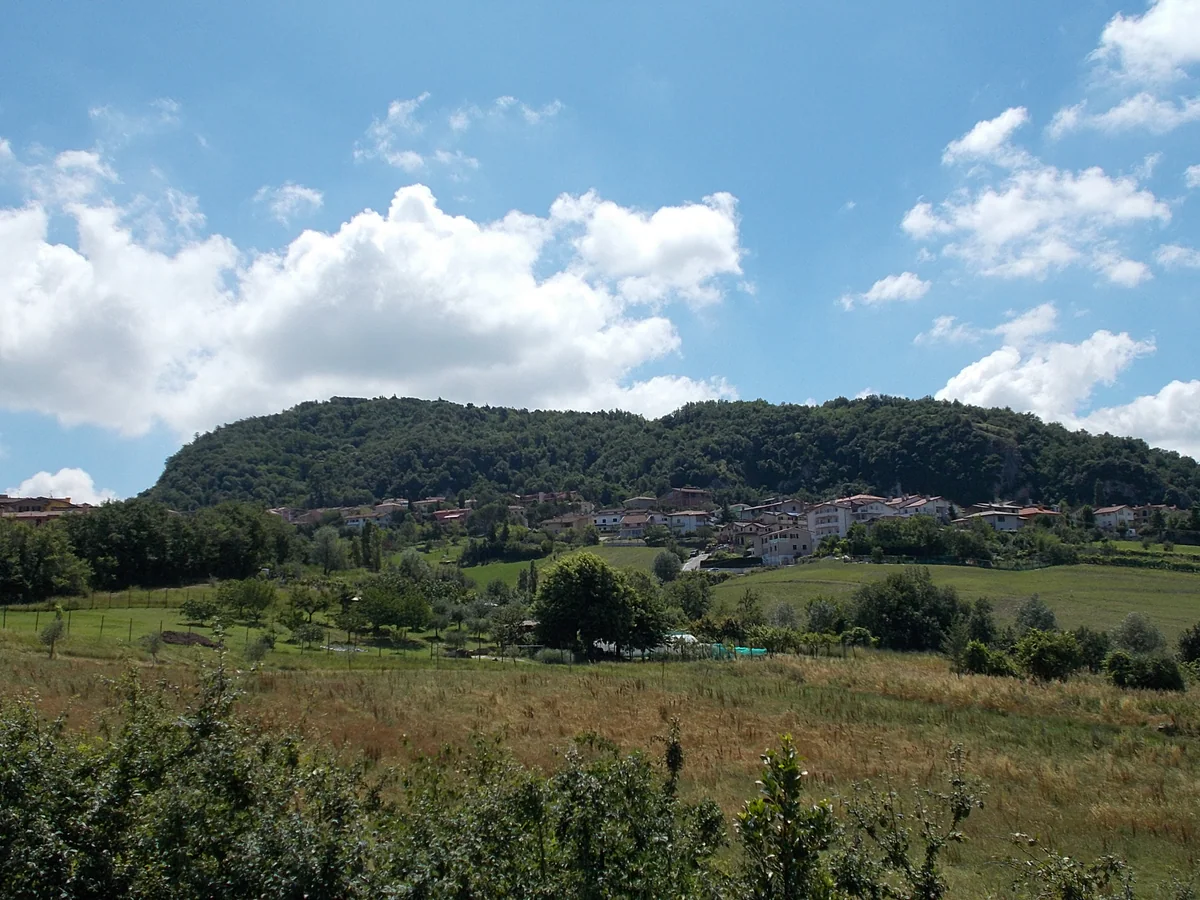
Where tradition says the saint arrived
Acquaviva, the western edge of San Marino facing San Leo
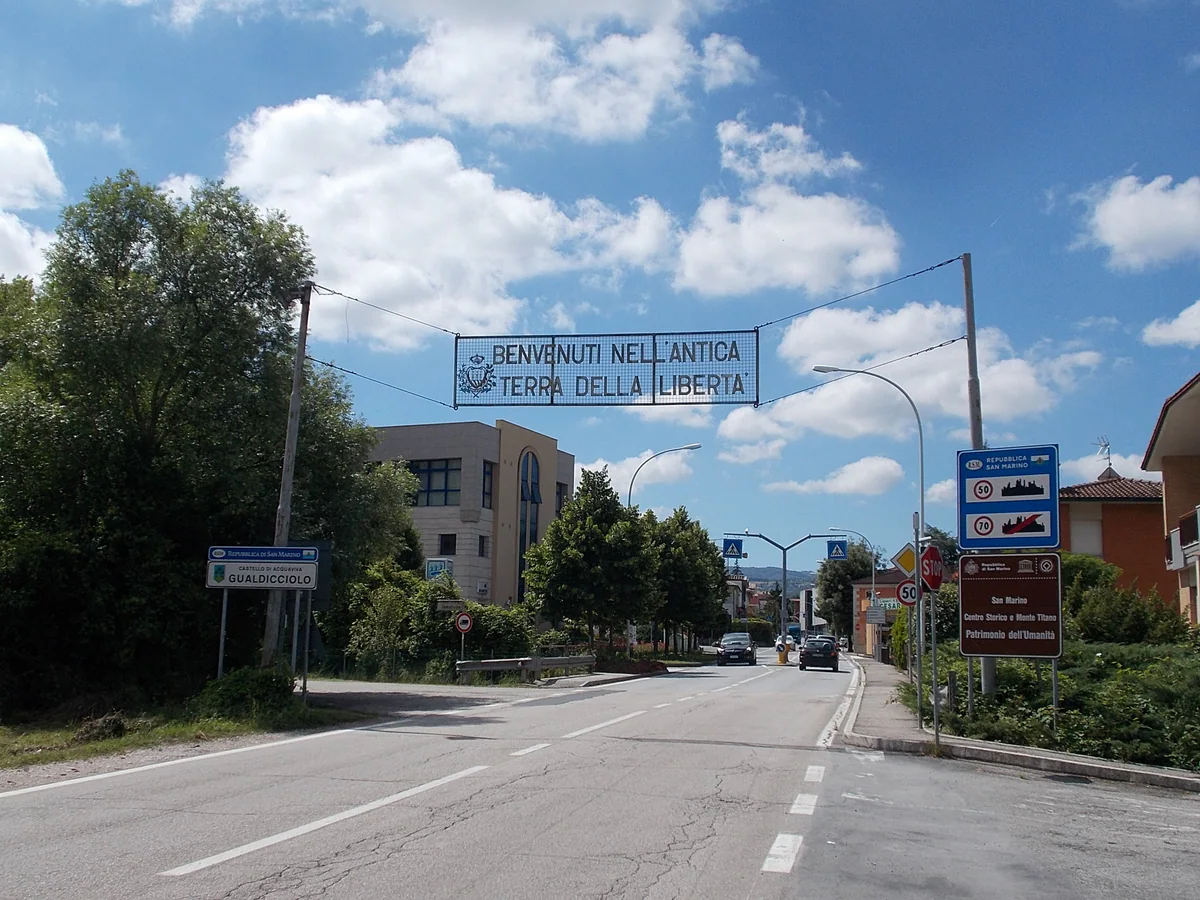
Acquaviva is one of San Marino's nine castelli, with 2,154 residents on 30 June 2026 and an area of 4.86 km². It lies west of Mount Titano, towards San Leo. Its council says the saint entered the territory here and baptised people with water from a spring; the Montecerreto castle has vanished and La Pineta park stands in its place.
In 30 seconds
Full read: 3 min
- Acquaviva is a San Marino castello west of Mount Titano, with 2,154 residents and 4.86 km².
- Tradition says the saint entered here and baptised people with water from the Montecerreto spring.
- Nothing remains of Montecerreto castle; the park called La Pineta has taken its place.
- AASS line 2 serves it on weekdays, and the SMUVI on-demand bus covers the rest.
Acquaviva isn't one for a first day trip. I'd save it for a second day with a car, paired with San Leo just across the border, and give La Pineta an hour if the weather is kind.
Before you go
What I would keep in mind
-
01 Most beautiful
La Pineta, where Montecerreto castle stood
The castello council describes the park on top of Montecerreto as lush and untouched. It's all that's left of the fort where, according to local tradition, the Placito Feretrano was signed in 885.
-
02 Getting there
Line 2 runs down to Gualdicciolo
From car park P9 in the City, AASS line 2 goes via Borgo Maggiore and Ventoso to Gualdicciolo and Molarini on weekdays. Outside those hours the SMUVI on-demand bus uses the same stops.
getting around San Marino -
03 My tip
Pair it with San Leo
Acquaviva borders the Italian municipalities of San Leo and Verucchio. If you're driving to San Leo's fortress, coming this way adds very little to the journey.
San Leo and its fortress
If you believe the local story, Acquaviva is where Saint Marinus first set foot in what became San Marino. It sits on the western side of Mount Titano, looking across to San Leo, and it has no towers or museums to speak of. What it does have is a founding legend the Sammarinese take seriously and a hilltop park where a castle used to be.
A name that comes from a spring
The castello’s official page explains that the saint baptised new believers with the clear water of a spring at the foot of Montecerreto, hence Acquaviva, «living water». I like it when a place name does the history lesson for you. Montecerreto was the old name, and the trees on the coat of arms still refer to it.
The same page goes further and places the Placito Feretrano here, the document the Republic long leaned on to argue for its independence, signed, it says, inside the hilltop fort in 885. I’m giving you the castello’s version, because historians don’t treat that as settled. You’ll find the wider background in the history of San Marino.
La Pineta, the castle that isn’t there
Not a stone of the Montecerreto fort is visible today. In its place is a wooded park the locals simply call La Pineta, which the government describes as untouched. With a car, I’d spend an hour walking up there before moving on, ideally in spring or early autumn. Don’t expect viewing platforms or information boards; it’s a village park.
Wikipedia puts the castello’s highest point at 414 metres and repeats a legend you’ll hear a lot in San Marino, that a cave in the Baldasserona cliff was the first hiding place of Saints Marinus and Leo. It also notes that on 19 December 1243 one Guido di Cerreto sold the Sammarinese his right to charge tolls at Cerreto and Ventoso, one of the small deals through which the country pieced its territory together.
Gualdicciolo and the Strada del Lavoro
The lower part of Acquaviva, Gualdicciolo, feels quite different. It’s flat, close to the roads into Italy, and grew up as a workshop and factory district. Five watermills once turned along the San Marino stream and gave families a modest living from the middle of the 19th century. The road is now known, fittingly, as the Strada del Lavoro, the «road of work», and according to the council it has 64 manufacturing firms employing 748 people.
It’s not a sightseeing stroll, but it helps you see that valley San Marino lives on industry rather than souvenirs. For a mill with its walls still intact, the Molarini mill is close by in neighbouring Chiesanuova.
Festivals and village life
The government’s official festival calendar for the castelli dates from 2024, when Acquaviva’s castello festival ran from 27 to 30 June, with the parish festival in early May and another in October. Nothing is out yet for 2026, so I’d look at the council’s page before travelling. For what’s on across the country, see San Marino’s events calendar.
The castello also has a shooting range at Ca’ Martino that the government says can host international competitions, and a toy library that local families use a great deal.
Getting there
By car it’s a short hop from Borgo Maggiore. By bus, AASS line 2 starts from car park P9 in the City and runs via Borgo Maggiore and Ventoso to Gualdicciolo and Molarini, on weekdays only. Outside those times the SMUVI on-demand service uses the regular stops and is booked through its app or by phone, and buses within the country were free of charge between March and the end of September 2026. Everything’s in getting around San Marino, and the other eight municipalities are in San Marino’s castelli.
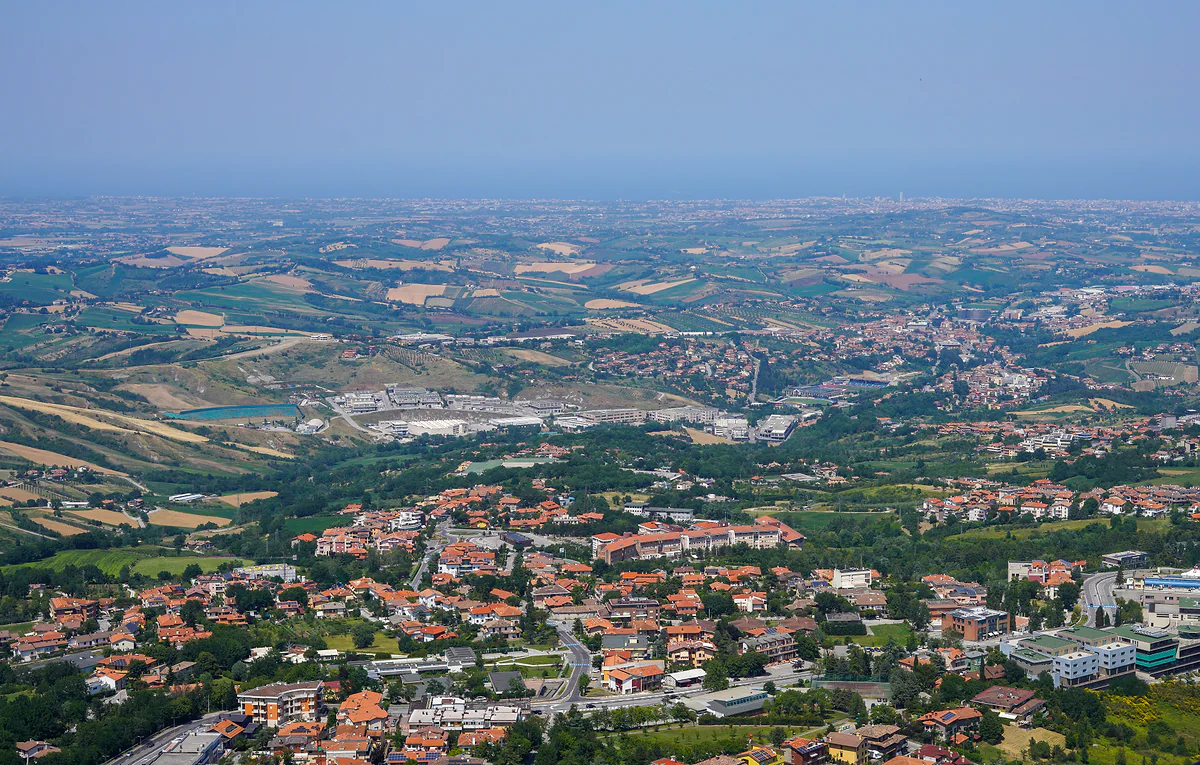
Borgo Maggiore and the Rimini plain seen from Monte Titano, stretching all the way to the Adriatic coast on the horizon.
Acquaviva at a glance
| Fact | Figure | Source |
|---|---|---|
| Residents on 30 June 2026 | 2,154 | Statistics Bulletin |
| Area | 4.86 km² | Government of San Marino |
| Businesses | 324, mostly industry | Government of San Marino |
| Watermills once in Gualdicciolo | 5 | Government of San Marino |
| Highest point | 414 m | Wikipedia |
The castello's own page gives the 2024 population (2,130); this table uses the latest official figure, for 30 June 2026.
Test yourself
True or false?
0/3 Pick before you peek.
-
Montecerreto castle in Acquaviva is still standing.
See the answer
False. The castello's page says it no longer exists. The park locals call La Pineta now occupies the spot.
-
Acquaviva has a border with Italy.
See the answer
True. According to Wikipedia it borders the Italian municipalities of San Leo and Verucchio, as well as Borgo Maggiore and the City of San Marino.
-
Gualdicciolo once had five watermills.
See the answer
True. So says the castello council. They brought modest prosperity from the mid 19th century, and the same road is now the Strada del Lavoro industrial area.
- Residents on 30 June 2026
- 2,154
- Area of the castello
- 4.86 km²
- Year of the Placito Feretrano, per local tradition
- 885
- Watermills that once worked in Gualdicciolo
- 5
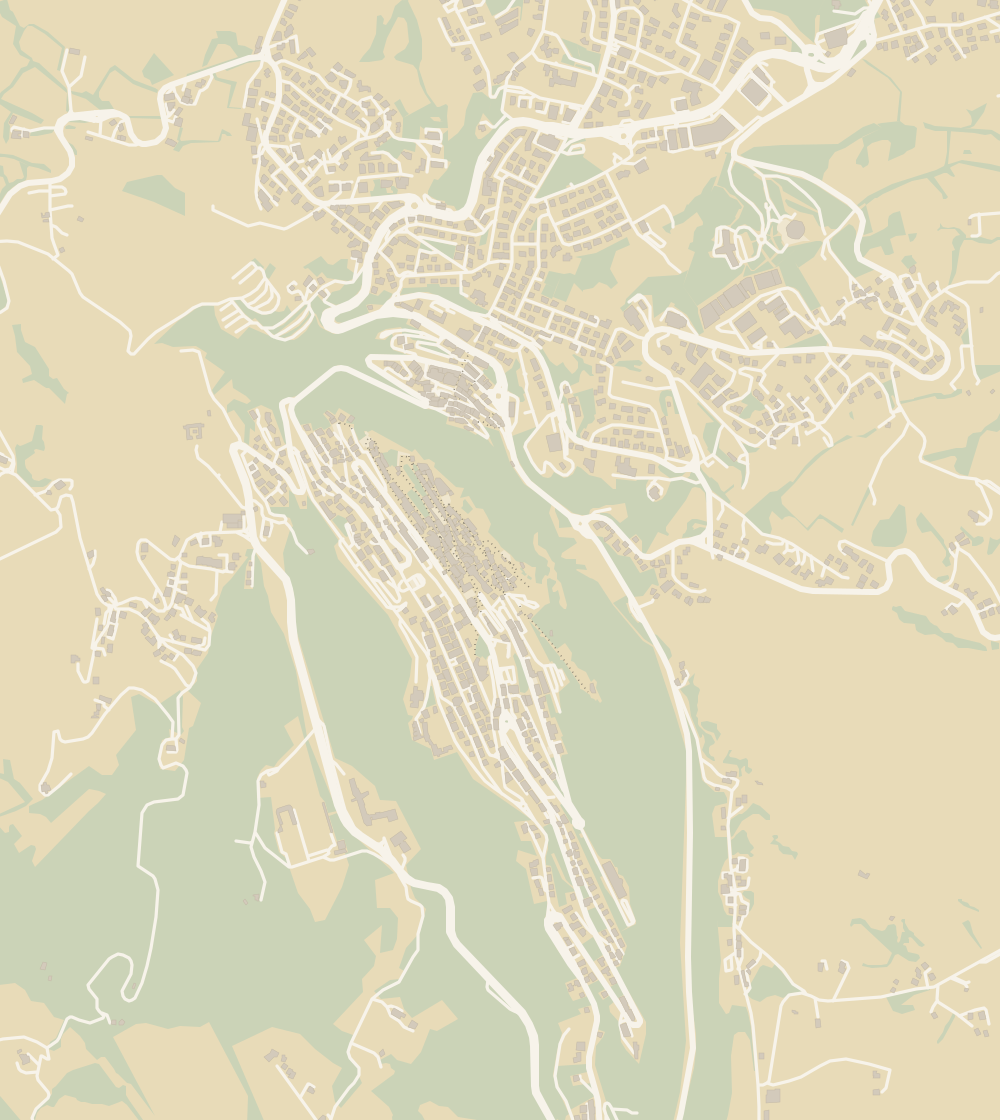
Map
Where Acquaviva is
Every number opens its guide. The towers sit on the ridge, the city beside them and Borgo Maggiore below, linked by the cable car.
 1The Three Towers 2Guaita Tower 3Cesta Tower and Arms Museum 4City of San Marino 5Montale Tower 6Borgo Maggiore 7Witches' Passage 8Palazzo Pubblico 9Changing of the guard 10Basilica of Saint Marinus 11Mount Titano 12Museums 13State Museum 14San Francesco Art Gallery 15Torture Museum 16Cable car (funivia) 17Quirky museums 18Stamp and Coin Museum 19National Gallery 20Valdragone 21San Giovanni sotto le Penne 22Medieval Days 23Christmas 24Hotel Titano 25Grand Hotel San Marino 26Hotel Rosa 27Hotel Crocenzi 28Hotel La Rocca 29Porta San Francesco 30Cava dei Balestrieri 31Map 32Teatro Titano 33Church of San Quirino 34Trenino Bianco Azzurro 35Consolazione Sanctuary 36University 37Prison 38Piazza della Libertà
 Map data © OpenStreetMap contributors (ODbL)
- 1The Three TowersTwo open inside, the third only from outside
- 2Guaita TowerAn 11th-century fortress that was a jail until 1970
- 3Cesta Tower and Arms MuseumThe top of Mount Titano, at 755 metres
- 4City of San MarinoWorld Heritage since 2008
- 5Montale TowerNo ticket, no hours, no pass
- 6Borgo MaggioreA cable car to the capital every 15 minutes
- 7Witches' PassageAbout 200 metres of battlements, no ticket
- 8Palazzo PubblicoClosed for restoration in 2026
- 9Changing of the guardNo timetable in any reliable source
- 10Basilica of Saint MarinusNeoclassical, begun in 1826, free to enter
- 11Mount Titano755 metres at the top of the Cesta
- 12MuseumsOne €11 ticket, seven venues
- 13State MuseumOpen to the public since 1899
- 14San Francesco Art GalleryIn the Franciscan cloister since 1966
- 15Torture MuseumMore than 100 original instruments
- 16Cable car (funivia)Closed from 21 to 23 October 2026
- 17Quirky museumsThree private museums with their own websites
- 18Stamp and Coin MuseumStamps since 1877, on the €11 pass
- 19National GalleryOpened on 7 July 2018
- 20ValdragoneA curazia of Borgo Maggiore
- 21San Giovanni sotto le PenneA curazia of Borgo Maggiore, below the towers
- 22Medieval DaysJuly, the old town and free entry
- 23Christmas28 November to 6 January, with a caveat
- 24Hotel TitanoOpen since 30 September 1894
- 25Grand Hotel San MarinoA hot tub on the third-floor terrace
- 26Hotel RosaFamily-run and open all year since 1965
- 27Hotel Crocenzi1 km from the cable car, 3 km from the old town
- 28Hotel La RoccaNot the Rocca, but on the road up to it
- 29Porta San FrancescoA guard post since 1361
- 30Cava dei BalestrieriThe crossbowmen's range since 1965
- 31MapNine castelli in 61 km²
- 32Teatro Titano2026-27 season from 22 October
- 33Church of San QuirinoOn the 5-cent coin
- 34Trenino Bianco AzzurroRimini to the City, 1932 to 1944
- 35Consolazione SanctuaryConsecrated on 11 June 1967
- 36UniversityCreated by law on 31 October 1985
- 37PrisonEmpty on the day the European inspectors arrived
- 38Piazza della LibertàIt used to be called the Pianello
What to see
What to see in Acquaviva
0 of 108 San Marino guides
Your next stamp
- Gualdicciolo
- Chiesanuova
- The 9 castelli
- City of San Marino
- Walking trails
- Basilica of Saint Marinus
- Mount Titano
- Things to do
- One day
- Two days
- The Three Towers
- Guaita Tower
- Cesta Tower and Arms Museum
- Montale Tower
- Borgo Maggiore
- Witches' Passage
- Palazzo Pubblico
- Serravalle
- Changing of the guard
- Dogana
- Domagnano
- Faetano
- Fiorentino
- Montegiardino
- Museums
- State Museum
- San Francesco Art Gallery
- Torture Museum
- Cable car (funivia)
- Quirky museums
- Viewpoints
- Murata
- Stamp and Coin Museum
- Cailungo
- National Gallery
- Valdragone
- Best time to visit
- Getting there
- Ventoso
- Rimini to San Marino
- San Giovanni sotto le Penne
- Weather
- Getting around
- In winter
- With kids
- In summer
- Parking
- Passport stamp
- Rainy day
- Nightlife
- Phone and roaming
- Casino
- Money
- Coins and stamps
- Torraccia
- Falciano
- Shopping and tax-free
- Rovereta
- Lake Faetano
- Events
- Beaches
- Medieval Days
- Christmas
- MotoGP
- Where to stay
- Hotel Titano
- Where to eat
- Food
- Grand Hotel San Marino
- Luxury hotels
- Free and cheap
- Hotel iDesign
- Day trips
- Hotel Rosa
- Safety and rules
- Hotel Crocenzi
- Language
- Entry requirements
- Hotel La Rocca
- Healthcare and emergencies
- Plugs and voltage
- Is it a country?
- Opening hours
- Porta San Francesco
- Tap water
- Cava dei Balestrieri
- Map
- Post office
- Cost of a trip
- Flag
- Teatro Titano
- Accessibility
- Church of San Quirino
- History
- Captains Regent
- Trenino Bianco Azzurro
- With a dog
- Consolazione Sanctuary
- Facts
- University
- Weddings
- Wine
- Prison
- Camping
- Piazza della Libertà
- Is it worth visiting?
- Constitution
Frequently asked questions
Where is Acquaviva in San Marino?
West of Mount Titano, between Borgo Maggiore, the City of San Marino and the border with the Italian municipalities of San Leo and Verucchio. Its lower part, Gualdicciolo, sits beside the San Marino stream.
What is the population of Acquaviva?
2,154 residents on 30 June 2026, according to the official statistics bulletin. At 4.86 km² it's one of the smaller castelli.
What is there to see in Acquaviva?
La Pineta, the park on the summit of Montecerreto where the old fort stood. If industrial history appeals, the Strada del Lavoro in Gualdicciolo is where five watermills once worked.
Why is it called Acquaviva?
After the spring at the foot of Montecerreto. Tradition says the saint entered the territory here and used that water to baptise new Christians.
How do I get to Acquaviva without a car?
Take AASS line 2 from car park P9 in the City via Borgo Maggiore, Ventoso and Gualdicciolo, on weekdays only. At other times there's the SMUVI on-demand bus, booked through its app or on 0549 883700.
By
Tourism graduate with a master’s in Tourism Management and Planning from the University of Málaga, who has travelled across Europe. He writes every guide from official sources and his own judgement.
Published on . Updated on . Facts checked on .
Sources
Photos: Szeder László (CC BY-SA 4.0); Messapi (CC BY 4.0), via Wikimedia Commons.