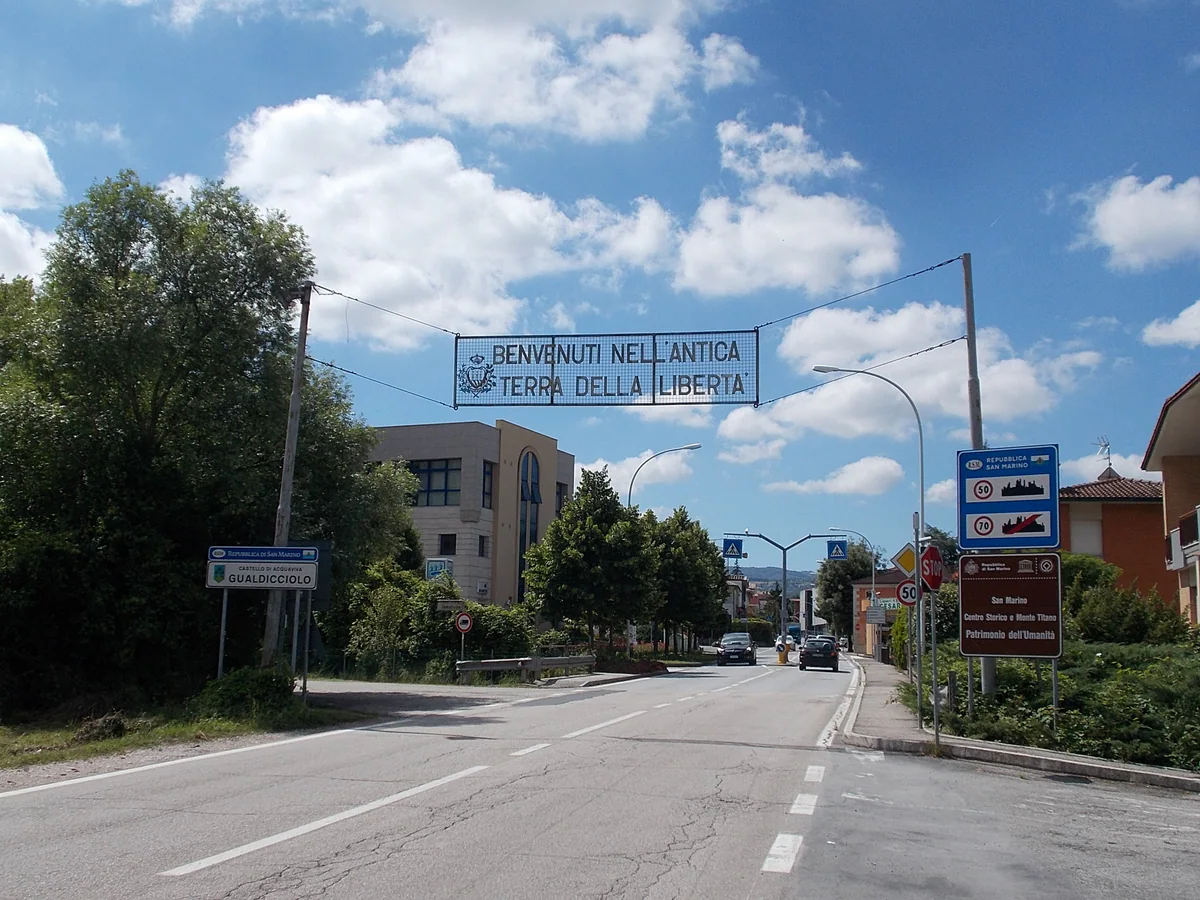
A curazia of Acquaviva on the western border
Gualdicciolo, where San Marino goes to work by the stream
Gualdicciolo is the lower curazia of Acquaviva, on the flat ground along the San Marino stream, right by the Italian border. From the mid-19th century it had five watermills, and today its Strada del Lavoro holds 64 factories employing 748 people. It has a 1971 church of St Joseph the Worker and AASS bus line 2 ends nearby.
In 30 seconds
Full read: 4 min
- Gualdicciolo is Acquaviva's lower curazia, on the flat ground by the San Marino stream and the border.
- It had five watermills from the mid-19th century.
- Its Strada del Lavoro now has 64 factories and 748 workers, according to the government.
- It's a place to pass through; the better stops are La Pineta in Acquaviva and the Molarini mill.
I wouldn't make a special trip to Gualdicciolo. I'd pass through on a drive round the west, then head up to La Pineta in Acquaviva and on to the Molarini mill, which is where the story of water power still has walls standing.
Before you go
What I would keep in mind
-
01 My tip
Five mills on one stream
The government says five watermills once turned along the road beside the San Marino stream, and that they gave local families a measure of prosperity from the mid-19th century.
Acquaviva, the castello of the spring -
02 Most beautiful
The mill with its walls intact is next door
For a proper mill, the Molarini mill in Chiesanuova is one of the few with its masonry still whole, according to the government. Line 2 ends at Molarini, one stop after Gualdicciolo.
Chiesanuova, the castello that asked to join -
03 Getting there
Line 2 keeps running in summer
It leaves car park P9 in the City and runs down through Murata, Borgo Maggiore and Ventoso to Gualdicciolo. It's one of five lines the AASS keeps going from 16 June to 14 September, on weekdays.
getting around San Marino -
04 My tip
Most of the country's liqueurs are made here
According to Wikipedia, the Cesarini liqueur works, opened in Gualdicciolo in 1968, turns out most of San Marino's liqueurs. I couldn't find a website or visiting hours, so treat it as trivia rather than a plan.
San Marino wine
Most visitors know the «Benvenuti nell’antica terra della libertà» arch at Dogana. There’s a second welcome sign on the road into Gualdicciolo, on the western border, and hardly anyone sees it. This is the lower end of Acquaviva, a narrow strip of flat land along the San Marino stream where the country stops posing for photos and gets on with its job. I won’t pretend it has monuments. What I can give you is what it was, what it is and how I’d fit it into a loop of the western castelli.
A little wood by the water
The name is a clue. According to Wikipedia, Gualdicciolo means «little wood», from «wald», the Lombard word for forest, the same root as the medieval gualdarie that San Marino’s land was split into. There isn’t much wood left, as the valley has filled up with sheds and workshops, but the water is still there. The same source puts the village where the Fosso del Re joins the San Marino stream, on provincial road 15, which runs on to Torello on the Italian side.
The official page for Acquaviva explains why it grew up here. The ground is flat and it sits by the main routes into Italy, two things worth their weight in gold in a country of hills. So while the upper part of the castello keeps the legend of the saint and La Pineta park, the lower part turned to workshops and factories.
What happened to the five mills?
For me, the most interesting thing about Gualdicciolo is its milling past. The government says five watermills once worked along the stream, and that from the mid-19th century they gave families here a modest prosperity, which in rural San Marino back then counted for a lot. I haven’t found any source saying one of them can be visited, so I won’t send you looking.
To put a face to that story, line 2 ends one stop further on at Molarini, near the Molarini mill in neighbouring Chiesanuova. The government counts it among the very few whose masonry survives complete. I like the pairing, since Gualdicciolo shows you the scale of the trade and Chiesanuova shows you what a mill actually looked like.
The Road of Work
These days the road beside the stream goes by the name Strada del Lavoro, and the government reckons it has earned it. It became one of the most productive areas of the Republic, with 64 manufacturing firms employing 748 people, plus 97 service businesses and 54 shops. Wikipedia says more than 60 factories, so the figures tally.
One detail links it to the dinner table. According to Wikipedia, the Cesarini liqueur works opened here in 1968 and makes most of the liqueurs produced in San Marino. It has no website I could read and no visiting hours, so I don’t suggest it as a stop. If you’re curious about what the country drinks, it’s covered in San Marino wine and liqueurs.
A 1971 church and a May festival
Gualdicciolo has its own church, dedicated to St Joseph the Worker, a fitting saint for a road named after work. According to Wikipedia it was built in 1971, and the diocese celebrates the patronal feast here on 1 May. In the official 2024 castelli calendar, the joint parish festival of Acquaviva and Gualdicciolo took place on 4 and 5 May. There’s no 2026 calendar yet, so I’d check the castello council’s page before planning round it.
On the practical side, Gualdicciolo has more than it looks. One of the ISS state pharmacies is at Via F. da Montebello 5, which opens from 8:00 to 19:30 every day but Sunday, though it shuts for the second and third weeks of August. Poste San Marino’s «Acquaviva» branch is at the same address, which is handy for sending a postcard with a Sammarinese stamp away from the old-town queues.
Getting there and fitting it into a route
Without a car, the bus you want is the 2. It starts at P9, goes through Murata, Borgo Maggiore and Ventoso and terminates at Molarini, just past Gualdicciolo. It runs on weekdays all year, including 16 June to 14 September when most lines stop, and fares on it were suspended until 30 September 2026. On Sundays you have SMUVI, the on-demand minibus explained in getting around San Marino.
By car, this is the route I’d take. Drop down from the capital through Ventoso, stop in Gualdicciolo just long enough to see the stream and the border sign, climb to La Pineta in Acquaviva for a walk, and finish at the Molarini mill. That’s three western castelli in a relaxed morning, and a picture of the country you won’t get from the three towers. The rest are in San Marino’s nine castelli.
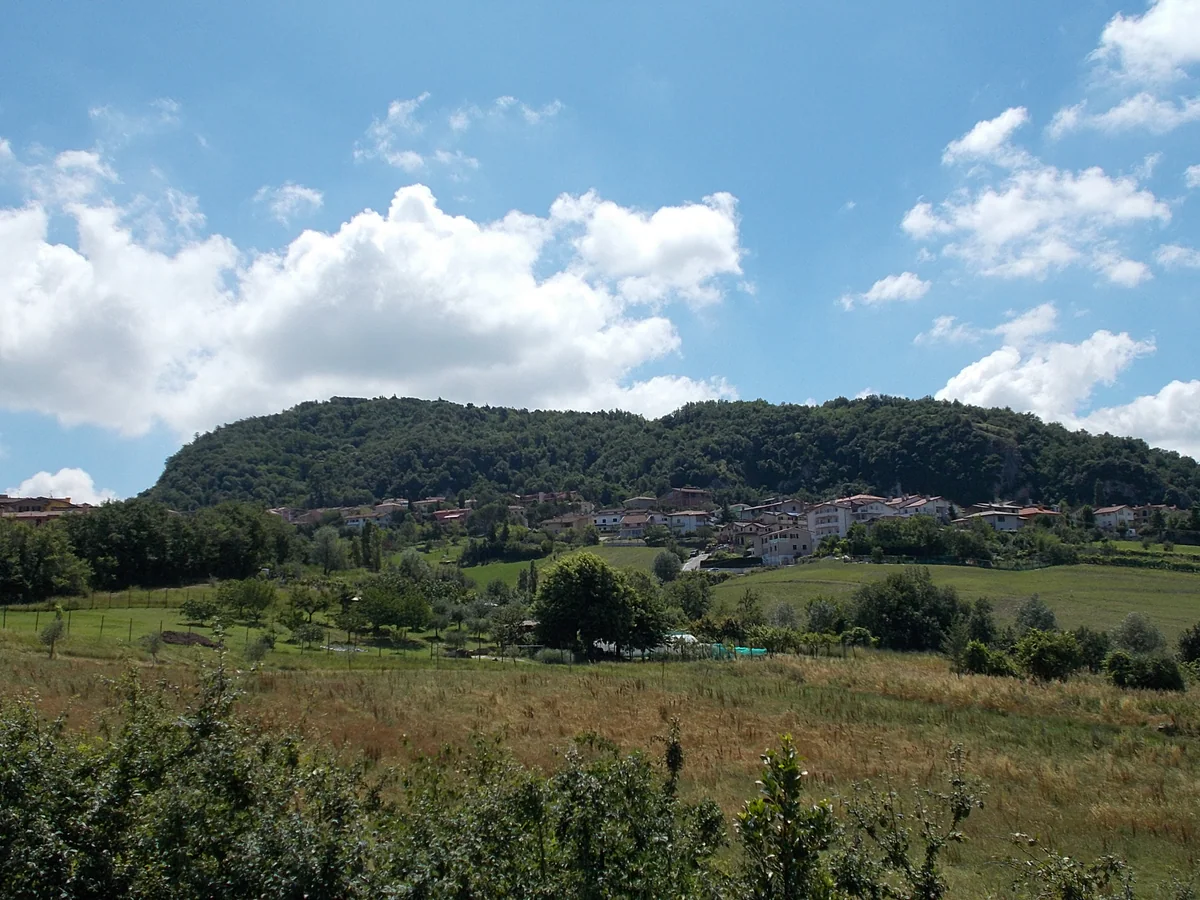
Meadows in Acquaviva with houses at the foot of Montecerreto, the wooded hill that holds La Pineta park, under a sky full of cloud.
Gualdicciolo at a glance
| Fact | Figure | Source |
|---|---|---|
| Castello | Acquaviva (4.86 km², 2,130 residents in 2024) | Government of San Marino |
| Watermills on the stream | 5, from the mid-19th century | Government of San Marino |
| Factories on the Strada del Lavoro | 64, employing 748 | Government of San Marino |
| Church of St Joseph the Worker | Built 1971 | Wikipedia |
| Cesarini liqueur works | Opened 1968 | Wikipedia |
| Parish festival with Acquaviva | 4 and 5 May 2024 | Official 2024 calendar |
| ISS pharmacy | Via F. da Montebello 5, Mon-Sat 8:00-19:30 | ISS |
| «Acquaviva» post office | Via Fabrizio da Montebello 5, Mon-Fri 8:15-14:30, Sat 8:15-12:00 | Poste San Marino |
No 2026 festival calendar has been published. The diocese holds Gualdicciolo's patronal feast of St Joseph the Worker on 1 May.
Test yourself
True or false?
0/3 Pick before you peek.
-
Gualdicciolo once had five watermills.
See the answer
True. The Acquaviva castello page places them along the San Marino stream from the mid-19th century.
-
Gualdicciolo is one of San Marino's nine castelli.
See the answer
False. It's a curazia, a village that belongs to a castello. In this case, Acquaviva.
-
Gualdicciolo's church is medieval.
See the answer
False. According to Wikipedia, the church of St Joseph the Worker was built in 1971, and its patronal feast falls on 1 May.
- Watermills on the San Marino stream
- 5
- Factories on the Strada del Lavoro
- 64
- People working in them
- 748
- Church of St Joseph the Worker built
- 1971
Map
Where Gualdicciolo is
Every number opens its guide. The towers sit on the ridge, the city beside them and Borgo Maggiore below, linked by the cable car.
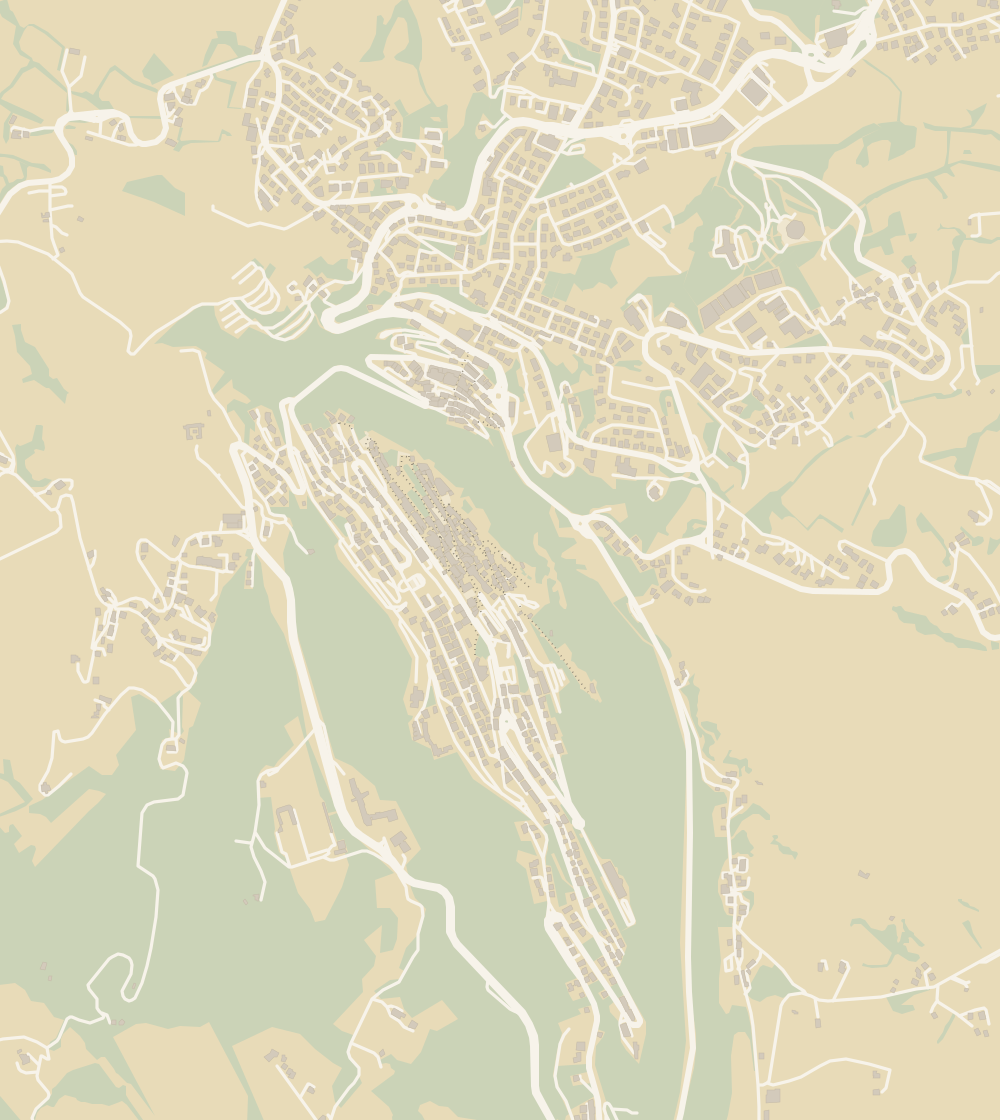 1The Three Towers 2Guaita Tower 3Cesta Tower and Arms Museum 4City of San Marino 5Montale Tower 6Borgo Maggiore 7Witches' Passage 8Palazzo Pubblico 9Changing of the guard 10Basilica of Saint Marinus 11Mount Titano 12Museums 13State Museum 14San Francesco Art Gallery 15Torture Museum 16Cable car (funivia) 17Quirky museums 18Stamp and Coin Museum 19National Gallery 20Valdragone 21San Giovanni sotto le Penne 22Medieval Days 23Christmas 24Hotel Titano 25Grand Hotel San Marino 26Hotel Rosa 27Hotel Crocenzi 28Hotel La Rocca 29Porta San Francesco 30Cava dei Balestrieri 31Map 32Teatro Titano 33Church of San Quirino 34Trenino Bianco Azzurro 35Consolazione Sanctuary 36University 37Prison 38Piazza della Libertà
 Map data © OpenStreetMap contributors (ODbL)
- 1The Three TowersTwo open inside, the third only from outside
- 2Guaita TowerAn 11th-century fortress that was a jail until 1970
- 3Cesta Tower and Arms MuseumThe top of Mount Titano, at 755 metres
- 4City of San MarinoWorld Heritage since 2008
- 5Montale TowerNo ticket, no hours, no pass
- 6Borgo MaggioreA cable car to the capital every 15 minutes
- 7Witches' PassageAbout 200 metres of battlements, no ticket
- 8Palazzo PubblicoClosed for restoration in 2026
- 9Changing of the guardNo timetable in any reliable source
- 10Basilica of Saint MarinusNeoclassical, begun in 1826, free to enter
- 11Mount Titano755 metres at the top of the Cesta
- 12MuseumsOne €11 ticket, seven venues
- 13State MuseumOpen to the public since 1899
- 14San Francesco Art GalleryIn the Franciscan cloister since 1966
- 15Torture MuseumMore than 100 original instruments
- 16Cable car (funivia)Closed from 21 to 23 October 2026
- 17Quirky museumsThree private museums with their own websites
- 18Stamp and Coin MuseumStamps since 1877, on the €11 pass
- 19National GalleryOpened on 7 July 2018
- 20ValdragoneA curazia of Borgo Maggiore
- 21San Giovanni sotto le PenneA curazia of Borgo Maggiore, below the towers
- 22Medieval DaysJuly, the old town and free entry
- 23Christmas28 November to 6 January, with a caveat
- 24Hotel TitanoOpen since 30 September 1894
- 25Grand Hotel San MarinoA hot tub on the third-floor terrace
- 26Hotel RosaFamily-run and open all year since 1965
- 27Hotel Crocenzi1 km from the cable car, 3 km from the old town
- 28Hotel La RoccaNot the Rocca, but on the road up to it
- 29Porta San FrancescoA guard post since 1361
- 30Cava dei BalestrieriThe crossbowmen's range since 1965
- 31MapNine castelli in 61 km²
- 32Teatro Titano2026-27 season from 22 October
- 33Church of San QuirinoOn the 5-cent coin
- 34Trenino Bianco AzzurroRimini to the City, 1932 to 1944
- 35Consolazione SanctuaryConsecrated on 11 June 1967
- 36UniversityCreated by law on 31 October 1985
- 37PrisonEmpty on the day the European inspectors arrived
- 38Piazza della LibertàIt used to be called the Pianello
0 of 108 San Marino guides
Your next stamp
- Acquaviva
- Chiesanuova
- Walking trails
- The 9 castelli
- Domagnano
- Witches' Passage
- Prison
- Things to do
- One day
- Two days
- The Three Towers
- Guaita Tower
- Cesta Tower and Arms Museum
- City of San Marino
- Montale Tower
- Borgo Maggiore
- Palazzo Pubblico
- Serravalle
- Changing of the guard
- Dogana
- Basilica of Saint Marinus
- Mount Titano
- Faetano
- Fiorentino
- Montegiardino
- Museums
- State Museum
- San Francesco Art Gallery
- Torture Museum
- Cable car (funivia)
- Quirky museums
- Viewpoints
- Murata
- Stamp and Coin Museum
- Cailungo
- National Gallery
- Valdragone
- Best time to visit
- Getting there
- Ventoso
- Rimini to San Marino
- San Giovanni sotto le Penne
- Weather
- Getting around
- In winter
- With kids
- In summer
- Parking
- Passport stamp
- Rainy day
- Nightlife
- Phone and roaming
- Casino
- Money
- Coins and stamps
- Torraccia
- Falciano
- Shopping and tax-free
- Rovereta
- Lake Faetano
- Events
- Beaches
- Medieval Days
- Christmas
- MotoGP
- Where to stay
- Hotel Titano
- Where to eat
- Food
- Grand Hotel San Marino
- Luxury hotels
- Free and cheap
- Hotel iDesign
- Day trips
- Hotel Rosa
- Safety and rules
- Hotel Crocenzi
- Language
- Entry requirements
- Hotel La Rocca
- Healthcare and emergencies
- Plugs and voltage
- Is it a country?
- Opening hours
- Porta San Francesco
- Tap water
- Cava dei Balestrieri
- Map
- Post office
- Cost of a trip
- Flag
- Teatro Titano
- Accessibility
- Church of San Quirino
- History
- Captains Regent
- Trenino Bianco Azzurro
- With a dog
- Consolazione Sanctuary
- Facts
- University
- Weddings
- Wine
- Camping
- Piazza della Libertà
- Is it worth visiting?
- Constitution
Frequently asked questions
Where is Gualdicciolo in San Marino?
In the west of the country, in the lower part of the castello of Acquaviva, where the Fosso del Re meets the San Marino stream. It sits right on the border, on the road that carries on to Torello in Italy.
What does Gualdicciolo mean?
According to Wikipedia, «little wood», from the Lombard word «wald». It's the same Germanic root as the gualdarie, the districts San Marino was divided into in the Middle Ages.
Is there anything to see in Gualdicciolo?
Not much in the way of monuments. There's the road along the stream where the five mills stood, the 1971 church of St Joseph the Worker and the welcome sign at the border. The better sights are close by, at La Pineta in Acquaviva and the Molarini mill.
How do I get to Gualdicciolo by bus?
On AASS line 2, which leaves car park P9 in the City and runs via Murata, Borgo Maggiore and Ventoso. It runs on weekdays all year and was free from 2 March to 30 September 2026. On Sundays there's SMUVI, the on-demand minibus.
What is the Strada del Lavoro?
The road that follows the San Marino stream through Gualdicciolo. The government says the name, Road of Work, is well earned, as it became one of the most productive areas in the country, with 64 factories and 748 workers.
By
Tourism graduate with a master’s in Tourism Management and Planning from the University of Málaga, who has travelled across Europe. He writes every guide from official sources and his own judgement.
Published on . Updated on . Facts checked on .
Sources
Photos: Szeder László (CC BY-SA 4.0); Szeder László (CC BY-SA 4.0), via Wikimedia Commons.