Same 230V as home, different pins
Plugs and voltage in San Marino, and which adapter to pack
San Marino uses type C, F and L sockets at 230V and 50Hz, the same as Italy, according to the International Electrotechnical Commission (IEC). British type G plugs don't fit any of them, so you'll need an adapter. The voltage matches the UK's, so hairdryers, laptops and phone chargers work without a converter.
In 30 seconds
Full read: 3 min
- San Marino uses type C, F and L plugs, as in Italy.
- The supply is 230V at 50Hz, the same as the UK.
- UK three-pin plugs don't fit, so bring an adapter; no converter needed.
- A slim two-pin type C adapter fits every socket; a Schuko-style one won't fit the bipasso.
I'd pack two cheap adapters with the slim two-pin European output, the type C, because it goes into every socket in San Marino. Skip the chunky Schuko-style ones, which won't fit the Italian bipasso socket you may find in older rooms.

Before you go
What I would keep in mind
-
01 My tip
Two round pins beat three
A slim type C adapter fits type F sockets and both Italian designs, according to the IEC. It's the one shape that will never leave you stuck.
-
02 My tip
Watch out for the bipasso socket
Italy's bipasso socket only takes type L and C plugs, says the IEC. A fat Schuko-style adapter with side earth clips won't go in, so choose a slim one.
-
03 To save money
Leave the voltage converter at home
The UK and San Marino both run at 230V and 50Hz, so your appliances work as they are. You only need something to change the shape of the pins.
-
04 Watch out
Your phone bill is the bigger worry
Charging is easy. What can hurt is data, because UK networks set their own roaming terms for San Marino. Check yours before you go.
using your phone in San Marino
It’s the question that turns up halfway through packing, and the answer is short. You’ll need an adapter, you won’t need a converter, and it pays to pick the right adapter. Here’s which sockets you’ll find in San Marino and the one mismatch that catches people out.
Which plugs does San Marino use?
Three types, C, F and L, exactly as in Italy. That comes from the world plugs guide of the International Electrotechnical Commission (IEC), the body that sets international electrical standards. The IEC has since taken its interactive guide offline, so I’ve checked it in the December 2023 copy kept by the Internet Archive, which matches the older 2020 list. I haven’t found a Sammarinese source that says the same, but for this the IEC is the reference.
Type C is the Europlug, the slim two-pin plug you’ll recognise from almost every European phone charger. Type F is the Schuko, round with earth clips on the sides, standard in Germany and Spain. Type L is the Italian design, three round pins in a row with the earth in the middle. It makes sense that San Marino shares Italy’s sockets, surrounded as it is on every side. AASS, the state utility, explains that power comes in on four 132,000-volt lines to substations at Cailungo and Rovereta before being stepped down for homes and hotels.
What voltage is it?
230V at 50Hz, the same as the UK, according to the same IEC table. That’s the reassuring bit. Your hairdryer, straighteners, laptop and electric toothbrush will all work without a voltage converter. The only thing that doesn’t match is the shape of the pins.
Do you need an adapter from the UK?
Yes, always. The UK uses type G, three rectangular pins with a fuse in the plug, and it doesn’t fit any socket in San Marino. The question is which adapter to buy, and here the detail matters.
The IEC explains that Italy uses what it calls a universal socket, combining a Schuko socket that takes C, E, F and L plugs with a bipasso one that takes only L and C. A slim type C adapter goes into all of them. A chunky Schuko-style adapter, the round one with earth clips, fits the universal socket but not a bipasso on its own. No hotel publishes which sockets it has, so I can’t tell you what you’ll find. My answer is to buy slim type C adapters and not worry about it, unless you’re bringing something that really needs an earth, in which case I’d ask the hotel before booking.
Type L, in case you meet one
The IEC describes two versions of the Italian plug. The 10-amp one has 4mm pins 5.5mm apart, and the 16-amp one has 5mm pins 8mm apart, both with the earth pin in the centre. The smaller one looks like a Europlug with a third pin added, and the larger is for power-hungry appliances. You don’t need to memorise any of that. If you see three holes in a row, your slim type C adapter will go in, because the IEC lists type C among the plugs that socket accepts.
If San Marino is one stop on a longer trip
This is where the slim type C adapter really earns its place. The IEC says the Europlug fits any socket that takes round contacts of 4.0 to 4.8mm on 19mm centres, and that it works with type E, F, J, K and N sockets as well as the Italian ones. In practice that covers France, Germany, Switzerland and most of mainland Europe. So if you’re combining San Marino with Rimini, Bologna or a longer rail trip, one small bag of type C adapters does the whole journey. The European exceptions the IEC names are Ireland, Cyprus and Malta, which use the same type G plug as home.
A couple of things more likely to catch you out
Honestly, the plug is the easy part. The bigger risk to your budget is your phone, because UK networks decide their own roaming terms for San Marino, which I unpick in San Marino roaming for UK phones. For the rest of the practical checklist, whether you can drink from the tap is covered in is tap water safe in San Marino? and passports in San Marino entry requirements.
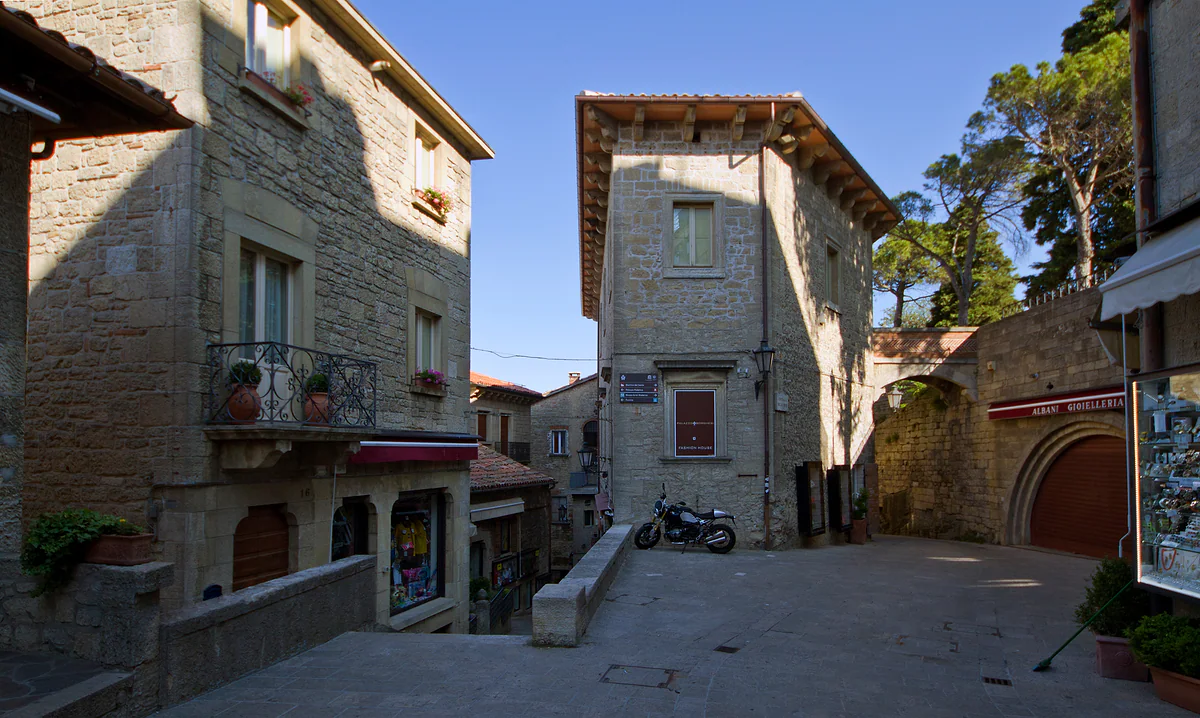
A corner of the old town with stone houses, balconies with flowers and a tower with a wooden eave under a blue sky.
Plugs in San Marino, Italy and the UK
| Country | Plug types | Voltage and frequency |
|---|---|---|
| San Marino | C, F and L | 230V, 50Hz |
| Italy | C, F and L | 230V, 50Hz |
| United Kingdom | G | 230V, 50Hz |
IEC World Plugs, archived copy of 20 December 2023. The IEC has since withdrawn its interactive guide.
Which plug fits which socket
| Your plug or adapter | Type F (Schuko) | Italian universal | Italian bipasso (L) |
|---|---|---|---|
| Type C, slim two-pin | Yes | Yes | Yes |
| Type F, with side earth clips | Yes | Yes | No |
| Type G, UK three-pin | No | No | No |
Worked out from the IEC's descriptions. Italy's universal socket combines a Schuko socket (C, E, F and L) with a bipasso one (L and C).
Test yourself
True or false?
0/3 Pick before you peek.
-
You need a voltage converter to use a British hairdryer in San Marino.
See the answer
False. San Marino runs at 230V and 50Hz, like the UK. You only need an adapter to fit the pins.
-
San Marino uses the same plug types as Italy.
See the answer
True. The IEC lists types C, F and L for both countries, at 230V and 50Hz.
-
Any European two-pin adapter fits every socket in San Marino.
See the answer
False. The slim type C does, but a chunky type F with side earth clips won't go into an Italian bipasso socket, which takes only L and C.
- Mains voltage, per the IEC
- 230V
- Frequency, the same as the UK
- 50Hz
- Socket types, C, F and L
- 3
Map
Where Plugs and voltage is
Every number opens its guide. The towers sit on the ridge, the city beside them and Borgo Maggiore below, linked by the cable car.
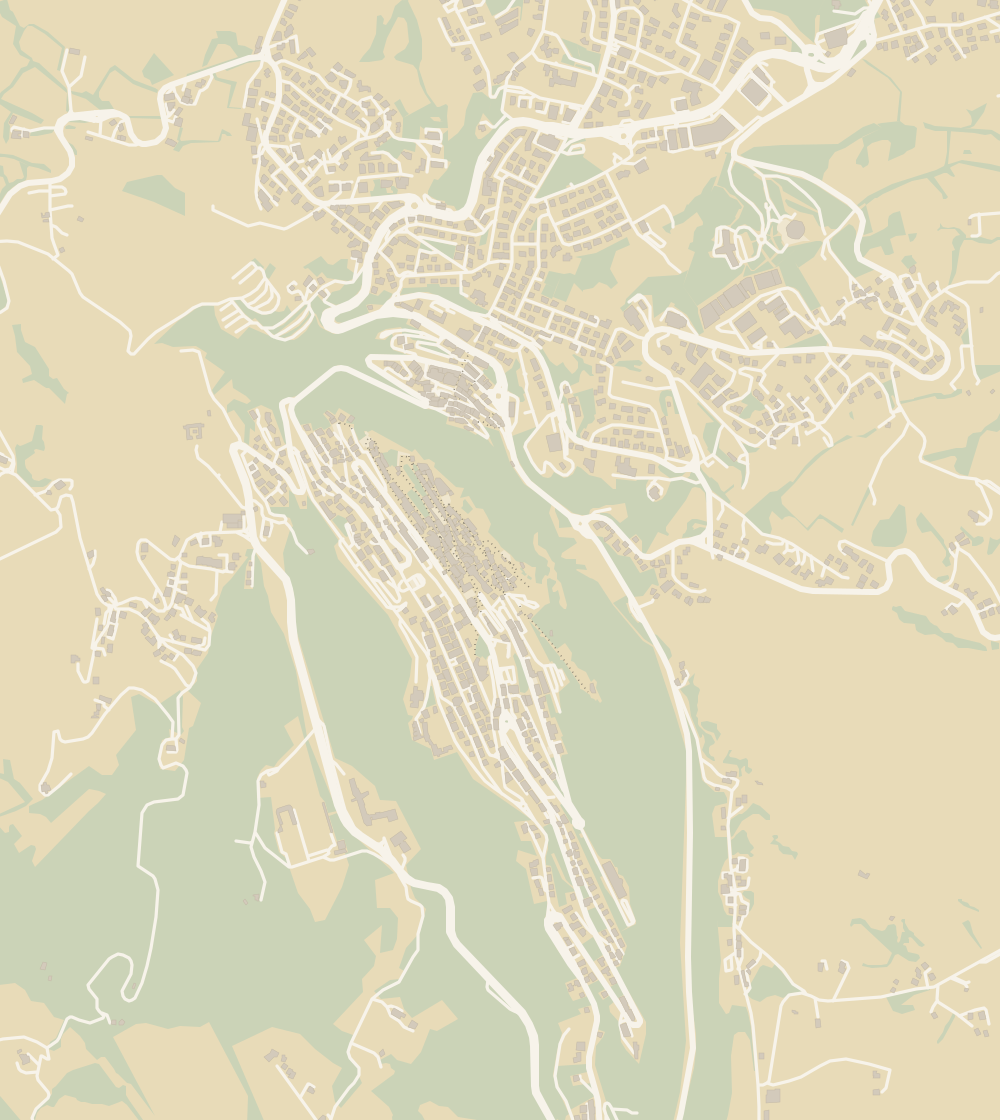 1The Three Towers 2Guaita Tower 3Cesta Tower and Arms Museum 4City of San Marino 5Montale Tower 6Borgo Maggiore 7Witches' Passage 8Palazzo Pubblico 9Changing of the guard 10Basilica of Saint Marinus 11Mount Titano 12Museums 13State Museum 14San Francesco Art Gallery 15Torture Museum 16Cable car (funivia) 17Quirky museums 18Stamp and Coin Museum 19National Gallery 20Valdragone 21San Giovanni sotto le Penne 22Medieval Days 23Christmas 24Hotel Titano 25Grand Hotel San Marino 26Hotel Rosa 27Hotel Crocenzi 28Hotel La Rocca 29Porta San Francesco 30Cava dei Balestrieri 31Map 32Teatro Titano 33Church of San Quirino 34Trenino Bianco Azzurro 35Consolazione Sanctuary 36University 37Prison 38Piazza della Libertà
 Map data © OpenStreetMap contributors (ODbL)
- 1The Three TowersTwo open inside, the third only from outside
- 2Guaita TowerAn 11th-century fortress that was a jail until 1970
- 3Cesta Tower and Arms MuseumThe top of Mount Titano, at 755 metres
- 4City of San MarinoWorld Heritage since 2008
- 5Montale TowerNo ticket, no hours, no pass
- 6Borgo MaggioreA cable car to the capital every 15 minutes
- 7Witches' PassageAbout 200 metres of battlements, no ticket
- 8Palazzo PubblicoClosed for restoration in 2026
- 9Changing of the guardNo timetable in any reliable source
- 10Basilica of Saint MarinusNeoclassical, begun in 1826, free to enter
- 11Mount Titano755 metres at the top of the Cesta
- 12MuseumsOne €11 ticket, seven venues
- 13State MuseumOpen to the public since 1899
- 14San Francesco Art GalleryIn the Franciscan cloister since 1966
- 15Torture MuseumMore than 100 original instruments
- 16Cable car (funivia)Closed from 21 to 23 October 2026
- 17Quirky museumsThree private museums with their own websites
- 18Stamp and Coin MuseumStamps since 1877, on the €11 pass
- 19National GalleryOpened on 7 July 2018
- 20ValdragoneA curazia of Borgo Maggiore
- 21San Giovanni sotto le PenneA curazia of Borgo Maggiore, below the towers
- 22Medieval DaysJuly, the old town and free entry
- 23Christmas28 November to 6 January, with a caveat
- 24Hotel TitanoOpen since 30 September 1894
- 25Grand Hotel San MarinoA hot tub on the third-floor terrace
- 26Hotel RosaFamily-run and open all year since 1965
- 27Hotel Crocenzi1 km from the cable car, 3 km from the old town
- 28Hotel La RoccaNot the Rocca, but on the road up to it
- 29Porta San FrancescoA guard post since 1361
- 30Cava dei BalestrieriThe crossbowmen's range since 1965
- 31MapNine castelli in 61 km²
- 32Teatro Titano2026-27 season from 22 October
- 33Church of San QuirinoOn the 5-cent coin
- 34Trenino Bianco AzzurroRimini to the City, 1932 to 1944
- 35Consolazione SanctuaryConsecrated on 11 June 1967
- 36UniversityCreated by law on 31 October 1985
- 37PrisonEmpty on the day the European inspectors arrived
- 38Piazza della LibertàIt used to be called the Pianello
0 of 108 San Marino guides
Your next stamp
- Shopping and tax-free
- One day
- Phone and roaming
- With a dog
- In winter
- Things to do
- Two days
- The Three Towers
- Guaita Tower
- Cesta Tower and Arms Museum
- The 9 castelli
- City of San Marino
- Montale Tower
- Borgo Maggiore
- Witches' Passage
- Palazzo Pubblico
- Serravalle
- Changing of the guard
- Dogana
- Acquaviva
- Basilica of Saint Marinus
- Mount Titano
- Chiesanuova
- Domagnano
- Faetano
- Fiorentino
- Montegiardino
- Museums
- State Museum
- San Francesco Art Gallery
- Torture Museum
- Cable car (funivia)
- Quirky museums
- Viewpoints
- Murata
- Stamp and Coin Museum
- Walking trails
- Cailungo
- National Gallery
- Valdragone
- Best time to visit
- Getting there
- Ventoso
- Rimini to San Marino
- San Giovanni sotto le Penne
- Weather
- Getting around
- With kids
- In summer
- Parking
- Passport stamp
- Rainy day
- Nightlife
- Casino
- Gualdicciolo
- Money
- Coins and stamps
- Torraccia
- Falciano
- Rovereta
- Lake Faetano
- Events
- Beaches
- Medieval Days
- Christmas
- MotoGP
- Where to stay
- Hotel Titano
- Where to eat
- Food
- Grand Hotel San Marino
- Luxury hotels
- Free and cheap
- Hotel iDesign
- Day trips
- Hotel Rosa
- Safety and rules
- Hotel Crocenzi
- Language
- Entry requirements
- Hotel La Rocca
- Healthcare and emergencies
- Is it a country?
- Opening hours
- Porta San Francesco
- Tap water
- Cava dei Balestrieri
- Map
- Post office
- Cost of a trip
- Flag
- Teatro Titano
- Accessibility
- Church of San Quirino
- History
- Captains Regent
- Trenino Bianco Azzurro
- Consolazione Sanctuary
- Facts
- University
- Weddings
- Wine
- Prison
- Camping
- Piazza della Libertà
- Is it worth visiting?
- Constitution
Frequently asked questions
What plug type does San Marino use?
Types C, F and L, according to the International Electrotechnical Commission. They're the same as in Italy, with a supply of 230V at 50Hz.
Do I need an adapter for San Marino from the UK?
Yes. UK type G plugs, with three rectangular pins, don't fit any socket in San Marino. A slim type C adapter is the safest choice, as it fits all three socket types.
What voltage is used in San Marino?
230V at 50Hz, the same as the UK, according to the IEC. British appliances work without a voltage converter.
What is a type L plug?
The Italian plug, with three round pins in a line. The IEC describes a 10A version with 4mm pins 5.5mm apart and a 16A version with 5mm pins 8mm apart, both with the earth pin in the middle.
Will my phone charger work in San Marino?
Yes, with an adapter. The voltage matches the UK's, so the charger itself is fine; you just need to change the shape of the plug.
By
Tourism graduate with a master’s in Tourism Management and Planning from the University of Málaga, who has travelled across Europe. He writes every guide from official sources and his own judgement.
Published on . Facts checked on .
Sources
Photos: karel291 (CC BY 3.0); trolvag (CC BY-SA 3.0), via Wikimedia Commons.